
 REVIEW: Progressive Museum Practice: John Dewey and Democracy by George Hein
During an election cycle it is difficult to turn on the television, read the newspaper or listen to the radio without a candidate or pundit talking about democracy and freedom. Yet, rarely does education factor into these discussions and I have never heard any politician address museums as central to a democratic society. George Hein’s new book Progressive Museum Practice: John Dewey and Democracy elucidates a history of museum education in America that is deeply rooted in building a democratic society and promoting social justice.
John Dewey is often referenced in art museum education for his ideas about active and experience based learning and the promotion of museums as a critical component of a child’s education. George Hein illuminates a much more complex portrait of Dewey. He explores the democratic core of Dewey’s philosophies. Progressive Museum Practice focuses on Dewey’s ideas in relation to museum practice in a Progressive tradition, exploring his predecessors, contemporaries and successors. Hein writes, “What could be more worthwhile than consistently considering how our educational activities might support democracy and social justice?” (Hein, 200). Indeed! This book and the thinking and action it advocates are very worthwhile.
It has been my experience that many museum educators know the work of John Dewey but have read very little if any of his actual work. Who can blame them? Dewey’s writing is dense and complex and often very long. He was a prolific philosopher, writing approximately 40 books and 700 articles in his ninety-two years.
The Essentials of John Dewey and Progressivism
Progressive and Dewey’s core beliefs are essential foundations of Hein’s book, and warrant elucidation here. Hein begins with defining Progressivism, contextualizing Dewey within this movement and outlining Dewey’s theories on education. Three essential attributes of Progressivism that Hein outlines are:
The belief that in our democratic republican society, social problems will not solve themselves; they need to be addressed by direct and sustained social and political action.
A generally optimistic assumption that, although such progress will not come about on its own, society can be improved by concerted and focused social and political intervention that is based on rational policies and actions and that applies the best available scientific practices and findings.
A faith in public education as a particularly useful tool for improving society in the direction of greater social justice and more equitable dispersal of the benefits derived from progress in science and technology. (Hein, 11)
These essential tenets of Progressivism are continuous threads that woven throughout Dewey’s philosophies and writings and a critical understanding of his work.

Four Key Beliefs of John Dewey
Dewey believed that education can be the basis for a philosophical system, and that education has both a pedagogic and a social component (Hein, 23). Hein explained four key beliefs of Dewey that define his philosophies:
First, his belief in empirical naturalism, “…the concept that any explanation of life, including thoughts, action and interactions with others, must be based entirely on what we have experienced and have experienced historically—singly or, most especially, collectively. Thus, the definition of “experience” is a fundamental building block of his philosophy” (Hein, 26).
Second, is Dewey’s commitment to a process philosophy, or “determining the worth of any idea by examining the consequences of a belief…based on its consequences in experience” (Hein, 26). Hein goes on to explain, “Dewey’s philosophy does not aim to solve human problems; rather it focuses on the process of addressing problems and the means of ameliorating negative aspects of life and society” (Hein, 27). Thus, reflection on our experiences and what we have learned from them is essential.
Third, Dewey’s philosophies are based on a concept of “human behavior as a social activity” (Hein, 27). Dewey understood human life on a biological model, individual parts interacting in symbiotic relationships. Thus, concepts of community, individuals interacting and self-regulating as part of a larger group, was fundamental to Dewey’s thinking.
Fourth, Hein explains the impact of Darwinian evolutionary thinking on Dewey’s philosophies. Darwin’s theories (On the Origin of Species was first published the year of Dewey’s birth, 1859) demonstrated that change was part of natural life cycles, and that it has direction rather than being viewed as a disruption. Dewey’s philosophies addressed change, not through external forces, but rather through “interactions between an organism and its environment, including social environment” (Hein, 29).
Hein explains that:
“For Dewey, the pedagogic aspects of progressive education were necessarily linked with the social goals of progressivism…In order to engage in progressive educational practice, museum staff need to keep progressive social aims as well as pedagogic practices foremost in planning both exhibitions and programs.” (Hein, 38)
This is, in fact, Hein’s thesis.
Interrogating Museum Education through the Progressive Lens
Hein interrogates three periods in the history of museum education, Dewey’s predecessors, his contemporaries and his successors, each roughly a century apart. With each Hein examines the progressive aims of individuals and institutions, looking at what the social goals of museum practice. Looking to Dewey’s predecessors, Hein characterizes Charles Wilson Peale as a “proto-progressive” in the early republican period in the United States. Peale established his museum in Philadelphia with an expressly educational mission. In the early years of the American democratic experiment, Peale, and his contemporaries amongst the intellectual elite of Philadelphia, believed that education, and thus the museum, was essential to build and sustain a democracy. Hein argues that “Peale pioneered that notion, reaffirmed by Dewey a century later, that as educational institutions, museums should be in the service of democracy, and should provide education that leads to better informed, critical citizens for a more egalitarian society” (Hein, 66).
 A century later, Dewey and his contemporaries in the progressive movement, saw education and museums as integral components to ameliorate social problems growing out of increased industrialization, urbanization and immigration. Hein highlights the pioneering work of John Cotton Dana, Louise Connolly, Anna Billings Gallup and Laura Mary Bragg. While Dana’s work is relatively well known today, Hein brings forth the work of these three women and reveals our professional heritage as passionate and driven social radicals. Each woman, in her own way, sought to make museums more accessible to a broad public and responsive to their communities through integrated mission driven programs.
Hein also examines progressive practices in art museums and debates of this period, that also remain relevant today, namely the purpose of art museums as primarily educational or aesthetic. Discussions of Benjamin Ives Gilman, George Brown Goode, and Theodore Low, are particularly enlightening and relevant today in light of recent debates about cuts in professional education staff and increased emphasis on acquisitions over access. Hein brings forth some truly radical ideas and programs that circulated in the early twentieth century that would shock even some of our most liberal educators today. Art museum directors might positively faint! The examples discussed include the Met’s work with the International Ladies’ Garment Worker’s Union in the early 1940s that included evening tours, lectures, and concerts and participation in selecting works for exhibitions, and the work of the New Deal programs, the Federal Arts Project, and the Works Progress Administration that brought art and arts education to a broad public through commissioned public art and establishing small art centers around the country. Hein shows us that our work today has strong historical precedent and these predecessors are arguably far more progressive than we are today.
Hein gives particular attention to a discussion of Albert Barnes. He devotes an entire chapter as well as a section of the discussion on progressive education in art museums, to Barnes’s impact on Dewey’s thinking and the friendship between these two men. Hein notes that Barnes’s reputation as a cantankerous and disagreeable individual has resulted in the tendency to ignore him when considering Dewey and to ignoring his progressive thinking and actions. In art museum education today many associate John Dewey with Art as Experience and his thinking on aesthetic experience. However, this aspect of Dewey’s thinking did not come until late in his career. It was through his discourse and friendship with Albert Barnes that Dewey became engaged with aesthetics. Barnes can be seen as both influencing Dewey’s idea and encouraging him to give them systematic thought, as well as experiment with these ideas and putting them into practice through his foundation and classes. Like Dewey, Barnes shared a deep commitment to potential of education and particular art to benefit and improve the lives of people.
Hein’s discourse on Dewey’s successors looks at museum education in the 1960s and more contemporary practices. Hein argues that the 1960s was America’s most progressive moment, despite progressivism’s association with earlier in the century. Changing museum practices are situated within this period that saw the growth of the civil rights movement, women’s rights, free speech movement, protests of the Vietnam era and a wave of government policies and programs ushered in under President Johnson, including Medicare and Medicaid, Head Start, the Voting Rights Act, the Freedom of Information Action, and the Elementary and Secondary Education Act (ESEA), as well as the establishment of the National Endowment for the Humanities and the National Endowment for the Arts.
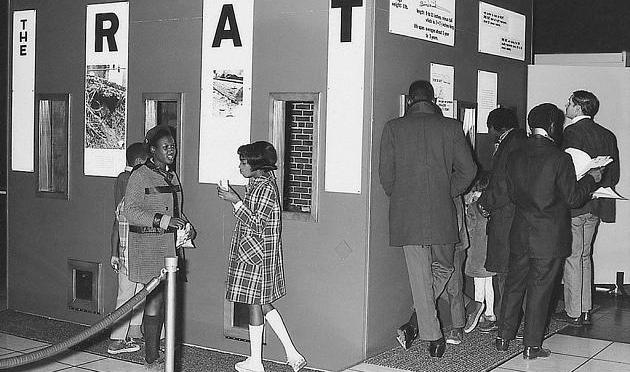
Hein highlights the works of three pioneering institutions that illustrate the reemergence of progressive practice at this time, the Anacostia Neighborhood Museum, Science Centers, and the Boston Children’s Museum, each addressing different aspects of progressive practice. The Anacostia Neighborhood Museum, as a satellite of the Smithsonian, addressed underserved audiences in economically depressed areas through establishing a community driven and focused museum. Museum exhibitions were community generated and focused on neighborhood issues and concerns, most notably The Rat: Man’s Invited Affliction, mounted in 1970. Science Centers, such as the Exploratorium in San Francisco, founded by Frank Oppenheimer in 1969, developed engaging hands-on learning experiences that engaged curiosity in everyday things and the world around us. Oppenheimer, who attended the progressive Ethical Culture School in New York as a child, combined his interested in popularizing science and a socio-political agenda, “[his] faith that better science education—based on interactive exploration of the natural world through close observation, experimentation, weighing evidence, and critical thinking in the Deweyan sense—could lead to a better world was repeatedly mentioned…” (Hein, 171).
Dewey argued that schools should be models of a democratic society and community, ones in which children had a voice and rights. Hein points to the work of the Boston Children’s Museum in the 1960s as a museum that created this type of model of democratic communities for children and their parents, both within the museum and working with community partners to reach broader audiences.
Progressive Museum Practice in Museums Today: Are We Embracing Our Potential?
Hein’s final chapter focuses on progressive practice in the twenty-first century, and takes a much less institutional driven approach. He states, “Progressive theory in action combines pedagogic practice with the political aspects of progressivism. The examples discussed here are not presented as models to be reproduced elsewhere, but as indications of what can be accomplished” (Hein, 181). As such, Hein runs through a brief discussion of a number of projects and practices that have progressive potential. Some of these include new technologies, innovative exhibition methodologies, and staffing structure. The one institution he addresses specifically is the Lower Eastside Tenement Museum and its mission to promote social justice. He also addresses the potential of exhibitions to take on socio-political goals with a discussion of Mining the Museum, presented by Fred Wilson and The Contemporary at the Maryland Historical Society in 1992. However, Hein notes that this exhibition, while still greatly discussed as groundbreaking, was mounted twenty years ago.
While Hein’s book adeptly unpacks and elucidates the complex and interwoven philosophies of John Dewey, and illuminates the rich and radical past in museum education in the United States, the book came to a soft and disheartening conclusion. The early chapters of this book were filled will discussions of art museums and the role art played in progressive practice. However, in Hein’s final chapters that address our practice since 1960 there was scant reference to art museums. I do not argue that Hein is an insufficient researcher, to the contrary; rather I argue that art museums have lost their progressive goals and thus their progressive practice.
While Hein regards the 1960s as our most progressive era politically, within the art museum, I argue it is one of our most conservative. In this era the art museum saw the increasing professionalization of art history and curatorial practice as well as other professions within the art museum, including museum education. From the 1960s and arguably into today there has been a rise in the notion of art museums as bastions of unmediated aesthetic experience. Education in these hollowed halls sought to transfer knowledge about art history. Am I being dramatic? A little. But, when attending conferences or discussions with colleagues from all types of museums, I often feel that art museums are lagging far behind in their understanding and willingness to embrace their truly progressive potential to impact individuals and society.
In my graduate school classes we would often ask “WWJDD? (What Would John Dewey Do?)”. So, art museum educators, WWJDD, if he were here today? I think that he would be pleased to see many examples of progressive pedagogy, but charge us to embrace the political aspects of progressivism, and thus a truly progressive practice. I believe that we have an obligation for a greater social commitment. As a field, as institutions, as educators, are we committed to progressive practice?

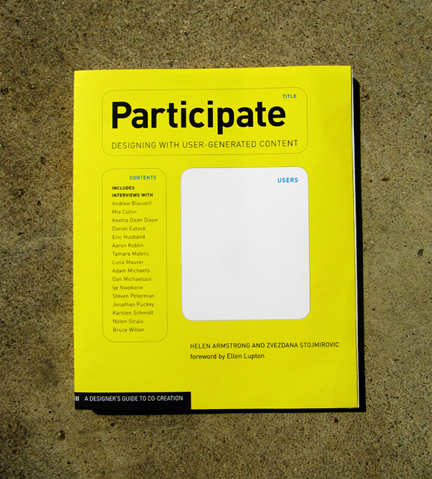
 Participate also rightfully spotlights some of the recent identity, branding, and promotional campaign designs at the Walker Art Center, including a great interview with





 Art Museum Teaching