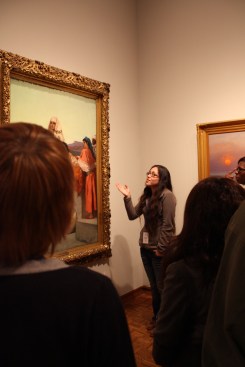
Sara shares her thoughts on Jean Joseph Benjamin Constant’s “Evening on the Seashore—Tangiers.” Photo by Nate Pyper.
How do we engage teenagers at art museums? Our museums offer powerful classes, internships, and multi-visit programs–but their reach is limited. For many teens, their first (and sometimes only) exposure to an art museum is through a school field trip. There are already a number of great conversations on this site posing suggestions and challenges for ideal school tours, which consider the needs and perspectives of the museum educator and the classroom teacher.
But what about asking the students themselves?In summer 2012, we did just that at the Milwaukee Art Museum. A group of fourteen teen interns teamed up with ten docents to delve deep into what can make a school tour successful and engaging. They worked to jointly share ideas and troubleshoot concerns. The session was such a hit for both groups that we decided to bring back five of those students this fall to share their thoughts with our full docent corps–all 100+ of them!
We taped the dialogue so that we could share the teens’ ideas as faithfully as possible. The video below shows the five summer teen interns in dialogue with our docents. The teens quickly do a check-in/icebreaker with the docents, describe the summer program, and facilitate a Q&A session.
What I found particularly powerful about the teens’ suggestions is that they are not only relevant to teen audiences–these tips can be used for younger and older visitors, too. In the spirit of continuing the conversation begun by these young people and our docents, I’d like to offer some of my own take-aways:
Take the time to get to know each other (even if the tour is only an hour). Over the summer, I began our sessions with a “check in” activity, inspired by the Milwaukee Writing Project, as a way for us to get to know each other. If you know your audience, you can tailor your tour to their interests from the get-go. As Rosehaydee said in the video, it can bring the group together and set a friendly tone.
Be aware of your group–and do what they want to do. Be in tune with your group and their reactions: if something’s not working, move on rather than pressing it.
Be yourself. Share your passion, and be friendly and relaxed. As Sensei said, if you are enthusiastic about what you’re discussing, chances are good that your group will respond to your enthusiasm.
Museum tours can be intimidating. Teens are aware that docents and educators are extremely knowledgeable; and it’s scary to offer your thoughts in front of not just a docent but also your peers. To support conversation, Steven suggested using clear, simple language (without being patronizing), and Rosehaydee encouraged us to acknowledge student voices, even if they’re not the “right” answer, so teens know they’re being heard.
Technology is a tool, not a goal. When asked if museums should use more technology to engage teens, responses were mixed. Yes, technology is cool and lots of teens use it–but not all teens have access, and technology is not always successful or necessary. If the activity can be done equally as well or better in analogue format, it’s probably not worth it to try to use a gadget. But if it’s something that can only be done with technology–like Skyping with an artist or out-of-town group–then take the time to give it a try.
Remember that we all learn differently. To combat teen boredom, Rosehaydee suggested calling on specific individuals to get them to pay attention, but Sensei noted that sometimes it can be just as effective to try a pair-share or solitary writing activity. This reminded me that museum educators and docents have a responsibility to provide many different kinds of learning opportunities for our students. We need to know when to support and when to gently challenge them.
Respect the group; think of them as family. One of my favorite suggestions from the teens over the summer was for docents to think of the teens as their children or grandchildren. To me, this gets to the heart of working with any visitor that comes into our space: respect them–their prior knowledge, their interests, their reasons for coming to museums in the first place. We can learn from visitors as much as (if not more than!) they can learn from us.
Sometimes, as we plan programs and tours, educational goals and strict standards can overshadow the much more abstract magic that can come from engaging with works of art. I’m glad these young people remind us of the steps we can take to achieve that “bigger picture”: a museum experience that is supportive, interesting, and fun. Such experiences help teens know that museums are places where they can be themselves, connect with peers who also love art, enrich their thinking, or simply take a break from a busy day of school.
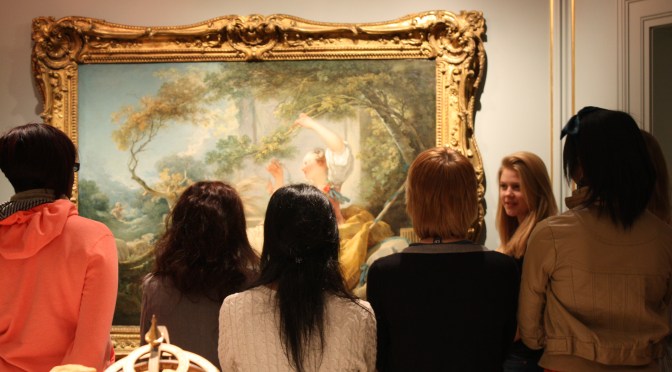
Helena discusses Fragonard’s “The Shepherdess” in the Milwaukee Art Museum galleries. Photo by Nate Pyper.
Flickr photo of visitor at California Academy of Sciences, one of Howard Hwang’s favorite museums these days. Photo by Alastair Green.
Many times when I have encountered a brusque and surly teenager in the museum (whether on a tour, in a program, or simply visiting with his or her family), I do wonder what that kid will be like years down the road. Maybe it’s the parent in me, but I can’t help thinking: will that teenager still roll their eyes during museum visits? will they perhaps change, and gain a new perspective toward museums? These same questions arose when I first read Howard Hwang’s now-infamous article “Why Museums Suck” — would he really be such a choleric and grumpy person after he became an adult? Could we ever see Howard visiting a museum alone or with his family, and loving it? If I could only hop into a time machine, and ask him myself.
Well, as it turns out, no time machine is necessary! As I dug further and further into the LA Youth article, I not only found out that Howard wrote the piece 11 years ago (part of a fall 2001 issue), but I was able to get in contact with Howard himself to ask him a few questions. And while I would have loved to actually use a time machine to write this epilogue to my original post “Why Museums Don’t Suck,” I was lucky enough to speak with the now 26-year-old Howard about his article, his thoughts about museums, and what he thinks about all this attention surrounding his article so many years later. In my opinion, this is a fascinating turn of events in a story that has garnered so much attention from across the museum community.
Here are my notes and thoughts from my short but very interesting phone conversation with Howard Hwang:
and now, the rest of the story…
Thoughts on writing the original LA Youth article: I began by asking Howard to tell me a bit more about why he wrote that article back in 2001 about “why museums suck,” and his thoughts at the time. He remembers writing the article as part of a group/community paper, focusing mostly on it being a piece that kids his age would read. It grew out of a high school project in which he was analyzing museums, so the article seemed a natural extension. “I wanted to be very honest, very blunt, and not sugar-coated,” recounts Howard. After writing the article, he recalls telling his sister, “I want to write something that will make people feel that I am talking to them.” This is a tone that made the piece more visceral for me and many of the museum professionals who have since commented, and I think it represented a certain level of honesty that many of us admired.
Thoughts on reading the article 11 years later: Howard’s editor from LA Youth (11 years ago) contacted him recently to let him know about all the back-and-forth going on in the blogosphere about his article, thinking he might enjoy seeing the ArtMuseumTeaching.com blog post and comments. So Howard did, and then he also read his original article which he hadn’t returned to since it was first published. So what was his immediate response? “My face turned bright red,” says Howard. He told me that he feels totally embarrassed by his teen article, especially because his entire perception of museums is completely different now. I asked him a little more about why he might have written something like this back as a 15-year-old, and he remembers being very “A.D.D.” with a low threshold for attention — something had to really jump out at him to win his favor.
Current thoughts about museums: It was great to hear that Howard’s attitude towards museums has totally changed. But I asked a little more about why, and how did that change come about. Howard attributes much of this shift to visiting museums in college for certain classes. Majoring in molecular biology at the time, Howard says “I really started going to museums when they related more to my own interests.” And those interests were obviously there in Howard when he was 15 as he capped his grouchy LA Youth article with unique praise for the Natural History Museum of Los Angeles, writing: “All you museum people should go over to the Natural History Museum. This is a great museum.”
Any favorite museums these days? My final question for Howard related to any museums he might visit regularly now, and why. He quickly mentioned the California Academy of Sciences, which he visits regularly (being a resident now in the San Francisco Bay Area), and actually just visited a few weeks ago to see their newest exhibits. Our conversation concluded with a brief discussion of what might make a museum more attractive to him these days, and Howard spoke of the volunteer tour guides and docents that interact with the public. “The quality of tour guides,” says Howard, “are a very powerful thing for the museum experience, increasing the attractiveness of museums.” He recounted the knowledgeable tour guides at the California Academy of Sciences during tours he has taken, and he wrapped up our conversation chatting about the importance of human interaction in museum learning.
I extend an enormous thanks to Howard for agreeing to talk with me about his article and his thoughts 11 years later, and I appreciate how much his article challenges us as museum professional to reflect on the extent to which we do, or do not, ‘suck’ when it comes to teen audiences. All we can do is continue to reach out to all audiences, and know that cantankerous teenagers may very well grow up to be dedicated, thoughtful museum visitors. Thanks, Howard!
I recently was invited to participate in a panel session on museum blogging at the 2012 Museum Computer Network (MCN) conference, which was luckily hosted in nearby Seattle. The session was pulled together by power blogger Ed Rodley (aka Senior Exhibit Developer at the Museum of Science in Boston) and moderated by what I would now consider the new James Brown of museum technology, Koven Smith (aka Director of Technology at the Denver Art Museum). It was my first time attending MCN — which I had followed closely via Twitter during their last conference — and I was blown away at the energy and passion of this group of museum professionals that represented so many areas of museum work.
Since this conference has sparked a lot of thinking for me, I may end up writing a few MCN-related posts in the next week or so, but for now I wanted to focus on the reason I was there in Seattle this past week — the bringing together of a diverse group of active bloggers to dissect the how, why, and who of museum blogging. For me, this was the first time meeting these other bloggers “in the flesh” or face-to-face — what would happen? I could not help thinking about my favorite lines from the 1984 classic film Ghostbusters:
Egon: There’s something very important I forgot to tell you. Peter: What? Egon: Don’t cross the streams. Peter: Why? Egon: It would be bad. Peter: I’m fuzzy on the whole good/bad thing. What do you mean, “bad”? Egon: Try to imagine all life as you know it stopping instantaneously and every molecule in your body exploding at the speed of light.
Luckily, just as in the movie, that’s not what happened at all. It turns out, when bloggers collide, you get some productive conversations about professional and personal (or offline and online) identity, the complex networks that these blogs build online, and the ways in which these online entities may even push museum thinking forward. In this post, I would simply like to introduce those who came together for this MCN session, and then lay out three questions that I spent time thinking about before participating in the panel (and that we grappled with a bit during our conversations).
The Blog Roll
Here is a quick run down of the other bloggers/blogs represented at this exciting MCN session:
Ed Rodley, Eric Siegel, Me, & Suse Cairns
Suse Cairns blogs at Museum Geek, and is also currently a PhD candidate at the University of Newcastle, Australia. She holds a unique position as an emerging museum professional without a museum institutional affiliation, perhaps permitting her to strike up a bit more of a disruptive conversation (or maybe that’s her indie rockstar background). She contributed a guest post to ArtMuseumTeaching.com about “Getting Uncomfortable in Museums.”
Ed Rodley blogs at Thinking About Museums, and currently works as Senior Exhibit Developer for the Museum of Science, Boston. He also coordinates a series of conversations & explorations among the Boston museum community that he has dubbed “Drinking About Museums,” posted to his blog regularly (here is the most recent installment). Ed and I are in a similar boat in which we blog independently of the institutions we work for — making for a slightly more complex situation when it comes to our more ‘rebellious’ ideas or questions. I’m grateful that he pulled this panel together for MCN.
Eric Siegel blogs at The Works, a New York Hall of Science blog, and is currently that institution’s Director and Chief Content Officer. With 30 years of experience in museums, Eric writes about challenging aspects of innovative projects in exhibition, technology, and education as well as collaborations and current thinking in museum work. One of his great recent posts discusses the ReGeneration exhibition being developed at the New York Hall of Science that will bring together contemporary art and science. Not only does Eric blog about projects like this, but he also supports his staff creating their own blog content across the institution — see SciSpotlight.
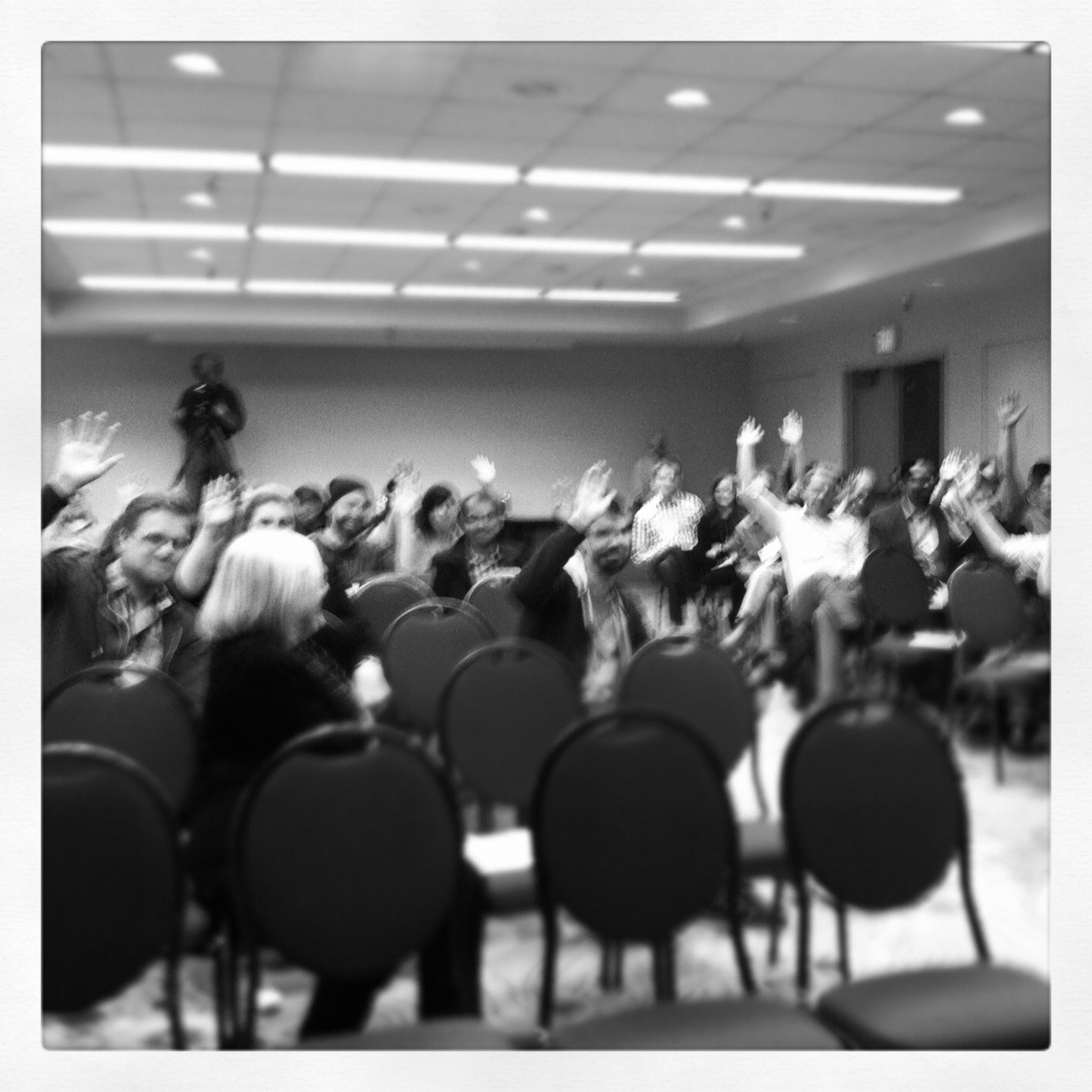
Session Attendees — OK, this was the real fire power at the session. Almost everyone who attended the panel also blogs themselves, and some for longer than the entire panel combined. During the session, we asked how many of them had their own blogs, and the photo on the right shows the sea of hands (as good as an iPhone can show it). In hindsight, we should have really thrown more questions out to the “audience” and had a richer conversation about blogging — and not just our blogs. I wanted to give a shout out to everyone who submitted their blogs to our session’s Twitter feed, but I know there are more.
So that gives the long and short of who was there for the session, and it might also help many of you connect with more of the museum blogging community. Now I wanted to quickly frame some of the issues I brought to the table during the session, and then I invite your feedback and comments below.
Museum Blogging Issue #1: Who Reads This Stuff?
After writing for and managing this blog for over 9 months, I have come to be quite fascinated by blog readership … or clicker-ship, as I’d rather call it (mostly because I can measure how many people click on the blog, but I can’t measure how closely they read it). First of all, there is the actual number of people that museum blogs reach. I estimate that across a few dozen museum blogs (17 of them are listed above), there are approximately 1-2 million people accessing these sites each year. And I don’t think this figure is exaggerated — I recently met an art blogger who gets about 1.25 million hits a year, showing how widespread the reach of this form of content can be. And I want to be clear here: I am not associating the number of hits or clicks with the value of a blog’s content or the blogger. I frankly don’t care whether a blog gets 1 million hits a year, or 100 hits a year — if they both have thoughtful, quality content, then they both serve an important role in this online thinking space.
Beyond the sheer number of hits or clicks, I am way more interested in the organic web of interactions that can take place online after a blog post is published. For example, a blogger can share their post via Facebook, Twitter, Pinterest, LinkedIn, Google+, and their own circles of colleagues and peers. Then, others share or retweet the post, and the ideas start to spread in unpredictable ways. Search engines also direct people to the blog from Google, Bing, Yahoo, etc. Then, people from across the world have the chance to add their thoughts and comments on the blog itself, or on Twitter and Facebook, and the conversation grows beyond the blog. Furthermore, other bloggers can respond to your ideas through their own posts. For instance, my recent post on teen engagement in museums has pingbacks from 4 other blogs — and each of those blogs has its own social media networks and clicker-ship. The term ‘blog’ often seems so two-dimensional and self-directed when you consider the three-dimensional interactions, relationships, and ideating that can potentially ripple out from each post. After hearing a great “Ignite” presentation at MCN from Lori Byrd Phillips on “open authority,” I think I am going with the term “BAZAAR” instead. More to come on that idea in a future post.
Museum Blogging Issue #2: Do Blogs Really Have the Power to Create Communities?
Sometimes people can get quite cynical about blogs, thinking that it is just a bunch of people talking to themselves. Can these sites really create relationships among people and professionals? Are blogs really a way for people to collaborate online and share ideas, questions, and processes? Well, I would not have created this online forum (now with 14 authors) if I didn’t think that it had the potential to create an online community of practice in the field of art museum education. My experience thus far proves that people really do come together through a blog to exchange ideas, ask questions, and challenge each other. Since us art museum educators only come together a couple times a year at conferences (and most museum educators are not able to even attend these conferences), I do find that online communities are finding a new role in the professional field. There is certainly more that sites like ArtMuseumTeaching could be doing to enhance peer engagement, and I hope to explore some of these in the upcoming months.
This whole question of how we build online communities is something that really interests me, and I will be partnering with some amazing colleagues (Dana Carlisle Kletchka and Elyse Eidman-Aadahl) to explore this through a session at next year’s National Art Education Association conference — a session that will have a rich online, digital presence before, during, and after the conference. So I leave these questions open: how do we build communities of practice online, and what does that mean in terms of the way we work, interact, and play together?
Museum Blogging Issue #3: How Well Do We Play With Others?
My final thought simply opens up more questions about how we develop expansive, boundary-crossing communities online. As bloggers, how well do we play with each other? If you have your own museum blog, how many times have you invited other museum bloggers to write a guest post, commented on their blog, or added a link to their blog on your site? Do bloggers reach out to make connections with other bloggers outside of their own national and cultural boundaries? What about across types of museums and academic disciplines? Even outside of the blogging circles — how well do we connect with other existing forms of online interaction (Google Hangout, Blog Talk Radio, or other online communities such as Digital Is)? I, myself, have a lot of work to do in many of these categories, but I wanted to lay out these questions so that we can be thinking of them as we push forward in the blogosphere.
**********
So, I really enjoyed attending MCN, and it sparked all kinds of questions and thoughts in my mind about this site as well as large areas of my professional work. I invite your thoughts and perspectives below, and I am open to all suggestions as to how to grow the community already forming around this online “bazaar” I call ArtMuseumTeaching.com.
During the conference, MCN publicized Twitter hashtags for each session, so I wanted to make available an archive of all of the tweets up to this point that used our hashtag: #mcn2012tale. Here it is in PDF form, with lots of great questions and thoughts from those attending the session and beyond: TweetArchive_#mcn2012tale






 Art Museum Teaching