
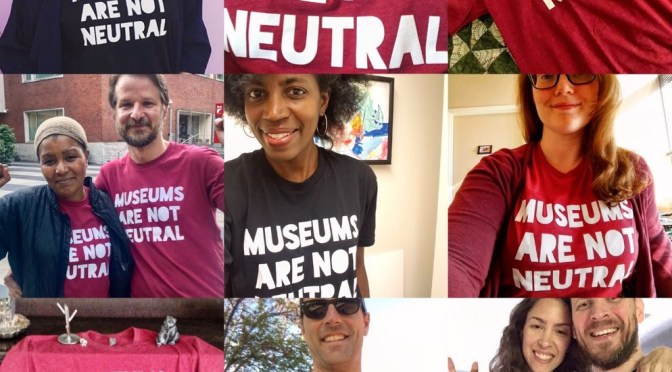
MUSEUMS ARE NOT NEUTRAL

Written by Mike Murawski (updated July 2020)

Learn more by visiting MuseumsAreNotNeutral.com.

Museums have the potential to be relevant, socially-engaged spaces in our communities, acting as agents of positive change.  Yet, too often, they strive to remain “above” the political and social issues that affect our lives — embracing a myth of neutrality.

Well, MUSEUMS ARE NOT NEUTRAL, plain and simple.  Let’s come together and spread this message.

Museums Are Not Neutral is a global advocacy initiative co-produced by La Tanya S. Autry and I to expose the myth of museum neutrality and demand equity-based transformation across institutions. The initiative began in August 2017 through an online t-shirt campaign and the social media hashtag #MuseumsAreNotNeutral. During its first 3 years, the initiative has sold more than three thousand shirts to people around the entire world, raised more than $20,000 for social justice organizations and relief funds supporting museum workers, and engaged more than one million people across social media platforms. This movement continues to grow, bring people together, and demand change happen now.

“Our initiative spotlights actions for change and exposes how the claim of neutrality fosters unequal power relations, and Museums Are Not Neutral became my way to inform people that I reject the status quo. It’s one of my tools for improving the museum field, and it is now a global community.” – La Tanya S. Autry, co-producer & cultural organizer

latanya-mike

“White supremacy thrives within this tyranny of the universal, the neutral, the apolitical, the fair and balanced, and the objective. Acknowledging that museums are not neutral is a meaningful and urgent step toward gaining awareness of the powerful role that these forces play within these institutions. It is a crucial step toward recognizing one’s own role in questioning it, interrupting it, and being a part of taking transformative action to replace it.” – Mike Murawski, co-producer & change leader

Add Your Voice

Join the conversation using the hashtag #MuseumsAreNotNeutral on Twitter. Through social media advocacy, we’re bringing together a large, growing community of people throughout the world to share questions, practices & resources and to hold institutions accountable.

Wear the Message

Help spread the Museums Are Not Neutral message by purchasing your own t-shirt, sweatshirt, hoodie, coffee mug, or tote bag at our Bonfire.com Store. Join the thousands of changemakers across the globe in proudly sharing the message, sparking conversations, and growing the community.

Support Museum Workers

Profits from each product purchased from this campaign now (updated July 2020) go to support the Museum Workers Relief Fund, a mutual aid fund organized by and for museum workers and founded on the principles of dignity, justice, and humanity.

Resources

Here is a list of some resources and articles that tackle the issue of museum neutrality (last updated July 2020).  Be sure to follow the hashtag #MuseumsAreNotNeutral on social media to get connected to the community.

A Moment for Accountability, Transformation, & Real Questions,by Mike Murawski, ArtMuseumTeaching.com, June 3, 2020.

Museums are Not Neutral with Movement Co-Founders La Tanya S. Autry and Mike Murawski, Monument Lab podcast, May 14, 2020.

Museums Are Not Neutral: We Are Stronger Together, by La Tanya S. Autry and Mike Murawski, Panorama: Journal of the Association of Historians of American Art 5, no. 2 (Fall 2019)

Museums Are Not Neutral, Museopunks podcast, June 28, 2018.

Changing the Things I Cannot Accept: Museums Are Not Neutral, by La Tanya S. Autry, Artstuffmatters blog, October 15, 2017

Museums Are Not Neutral: Wear It Across Your Heart, by La Tanya S. Autry Artstuffmatters blog,  August 31, 2017

“The Idea of Museum Neutrality: Where Did It Come From,” by Gretchen Jennings, Museum Commons blog, June 26, 2017

“Museums Are Not Neutral,” by Anabel Roque Rodriguez, September 2017

“Your neutral is not our neutral,” by Nathan “Mudyi” Sentance, January 2018.

Sean Kelley, “Beyond Neutrality,” August 2016. https://www.aam-us.org/2016/08/23/beyond-neutrality/

Nothing About Us Without Us: Culture Lab Manifesto

Written by Andrea Kim Neighbors

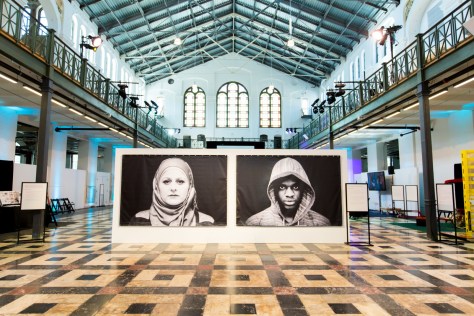
The first time I experienced a Smithsonian Asian Pacific American Center (APAC) Culture Lab, a pop-up museum experience, it was as a visitor repeating the word “finally.” Crosslines: A Culture Lab on Intersectionality took over the Smithsonian’s Arts & Industries Building during Memorial Day weekend in 2016, and was APAC’s first Culture Lab. It was a truly immersive experience with emotional weight—over 40 artists from all over the country created original works of art and interactive spaces where visitors of all ages and backgrounds entered to learn about, challenge, and be challenged by the Lab’s theme of intersectionality. The atmosphere was festive with a constant murmur of excitement as deep conversation filled the air of an historic building erected as the first United States National Museum. Since Crosslines, APAC has co-created Culture Labs in New York City (CTRL+ALT: A Culture Lab on Imagined Futures) and most recently in Honolulu (‘Ae Kai: A Culture Lab on Convergence). Culture Labs are built with communities, a co-created and collaborative experiment that has since impacted the way we think about and approach the idea of what a museum should be.

I am grateful to be a part of APAC as their Education Specialist. Since joining the team earlier this year, I find the one question I get asked by my fellow museum educators is, “What does museum education look like at a Culture Lab?” My answers can be found in APAC’s Culture Lab Manifesto, which was published this July in an all-Asian American issue of Poetry Magazine (see full text below, along with links to Culture Lab’s Manifesto page).

As a museum educator, I think back to my impressions of Crosslines, and how surprising  it was to walk into a museum space feeling like I belong, like my voice would be heard and that I would experience genuine empathy. How often can you walk up to an artist at a museum and jump right into conversations about intersectionality, what our futures may hold, and how our stories may converge into paths of better understanding? What I love most about being a museum educator is what is learned and shared from visitors of all ages and backgrounds. Creative dreaming and building with communities is something we don’t often allow ourselves the time and space to do in our professional realm. This manifesto was created out of a team effort steeped in reflection and proactive energies—it was time to share our vision and belief in how museums could be re-built with communities.

As an education program builds at APAC and future Culture Labs, I welcome conversation, idea sharing, and creative dreaming. I hope you will take a look at our manifesto and reach out if you would like to discuss re-building museum spaces with communities.

02 Tracy Keza_CrossLines_160529_008 copy
“Hijabs & Hoodies,” portraiture installation, 2016, by Tracy Keza with Studio Revolt. Photograph by Les Talusan.

Culture Lab Manifesto

BY SMITHSONIAN ASIAN PACIFIC AMERICAN CENTER

We at the Smithsonian Asian Pacific American Center believe the soul of a museum lies not in its brick-and-mortar walls but in what happens inside those walls — the experiential friction between guests and hosts, history and future. We believe that curation can be a form of community organizing; that art can be collaborative, participatory, and socially responsible; that those who have historically been pushed to the margins hold the stories that will center our future.

With these beliefs, we introduce the Culture Lab into the fold of museum practice. Culture Labs are fleeting, site-specific happenings that recognize art and culture as vehicles that can bring artists, scholars, curators, and the public together in creative and ambitious ways.

The images in this slideshow are from the first two Culture Labs: CrossLines: A Culture Lab on Intersectionality (May 2016, Washington, DC) and CTRL+ALT: A Culture Lab on Imagined Futures (November 2016, New York City). What you see are alternatives to traditional museum exhibitions — or perhaps their next evolution. What follows 
is a declaration of principles for you to consider as you envision the museum experiences of today and tomorrow.

We at the Smithsonian Asian Pacific American Center believe that museums engaging communities should be built upon:

  • A CULTURE OF MEMORY. Every place embodies genealogies we must honor. Amplifying hidden histories builds empathy. Intervening in public space enriches our collective memory.
  • A CULTURE OF REPRESENTATION. Prioritize local artists, participants, and organizers. Nothing about communities without those communities.
  • A CULTURE OF AMBITION & EVOLUTION. Scale up. Open yourself to growth through conversation. Push both your ideas and practices.
  • A CULTURE OF IMAGINATION. Place value on daydreaming. Not everything is a logistic. Find the amazing in the margins.
  • A CULTURE OF PRESENCE. Live-time interaction — nothing 
replaces human contact. Make all spaces maker spaces.
  • A CULTURE OF EQUITY. Pay artists. Pay artists fairly. Dismantle hierarchies. Everyone shares in the work.
  • A CULTURE OF COMMUNITY. Create lasting collectives. Come to museums to be challenged, to change, to fall in love.
  • A CULTURE OF INTERSECTIONALITY. Step outside the silos that constrain our narratives. Allow yourself to think, feel, and remember in the same complex ways that we live.
  • A CULTURE OF RELEVANCE. Choose to engage in what matters right now.
  • A CULTURE OF BELONGING. Forge brave space. Extend welcome and safety to all peoples and communities. Make room for the marginalized, especially by questioning what marginalizes them.
  • A CULTURE OF BEAUTY. Who gets to decide what counts as beautiful? Question aesthetic classifications and priorities.
  • A CULTURE OF INSPIRATION. Open the process. Dream together. Make together.
  • A CULTURE OF FUN. Play is innovation. Play is care. Play is life.
  • A CULTURE OF ACTION. Stay woke. We have a social contract with one another to protect the vulnerable and ensure human rights for everyone.

—Adriel Luis, Lawrence-Minh Bùi Davis, Nafisa Isa, Kālewa Correa, Jeanny Kim, Hana Maruyama, Clara Kim, Nathan Kawanishi, Emmanuel Mones, Desun Oka, Carlo Tuason, Lisa Sasaki, Andrea Kim Neighbors, Deloris Perry, and Emily Alvey.

Originally Published, Poetry Foundation: July 5th, 2017

*     *     *

Header image: The Red Chador: Threshold, durational performance, 2016, by Anida Yoeu Ali. Photograph by Les Talusan.