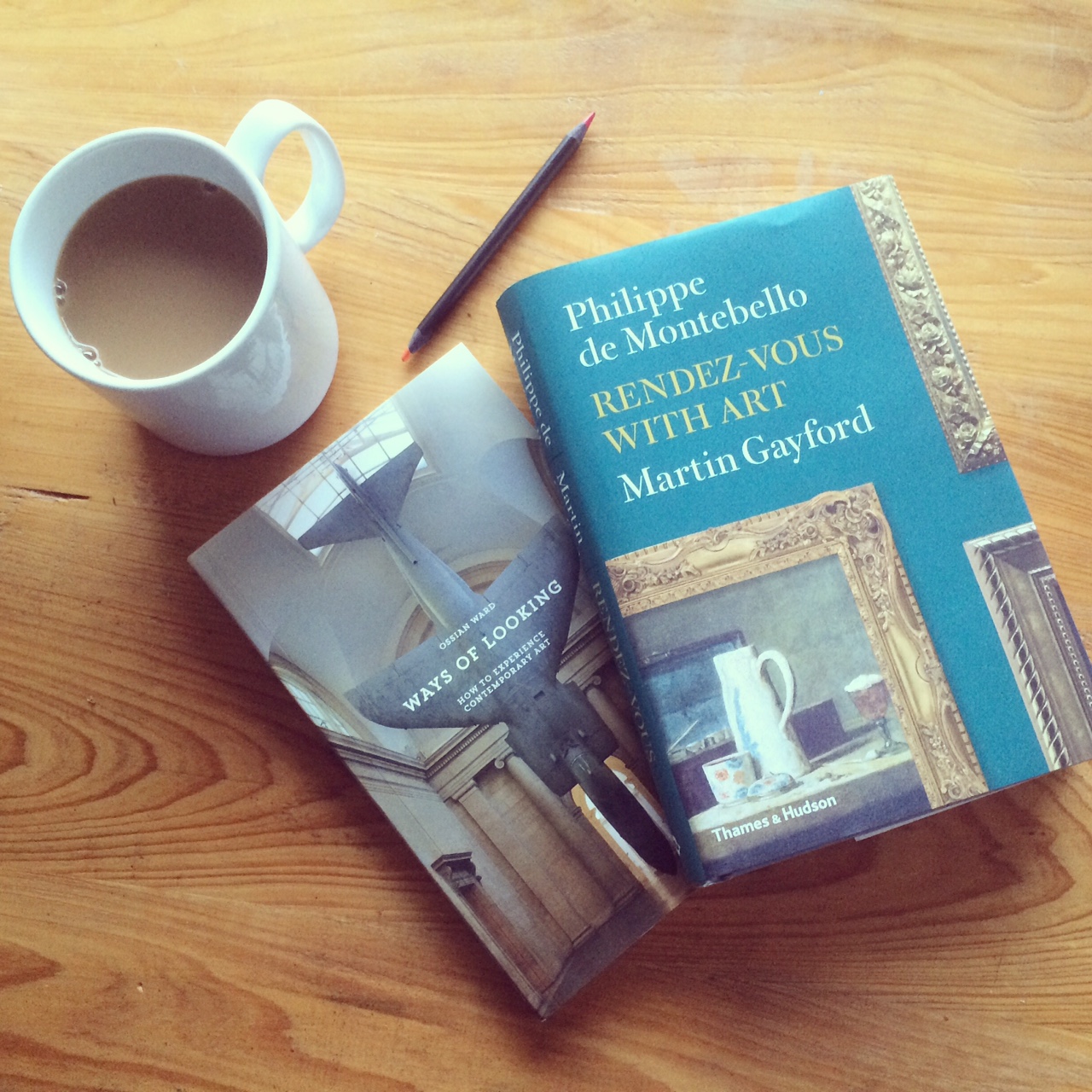
I have to admit that I am a bit of an enthusiast when it comes to books about how we look at and experience art. So when I found out about the recently published books by Philippe de Montebello and Martin Gayford as well as Ossian Ward, I was more than just a little curious (I ordered them right away and began to dig in during the winter holidays).
Rendez-Vous with Art, by Philippe de Montebello and Martin Gayford (Thames & Hudson, 2014)
First, let me dive a bit into the pages of Rendez-Vous with Art. This book reads like an enjoyable travelogue of the great museums of the world, retelling in lush detail a series of art encounters as filtered through the interests, knowledge, passions, and opinions of de Montebello (Director of the Metropolitan Museum of Art for 31 years, 1977-2008). At café moments and interludes, both authors engage in brief conversations about how we experience art, how we think about it, and how we look at it. The book is, as the authors write, “an attempt to get at not history or theory but the actual experience of looking at art” (9). Visiting the Louvre, the Prado, the Palazzo Pitti, the Mauritshuis, the British Museum, the Brancacci Chapel, the Met, and other notable art sites, their conversations focus on their experiences with masterpieces and lesser known works that allow them to escape the crowds of some of the more popular cultural destinations.
I happened to be reading this book during the days leading up to a workshop I was facilitating with our docents at the Portland Art Museum, spending time in the galleries looking at an absolutely electric El Greco painting on loan to our museum from the Cleveland Museum of Art. I was searching for a new way to frame our extended experience with this masterpiece — a way to prompt our viewing of the painting in a way that could transcend the art historical facts of the painting’s creation and context. Could a work like this speak to us today about something meaningful? As a viewer, what does this work mean to me? De Montebello provided the tee-up:
“A characteristic of great works of art is that they persistently catch our attention and beckon us. It is like a piece of music that we want to listen to ad infinitum or a book that we love re-reading — because one never exhausts what a great work has to give, whether it’s in the detail or the whole…. It has an ability not just to defy time, but also to communicate through time, even to people who do not and cannot know much about the beliefs of the people who made it or the message it was supposed originally to have. Somehow, inexplicably, a great work of art transcends its own age.” (31, 34)
While I may not agree with de Montebello when it comes to how we shape visitor learning experiences and use social media & digital technologies to broaden public engagement (among other things), I did enjoy his grandiose statements about the powerful nature of experiencing art. The hustle and bustle of a crowded art museum can certainly be music to a museum educator’s ears, yet I know that many of us, like myself, also seek out the more intimate, quiet, deeply rewarding experience of being the only person standing in front of a masterpiece (how many of us sneak into the galleries when the museum is closed to steal away our own time with art?). De Montebello muses on the challenge of viewing art amidst the crowds of popular, well-visited institutions … or, as they write, “the hell of looking at art with other people” (128). As Gayford recounts, de Montebello originally wanted the title of the book to be “The Art Museum: An Imperfect Construct.”
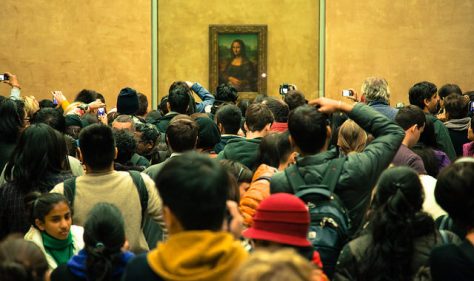
At times, both authors seem rather grumpy about the millions and millions of people who crowd into museums to see masterworks of culture and history, but their questions about how we experience art in these contexts raises interesting issues about marketing, image reproductions, and digital collections. For example, given the deep crowds of camera-phone-wielding tourists crammed in front of the Mona Lisa on any given day, is it more valuable or meaningful to look at a high quality digital image on my iPad (here in the quiet comfort of my own home or office)? And how does our repeated exposure to beautiful, massive publicity banners and posters showings close-up details of masterpieces effect our expectations of the actual museum gallery experience with these artworks?
This is what it is like when you’re standing looking at the Mona Lisa in the Louvre. Photo by Stephen R Melling, Flickr, CC BY-ND 2.0
How Do We Experience Contemporary Art?
OK, let me shift gears here, from talking about experiences with Egyptian sculpture, Renaissance masterpieces, and nineteenth-century portraiture to experiencing the art of now — contemporary art that can be scattered across a gallery floor, projected on multiple walls, consuming a massive space, requiring us to talk to someone or eat something, confusing, perplexing, and having no apparent start or finish.
“The old rules of not touching a work of art or of reverentially paying homage to each picture in a state of quiet awe are now gone….” (Ward 8)
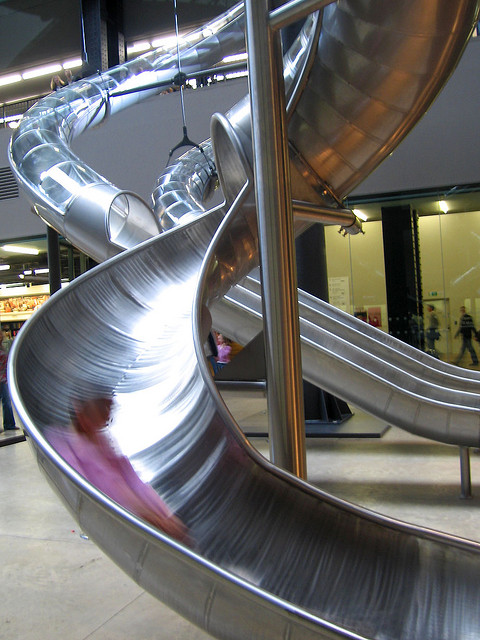
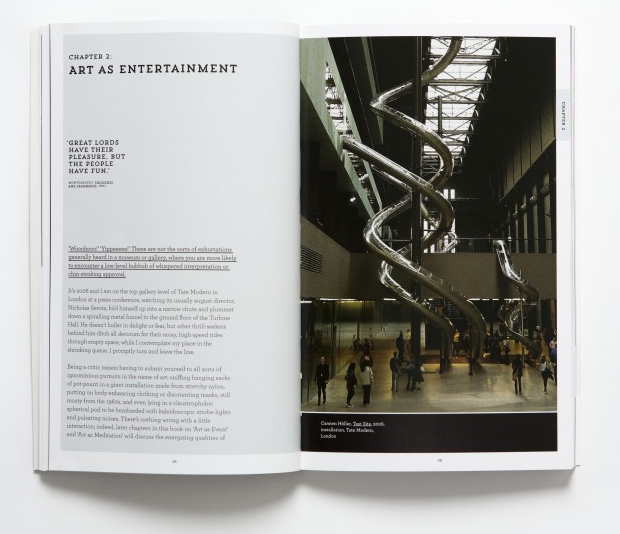
Carsten Höller “Test Site” installation at Tate Modern, 2006. Photo by David Sim, Creative Commons 2.0 license
Ossian Ward’s Ways of Looking makes a fresh pairing with Rendez-Vous with Art, focusing on art created since 2000 that frequently expects viewers to perform, interact with, or complete the piece in front of you. In this highly readable, straightforward book, Ward offers a set of tools that go beyond just looking and might help provide a way to make sense of contemporary art. While an art critic and art world insider himself, I think he succeeds in his attempts to combat the ubiquitous and opaque ‘art speak’ that so frustratingly surrounds contemporary art. He writes (and I quite agree):
“Too often, these gatekeepers [curators and critics] stand in the way of the understanding of a work of art by using a morass of theoretical jargon and pseudo-philosophical art-speak. This kind of clever-clever writing about art does very little to bolster or boost an artist’s cause, other than perpetuating more reams of similarly hard-to-fathom ‘discourse.'” (20)
So how does Ward propose we cut through the verbose jargon and allow for better experiences with contemporary art? His central foundation is to “start from zero” and wipe the slate clean — tabula rasa — using the first word TABULA as a mnemonic device for the approach he proposes. While I don’t want to give away all the details (after all, you should read the book yourself and explore this approach), here is a very brief summary:
Time: Always a good idea to start with a few minutes of calm contemplation, looking, and exploration. Take stock.
Association: What is the personal resonance or ‘hook’ for you? This can be a visual attraction or a connection with a memory or experience you’ve had. Make some associations.
Background: Use some basic ways to learn a bit more about the backdrop of the piece or the artist — using the title, label, press release, museum brochure or website, etc.
Understand: After looking, connecting, and learning a few basic background facts, the piece is more likely to sink in a bit more. What might be some broader messages at play here?
Look again: Simple as it sounds. After a bit of pondering, go back and look or engage with the work even more. Did you miss a detail?
Assessment: After these first four steps, you’re now in a better place to decide whether you think the work is good or not. But Ward reminds us not to hastily jump to this step (which we all do far too often).
Much about this method of looking at contemporary art or thinking about an encounter makes sense, and reaffirms many existing pedagogies and educational philosophies already informing museum practice. In addition, throughout his book, Ward provides us with wonderfully pithy ‘Spotlight’ features that lead us through parts of the TABULA approach with individual works of contemporary art — including explorations of Christian Marclay’s The Clock (2010), Carsten Holler’s whimsical Tate Modern installation Test Site (2006), Glen Ligon’s Warm Broad Glow (2005), and Roger Hiorns’s amazing and enormous Seizure (2009). When the TABULA approach seems a bit lacking, at least the discussions of contemporary art are enjoyable and digestible.
Everything Comes Full Circle
The entire experience of reading these two ‘looking at art’ books side by side became eerily connected when I reached the final pages of Ward’s book only to find a Spotlight on Rembrandt’s Self-Portrait with Two Circles (1661) — a painting that de Montebello and Gayford could have easily included in their travels. Ward comes around full circle to the more traditional ways of looking at art that form the foundation of Rendez-Vous with Art, writing: “there is no better way to slow down and tabulate one’s appreciation of art than by sitting with one of the Old Masters.” No matter what approach or strategy you take when it comes to encountering art of any time period or culture, is there anything more essential than spending time to look, perceive, and use our multitude of senses to take it in?
“It’s not rude to stare at art. Quite the opposite, in fact: it’s the least you can do. Stop. Breathe. Relax. Don’t think, just look, take it all in. Soak up your surroundings, feel the space in front of you, set your mind free, let your internal monologue recede and allow your eyes to settle. When was it that you last allowed yourself such a moment?” (Ward 148)
Recently, the use of questions in art museum teaching has been questioned. In their book, Teaching in the Art Museum: Interpretation as Experience, Rika Burnham and Elliot Kai-Kee wonder “why we ask questions at all.” They have observed too many instances of questions that merely stand in for the delivery of facts, questions that limit viewers’ responses, or questions aimed only at “getting the students to talk.” They write:
“Even so-called open-ended questions always define a finite horizon of response that limits the range of answers that will make sense to both questioner and respondent” (100).
Are they right?
While they have written an eloquent, essential book that I am very grateful for, I do not agree with their premise that because some docents or educators ask terrible questions, questions in general are a flawed pedagogical tool. Every teaching method has unsatisfactory practitioners. That does not mean the teaching method itself is bad. More likely it means that some practitioners are not buying into the philosophical underpinnings of the methods, or, in some cases, that they don’t have enough experience or good mentorship.
I can assure you that many docents or educators could also botch Burnham and Kai-Kee’s described methods. Does that mean their methods are bad? Certainly not. I have been with Burnham for an experience with an artwork, and it was powerful. I don’t disagree that what she does works wonderfully for her audiences. However, I also don’t agree that all audiences can or will look for an hour at a painting without prompting through questioning. I have taught audiences for whom this works just fine, but over ten years of teaching literally thousands of tours at art museums, I believe that museum educators must not do away with open-ended, non-leading questions.
In Defense of Questions
Why not do away with questions? Because some groups have never been to a museum before, or looked for longer than a few seconds at an artwork. Some groups have rarely been asked their opinion before. Some groups have not experienced learning as interpretative and dialogic instead of didactic. Some groups have had no practice listening to each other. Some groups are scared to death of sounding stupid. Some feel highly uncomfortable in the galleries. “We are the only people who look like us here,” a student once said to me on a tour at the Whitney Museum, and when she broke down in tears, so did others in the group and so did I. Some groups don’t even want to travel to the area where the museum is. When I taught high school in the South Bronx, my students said they did not want to go on field trips to Manhattan. “Too many white people in Manhattan, Miss,” said one student, and I don’t think he was joking. Some groups are still thinking about the backpack they were forced to check in the lobby. Some are just marveling at the museum – a place entirely new to them. Some are hungry or wondering when they will be allowed to go to the bathroom. Perhaps some students (hard to believe for us art lovers) are simply not interested in art. (I don’t blame them. We all have affinities. I would probably not have been enthusiastic about a school field trip to a car mechanic unless ways to be engaged in the topic were modeled for me.)
For many groups, questions will help them move through fear, discomfort, distraction, or lack of experience or affinity. By asking questions, we model the rules of interpretative play that Burnham and Kai-Kee propose. “Look keenly…share your observations…ask questions… listen to and respect what others say…be patient” (130). We hope that they might internalize these modes of inquiry and use them to think about not just art but the visual culture we live with.
In my experience, questions are critical in modeling how to explore a work of art. When we ask, “What do you notice?” we model for students that their observations are important and meaningful. When we ask, “What more do you notice?” we model that their initial observations are not enough. When we ask, “Where do you see that?” we model that their observations are best grounded in the work. When we ask interpretative questions such as, “What can you guess about this place?” or “How would you describe this person?” we model that their hypotheses are valuable even without a higher degree in art history. When we ask, “What makes you say that?” we remind them to ground their interpretations in observations. When we offer curatorial interpretations or artists’ quotes and ask them what they think of these ideas, we model that the conversation around art in the galleries is still alive and far from complete. When we ask, “Do you agree or disagree?” (with curatorial or artists’ statements or with other students’ thoughts), prompting them to explain their answers, we model that debate and an openness to multiple interpretations are appropriate and they are capable of it. When we ask, “Do you like it? Why or why not?” we model that their opinions matter. When we ask about how art relates to their own lives, we model that what you see in a museum can have an impact beyond its walls. When we ask students to offer up their own questions about the artwork, we model how they can conduct their own conversations with an artwork – on their own or with a group.
Do Burnham and Kai-Kee really think that questions like these “define a finite horizon of response?” For every single one of these questions, I can imagine an unlimited array of responses. These are the kinds of questions that experienced lookers ask themselves about an artwork without prompting. But what of the groups with the aforementioned preoccupations or inexperience? Our role as educators for every visitor – not just the experienced lookers – is to model these modes of inquiry. I love Burnham and Kai-Kee’s model for dialogical teaching. In their model, imagined as a four-sided diagram, or diamond, participants in a dialogue move between any of four roles:
The mover pushes the dialogue forward with statements or questions.
The follower supports the dialogue with evidence, encouragement, or just active listening.
The bystander stands back, views the dialogue from afar, perhaps metacognitively.
The opposer actively disagrees with another’s point of view. (87-89)
Many viewers would not naturally know how or be willing to take on these roles. Questions can help. When we ask questions, we model the role of the mover for students. When later in an experience (or even in the beginning of one), we ask them to raise their own questions about an artwork, we invite them to be movers. When we ask students to think about what others have said and express their agreement or disagreement we are asking them to be both bystanders and, possibly, opposers. We are modeling the role of listening to the whole of the conversation and stepping in when they have a different opinion or even if they want to agree or support as a follower.
Later in their discussion of this dialogical model, Burnham and Kai-Kee describe what I think of as the most exciting kind of question. If you’ll allow me an extended metaphor, the questions I have already described are the meat-and-potato questions – the questions to facilitate a sustained, filling experience with an artwork. But then there is the Boeuf Bourguignon of questions – the one that has been simmering so long it excites the palate upon contact. The educator has reflected on an artwork for days, weeks, even years, and has come back again and again to a question that she cannot answer, that she wants to hear as many thoughts on as possible. It is “a question that is real for [the teacher], a question she wants to share with the students, and whose answer she does not already know” (91).
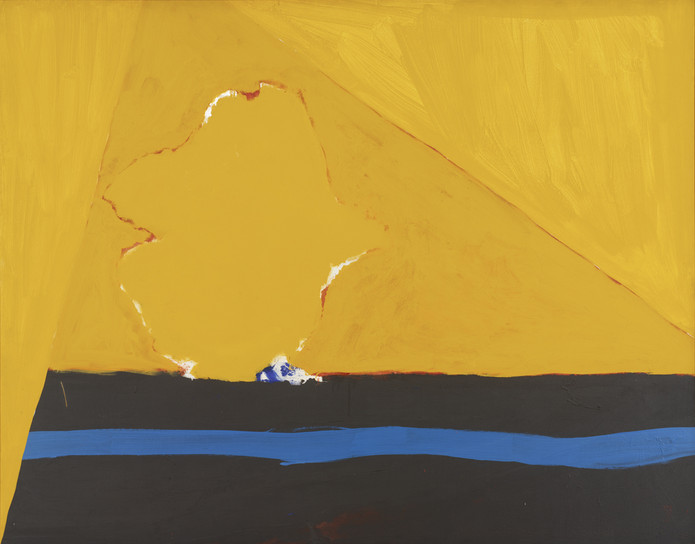
I had the good fortune of being able to research the painting for months. I read Motherwell’s writings, asked a curator at the museum for background on the work, spoke to a conservator about it, and looked at it carefully for extended periods. I was even able to gather with educator colleagues in front of the painting and discuss it. During this latter session, a question came up that none of us could answer definitively. It stuck with me through all my research. I knew I wanted to share it with the participants in my session.
Motherwell was fascinated by collage. When he discovered it, he said, he took to it like a “duck to water.” He said the experience of making collage was like “making beautiful love for the first time.” The painting I was planning to discuss, according to one curator, “could be read as a translation to another scale of one of his collages.” My colleagues, after seeing his collages, had been perplexed. The painting was not nearly as good as his collages, they agreed. Their question became: Why even make the painting? Why not stick with collage? Indeed, in Motherwell’s writings he describes getting more pleasure out of making collage: “I do feel more joyful with collage, less austere. A form of play. Which painting, in general, is not, for me, at least…” (Collected Writings of Robert Motherwell, ed. Stephanie Terenzio). So the question stuck with me. Why even make paintings? I wanted to ask this question because after all my research and time looking at the artwork, I still found it fascinated me.
After a long, free-wheeling, open-ended discussion of the painting, I proposed the question to my first group. There was silence. Uh-oh, I thought, maybe this question was only interesting to me. Maybe, like Burnham and Kai-Kee suggest, I had asked a question that limited “the range of answers that will make sense to both questioner and respondent.” Maybe I had asked a question unrelated to their experience of or interest in the artwork. But I sat with the silence for a few moments, and people began to speak up.
“Perhaps,” one said, “he wanted to make something bigger than collage would allow.”
“Perhaps,” said another, “he couldn’t make as much money from collages.”
“I think,” said yet another, “he could learn something about his collages by making the paintings.”
“I think he needed them for his legacy – to be considered important.”
We laughed about some of the answers, and there were plenty of perplexed looks as we sat with the question. It was another way into the painting. Yes, it was influenced by my own experiences with and interest in the work, but it was an open-ended, genuine, and satisfyingly riddling question and the range of answers took us places we hadn’t yet been in the conversation.
Sometimes no one answers questions like this, and I think that’s OK, too. These questions are modeling something that all questions should model, and I think these questions throw into sharp relief. They model that we are all learners, and we are learning together. We are asking questions because we are genuinely curious about their answers.
About the Author
JACKIE DELAMATRE: museum educator, currently teaching at the Rhode Island School of Design Museum and writes teacher curricula for the Guggenheim Museum, the International Center of Photography, and the Neuberger Museum of Art. Until this summer, she taught at the Museum of Modern Art, the Whitney Museum, and the Guggenheim Museum for nearly a decade. She has coordinated research on the effects of looking at art on critical thinking skills, founded programs for teens as well as babies and their caregivers, and written for the Journal of Museum Education as well as several museum and museum education blogs, most recently for Museum Questions. She holds a B.A. from Brown University and an M.F.A. from New York University in Fiction. She is at work on a novel.
Written by David Bowles, Assistant Museum Educator for School Programs, Metropolitan Museum of Art
Cross-posted with Museum Questions, a blog authored by Rebecca Herz that is dedicated to questions about museums and thoughts on creating a reflective practice.
This blog post is about listening and reflection. As a museum educator, my job is to listen. On a good tour, I learn about as much about art from visitors as they learn from me. I also learn something about their lives. But often it seems like these moments evaporate. So for the past two years, I have been posting some of the most indelible teachable moments from my gallery experiences on Facebook.
I limit myself to one moment per tour. I try to stick to the facts, and not interpret the child’s ideas in my own words. I describe the context succinctly, and stick to a few sentences at most. I imagine reflecting on the teaching experience with someone who has never heard of the field of museum education – so no jargon allowed. When it makes sense, I include a visual of the artwork that sparked the teachable moment.
The moments I capture tend to be funny, which is why they make good Facebook posts. But they also highlight important moments of discovery, and often mark pivot points in gallery conversations. I try to focus on what Piaget might have called moments of disequilibrium – those wonderful, maddening moments when you discover for yourself that what you thought was simple, is not.
Here are three such experiences, some thoughts on what I’ve learned about school tours and student visitors along the way, and tips for anyone interested in giving this a try.
1. Fear of the Unknown
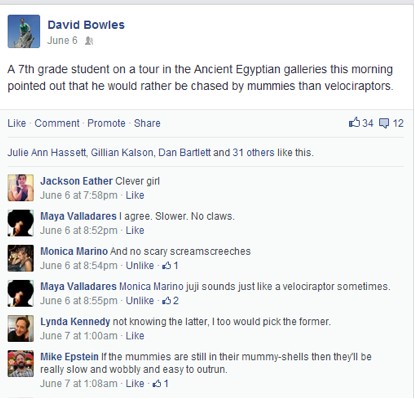
“A 7th grade student on a tour in the Ancient Egypt galleries this morning pointed out that he would rather be chased by mummies than velociraptors.”
I think the young man’s logic was that mummies chasing him through the Museum were likely to shuffle along slowly, while raptors are nimble pack hunters (as anyone who saw the kitchen scene from the original Jurassic Park can attest). He makes a valid point. This comment sparked a stimulating conversation among the class about fear of the unknown. We sat in the dimly lit gallery surrounded by sarcophagi and other tomb equipment unearthed along the Nile, and other classmates chimed in with their honest reactions to the unfamiliarity of the experience. After several other students also expressed fear, one young lady allowed that she “sort of liked being scared.” I asked her if it felt “safe scary” and she nodded. The young man whose comment started the conversation smiled at her and nodded as well.
These students feel slightly scared by the unknown Egyptian galleries filled with mummies and other ancient artifacts. But they are attracted to the unknown. The unknown in a museum setting, like the unknown in movies, is “safe scary.” For them, what is interesting about this space at the Met is not the connections they can make to their school curriculum, or the comparison between the ancient and the contemporary, but the opportunity to exist temporarily and safely in a space outside of the safety and routine of the everyday.
2. Time Travel
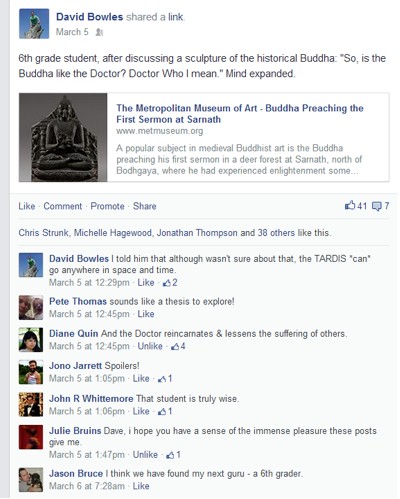
“6th grade student, after discussing a sculpture of the historical Buddha: “So, is the Buddha like the Doctor? Doctor Who I mean.” Mind expanded.”
If you’ve never watched Doctor Who, close this browser and go watch some. The Doctor is an extravagant, brilliant, and charismatic alien who explores the universe trying to help the helpless, ease suffering, and generally leave things better than he found them. His ship, the TARDIS, can travel anywhere in space or time. Since he seems to like Great Britain, he comes to Earth a lot. Coincidentally, the show is produced by the BBC, so the Doctor is invariably British, as are his plucky human companions. The Doctor is a troubled hero, whose views on the universe are often transcendent as well as maddening.
On some level, the young lady who asked me if the Buddha was anything like the Doctor understood that the story of the Buddha, like the story of Doctor Who, is about creating an impossible narrative of characters who can save the world. On another hand, she may have been reaching for a way to connect historical information about the Buddha (i.e. he really existed, he was a prince, he traveled throughout India and Nepal, etc.) with the more incredible aspects of his story (i.e. his description of concepts like samsara and nirvana, his awakening or enlightenment, etc.) She seemed interested in the Buddha not as a representative of another culture but as a superhero, an embodiment of the type of figure that could save the world. In short, I think she saw a role model.
3. Love and Marriage
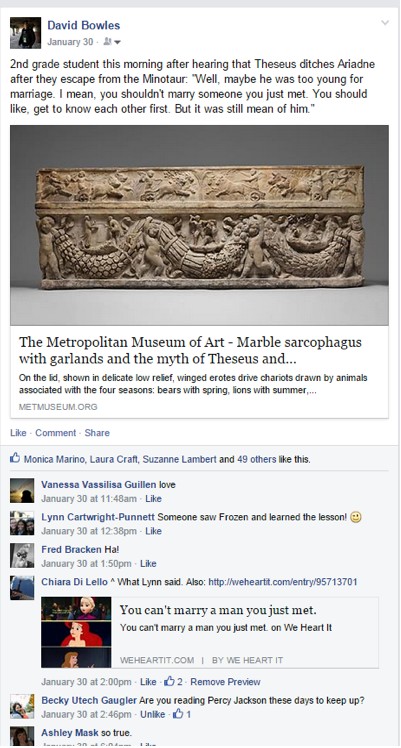
“2nd grade student this morning after hearing that Theseus ditches Ariadne after they escape from the Minotaur: “Well, maybe he was too young for marriage. I mean, you shouldn’t marry someone you just met. You should like, get to know each other first. But it was still mean of him.”
Like the Greek myths that inspired it, this discussion offered an interesting analysis of human behavior. After telling these students the myth of Theseus and Ariadne, I asked students what they thought of the story’s ending. The first flurry of responses focused on abandonment and notions of fairness; everyone agreed that Theseus made a bad choice. Well, nearly everyone. I pushed for dissent, and asked if anyone had another point of view. This young lady had been sitting silently for a while, and when she did speak it was with energy.
On some level she was trying to make Theseus’ decision to abandon Ariadne acceptable. On a deeper level, I wonder if this student, like the young lady who compared the Buddha to the Doctor, was thinking about role models. As you can see in the comments left by my Facebook friends, Disney’s ‘Frozen’ explores these ideas very effectively as well. Whether or not this student had seen the movie (and I suspect she had), it was a powerful reminder to me about making room for respectful dissent when interpreting works of art. Students really absorb the lessons that they learn from movies, so it makes good sense to keep tabs on what those lessons are – and what ambiguities they might offer.
So what patterns have I noticed about kids’ interests at the Met?
The Unknown
Many of these conversations involve discovering new frontiers, and the thrill and fear that accompany real, authentic exploration. As long as the fear of the new doesn’t overwhelm the group, it can be very productive if acknowledged. There’s a lot to be said about the transformative power of discomfort; just ask an oyster.
Role Models
Humans are social animals; we look to others for tips on how to behave. Many students are searching for role models, and some have found them in fictional characters. These young people are looking for ways to connect these characters and their worlds to the real world around them, and they will do so at the first opportunity.
Contemporary Connections
Museum educators often talk about contemporary connections: strategies or concepts that help visitors understand something unfamiliar by tying it to something personally familiar from today. When students initiate their own contemporary connections, they often do so in unpredictable ways that can be surprising, humorous, or subversive. There is something to be said for letting students make their own connections instead of doing it for them. Kids will bring pop culture with them into the museum regardless, so ignoring its power means missing opportunities for authentic discussion.
Keeping up-to-date on popular trends among young learners can really help make genuine connections that make complex ideas accessible. It can also highlight key misunderstandings about objects or the stories objects tell. For example, the idea that you should get to know your future partner well before committing is a very particular approach to marriage, presumably not one endorsed in most ancient societies.
Some Takeaways for Museum Educators
1. Listen. Really Listen.
Focus on what students are really saying when they respond to your questions, not just what you think they mean. This is hard. Use the words they use to define academic terms and abstract concepts. If a student’s comment strikes you as snarky or disruptive, lean in to it. Find out more. Let them know you’re interested in their thinking. Give them space to explain. If they don’t want to explain to you, consider asking them to turn and talk with some of their peers. Listen to what you hear, and think about how it connects to your own ideas about the content or lesson.
2. Let students drive the conversation.
My boss sometimes talks about how effective museum educators need to be a ‘Guide on the Side’ rather than a ‘Sage on the Stage,’ and this is vital to effective gallery teaching. Use a light touch to keep the conversation moving. Stay goal-oriented, but don’t get so attached to your goals that you lose sight of the importance of the process of discovery for your participants.
3. Ask for divergent thinking
Seek out dissenting ideas so that you are encouraging participants to think both deeply and individually. Some works of art open themselves up to a wide range of possible interpretations without ever committing to just one – examples might include many modern and contemporary art objects. Other works of art, like a Gupta period Buddhist sculpture or ancient Roman sarcophagi, have very specific meanings that their makers intended; there are incorrect understandings of some works of art, and that is important for us to acknowledge. Those misunderstandings are often great starting points for real inquiry if you can help students ground their misunderstandings in the visual elements of the artwork! Either way, seeking out divergent thinking empowers students to discover and craft the complexity of interpretation for themselves.
4. Reflective Practice needs others
I think the capacity to reflect in action (while doing something) and on action (after having done it) is an important part of professional practice. Both are hard to do, and both benefit greatly when other people can be sounding boards. I find these status updates help me slow down and think about the choices I’ve made. Better yet, doing so gives me immediate informal feedback.
Give it a try!
About the Author
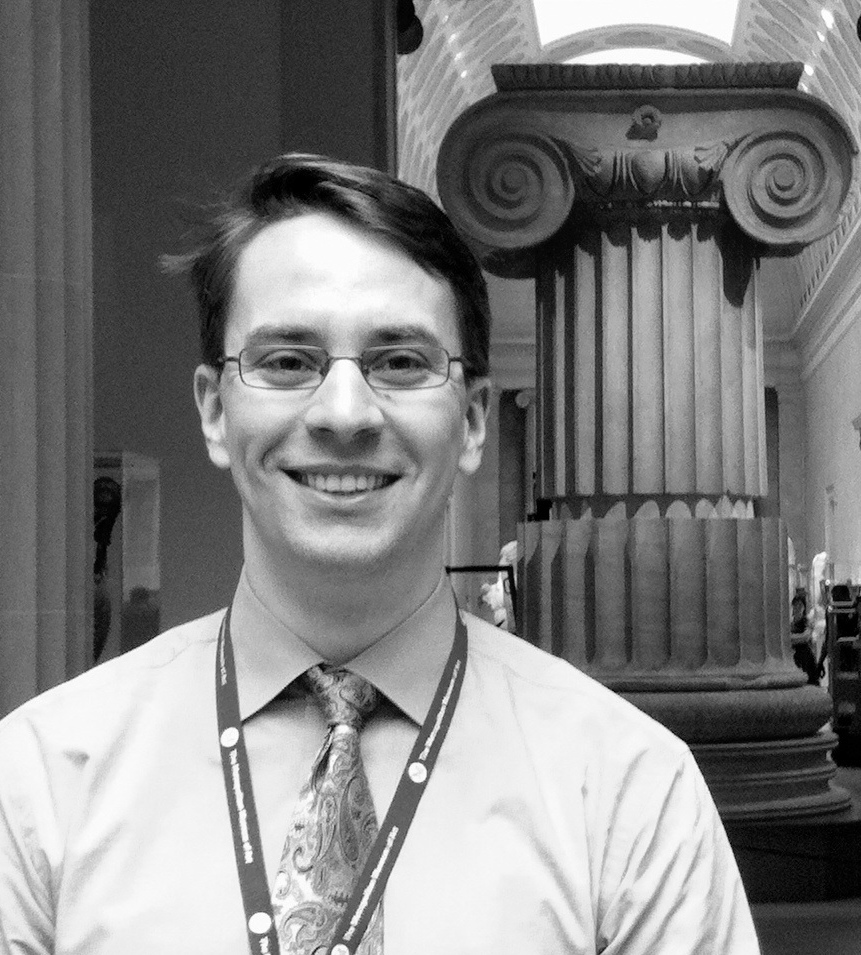
DAVID BOWLES: Assistant Museum Educator for School Programs, Metropolitan Museum of Art. David oversees the strategic planning, staff and volunteer training, program implementation, and evaluation of all aspects of guided K-12 school tours at the Metropolitan Museum of Art. In collaboration with colleagues, he also develops resources for educators, in particular for educators who are bringing students to the Museum on guided or self-guided visits. David also teaches across a range of audience areas, including K-12 educator programs and adult gallery talks. Before this, he worked at the Rubin Museum of Art as Manager of School Programs. He earned his M.S.Ed from Bank Street College and a B.A. with Honours from McGill University. David’s postings on this site are his own and don’t necessarily represent the Metropolitan Museum of Art’s positions, strategies, or opinions.





 Art Museum Teaching