

Written by Sara Egan, Isabella Stewart Gardner Museum, and Michael Baulier, Edward M. Kennedy Academy for Health Careers
The School Partnership Program at the Isabella Stewart Gardner Museum is like a laboratory for museum education, through which we work for multiple years with a diverse range of students and teachers with a collection of art that never changes. This combination of stable and changing variables has allowed the Gardner Museum to maintain a cycle of theory, practice, research and reflection. The School Partnership Program uses Visual Thinking Strategies (VTS) as the primary teaching and assessment method, responding to findings from our 2007 U.S. Department of Education study, Thinking Through Art. We’ve continued to learn and grow since that study, most recently through our work with the Edward M. Kennedy Academy for Health Careers (EMK), an in-district charter school in Boston. We started partnering with the English Language Arts and History teachers in 2012 and this year added Spanish teachers. While the successes and challenges we encounter working with EMK are specific to our partnership, we hope you will use our example to consider how praxis (the practical application of theory) and research can contribute to your own programs.
Research: Getting to know our audience
Working with the same audience over time is a luxury, but also crucial in our pursuit to consistently tailor our program to the specific needs of our partner students and teachers. Since we work with the students throughout their high school careers, we see the EMK 11th grade students respond to the Museum very differently than they did in 9th grade. We see changes through a variety of data collection methods: surveys, writing samples, long and short interviews, observations, and more. Our program goals include developing visual literacy and critical thinking and communication skills, so we mine the program data to determine how the students are making meaning from works of art and quantify the frequency of critical thinking that they deploy in that quest. The quantitative research tells us where the students are, while the qualitative data helps us to understand the context and explain how, when and why students develop these skills. So, how do we respond when we see that students shift over time from 9th grade comments like,
“Yeah. It’s a nice picture. It’s nice and, I don’t know, it’s colorful”
to interpretations from 11th graders such as,
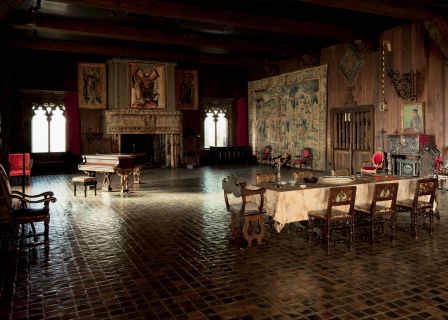
“This room looks dark and mysterious. Kind of like a church because of all the holy statues and religious references. Maybe it means you can find light even in the darkness?”
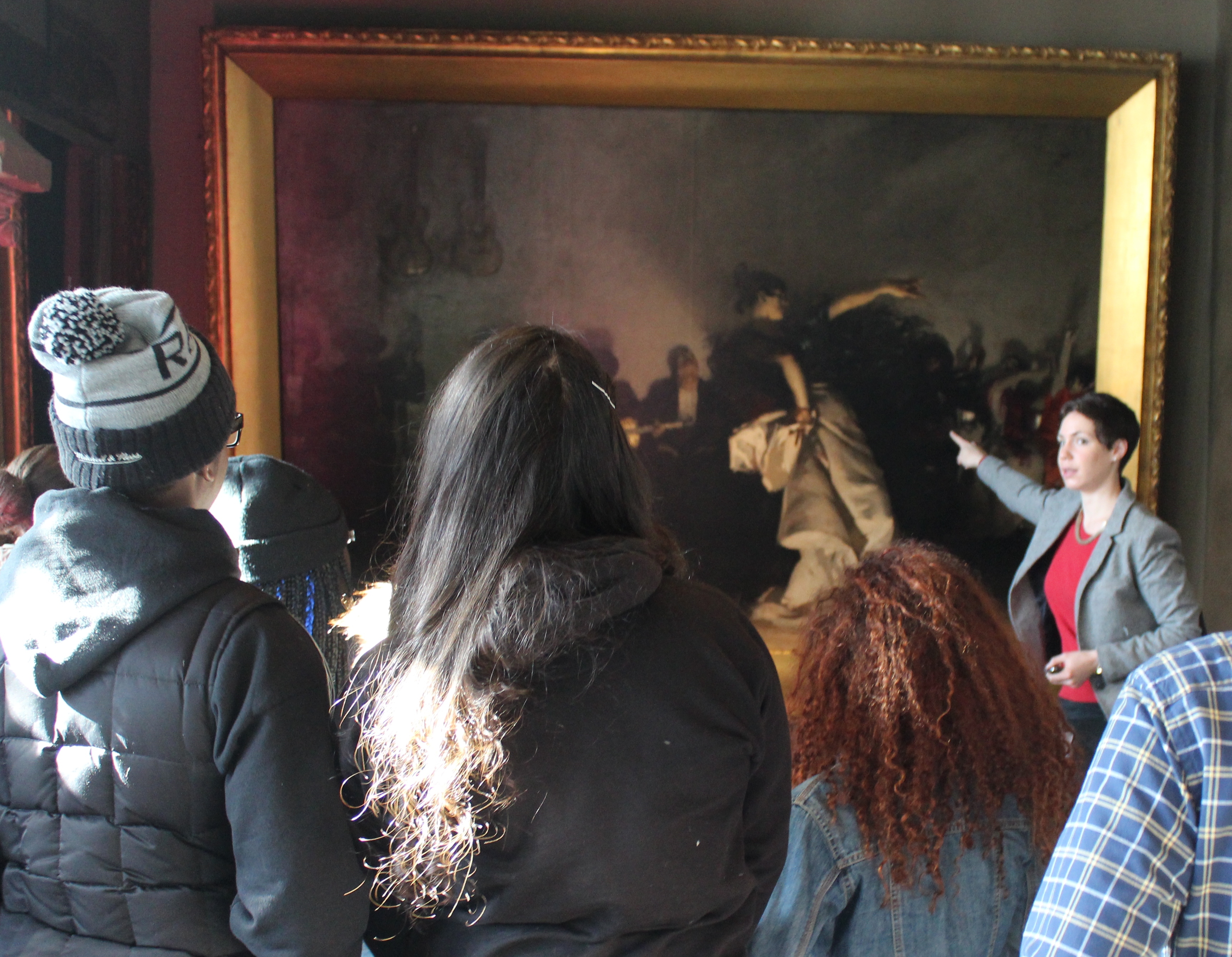
Theory: Making sense of the data
The work of constructivist theorists like Piaget, Vygotsky and Duckworth, Abigail Housen’s theory of Aesthetic Development, in addition to our own personal theories of learning and change inform our interpretations of our research. Viewing the raw data through the lens of theory helps our team of educators explain what we see while validating the theories that we are considering. Returning to the EMK example, we know from our research that as these high school students are introduced to the Gardner Museum and begin discussing art using VTS they are primarily concerned with their own observations and prior knowledge. After two years of monthly discussions of art in the classroom and at the museum, they start to wonder about the intent or history of the artist. Housen’s theory tells us that through extensive experience looking at art there will be a development from storytelling to considering new kinds of information such as art history. Piaget’s theory of childhood development contributes to our understanding of why this happens more quickly in high school students than elementary-aged students. We use these frameworks to understand where the EMK 11th grade students are now, and then estimate where they are likely to go next and what kinds of questions they will pose in the months ahead. The students are capable of abstract reasoning and are interested in the way that an artist’s intentions play out in a work of art. They are also thinking about the VTS process itself and questioning the boundaries of its usefulness with art and across disciplines.
Practice: Putting it all into action
With a solid grounding of data and theory, our next step in August 2014 (Year 3 of partnering with EMK) was to adjust our practice to fit the new reality of these more experienced students’ needs and interests. First we began experimenting with new types of information when the students visited the Museum, for example providing more context about a special exhibition or asking probing questions like, “What do you think might have interested the artist when making this artwork?” Next, we held intensive professional development for our partner teachers at EMK, collaborating to create “VTS extensions” that use VTS skills to explore new concepts, for example predicting the themes of a new novel or unit of history by examining images.
Collaboration: Insights from Michael Baulier, 9th grade English Teacher
As a STEM school with a strong focus on math and science, EMK relies heavily on relationships with peer institutions to offer opportunities for students to engage in the arts. I embraced VTS because I view this instructional approach as an opportunity to address the dearth of arts education in our school. What I did not anticipate was the extraordinary impact VTS would have on the daily instruction that occurs in my classroom.
VTS fits seamlessly into my teaching as an instructional strategy that promotes whole-group discussions grounded in visual evidence. When I ask students the first VTS question, “What’s going on in this image?” I am cuing them to develop claims based on a visual text. The follow-up question, “What do you see that makes you say that?” requires students to provide visual evidence to support their claims. In ELA class evidence-based reasoning is at the core of everything we do, whether a student is discussing a visual text during VTS, making an inference while reading a short story, or writing a paragraph to support a thesis statement in an essay. VTS also aligns nicely with the ELA Common Core Standards’ emphasis on student-centered exploration over teacher-directed instruction, and the development of listening skills and oral proficiency are beneficial to students who are English Language Learners or receiving Special Education. Instead of frontloading tasks with teacher-generated content knowledge, students engage with texts, take risks, and uncover meaning collaboratively. Because the subject of VTS is an image, all students have an opportunity to contribute to the discussion in a low stakes environment. The deliberate focus on active listening and high volume of oral language input for students to process leads over time to increased language output. I have observed students who are typically reluctant to speak aloud share detailed responses to complex images in the classroom or at the Museum.
In the third year of our partnership with the Gardner Museum we are collaborating more than ever to explore new opportunities for using VTS to enhance teaching and learning in our school. In November my students visited the Museum to brainstorm ideas for image-based short stories written as part of a VTS extension project. In April we look forward to hosting our first family event to showcase student work inspired by the Gardner Museum. The Museum’s eagerness to engage our school community through so many unique learning opportunities makes this partnership especially exciting, because it speaks to the creativity that is so vital to both the arts and education.
Reflection: What did we learn from the cycle of praxis?
The contours of this partnership have changed over time as we listen to our audience through research, interpret what we hear through the lens of theory, and translate our understanding into practice. Rather than automatically replicating practices that have worked in the past we continually strive to improve and to justify, to ourselves as well as all other stakeholders, the value and relevancy of our program. At EMK, our partnership is a component of school culture and the value of the arts and critical thinking are infused at every grade. Teachers and students consider the Gardner Museum as an active part of their campus, visiting independently and attending the Museum’s other programs. This cycle keeps the work always fresh and exciting, as there is always more to learn from and with our partners.
* * * * *
About the Authors
 SARA EGAN: School Partnership Manager at the Isabella Stewart Gardner Museum, where she connects Boston students and teachers to the Gardner through Visual Thinking Strategies (VTS). She teaches preK-12th grade students in the galleries and the classroom, trains and coaches teachers to use VTS, and researches the impact of the School Partnership Program. Sara also manages the Gardner Museum’s paid Teens Behind the Scenes. She holds a BA from Vassar College and an Ed.M. in Arts in Education from the Harvard Graduate School of Education.
MICHAEL L. BAULIER: Educator at the Edward M. Kennedy Academy for Health Careers, where he teaches English Language Arts to ninth grade students. Michael is an inclusion teacher who is licensed to teach students receiving Special Education (SPED) support services as well as English Language Learners (ELL). He earned his National Board Certification for Professional Teaching Standards (NBCT) in 2014. Michael holds a BA and MAT from Northeastern University and is currently studying at the University of Massachusetts Boston to become a school administrator.
* * * * *
Header Image: Sara and 9th grade students from the Edward M. Kennedy Academy for Health Careers in the Courtyard of the Isabella Stewart Gardner Museum, Boston.

 Art Museum Teaching