NAEA Breakdown – Museum Education Edition

As art museum educators from across the country begin to pack their bags and head to New York this week for the National Art Education Association annual conference (Wed-Sun), I thought it might be interesting to offer a quick breakdown of the sessions being offered in conjunction with the Museum Education Division.  And it’s important to note that the Museum Education Division is celebrating its 36th year, having been created during the annual conference held in St. Louis back in 1976 (go Cards!).  So, what’s hot this year?  Let’s run some of the numbers:

Total Museum Education Sessions: 76

Total museum educators presenting: 185 (plus or minus)

Most Frequent Session Topics:

Technology (digital media, blogging, podcasting, etc.) – 13

Teacher professional development & resources – 10  (duh, it’s NAEA — thousands of teachers attending)

Community and family audiences – 8

Museum-school partnerships – 6

Visitor-centered programs / listening to visitors – 5

Evaluation – 4

Docents – 4  (WAY down from last year — I guess docents aren’t cool anymore)
Looking deeper at the topics and issues being addressed this week in sessions spread all across the New York Hilton and Sherton hotels, one can find a distinct focus on museum audiences — and expanding those audiences to non-traditional groups.  Other than the sessions dealing with larger issues of community and family outreach, almost two dozen sessions bring attention to exemplary work being done to connect with the vision-impaired, English language learners, teens, young children, homeschoolers, pediatric patients, students with autism, etc.  A handful of sessions will be addressing the needs and questions of visitors, and how museums can listen to those voices to develop more effective programs, interpretives, and tours. Another dozen sessions will be exploring strategies to engage those visitors — from theatre activities and multi-sensory tours to newly-designed gallery spaces and art-making projects that inspire creativity.

When I ran a quick analysis of the session titles and short descriptions, the most common words used (outside of “art” and “museum”) were, in order of frequency: learning, education, programs, research, teaching, visitors, community, and technology.  I only find this interesting as it pertains to how our field describes the work we do to a larger audience — the vocabulary and terms we use to label what we do best.  The word “learning” was used more frequently than “education” and “programs” combined, perhaps providing a sense that our field is thinking of itself more as “museum learning” than “museum education” (a distinction the Brits have drawn for quite some time).  Of course, this blog is titled “art museum teaching,” so I suppose I’m already behind the curve ; )

All in all, I am surprised to not see more sessions using the word “participatory” now popularized by Nina Simon.  It does pop up some, but not as frequently as “interactive” or “conversation.”  More so, I’m amazed to not see more sessions (there is at least one) addressing the conflicts, challenges, and collaborations that exist between education and curatorial.  This seems to be a growing concern or issue among colleagues across the field, with several museums actively restructuring or retooling in order to ensure that these collaborations take place between educators and curators.  Perhaps the goal for NAEA in 2013 could be to convince some curators to present sessions with us, making strong connections with education (and we can, in turn, lead parallel sessions with them at CAA making similarly strong connections with curatorial).  Who’s with me?

For those of you packing your bags for New York, travel safely and I’ll see you there!  And for those not attending this year, please check back here — you’ll definitely see some updates as well as new content once NAEA concludes (and new authors, as the community of contributors to this blog is about to grow!  If you’re interested in contributing, just let me know via Twitter or in the Comments below).

Reading Murals – Telling Stories

The power of stories—whether telling our own, listening to those of others, or building them from our imagination—has a deep connection to human development and learning. Telling stories allows us to learn about ourselves, but it is also an act of “mutual creation involving interactions and understanding between teller and listener” (1).  For museums, storytelling can tap into personal, cultural, and family-based dimensions of learning that have the potential to create more meaningful experiences.

During a recent advanced institute organized by the CoLab and National Writing Project sites in 3 states (Piasa Bluffs Writing Project at SIUE, South Coast Writing Project at UCSB, and Gateway Writing Project at UMSL), a multiprofessional community of educators experimented with storytelling as a way to engage with a 1932 mural by Mexican artist David Siqueiros—now in the collection of the Santa Barbara Museum of Art.  The hard-hitting subjects depicted in the mural connect with the realities of Mexican politics at the time, with Siqueiros delineating the cause and result of the corruption of the administration of Mexican president Plutarco Elias Calles [more information about the mural can be found through the Santa Barbara Museum of Art’s online resource].  This quite somber and personal mural by Siqueiros seemed to lend itself to a more personal form of exploration, so we engaged with the piece through a series of strategies that included various forms of storytelling — creating stories with words and sharing stories with our bodies.

After spending time looking at the mural and navigating the architectural space in which it exists, our group of teachers and educators were asked to focus in on details within the piece and create a series of quick sketches.  We then spread our sketches out across the floor for everyone to explore, and individuals were invited to select one sketch (not their own) that they might connect with a meaningful story.  Those sketches then launched each person into writing a story informed by a close study of that drawn response, adding words directly on top of the sketch.  Here are some excerpts from those stories:

P’s Story Sketch

P: “A woman who has seen much – who endured much and who is still open to what life has to offer. She opens her hand, gesturing for those who will give to her, a sensing that life has come today in the form of men with guns. She can hold her own in the face of those things that may seem as if they could cause harm. She holds her knee to her chest and it brings comfort to her. She feels stable and centered while around her she is surrounded by a man who frowns, who has, without emotion of any kind, shot his neighbor as directed. She has witnessed the death of others not once, but many times….”

S: “The sun now shines on part of this street. Most people, most faces are still in shadows. Later today, later this year, later this century, the light will shine on the whole village, allowing the whole world to see what we all wish could have stayed covered up or better yet, could have never happened.”

Story-writing became story-telling as participants verbally shared their own stories with each other in small groups, working together to select one “critical moment” from their stories to explore more deeply.  Each group wrote down their selected “critical moment” on a sheet of paper, and we then moved down to the sidewalk to physicalize these moments through Image Theatre exercises [read more about Image Theatre in the Teaching Tools section].

To launch into this process of bodily learning, I selected a couple of volunteers to model a technique called “body storming”—the physical equivalent to brainstorming. In “body storming,” participants are invited to silently (communicating only with physical gestures or facial expressions) and rapidly create a series of body shapes or group poses in response to a prompt.  For this exercise, I invited each group to body storm the “critical moment” pulled from their stories.  Groups spread out along the sidewalk adjacent to the busy State Street that runs in front of the Santa Barbara Museum of Art, and they explored their stories through this theatre and movement strategy.  After they body-stormed through their ideas, each group was asked to build a single movement composition to perform for the entire group.

To create a space for the performances, we all formed a circle around our new public “street theatre” venue here in Santa Barbara, interrupting the flow of pedestrians (several whom stopped to peek at what we were up to). Each group shared their group pose or movement, and I jumped in to play the Joker — a concept coming directly from Augusto Boal’s Theatre of the Oppressed that authorizes the Joker and spectators to make changes to the performance.  In this strategy, spectators become “spect-actors,” according to Boal, and they are empowered to transform the performance in a variety of ways.  For these group performances, we invited “spect-actors” to add themselves to the group pose, change something about it, or make new connections beyond the group’s story (to people’s own lived experiences, for example).

After each group shared their performances (and were subject to the wild card actions of the Joker and “spect-actors”), we returned up the steps to the Siqueiros mural for final reflective writing and processing. After engaging our bodies in new ways, this gave participants some time to allow their minds to let the experience soak in and reconnect with the visual images that sparked our creative explorations. The stories we had explored, envisioned, and enacted as a community of learners brought Siqueiros’s images into our own professional and personal lives … and brought our lives into the faces and stories of that powerful mural.

Reposted through the National Writing Project’s Digital Is website.

Notes:

1. C. Abramson, “Storytelling as a Pedagogical Tool in Higher Education,” Education 118 (1998), p. 441.

Marcia Tucker on Museums as ‘Agent Provocateur’

“I see art history, and museums in particular, as a process, an interface, a tool, an ‘agent provocateur’ whose role, rather than being didactic, is to get people to see and think for themselves.”

Marcia Tucker

Marcia Tucker was the founding director of the New Museum in New York and a visionary curator, also working for many years as a free-lance art critic, writer, lecturer, and professor.  Her defiance of conventional practice has always inspired me, even though I only became familiar with her work and writings during the year that she sadly passed away, 2006.  Marcia founded the New Museum when she was 37 after being fired from the Whitney Museum of American Art. According to the New York Times, her motto in founding the museum was, “Act first, think later — that way you have something to think about.”  This quote by her has driven my own personal philosophy of museum teaching — to “get people to see and think for themselves.”

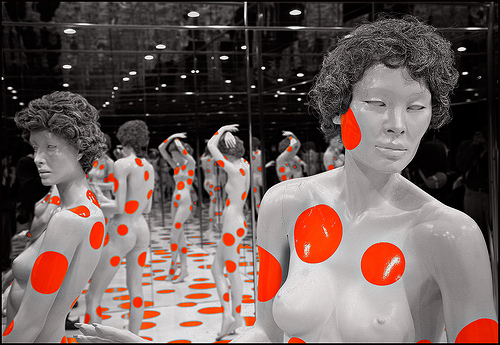
p.s.  the image below from an installation at the Mattress Factory was the best I could come up with for a visual of museums as a real interface and provocateur.  My only visit to that institution a couple years ago was quite a unique experience in seeing, exploring, wondering, and thinking for myself — culminating in my encounter with this permanent installation space by artist Yayoi Kusama.

Photo by Anjan Chatterjee

Image Theatre: Opening a Dialogue through Our Bodies

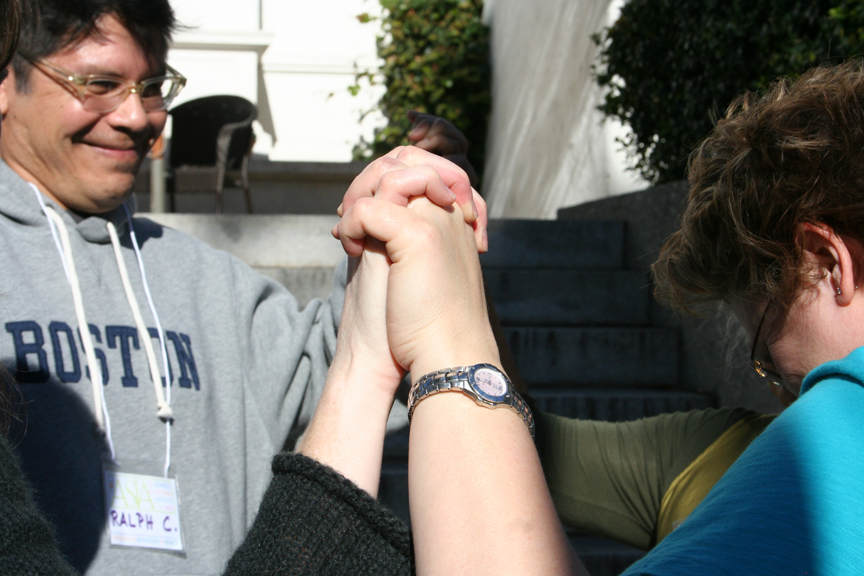
Photo by Julio Albarran

How can we create more meaningful dialogues among museum learners as well as with works of art?  How might we effectively explore abstract concepts such as power, struggle, class, and interpersonal relationships through objects in our galleries?

The Image Theatre technique, an exercise developed by Brazilian director Augusto Boal (author of Theatre of the Oppressed), can provide a fresh way to activate museum learning for all ages. I was reintroduced to this technique last year, when educators from the Metro Theater Company led a series of teacher workshops at the Saint Louis Art Museum. These workshops all focused on kinesthetic learning and participant-centered drama strategies as ways to make stronger connections with artworks on view in the galleries, but the Image Theatre exercise has stuck with me ever since.  It is such a flexible teaching tool, and great for breaking down the passive museum viewing experience and transforming a quiet museum gallery into an interactive, imaginative space.

While I know that every theatre group has its own way of practicing the Image Theatre technique (and I love keeping these strategies “open source” and adaptable), the steps below were inspired by Metro Theater Company’s approach. Although this strategy can be extended in various ways, the basic exercise outlined below can be completed in about 20 minutes (although a larger, very-engaged group can easily push this activity to 40 minutes).

  1. Form a Circle: Invite your group (whether students or adults) to form a circle in the center of the gallery, standing around the space that will become their “theatre.”
  2. Identify Actors: Ask for 2 volunteers to become actors enter the theatre space in the center.
  3. Construct an Image: Quickly work with these actors to move into a pose that you construct (something as simple as a handshake works well, or you can ask the actors to quickly create a pose). Ask the actors to freeze their pose, creating an image or snapshot.
  4. Describe & Imagine: The group participants standing around the outside of the circle can now take some time to look closely at the image in front of them, and the facilitator invites group members to begin describing what they see — using their imaginations to construct stories, narratives, and relationships based on the visual and physical evidence they have before them (body pose, gestures, facial expression, clothing, etc.).  Begin to delve into questions of power — who has it? who doesn’t? what evidence indicates that?
  5. Thought Bubble: After you “interview” the group’s imagination and develop several stories about the image created by the 2 actors’ bodies, you can also use a paper or cardboard thought bubble to ask participants what they think the characters might be thinking — probing their internal thoughts and emotions.
  6. Shift & Re-Examine: Now, have the actors’ make a simple change to their pose that will flip the dynamic between their characters — sometimes as simple as having one of the actors kneel down, sit, or take a different physical position.  Re-interview the group participants about the new image, and what is different.  Has the power relationship changed?  Why?  What else might be going on here?  You can use the thought bubble again to probe the internal thoughts of the characters.
  7. Reflect: Wrap-up the exercise by inviting the entire group (including the actors) to reflect on what just happened?  What did they notice about this exercise? Emphasize how this exercise may have heightened their observation skills and brought out complexity from a series of simple body poses.
  8. Move to an Artwork: Direct the group to gather in front of a nearby painting or sculpture, bringing their close looking, excitement, and imagination from the theatre exercise to their analysis of the artwork.  Identify the “actors” in the painting, and probe the power relationships and dynamics among those figures or visual elements.  While this can work really well with a painting that includes figures, you can also take the leap to a more abstract work and challenge participants to see colors, visual forms, and brushstrokes as “actors” or characters within the work.  Discuss what the group sees in the work, and you can even pull out the cardboard thought bubble to gather insights into the thoughts or feelings of the characters or elements in the artwork.

Over the past year, I have used this exercise many times in the galleries with groups ranging from elementary school students to museum docents.  Each time, I feel that the experience taps into the social dynamic of museum learning and helps make visitors’ engagement with art (and with themselves) more active and meaningful.  And it’s fun!

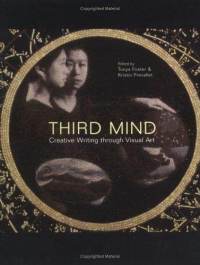
Third Mind: Creative Writing through Visual Art

“Listening to works of art and participating in a conversation with them can produce exciting and shifting responses in each of us: poems, stories, self-portraits, essays, and other creative works are generated that ‘talk back’ to the visual stimulus.” (xv)

The power of bringing together visual art and writing is something that all museum educators have likely experienced at one time or another while guiding a tour or workshop in the galleries–whether through a process of recording observations or a deeper engagement through poetry.  Writing has the ability to get students and visitors to truly “enter into” a work of art and open their imagination. While there are many excellent resources on the topic of art and writing that I use regularly (including Kathy Walsh-Piper’s Image to Word, the Weisman Art Museum’s Artful Writing, and the Philadelphia Museum of Art’s new Looking to Write resource), I keep coming back to the Third Mind: Creative Writing through Visual Art, edited by Tanya Foster and Kristin Prevallet.

Written by a range of educators, poets, and artists, the book’s chapters lay out a meaningful series of creative encounters with visual art, both within and outside the museum environment.  The chapters that have most influenced my own teaching practice are those centered around abstract and contemporary art — an area where writing (both reflective and creative) can open new pathways to meaning, especially for viewers who might be uncomfortable with work by artists like Mark Rothko, Cy Twombly, Robert Ryman, etc.

Cy Twombly, Wilder Shores of Love (1985)

My favorite strategy in the book comes from Gary Hawkins, who recounts an experience he leads for students with Cy Twombly’s monumental Catullus at the Menil Collection. First, he situates each student in their own spot in front of the 50-foot-long canvas, mapping out an area of the painting that he designates “yours” — giving the students a real sense of ownership and accountability. Each student observes and writes on their own at first, then assembles their responses into a larger group poem that is performed in front of the painting. For this final collaborative poem, students are asked to choose 2 lines from their writing, and read their favorite line when Gary taps them on the shoulder. As he writes, “the effect of these group poems that build down the face of the painting and rise to fill the room is stunning.” And I can agree, as I’ve adapted this experience for students in front of large works by Anselm Kiefer or Gerhard Richter, and the result is remarkable. This has been the perfect exercise to digest a large, complex, abstract work piece-by-piece in a way that allows students or visitors to own the experience.

Overall, Third Mind offers up these types of experiences with language that we can adapt to our own learning environments.  In her contribution to this volume, poet Anne Waldman provides the necessary linkage between this creative, collaborative act of writing and William Burroughs’ concept of “the third mind,” which inspired the book’s title as well as its conceptual framework:

“Something new, or ‘other,’ emerges from the combination that would not have come about without a solo act.” (131)

Reposted through the National Writing Project’s Digital Is website.

Michael Brenson on Conversation

“I believe in conversation. In the best conversations, no one is used; ownership is shared. Everyone leaves with a sense that the ideas exchanged belong to each person present. Everyone leaves respecting those who were part of the exchange, whether or not there was agreement.”

—Michael Brenson, art critic/writer

IMLS Strategic Plan: Creating a Nation of Learners

Link to IMLS Strategic Plan, 2012 – 2016: Creating a Nation of Learners

The Institute of Museum and Library Services recently announced its 2012-2016 Strategic Plan, which includes some key challenges for museums as we move firmly into the second decade of the 21st century.

Here is my favorite quote from the Center for the Future of Museums post about the new IMLS plan:

On how museums of the future might need to be different in order to meet the needs of their communities

Museums and libraries for many years were seen as repositories for information, for content, for objects, for paintings, and as places to go and experience things in a very non-interactive way. Now we’re in a world where it’s much more about your own experience of the information, the object or the art. I think the staff in museums has to be ready and willing to accept the role of facilitator of the individual or visitor experience. In a way, it’s giving something up—you don’t control the experience anymore. You try to make it useful and helpful but also flexible so that the visitor can really get what they want out of the experience not what you want them to have. It’s being willing to really walk in the visitor’s shoes and create experiences that are meaningful to them and allow them the opportunity to develop their own understanding and their own skills.

Merce Cunningham on Discovering

“One only has to get one’s mind out of the way about deciding that something is good or bad, and rather allow for different kinds of things to take place, so that you are or I am constantly on the point of discovering something I don’t know about, rather than repeating what I do know about.”

– Merce Cunningham

Merce Cunningham was a pivotal artist and choreographer of the 20th century who redefined modern dance and expanded the frontiers of both the visual and performing arts. In a 1985 interview with Terry Gross, he was asked about how he pushed forward in response to such heavy criticism and mocking during his early groundbreaking performances. The quote above was his powerful response.