Rethinking the Way Museums Work with Teachers

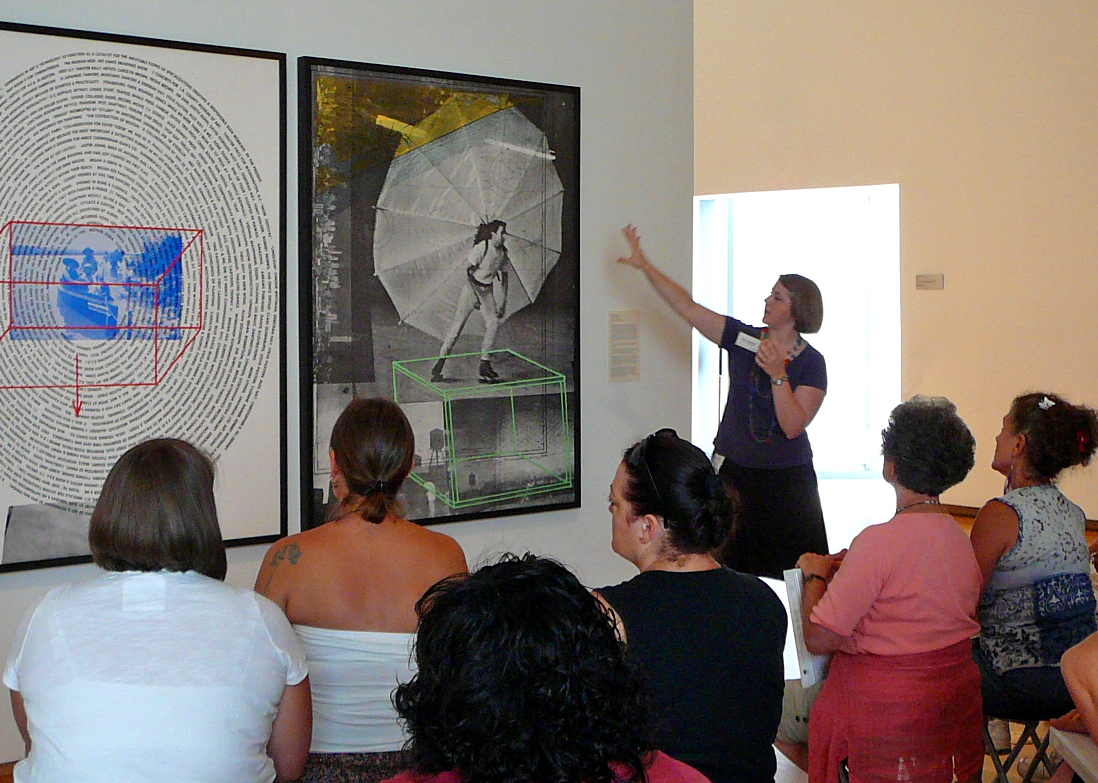
Experiences that provide for the professional and personal growth of teachers play an increasingly vital role in museums’ efforts to connect with educational reform. Faced with the complex demands of teaching and learning in the 21st century, museums across the country are rethinking the ways they interact with teachers.  At the recent 2012 National Art Education Association conference in New York, I was fortunate enough to lead a session with William Crow (Metropolitan Museum of Art) and Rachel Bernstein (Los Angeles County Museum of Art) that examined how art museums are collaborating with teachers to develop a “co-expertise” approach that allows for co-creating resources, co-delivering programs, and developing dedicated spaces for a shared exchange of ideas.

As we described through our own work, this “co-expertise” model can afford museums a new way to build meaningful exchanges with teachers and to develop new partnerships with teacher professional learning communities. One central question (of many) that guided our thinking was:

  • In what ways might a “co-expertise” approach catalyze a shift in what learning looks like in a museum, and allow for new ways in which teachers and schools access those types of informal learning?

Since teacher voices are essential to this approach, I spent some time interviewing teachers that I work with through the Saint Louis Art Museum and the CoLab.  The teachers I spoke with had all directly experienced various programs shaped by the co-expertise model, from summer institutes to school partnerships (learn more about the CoLab’s recent work by clicking here, here, and here). I asked each teacher what “co-expertise” means to them, in their own words — how would they describe their shared learning experience with the art museum and with other teachers, and what key things make this approach successful to them and their students?  Here is a short video compilation of these teacher voices, gathering insights from teachers across grade levels, subject areas, and even coming from 3 different states:

To me, these teachers’ perspectives (among many others) have been so inspiring, focusing in on some of the essentials of the co-learning experience.  In my own work with teachers and conversations with colleagues (including William Crow and Rachel Bernstein), a few aspects of the “co-expertise” model have bubbled to the surface for me:

  • Letting go. By this, I mean museums letting go of their ‘authority’ over knowledge and meaning-making, and instead empowering teachers to collaborate with museums as we work together to explore ways to learn from collections.  This model of co-creating learning experiences WITH museums — as opposed to passively receiving content FROM the museum authorities, whether that be text panels, audio guides, curators, or even educators — is so central to rethinking the way teachers interact with museums. It may be one of the most daunting aspects, too, since it requires many museums to broaden their approach to learning.
  • Recognizing teachers as experts. Part of achieving this “letting go” is simply valuing teachers’ voices and recognizing teachers as creators of content, knowledge, and meaning in relation to museums. Professional development workshops can be re-envisioned with more of an emphasis on developing communities of practice where we learn from each other no matter what our “home” educational setting might be (school classroom, university, museum, etc.).
  • Shared growth and experimentation. This sense of creating a community of practice then builds toward a shared, reflective process that leads to professional growth on the side of both teachers and museum educators. Through an open process of thinking ‘outside the box’ and taking risks, we can all move forward in our practice as teachers and learners.

Through this work that I have been engaged with thus far, I feel that the art museum has begun to make a shift in what it has the potential to become: a dynamic cultural landscape where authentic, learner-driven experiences are developed and enacted by teachers and their students. These experiences are empowering teachers to chart their own pathways in unpredictable ways and inviting parallel exploration, risk-taking, and fresh discovery on the part of their students.  And isn’t rethinking the way museums work with teachers ultimately about envisioning a new way to engage students in museum learning?

Reposted through the National Writing Project’s Digital Is website.
Speaking the Same Language

I am the newly-minted President-Elect of the North Carolina Art Education Association (NCAEA). This is an exciting role with a sometimes-daunting set of responsibilities. Most of the 600+ members of NCAEA are K-12 art teachers, so, as a museum educator, I am determined to listen carefully to their needs and wants to best represent them. Even though both museum educators and K-12 art teachers seemingly have the same central mission, we often speak very different professional languages and don’t always understand or appreciate the others’ job.

I had my first taste of the President-Elect “action” during the delegates assembly at the recent National Art Education Association conference in New York. Representatives and delegates from each state (and some from Canada) were part of the assembly activities that lasted a day and a half. One of the most interesting and productive things we did was comment and vote on Position Statements for the organization as a whole. For those who don’t know, the position statements put into writing the platform and position of the NAEA’s executive director and board (representing the membership) on a specific topic or issue. This ostensibly makes advocacy and lobbying a little easier. Plus, it lets the membership know what the association stands for.

Two of the five Position Statements we reviewed concerned art museum education. It was exciting for me to see that museum teaching and learning was really part of the fold, since I can sometimes feel like we’re a little on the edges in NAEA. The Position Statements were ultimately approved (and you can read them in full below), but during the discussion (before voting took place) several delegates had some critical feedback. I assume these delegates were K-12 art teachers, since there were only 2 other museum educators in delegates assembly (out of 100).

As these other perspectives were voiced, I realized that they came from a place of fear and worry. Many teachers are working in states or counties that are getting rid of full-time art teachers, and replacing them with artists-in-residence and the occasional field trip. A few delegates wondered aloud why museum education needed two whole position statements and if we were “tooting our own horn” too much. It may seem like they were resentful or critical of museum education, but I think they were actually concerned that art museum visits could replace classroom art education.

Of course, museum education is here to support and enhance what happens in the classroom, not replace it. I had the opportunity to say just that to the entire delegate assembly, and I’m really glad I did. It made me realize, however, just how much art teachers feel under attack. It must be awful to feel the need to justify your very presence in schools.

So, I’m on a mission, as President-Elect of NCAEA (and President in the future), to help museum educators and K-12 art teachers communicate better, support and defend one another, and spread the art love around.

NAEA Position Statement on Excellence in Art Museum Teaching [Adopted March 2012]

NAEA believes that the opportunity to discover, understand, and appreciate original works of art from cultures past and present is a vital part of a complete education. Furthermore, NAEA asserts that excellent teaching is necessary to foster profound and memorable learning experiences in the museum environment. Excellent museum educators help people see and understand the world in diverse ways and provide them with knowledge and skills to face an ever-changing future.

To achieve excellence in art museum teaching, museum educators:

  • Create a learning environment where students feel safe, comfortable, and respected, enabling them to engage in dialogue with works of art, with each other, and with the museum educator.
  • Actively engage students in processes of creative and critical thinking.
  • Employ a variety of teaching approaches and strategies to connect effectively with diverse learners.
  • Connect the arts to student lives through careful choices of art objects that reflect the complexity and diversity of human cultures and experiences.
  •  Collaborate with and support Pre K-16 educators and other community partners to create meaningful museum experiences that enrich and support learning in and beyond the classroom.

Education and preparation for excellent art museum teaching requires:

  • Deep knowledge of individual works of art and their makers.
  • Knowledge of aesthetics, art history, art practice, art criticism, and other disciplines as they relate to works of art.
  • Knowledge and application of education history, theory, and research relevant to museum learning and the needs and characteristics of learners and museum audiences including Pre K-16, families, and adults.
  • Professional development and ongoing learning to enhance their effectiveness as art museum educators.

NAEA Position Statement on the Benefits of Art Museum Learning in Education [Adopted March 2012]

NAEA believes that art museum learning is a fundamental component to a high quality,effective, and balanced education.

Museum Environment

  • Art museums are valuable cultural resources that offer learners a rich physical and social environment in which to experience and engage with original works of art from different time periods and cultures.

 Knowledge

  • Facilitated learning experiences with works of art cultivate global perspectives and an appreciation of the diversity of cultures, ideas, and human experiences.
  • Firsthand study of original works of art engages students in making connections across disciplines and enriches their understanding of other subjects.
  • Through close examination of artworks, students learn about creative processes, techniques, and materials.

 Skills

  • The study of works of art promotes the development of creative and critical thinking skills that are important to success in life as well as in school. These include inquiry, analysis, and interpretation as well as flexibility, imagination, and reflection.

Personal and Social Learning

  • Art museum learning opens students up to new ways of seeing, experiencing, and connecting to themselves, others, and the broader world.
  • In art museums, students learn from each other and from adults, including docents, museum educators, and artists. They gain confidence and knowledge about using museums and discover the range of careers that museums offer.

Cultural Appreciation and Participation

  • Students who visit art museums often develop an appreciation for cultural organizations and are more likely to use museums as a resource for life-long learning in the arts.

Beyond Just Staring: Personal Discovery as Core to Museum Learning

“When contemplating a work of art one of the key questions ought to be: `What is this to me?’ This is asked not in the sceptical tone it sometimes takes, implying `And I think it’s pretty irrelevant to me really,’ but rather in the tone of genuine inquiry, implying that one might come to discover how the object does matter in a personal sense.” (Armstrong, 5)

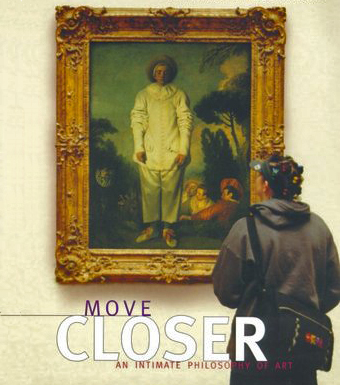
A couple years ago, I led a series of public gallery talks that began with the quote above, pulled from John Armstrong’s book Move Closer: An Intimate Philosophy of Art. I had become so invested in bringing the personal dimension of learning into the gallery experience that I decided to experiment with these public talks, inviting [perhaps somewhat unwilling] participants to explore an exhibition of contemporary photography through the lens of their own perceptions and lived experiences.  Since this is unfortunately something that museum visitors are rarely asked to do during a gallery talk or public program, it began with some awkwardness as I explained our task.  Two core questions, also coming straight from Armstong’s 2000 book, faced each of us as we examined the series of photographs by artist Bruce Yonemoto:

  • What do I have to do—beyond just staring—to get the most out of looking at these artworks?
  • What is the importance of any particular work to me?

Rather surprised by this line of inquiry, the group took my lead and embarked on this process of personal discovery.  To begin, we examined a large photograph that was re-staging a well-known Caravaggio painting, and spent some time sharing our observations and creating what meaning we could by just looking. This loosened them up for the next step, which was going out on their own, finding a photograph they felt connected to, and spending some time with the work exploring personal connections — keeping in mind John Armstrong’s charge ( what is this to me? what does this remind you of? what do you wonder about this image?).

“Being preoccupied with when something was made or who the designer or artist was can be a way of avoiding a more personal relationship with the object. External considerations can be so absorbing that they draw our attention away from the very thing which they are supposed to serve—we end up knowing about the picture, but not knowing it.” (Armstrong, 14)

Bruce Yonemoto, Untitled (NSEW 8), 2007

After about 20 minutes of self-exploration and ‘seeing for ourselves,’ we gathered back as a group to share the discoveries that everyone was able to make.  I am always amazed at how quickly people are willing to begin sharing personal connections, and the conversation began to build. It has been almost 2 years, but I distinctly recall one woman who had lived in Indonesia much of her life, and she told us several intimate stories about experiencing the strife and conflict in her home country and how that related to one of the photographs she chose (an American Civil War portrait that Yonemoto had re-staged with Southeast Asian men instead playing the roles of the soldiers).  Others made connections to their own experiences during the Vietnam War, a period which Yonemoto’s images specifically recall for Americans who lived through that era.

If we go to a painting demanding that something special happen, we end up in the condition of the insomniac who can’t sleep precisely because he keeps retelling himself, with mounting panic, that he must fall asleep.” (Armstrong, 63)

No doubt, the conversation was significantly more meaningful than if we had simply discussed the “facts” surrounding these works and the artist himself.  Like a mantra I often borrow from Rika Burnham, we ‘opened ourselves to the work’ and allowed for a slow, fluid process of perception.  We did come to some complex meanings that aligned with the curator’s perspective, but we also made these images our own — allowed them to “matter in a personal sense,” as Armstrong would say.  “What good we get from art depends upon the quality of our visual engagement with particular works. We need to ‘learn to look,'” Armstrong writes (60).  While I have not led a gallery talk quite like this since then (mostly because the Museum would quickly ask me to stop giving gallery talks, I imagine), I have continued to build a strong element of ‘creating personal meaning’ in the learning experiences I facilitate in the galleries — and the programs I manage for students, teachers, and docents.

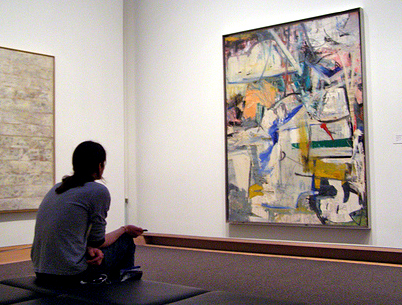
Photo by Clint Gardner

While there are many examples of museum educators writing about the power of ‘seeing for ourselves’ and the value of personal discovery (including some great stuff in Rika Burnham & Elliott Kai-Kee’s recent book and the article by Ray Williams published in a 2010 issue of the Journal of Museum Education), I always return to the words of John Armstrong from Move Closer.   Perhaps because my role in working with docents requires me to constantly be tackling issues related to the appeal of information & knowledge versus experience & the multiple dimensions of meaning-making. For many years now, Armstrong’s book has armed me with a clear sense to counter the over-emphasis of information in my work as a museum educator — but also to enhance my own response to art, and get beyond just staring.

Move Closer: An Intimate Philosophy of Art

“When contemplating a work of art one of the key questions ought to be: `What is this to me?’ This is asked not in the sceptical tone it sometimes takes, implying `And I think it’s pretty irrelevant to me really,’ but rather in the tone of genuine inquiry, implying that one might come to discover how the object does matter in a personal sense.” (Armstrong, 5)

A couple years ago, I led a series of public gallery talks that began with the quote above, pulled from John Armstrong’s book Move Closer: An Intimate Philosophy of Art. I had become so invested in bringing the personal dimension of learning into the gallery experience that I decided to experiment with these public talks, inviting [perhaps somewhat unwilling] participants to explore an exhibition of contemporary photography through the lens of their own perceptions and lived experiences.  Since this is unfortunately something that museum visitors are rarely asked to do during a gallery talk or public program, it began with some awkwardness as I explained our task.  Two core questions, also coming straight from Armstong’s 2000 book, faced each of us as we examined the series of photographs by artist Bruce Yonemoto:

  • What do I have to do—beyond just staring—to get the most out of looking at these artworks?
  • What is the importance of any particular work to me?

Rather surprised by this line of inquiry, the group took my lead and embarked on this process of personal discovery.  To begin, we examined a large photograph that was re-staging a well-known Caravaggio painting, and spent some time sharing our observations and creating what meaning we could by just looking. This loosened them up for the next step, which was going out on their own, finding a photograph they felt connected to, and spending some time with the work exploring personal connections — keeping in mind John Armstrong’s charge ( what is this to me? what does this remind you of? what do you wonder about this image?).

“Being preoccupied with when something was made or who the designer or artist was can be a way of avoiding a more personal relationship with the object. External considerations can be so absorbing that they draw our attention away from the very thing which they are supposed to serve—we end up knowing about the picture, but not knowing it.” (Armstrong, 14)

After about 20 minutes of self-exploration and ‘seeing for ourselves,’ we gathered back as a group to share the discoveries that everyone was able to make.  I am always amazed at how quickly people are willing to begin sharing personal connections, and the conversation began to build. It has been almost 2 years, but I distinctly recall one woman who had lived in Indonesia much of her life, and she told us several intimate stories about experiencing the strife and conflict in her home country and how that related to one of the photographs she chose (an American Civil War portrait that Yonemoto had re-staged with Southeast Asian men instead playing the roles of the soldiers).  Others made connections to their own experiences during the Vietnam War, a period which Yonemoto’s images specifically recall for Americans who lived through that era.

If we go to a painting demanding that something special happen, we end up in the condition of the insomniac who can’t sleep precisely because he keeps retelling himself, with mounting panic, that he must fall asleep.” (Armstrong, 63)

No doubt, the conversation was significantly more meaningful than if we had simply discussed the “facts” surrounding these works and the artist himself.  Like a mantra I often borrow from Rika Burnham, we ‘opened ourselves to the work’ and allowed for a slow, fluid process of perception.  We did come to some complex meanings that aligned with the curator’s perspective, but we also made these images our own — allowed them to “matter in a personal sense,” as Armstrong would say.  “What good we get from art depends upon the quality of our visual engagement with particular works. We need to ‘learn to look,'” Armstrong writes (60).  While I have not led a gallery talk quite like this since then (mostly because the Museum would quickly ask me to stop giving gallery talks, I imagine), I have continued to build a strong element of ‘creating personal meaning’ in the learning experiences I facilitate in the galleries — and the programs I manage for students, teachers, and docents.

While there are many examples of museum educators writing about the power of ‘seeing for ourselves’ and the value of personal discovery (including some great stuff in Rika Burnham & Elliott Kai-Kee’s recent book and the article by Ray Williams published in a 2010 issue of the Journal of Museum Education), I always return to the words of John Armstrong from Move Closer.   Perhaps because my role in working with docents requires me to constantly be tackling issues related to the appeal of information & knowledge versus experience & the multiple dimensions of meaning-making. For many years now, Armstrong’s book has armed me with a clear sense to counter the over-emphasis of information in my work as a museum educator — but also to enhance my own response to art, and get beyond just staring.

‘Getting In On the Act’: Exploring Participatory Arts Practice

A recent study published by the James Irvine Foundation (October 2011) entitled Getting In On the Act: How Arts Groups are Creating Opportunities for Active Participation draws insights from nonprofit arts groups and experts to explore a new model for understanding and supporting participatory arts practices, a growing trend here in the United States as well as across the globe.  Here is how the reports’ authors begin to frame this “siesmic shift” towards a participatory arts culture:

“Technology has fundamentally changed the way people interact, learn, and think about culture. Contemporary notions of creativity, shaped by Web 2.0, center on shared construction of cultural identity and an ethos of participatory experience…. The open, free and instantaneous exchange of digital content affords people the resources to control their own creative experiences and make their own meaning. Interactive experiences of all sorts are now an expected norm.” (6)

But, then the report got a lot more interesting to me…

This shift is about more than just technology. People are thinking about the experience of culture differently than in the past, placing value on a more immersive and interactive experience than is possible through mere observation…. Americans are activating their own creativity in new and unusual ways … [as] part of a larger ‘participatory economy’ in which social connection eclipses consumption. Americans want to meet the people who make our products, share in the work of the makers, and make things ourselves.” (6)

The report’s human-centered focus brings much-needed attention to the ability of the arts (and arts institutions) to connect people, to create shared experiences, and to contribute to the cultural fabric of the communities in which we live and work.

Photo by Santiago Ochoa

For art museums (and museum educators, especially), the report provides an extremely meaningful tool for reflecting on how we involve audiences in shaping their own experiences and making their own meaning. The report’s “Audience Involvement Spectrum” provides a nice, workable model for audience engagement, from “receptive” involvement (the type of spectating and educational enrichment occurring in the vast majority of arts museums) to increasingly “participatory” involvement (the types of crowd-sourcing, co-creation, and public artistic experiences that more and more art museums are slowly striving toward).

The report is worth a close read.  It asks some essential questions about arts programming in the 21st century, and I think art museums would have much to gain by thinking more about how they fit into this new landscape of active arts participation.  As museum educators, we have our hands on the wheel when it comes to programs — and the Irvine report clearly and strongly states that “attracting the next generation of audiences and visitors will require a transformation in programming” (11).  At the core of this transformation is both thinking outside the box (‘the box’ in this case being the rigid walls and traditions of art museums) and letting go of institutional and curatorial authority so that visitors can feel comfortable and empowered to shape their own creative experiences.

If you have a chance to peruse the Irvine Foundation’s report, I’d love to hear how your institution’s programs (or your own teaching philosophies) fit on their spectrum of audience involvement.  Has your institution embraced any of these aspects of participatory arts practice?  Do you value these types of creative, artistic experiences when you visit art museums yourself (or do you shy away from them for more passive types of engagement)?

How Can We Get Museum Visitors to ASK More Questions?

While museum educators (myself included) spend a lot of time thinking about the types of questions we ask to visitors and students, I’m not sure we spend enough time considering how to motivate visitors to ask their own questions? We know that getting visitors to ask questions can be an extremely important way to tap into their sense of “wonder” and curiosity, both key elements of a meaningful museum learning experience. So how do we get visitors to ask more questions?

My own thoughts on this topic were sparked by a session at the 2012 National Art Education Association conference held in New York. Entitled “Visitors Ask, We Learn: Visitor Questions that Shape our Teaching” and led by Elliott Kai-Kee and William Zaluski from the Getty, the session explored a project in which Getty Museum gallery teachers collected every single question visitors asked them. There were attempts to categorize the questions and make some sense of them in a more scientific manner, but that never materialized. Instead, the project brought attention (and reflection) to the ways that visitor questions can help drive inquiry in museum learning, and to the teaching philosophies and strategies that create a welcoming environment for different types of visitor questions. As Kai-Kee stated in the closing of their session, “gaining questions is to gain participation.” Which brings us back to the key question:

How do we get visitors to ask more questions?

Photo by Wexner Center

1. Model Curiosity

One technique that many educators use (including those at the Getty) is simply modeling the type of curiosity and open discovery that we want in our visitors. Choose an object early in a tour, and demonstrate some of the types of questions we might pose — information-based questions, museum-related questions, personal questions, and questions that allow us to use our imagination. The idea here is that visitors will feel more comfortable if you, as an educator, have opened the door to these types of questions. Being transparent about your motives here can be helpful, so that visitors or students know that you expect them to ask similar questions as the group moves to new objects. Creating a comfortable and inquiring environment for visitors is key to getting them to ask questions that matter to them.

2. Start with Visitor Questions

Elliott Kai-Kee mentioned this during their NAEA session. After introducing an object on a gallery talk or tour, he simply states: “I’d like to start with a question you might have for this object.” Of course, wait time is crucial here … remember to allow for silence if needed, and those first visitor questions will eventually spring up. This strategy truly uses visitor questions to drive the learning experience, and gallery teacher & visitors become fellow inquirers. Object selection can play an important role, too, as there are definitely some artworks that will likely spark more immediate questions in visitors. For example, in my own experiences, a large enigmatic painting by German artist Max Beckmann might draw out more immediate questions and curiosities than a Worcester porcelain coffee cup.

3. Cataloging Our Questions

Sometimes, it can be quite productive (especially for school groups) to allow time for students or visitors to brainstorm a list of questions they might have about an artwork. This can be as simple as each person writing down as many questions as they can about an object. An educator can take this further by inviting participants to pair up, review each others’ questions, and select one or two to share with the larger group. By doing this, you can quickly generate a large number of questions driven by students’ or visitors’ interests — a great place to begin a conversation about an object.

4. Creative Questions

One very effective “thinking routine” developed through Harvard’s Project Zero and the Artful Thinking project is called “Creative Questions.” This routine provides students with a series of question stems, and encourages them to be creative and come up with a list of several questions about an artwork — using the suggested stems only if they need help brainstorming different types of questions. While I tend to avoid using worksheets in the galleries, I often use this with students — and it can generate some interesting and fun questions (I especially like questions that come from the stem “How would it be different if…”). As with many thinking routines from Project Zero, this strategy can expand and deepen students’ thinking in relation to a work of art and encourage their curiosity.

5. Having a Conversation with the Artwork

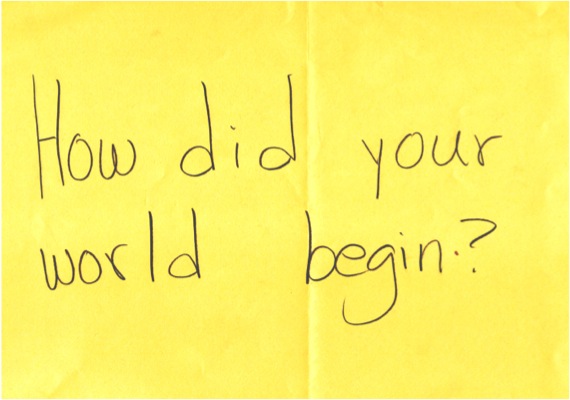
We may have success in getting visitors to ask questions about the artwork and its information/context (who’s the artist, when did she make it, how was it made, how did the museum acquire it, how much did it cost, etc. etc.), but it is quite rare for students and visitors to be invited to ask questions of the artwork? By this, I mean encouraging visitors to pretend that they are having a conversation with the painting — what would they ask it? Not the artist, but the actual painting itself. Yes, this stretches the imagination (a bit too much for some traditional visitors, truth be told), yet can be such a creative way to further our exploration and inquiry. I constantly ask adults, teachers, and students to do this with artworks in the galleries, and I always find that it taps into a more complex level of engagement. Participants frequently ask quite personal things of the painting — for example, when working with an Anselm Kiefer piece one afternoon, a teacher asked “Are you mad at me?” At the same session, other teachers asked “Why are you so chaotic?”, “Are you still becoming?” and “How did your world begin?”

What are some other ways that you have been able to motivate visitors and students to ask questions? How do we continue to create these learning experiences driven by visitor questions?

*     *     *     *     *

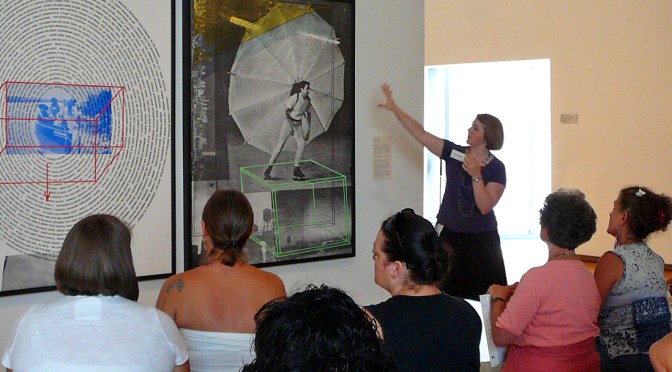
Featured header image: 1/19/11 PAGES Gallery Tour, from Wexner Center for the Arts, Flickr.com, Photo by Jay LaPrete, CC BY-NC-ND 2.0