
Reposted from Kiwi Loose in Museums, a project diary blog kept by Sarah Campbell as she embarked on her Churchill Fellowship to research the creative process of museum educators and innovative approaches to museum education.
Written by Sarah Campbell
As a Churchill Fellow, I have a commitment to share my learning with peers. Since my research trip to the US last September, I’ve been looking for ways to do this and have gained a huge amount from contributing to London-based workshops for museum and gallery educators, organised by engage and GEM (Group for Education in Museums). I hosted the GEM workshop at the V&A a couple of weeks ago and was one of three facilitators. Working with GEM convenor, Laura Lewis-Davies, we decided to riff off the current exhibition, You Say You Want a Revolution? and discuss what kind of revolution we wanted to see in museum learning practice. The exhibition charts five years of radical change in Western society, culture and music, spanning the period 1966-1970.
It’s amazing how much can happen in such a short time frame, and this motivated us to think back on museum practice in 2016 and project to where we wanted to be in 2020. We peppered the whole workshop with ‘revolutionary’ touches: on arrival, participants were asked to fill out a name tag with both their own name and that of a revolutionary hero/heroine; throughout the event, we had large sheets of paper on the wall, surrounded by images of the exhibition, where participants could add post-its that summarised our current position, our ambitions for 2020, and how we’re going to get there; and at the end of the night, we filled out coloured protest banners, recycling an activity that had been devised for the Families programme in response to the exhibition. The name tags proved a popular ice-breaker and I took great pleasure in seeing Geri Halliwell chat with St Augustine. Laura arranged a follow-up Twitter event where we could all share more information on our choices – check out #gemrevhero.

At the workshop, we split the group in three and each moved from one facilitator to the next. Robert Fleming, Temple Study Centre Manager at the National Army Museum, spoke about the transformation of their museum – due for completion Spring 2017 – and their new interdisciplinary and cross-disciplinary approaches to learning practice; Jo-Anne Sunderland Bowe, Project Co-ordinator at Heritec, shared her work with The Creative Museum project, which is prototyping new forms of collaboration; and I talked about some of my headline learning from the Churchill trip. This meant we each did the same session three times and unfortunately missed out on seeing the others in action, but it was a great chance to get feedback from the participants. In the spirit of revolution and change, I wanted to explore how the Fellowship has challenged some of my fundamental views on museum learning, I’ve been experiencing an interesting tension between the well-established perceived wisdom of standard museum learning practice, and new approaches that are pushing against this and leading to alternatives.
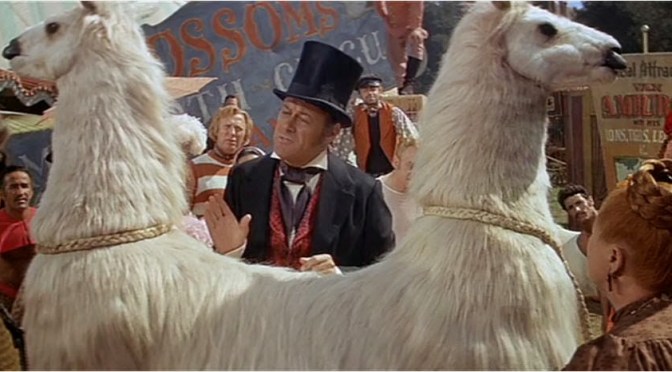
When planning the workshop, I was discussing these tensions with Laura and thinking about how to engage GEM participants with the subject. I compared these opposing forces to a Pushmi-Pullyu, the mythical, two-headed llama-esque companion of Doctor Dolittle, the equally mythical children’s book character who could talk to animals. The image of a Pushmi-Pullyu randomly popped into my head, and it was a bit of a throwaway comment. However, it ended up being a great way to introduce these ideas and became the basis for my session. I wanted people to have their own views first before I introduced my findings, and hoped to elicit a conversation where people could take different positions on the same topic. To do this, I created ‘The Pushmi-Pullyu of Change’, whereby Pushmi and Pullyu each took a different stance (represented by a speech bubble above their heads on a sheet of A3), and participants were asked to place a small playing counter somewhere along the spectrum in between the two to represent their views. From there, we could discuss the different rationales. It was a quick way to launch into meaty topics and everyone gamely played along and had plenty to contribute.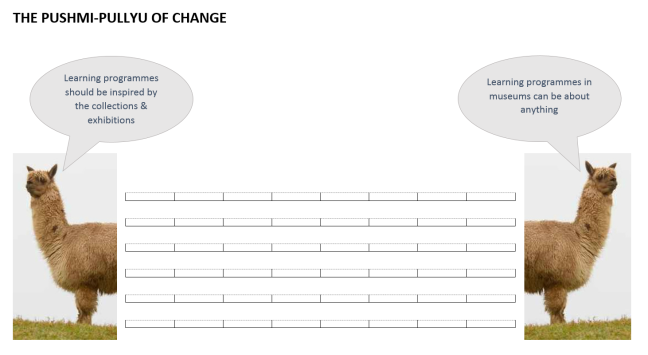 There were three ‘Pushmi-Pullyus of Change’ offering the following pairs of opinions:
- Learning programmes should be inspired by the collections and exhibitions / Learning programmes in museums can be about anything
- Museums must engage with and present political issues / Museums must take a neutral stance on political issues
- Our programmes should be educational first, entertaining second / Our programmes should be entertaining first, educational second
My only regret is that my questions weren’t quite fine-tuned enough. With more time and thought, I could have offered more nuanced phrasing and been more specific, especially around the claim that museums should be ‘neutral’ – I’m well aware museums are anything BUT neutral, but the provocation was meant to be about whether we should be hosting and/or debating issues such as Brexit. The third pairing was stolen directly from my conversation with Ethan Angelica at Museum Hack; he puts these statements to museum learning staff and insists they choose which one they support. To replicate this hard-line approach, I created a ‘no man’s land’ in the middle of the spectrum so that people couldn’t perch in the middle. The activity did generate some gentle debate, although I suspect our similarities outweigh our differences in many respects. I particularly liked how people spoke about using entertainment as a form of ‘stealth education’ – sneak in the learning when people are distracted and enjoying themselves.
 While it has its faults, I’m quite chuffed with how my Pushmi-Pullyus worked out. They’ve peaked my interest in ‘gamifying’ discussions (it’s a word, I promise, in fact ‘the gamification of learning’ is a whole thing). It’s commonplace to use postcards as a means of prompting conversation, but I like the idea of being able to represent one’s point-of-view visually and symbolically through a quick game before then explaining further. If you would like to share other examples of games that you use as part of discussions, I’d love to hear from you.
I also enjoyed exploring the combination of the metaphorical and the literal. As regular readers may have noticed, I’m a sucker for similes and metaphors. What makes me even happier is when some aspect of the metaphor is taken literally and folded back into the original idea. I could have just asked people their opinions on the questions above, but to put them along the back of a Pushmi-Pullyu takes it to a different headspace. I picked up this trick from the wonderful artist, Sarah Cole. During her residency at Kettle’s Yard a few years ago, she asked the staff where they felt they were ‘walking on eggshells’ and then positioned short trails of broken shell at these locations around the building. The then Director, Michael Harrison, spent a couple of days having to step over one of these trails every time he went into or came out of his office – like all good directors, he took it with good humour and grace.
About the Author
 SARAH CAMPBELL is Head of Learning Programmes at the Victoria and Albert Museum, London. She has worked previously in gallery education roles at Kettle’s Yard, Cambridge, The New Art Gallery Walsall, and the National Galleries of Scotland. She supports the work of engage, the National Association of Gallery Education, and is currently the Chair of the Editorial Advisory Board for the engage journal. She was awarded a Churchill Fellowship in 2016 to visit US museums and research the creative process of museum educators and new approaches to museum learning. Sarah has a long-standing interest in creative learning, and experimental, playful and unexpected approaches to programming for museum audiences.
 Art Museum Teaching