

“The purpose of strategic foresight is to prime your imagination to envision different futures — some of the many ways that the world could evolve into more than an amped-up version of today.” – Elizabeth Merritt
What does the future hold for museums? What are museums (or, more accurately, the people working in museums) doing right now that deserves to be shared, examined, and reflected upon? How can museums think more critically about their role in the transforming landscape of education — now and in the years ahead? We all have these questions floating through our minds, but may not often have the time and space to chew on them or hear others’ thoughts. I, myself, have a pile of printed reports, trend watches, and ‘future of museums’ readings sitting on my desk, and every once in a while I glare at it and wish that I could absorb it all in a few minutes like Neo in the film The Matrix. Without superhuman powers, though, I decided to dive into that pile this week.
In an exceptional Museum-iD post gathering perspectives from global museum innovators in response to the question “What will museums be like in the future?,” Adam Rozan from the Oakland Museum of California remarked:
“… museums will thrive, using challenges as opportunities to test new business and engagement models, and, in doing so, meeting the future head on.”
So it’s in that spirit that I wanted to bring together and share a group of resources from the past 6 months that present and analyze trends, future thinking, and ‘next’ practices in museums and education that help us meet the future head on. I hope that you find this list useful, and please add additional resources, links, and ideas to the Comments section below — allowing this to become a more organic resource. Let’s dive in, shall we…

Next Practices in Art Museum Education
 Intended to take us beyond “best practices,” Next Practices in Art Museum Education is a new compilation of information from the Association of Art Museum Directors (AAMD) member museums and their innovative approaches to engaging the public with the arts through diverse learning opportunities. Next Practices incorporates 100 case studies of the recent and ongoing educational programming that its member museums have designed and implemented.
The resource underscores the many forms art museum education can take, and provides practical and inspiring ideas for future programming at institutions worldwide. The resource represents a much-needed survey of the exceptional educational practices happening in art museums across the country, and ranges across ages and types of engagement & learning.
NMC Horizon Report: 2013 Museum Edition
 Released in November 2013, the NMC Horizon Report: 2013 Museum Edition examines key trends and technologies in the museum sector, as well as significant challenges that museums are faced with in adopting these technologies. The report hones in on six emerging technologies for their potential impact on and use in education and interpretation within the museum environment:
- BYOD (Bring Your Own Device): given the increasing number of people who take their smartphones and other devices with them everywhere they go, the BYOD movement is an effort to move away from a top-down system of providing devices toward a practice that instead provides the networks and frameworks through which museum visitors interact with a range of content on their own devices.
- Crowdsourcing: A method of gathering ideas, information, or content from a wider public community around a shared goal — capitalizing on the power of collective intelligence and public knowledge, as in the case of Wikipedia. Crowdsourcing strategies are being used by museums to curate exhibitions, gathering metadata around artworks or artifacts, promoting community engagement, and crowdfunding new projects.
- Electronic publishing: Near and dear to my heart, electronic and digital media are continuing to redefine the publishing avenues of museums, tapping into modern digital workflows and social media activities to develop new forms of content and significantly extend the reach of that content beyond the limits of traditional print. Beyond making these electronic platforms available to anyone, the report identifies the next phase of electronic publishing as linking these platforms together to produce new types of content.
- Location-based services: Enabled by WiFi access points, GPS, RFID tags, and crowdsourced positioning technologies, location-based services are now available to deliver up-to-the-moment information that is related to a particular spot — guiding visitors through spaces, directing them to exhibits and objects that match their preferences, and triggering information and content specific to the visitor’s exact location in the museum.
- Natural user interfaces: While we are already familiar with technologies and devices that respond to the natural movements of gestures of the human body (taps, swipes, arm motions, and natural language), there are prototype technologies being developed that extend these capabilities and combine facial expression and gesture-sensing technology with voice recognition that could allow museum visitors to interact in an increasingly natural fashion.
- Preservation and conservation technologies: While museums have always addressed issues of preserving and conserving cultural heritage, these practices are being challenged by questions around how to preserve and conserve via digital materials as well as working with digital and time-based media — requiring new approaches and new skills that bring in electronic and multi-disciplinary perspectives to digital preservation efforts.
I was fortunate to be part of the 44-member Advisory Board and the process that helped identify these technology trends currently affecting the practice of museum education, interpretation, and visitor experience, and I look forward to the next annual report in this NMC series.
TrendsWatch 2014
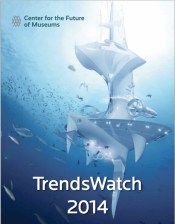 Center for the Future of Museum’s annual forecasting report, TrendsWatch 2014, summarizes six emerging trends identified through CFM’s research and the Dispatches from the Future of Museums, CFM’s free e-newsletter. The report explores how each trend is playing out in the world, investigates what this means for society and for museums, shares examples of how museums are engaging with this trend, and suggests how museums might respond. Here are the six trends/topics that this report identifies:
- “For Profit for Good: The rise of the social entrepreneurs”
- “Synesthesia: Multisensory experiences for a multisensory world”
- “A Geyser of Information: Tapping the big data oil boom”
- “Privacy in a Watchful World: What have you got to hide?”
- “What’s Mine Is Yours: The economy of collaborative consumption”
- “Robots! Are Rosie, Volton, Bender and their kin finally coming into their own?”
The report’s author, Elizabeth Merritt, writes in her introduction:
“As you read about these six trends, think about how they will shape the world, what it would be like to live in the world they may create, and how you and your organization might respond…. Personally I think the most important and challenging question question is raised in ‘For Profit for Good’: How big an impact do museums want to have on the world, and how can we ensure that the good we do is good enough?”
A great read, and certainly a report to look forward to each year from CFM. And speaking of CFM, here are a few more resources and future thinking items from their realm.
Building the Future of Education: Museums and the Learning Ecosystem
 Coming out of a convening organized in September 2013 by the American Alliance of Museums (AAMC) and The Henry Ford, the “Building the Future of Education: Museums and the Learning Ecosystem” report includes essays by educators, students, researchers and reformers that summarize and explore how leaders from the worlds of education and museums can work together to integrate the nation’s assets into what they call a ‘Vibrant Learning Grid.’ The convening and report asks the big question: How can museums and schools collaborate to create a new future for education?
The report pulls together leading thinkers and related case studies that focus on this and other core, burning questions, addressing a range of issues that include:
- investing in greater capacities to support and manage partnerships
- strengthening family engagement and envisioning parents as co-learners
- building open learning networks across community institutions
- leveraging digital learning and collaborative technologies
The report ends with a powerful “Call to Action” that came out of the second day of the convening, with some practical suggestions for moving the conversation forward and enacting change. They share several ideas, including increasing awareness, sharing information, disrupting conventional thinking about the educational landscape, and implementing radical experiments that increase the role of museums in an expanded view of education.
Guide to the Future at the 2014 Annual Meeting
 For those of you heading to Seattle this weekend for the 2014 Annual Meeting of the American Alliance of Museums (AAM), there are lots of great sessions, panels, and events to attend that bring together leading thinkers to discuss the future of museums as well as existing trends. The CFM’s Elizabeth Merritt shared her insights recently via the CFM blog, and I encourage you to take a look (even if, like me, you are not attending the AAM conference this year). You’ll find sessions discussing almost all of the reports I list above. If I were attending AAM this year, one of my top picks would be “Crowdsourcing to Community Sourcing: Engaging Visitor Input” with Jeff Inscho, Lori Phillips, Daniel Davis, and Petra Pankow.
Share Your Thoughts
What are some of your ideas about the future of museums, and the ‘next’ practices that will help museums thrive? And what are your thoughts about these types of reports and publications that spotlight ‘innovation’ and ‘future thinking’ — are they limited in their scope, or helpful as we all reflect on our own practice? What sources do you look toward when thinking about new ideas, experiments, and projects?
 Art Museum Teaching