

Written by Jeanie Noto
In support of the most recent exhibition at the Portland Art Museum, Rodin: The Human Experience, Rodin Remix was a hands-on space where visitors could create figures based on Rodin’s process of reusing previously-made sculpted arms, legs, and heads, into new works. It put a modern spin on Rodin’s method of mass production by showcasing 3D printed versions of Rodin’s sculptures.
3D Printing and Rodin?
I came into the Portland Art Museum in October, relatively new to interpretation. My guidelines for the Rodin project were to create an in-gallery multi-sensory experience for all ages that would communicate 3D elements of Rodin’s process. After researching Rodin, his assemblages struck me – it was creative and clever to reuse cast offs, fragments of plaster casts that had already been made, by recombining them into new sculptures.
I wanted to visitors to experience for themselves Rodin’s reuse of plaster casts, but we needed a 3D reusable material that could go in the gallery, not plaster. At first I thought of paper dolls, since they were easily reusable, simple to produce, and people might know how to put paper dolls together. But then at a brainstorming meeting, 3D printing came up – we could produce 3D plastic parts of Rodin’s sculptures with connections for constructing and deconstructing.
We partnered with the Portland 3D Printing Lab, a local Meet-Up group of enthusiasts, to produce 3D prints of Rodins. They were so enthusiastic, and figured out that magnets were the key to make the pieces of 3D printed sculpture easily stick together and break apart. The prints were made from free online STL files under the Creative Commons license, and, later, from scans of the Rodins in the show. We decided to scan some of the Rodins in the show because not every Rodin can be found in STL-file form online. The scanning process was surprisingly simple, and to show the public how it worked, it was filmed in a Facebook Live, the Museum’s first. The files that were used to print can now be found on the exhibition page of the Portland Art Museum’s exhibition website.
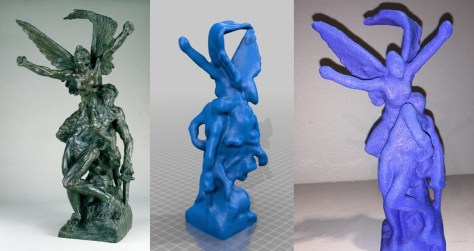
3D printing fit with other elements of Rodin’s process as well. Rodin would sculpt a model in clay, then pass it to his assistants. They rendered the work again in marble or bronze, sizing it up or down according to Rodin’s and his patron’s wishes. A 3D scan of an object can be similarly re-sized, to make a print of the desired height.
Rodin’s assistants made hundreds of casts of the same model, all official Rodins, in a sort of artistic mass-production. Smaller bronzes, produced in large quantities, were more affordable. These relatively inexpensive bronzes widened the range of people who could purchase a Rodin, earning the sculptor more money and popularity. Just as Rodin mass-produced bronze casts of the same sculpture in multiple sizes and media, the Portland 3D Printing Lab made many 3D prints of Rodin sculptures, experimenting with size and color.
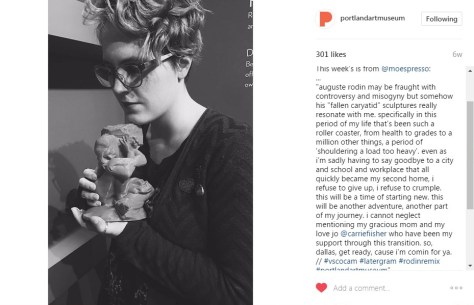
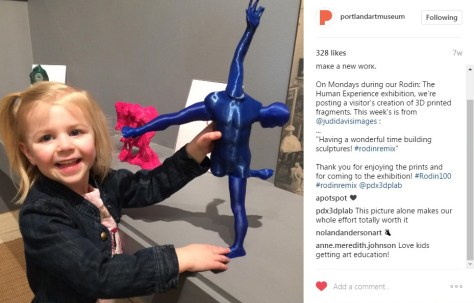
Visitors were also encouraged to Instagram a photo of their creation in front of a backdrop of Rodin’s studio, which showed the plaster fragments he used. Each Monday during the run of the show I reposted a visitor’s photograph to the @portlandartmuseum Instagram, with the tag #rodinremix. Over 125 people Instagrammed their Rodin Remixes, and the comments we received on our reposts were reflective and positive.
How did it go?
My goal was to make a fun, exciting interpretive space that used 3D prints to communicate to visitors about two parts of Rodin’s process: his assemblages, and his mass-production and use of resizing sculptures. This is my first interpretive space, and my first evaluation, and I am not positive this project fully met all of my learning goals.
Visitors, especially those with children, clearly enjoyed their time in Rodin Remix, laughing, talking, and playing – making the sculptures interact with each other. Docents used the 3D prints for tours for people who are blind or have low vision, and for ArtNow, PAM’s program for people living with dementia and their partners. The ability to touch Rodin’s forms, to understand 3D printing, and to Instagram were all appreciated. And, multiple members of the Portland 3D Printing Lab who had not been to the museum in years, if ever, came, because their work was displayed in the galleries.
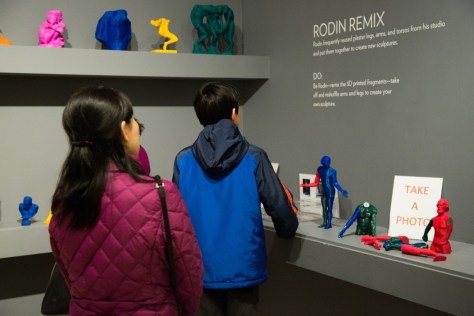
A little over half of the 250 people that I observed participated in the hands-on part of the interpretive space, and 145 people stayed in the space for more than 2 minutes. These numbers are skewed somewhat by two school tours I observed, since both of those had a lot of participation.
But my hope that the space would communicate Rodin’s process may not have always worked. When I asked a few visitors what they thought the purpose of the space was, on average, they felt it was to touch, play, and interact. That was part of it, but not the entirety. I did enjoy the couple who said, “He really churned them out” – they clearly understood the mass-production angle. I could have crafted more precise questions for my evaluation, and my evaluation should have been more survey-based than observatory. It is possible more people understood the learning goals than I thought, but I did not capture their responses well.
Attempting to cover two elements of Rodin’s process (mass-production and assemblage) in the same space, using 3D printing to illustrate both, confused people. Similarly, placing the space just outside the exhibition, in a throughway, meant Rodin Remix was not clearly a part of the exhibition. Rodin Remix evolved over time as well, which was both a boon and a complication. We planned for it to be a prototype space that would change, but it also evolved because even simple 3D prints took fifteen to twenty hours to print, and with over 20 prints in the space, the hours added up. The ability to change allowed me to experiment and improve. But Rodin Remix also did not look finished until the last month of the exhibition.
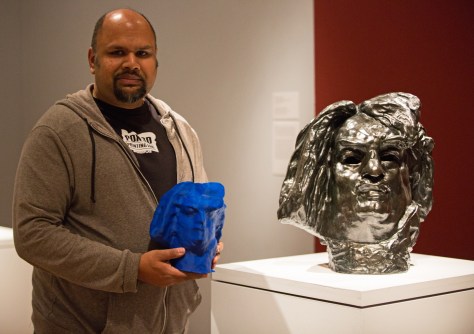
The most exciting part of this project was working with the Portland 3D Printing Lab. They were generous throughout, coming to the museum and bringing others, advertising through their own channels, and on the second to last Friday of the show, bringing a 3D printer to the museum and printing live, in the gallery, which drew a crowd all evening. The success of this partnership may allow for future 3D printing projects at the Portland Art Museum, as well as other evolving interpretive projects, which the education department continues to develop.
* * *
About the Author
JEANIE NOTO is the Kress Interpretive Fellow at the Portland Art Museum, where she produces interactives and descriptive information to support the permanent collection and visiting exhibitions. Before coming to Portland, she worked as the Academic Intern at the Norton Simon Museum, and got her M.A. in Art History from the Courtauld Institute of Art.
 Art Museum Teaching