Towards a More Community-Centered Museum, Part 2: Is ‘Community’ a Meaningless Word?

Written by Mike Murawski

The term ‘community’ may very well be one of the most frequently used words these days when it comes to describing the shifting goals, values, programs, exhibitions, staff, audience demographics, and communication strategies of museums.  To be honest, I use the word pretty regularly myself.  For decades, museums (and most funding organizations) have been increasingly using phrases like “aiming to serve our community,” “reaching out to our communities,” and “strengthening our community” to create a sense of a museum’s broader mission and social purpose.  In describing some of its more recent funding initiatives, for example, the Institute of Museum and Library Services (IMLS) states that “museums are at the forefront of change in our communities” and they serve as “strong community anchors.”  In their  thirteen-page Strategic Plan for 2018-2022 entitled Transforming Communities (which is worth a read), the word ‘community’ or ‘communities’ is used thirty-six times.

Museums and cultural organizations are constantly being asked how effectively we’re serving our communities and how well we represent our community.  But foundations, granting organizations, civic entities, and funders do not have a consistent definition of what they even mean by community.  We can begin to read between the lines when we are asked about the ZIP codes we serve, the number of Title I schools visiting, and what programs we have for “at-risk” youth or “underserved” audiences (I really dislike those labels, BTW).  In many cases, community is defined as “people of diverse geographic, cultural, and socioeconomic backgrounds” or “families and individuals of diverse cultural and socio-economic backgrounds and needs.”  Whether we are defining these groups based on geography, interests, or experience, are we essentially talking about people who are not engaging with our institutions?

Nina Simon writes about this common misuse of the word community to refer to the general public or “everyone who doesn’t currently visit here.”  Inclusion catalyst and museum expert Porchia Moore discusses the dangers of using the word ‘community’ in a reductive way, such as when it is used to describe a large group of different people by focusing on a single attribute.  In the context of discussions about inclusion, Moore writes,Community’ becomes code for discussing black and brown visitors.”  Referring to a group as “the black community” or “the LGBTQ community” can be problematic when groups are perceived as a monolithic or singular community.  Moore advocates for museums to dig deeper into this language and how it reflects the decisions we make to develop one-off programs or exhibitions.

Museums have certainly been dedicating significant time and resources to reach this elusive and mysterious ‘community’ we so badly want to connect with and engage.  Institutions large and small now have staff positions dedicated to Community Outreach, Community Programs, or Community Partnerships, indicating this increased investment in what engaging community means for many institutions.  There also seem to be more departments or divisions within museums with “Community” added to the title—Learning and Community Programs, Family and Community Programs, Community Engagement, Access and Community Initiatives, etc.   And I must confess, I’m regularly interested in changing the title of my own department from Education and Public Programs to something that more closely reflects the work we’re doing to advance community-centered practices.

13913965_10210126495989274_5955427877137373174_o
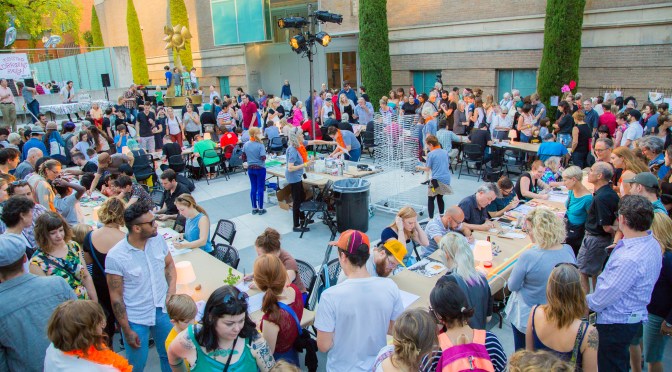
community social justice art project at Portland Art Museum, 2016

Overall, there is a generally agreed-upon sense that reaching out to and engaging with community is a good thing for museums.  When we add this word to a staff position, department, or to our mission statements, it is done as a symbol of good intentions. Yet how do we effectively do this work and advocate for it if we don’t truly have a sense of what it means beyond connecting with “those other people” out there?

As museums vaguely define community or communities as groups that might not be engaging or connecting with the museum, there is also a troubling binary and divide we have created between ‘museum’ and ‘community.’  It’s so ingrained in the way so many of us talk about our work, myself included.  Museums are perceived as separate from communities; they are seen as buildings with collections, objects, exhibitions, and experts that are made available to communities on a limited basis.  Referring to some functions of the museum as “outreach” just reinforces this separation.  By default, museums then exist as disconnected, disengaged, and distanced from this idea of community.  And not thinking about where museum staff and volunteers fit into the idea of ‘community’ is problematic. When we use the word ‘community’ in our institutions, are we thinking about staff and those who work for the institution?  Overall, we are really feeding this gap by simply not addressing it.

So has the word ‘community’ just become a vague and almost meaningless expression?  Museum professionals use it too frequently and in ways that overlook its inherent complexities.   I fully realize that by writing this series of blog posts, I’m engaging in overuse of the term myself, but my interest here lies in unpacking the term and opening up many of the rich complexities tied up in this concept.

Rather than stop using this word or replace it with something else, I’m advocating for those working for and with museums to gain a deeper understanding of what community means.  I believe it is an extremely meaningful concept, and I am thoroughly excited to see it being used more frequently by museums and funding organizations.  We just need to explore and address the complexities involved with defining community and communities for our institutions.

Stay tuned for my next post in this series, which will lay out some of the ways we can define community in our practice.  Future posts will also address strategies for thinking more deeply about these issues and developing ways to bridge these gaps.

*     *     *

ABOUT THE SERIES: Through this series of posts, I am exploring a range of ideas, challenges, and strategies for building community-centered practices in museums and advocating for deeper connections between institutions and community.    What do we mean by ‘community’?  How can we value community?  What are some strategies for change that we can enact now in our institutions?

I’m open to all types of critiques and questions, as long as they are aimed at moving this collective work forward.  My ideas, thoughts, and questions have emerged from decades of meaningful conversations with others, so I don’t claim ownership of these ideas — I simply hope they can spark new conversations and allow us all to add to our learning and growth as we work to transform museums.

Other Posts in This Series:

*     *     *

About the Author

MIKE MURAWSKI: Founding author and editor of ArtMuseumTeaching.com, museum educator, and currently the Director of Education & Public Programs for the Portland Art Museum. Mike earned his MA and PhD in Education from American University in Washington, DC, focusing his research on educational theory and interdisciplinary learning in the arts. Prior to his position at the Portland Art Museum, he served as Director of School Services at the Saint Louis Art Museum as well as coordinator of education and public programs at the Mildred Lane Kemper Art Museum at Washington University.  He is involved in the Museums as Sites of Social Action (MASS Action) initiative, contributing author to the MASS Action toolkit, and co-created the #MuseumsAreNotNeutral tshirt campaign with LaTanya Autry to erase the myth of museum neutrality. As a cultural activist and museum professional, he is passionate about how we can come to see museums as agents of change in their communities as well as sites for transformative learning and social action. He has led workshops and presented at conferences and institutions nationally and internationally, including a keynote at the 2016 MuseumNext conference. Mike’s postings on this site are his own and don’t represent the Portland Art Museum’s positions, strategies, or opinions.

Towards a More Community-Centered Museum, Part 1: Let Your Community In

Written by Mike Murawski

Last summer (2017) I made my first-ever visit to the Santa Cruz Museum of Art and History (MAH)—a long overdue pilgrimage to this institution led by author and change agent Nina Simon.  She had invited me to be a ‘camp counselor’ for their summer MuseumCamp, and I could not turn down a chance to visit the MAH, see what makes it tick, and be a part of this community of changemakers that gather each summer for the MuseumCamp experience.  Not only have I known Nina for several years and been a dedicated reader of her Museum 2.0 blog and her books on museums, but the MAH had just officially opened Abbott Square, an adjacent public plaza that the museum converted to a bustling community gathering place and food market. For me, the Santa Cruz museum is fundamentally one of the exemplars in turning an institution toward a focus on its local community.  Since arriving in 2011, Nina has worked with her team to tirelessly transform the MAH into a thriving museum and community center for Santa Cruz.

I was fortunate to visit during their exhibition Lost Childhoods, an issue-driven exhibition that the MAH staff created with their community.  Showcasing the stories, struggles, and triumphs of youth who are aging out of foster care, this powerful exhibition was co-created with the Foster Youth Museum and a group of over one hundred local foster youth, artists, and youth advocates.  This community was at the core of the exhibition, and there was even a large wall text that boldly declared “We made this with our community.” Through years of getting to know its local community and becoming intertwined in its people, the MAH team has embodied a shift from being a museum ‘for’ its community to being a museum ‘of’ and ‘by’ its community.  And most recently they launched the global OF/BY/FOR ALL movement to bring these community-centered practices to institutions everywhere (watch the MuseumNext 2018 keynote presentation by Nina).

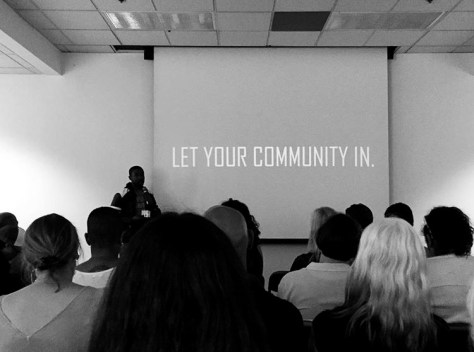
Amidst all the workshops, small group discussions, beach trips, and conversations with over a hundred passionate changemakers last summer during my first MuseumCamp experience, one moment still resonates with me more than any other—perhaps because of how simple and straightforward it was.  Portland-based writer, game critic, and creative entrepreneur Josh Boykin stepped up to the microphone during a series of fast-paced lightning talks.  Josh works outside of museums yet cares a great deal about building community; and while he lives and works in Portland, Oregon, our paths had not yet crossed.  His lightning talk was personal and inspiring, yet there’s one simple thing about his talk that has stuck in my mind.  Projected on the screen behind him during the entire duration of his talk were four words, large and bold: “Let Your Community In.”

Photo from Dalila Huerta, Instagram dlhuerta1848

Since that moment, Josh’s message has become one of my mantras when it comes to museum practice.  How do museums let community in?  Is community always separate and outside of museums, in need of being ‘let in’?  What does ‘community’ even mean?  Like many museum professionals, I have grappled with these questions my entire career, yet the complexities and challenges of engaging communities has come into focus in recent years as my own institution has created opportunities to advance this work.

It’s so important for museums to be a local place intertwined and inseparable from local realities and issues.  We are located in our communities, but we’re also a part of those communities.  How do we, as museum professionals, define our place, our town, our city, our neighborhood, our community?  How do we identify ways to break down the barriers between museums and their communities as well as build relevance through local community partnerships?  How do we learn about the people of our places (past and present), learn about what connects us and what brings people together into a community?

Right now, at this moment, some of the more challenging questions for me are: why open up museums to the challenges and potential failures of community-centered work?  Why invest the time, staff, energy, and resources it takes to do this work really well?  Why take on such risks?  Wouldn’t it be easier to just keep with business as usual?

When faced with these questions, I often find myself going to museum scholar Stephen Weil’s befitting statement: “The museum that does not prove an outcome to its community is as socially irresponsible as a business that fails to show a profit. It wastes society’s resources.” (Weil 2003, p. 43, as cited in Watson, ed. Museums and Their Communities, 1).  As museums and other institutions take steps to embrace community engagement, it is important to understand why this shift is occurring toward working with communities and local residents.  The meaning of community requires more thoughtfulness and deliberation than we typically give it. Going forward, museum professionals and leaders must embrace this complexity as they strive to understand and create social change.  It is not enough for museums to become an essential part of our communities—our communities also need to become an essential part of our museums.  Are we ready to let our community in, as Josh Boykin proclaimed, and allow neighbors, local residents, community members, and those who may have traditionally been excluded from our institutions to shape practices, programs, and policies?

Echoing the words of bell hooks, what would it mean for museums “to be in community, to work in community, and to be changed by community”?

*     *     *

ABOUT THE SERIES: Through this series of posts, I am exploring a range of ideas, challenges, and strategies for building community-centered practices in museums and advocating for deeper connections between institutions and community.    What do we mean by ‘community’?  How can we value community?  What are some strategies for change that we can enact now in our institutions?

I’m open to all types of critiques and questions, as long as they are aimed at moving this collective work forward.  My ideas, thoughts, and questions have emerged from decades of meaningful conversations with others, so I don’t claim ownership of these ideas — I simply hope they can spark new conversations and allow us all to add to our learning and growth as we work to transform museums.

Other Posts in This Series:

*     *     *

About the Author

MIKE MURAWSKI: Founding author and editor of ArtMuseumTeaching.com, museum educator, and currently the Director of Education & Public Programs for the Portland Art Museum. Mike earned his MA and PhD in Education from American University in Washington, DC, focusing his research on educational theory and interdisciplinary learning in the arts. Prior to his position at the Portland Art Museum, he served as Director of School Services at the Saint Louis Art Museum as well as coordinator of education and public programs at the Mildred Lane Kemper Art Museum at Washington University.  He is involved in the Museums as Sites of Social Action (MASS Action) initiative, contributing author to the MASS Action toolkit, and co-created the #MuseumsAreNotNeutral tshirt campaign with LaTanya Autry to erase the myth of museum neutrality. As a cultural activist and museum professional, he is passionate about how we can come to see museums as agents of change in their communities as well as sites for transformative learning and social action. He has led workshops and presented at conferences and institutions nationally and internationally, including a keynote at the 2016 MuseumNext conference. Mike’s postings on this site are his own and don’t represent the Portland Art Museum’s positions, strategies, or opinions.

The Dangers of Superficial Activism

Reposted from the blog of MASS Action (Museums as Sites of Social Action), an important cross-institutional initiative leading to actionable practices for greater equity and inclusion in our institutions. Be sure to visit the MASS Action website and check out their Toolkit under “Resources.”

Contributed by Kayleigh Bryant-Greenwell

Those that know me, especially those dedicated to the antiracist movement in museums, will likely find this post surprising and uncharacteristic of my practice. As a staunch supporter of social justice and changemaking in museums, it is very “off-brand” for me to affirm the limits of museum activism. Truthfully, I do believe museums can make a difference and more importantly that it is our duty to try. I am, nonetheless, writing this post on the boundaries of museum activism.

I was recently on an email chain conversation about the human rights crimes being committed at the border. A group of museum changemakers, we were discussing the damnable silence of museums on the issue. A group member wanted to end the silence with a social media post both condemning the atrocity and claiming a call to action for museums at large.

While I wholeheartedly support the effort to end museum silence—in silence we are complicit—this proposed effort gives me pause. We’re talking about the horrifically cruel and inhumane separation of children from their families upon entering the U.S. It is sickening and it is wrong.

But what is the call to action for museums?

The call to action as seen in Saturday, June 30th’s March was: reunite families and never separate them or any others ever again. The March served to demonstrate an angered public; but by the time it happened, the Trump administration had already enacted an executive order to cease forced separations, at least temporarily, because that’s not the endgame. The oppressive regime in power is actively rolling back human rights towards the goal of increased power and control. Their endgame is closed borders. So within museums, what is ours?

I point to the limitation of ineffective activism in museums in this specific situation, not to diminish the spirit of activism in museums. In fact, I want to see activism greatly expanded within our field. But I want true activism. Activism that is centered in action.

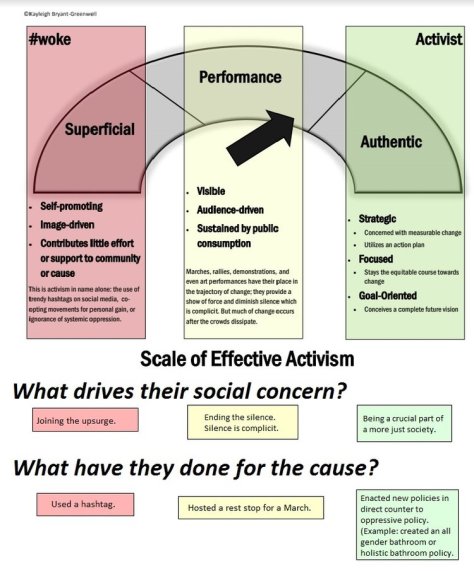
Unfortunately, I feel that most museum activism lies on The Scale of Effective Activism, somewhere between Superficial and Performative activism (see chart below).

Performative activism is highly visible, highly praised, but empty of strategy and impact. It is marches, rallies, viral hashtags, and grand displays of social cohesion around an issue. These efforts do not have a measurable impact of change. As the great activist organizer Saul Alinsky noted in his seminal Rules for Radicals, “Communication on a general basis without being fractured into the specifics of experience becomes rhetoric and it carries a very limited meaning.”

Even worse, Superficial activism—coopting the “brand” of activism without context or steps towards enacting internal or external change within the museum—serves to raise the visibility or popularity of the museum without any effort towards the cause. Alinsky dedicates an entire chapter in Radicals, “The Education of an Organizer,” on warning against the proliferation of organizing in name alone. He cautions, “They were radicals, and they were good at their job: they organized vast sectors of middle-class America in support of their programs. But they are gone, now, and any resemblance between them and the present professional labor organizer is only in title.”  To paraphrase Alinsky, tactics must always follow the communicated idea of change.

While it is important to be outraged and vocal, and there will always be a place for some Performed activism, we must consider the impact of these activist efforts. How do these efforts affect the opposition?

Do these efforts move the needle?

In our angered, empowered masses we have yet to effectively communicate to those who continually diminish the humanity of others. We are speaking in completely different languages. Without a radical action plan, our shows of force are dismissed as unimportant and ineffective.

In progressive Marches we speak in a language of “rightness, fairness, justice” while our opposition, in executive orders, policy change, and official mandates, speaks in a language of realized power unthreatened by words. And yet, we applaud every pithy protest sign we painstakingly create, as if we’ve achieved change, whereas we’ve frankly only communicated unrest, which is only enacted the first step towards change. The difference between working towards change and change is a lived experience: a constitutionally-protected marriage, a chance at a new life in a new land, the freedom to control your own body.

We cannot live in an illusion that museums can fix the world. Superficial and Performative activism can only provide an illusion of change. As illustrated in the Scale of Effective activism below, Superficial activism serves to provide the look of progress alone. Performative activism provides a sense of the magnitude of resistance, but doesn’t inherently provide changemaking action.

We must recognize these distinct versions of activism to truly understand the logistics of changemaking.

Museums can, and as MASS Action points out in the toolkit, museums should, sit somewhere between Performative and Authentic activism on this scale, and some may even achieve fully-realized change in Authentic activism. But in order to do so, we must recognize the progressive museum’s place within this trajectory.

Change is strategic. Justice is strategic.

When we eagerly take up activism in visible but actionless ways, we diminish the cause. When we jump to labeling ourselves “woke” without centering our practice in Social Justice and Critical Theory, we dilute our knowledge base. Mistakenly, we convince ourselves that we’ve done enough, when we’ve only done something.

Justice isn’t about “doing something,” it’s about doing the right thing. We are empathetic professionals. When we see the atrocities at the border we are inflamed and eager to start “doing something.” And of course museums can do any number of somethings (see examples below) in this border chaos and the resistance at large. Alinsky wrote, “The organizer knows that the real action is in the reaction of the opposition.” Authentic activism considers the endgame: protecting, expanding, or officializing human rights, not simply raising voice against the infringement of rights.

Effective Authentic activism demands us towards strategic, focused and goal-oriented action. We need our efforts to be tactical in order to be effective. Our future selves and loved ones don’t need our superficial activist distractions. They need real change.

If our goal is true justice we can’t continue to distract with all the unimpactful “somethings” we do. The cause isn’t over when we’ve accomplished something.

Yes, be courageous and radical and outraged. Be vocal and visible about it. But keep action at the center.

scale+of+effective+activism

*     *     *

About the Author

KAYLEIGH BRYANT-GREENWELL is a Washington, D.C. cultural programmer and strategist with over 10 years of GLAM experience devoted to exploring ways to engage with marginalized audiences through art, museum, and social justice practice. As a DEAI facilitator, she is a contributor to national initiatives towards increasing equity and inclusion in museums including: MASS Action, The Empathetic Museum, and the inaugural National Summit for Teaching Slavery. She moderated the keynote conversation on education and equity for the American Alliance of Museums 2018 Annual Conference in Phoenix, AZ, with Suse Anderson, Donovan Livingston, and Frank Waln. As an education specialist with the Smithsonian Institution National Museum of African American History and Culture, she curates participatory public programs focusing on social justice issues, which empower museum audiences to share their own ideas and strategies towards equity. In 2015 she launched the inaugural year of the National Museum of Women in the Arts’ Women, Arts, and Social Change initiative, bringing in over 600 new audience members to the museum’s advocacy programming. Her writing is featured with Americans for the Arts, the American Alliance of Museums, and the National Art Education Association’s Viewfinder: a journal of art museum practice.