Self-Care and Nature: An Interview

Reposted from the Museum Education Roundtable blog, a space created to address timely issues that we face in the field of museum work, reflect on member events, and expand upon recent Journal of Museum Education (JME) issues.

Submitted by Michelle Dezember

In a new format aimed at incorporating multiple perspectives on current topics in our field, the Museum Education Roundtable blog introduces “4 x 4” interview, in which they invite four thought leaders to answer four questions related to a chosen theme. This playful approach seeks to navigate pressing topics with the personal touch of a conversation. The first theme features four approaches to “self-care.” Below is the first interview in this series.

Aligning with the transition into the autumn season, Michelle Dezember, Chief Program Officer of the Aspen Art Museum and MER board member, caught up with Mike Murawski, Director of Education & Public Programs for the Portland Art Museum and Founding Editor at ArtMuseumTeaching.com, to talk about their experiences in nature, its restorative benefits, and what we can learn from reconnecting with the natural world.

*     *     *

Michelle Dezember: Which came first, your love of museums or your love of nature? How do you see these as related?

Mike Murawski: I grew up in St. Louis with my back yard right up next to Laumeier Sculpture Park, so my play in nature as a child also involved sculptures and art. I don’t remember visiting a museum until eighth grade, and so my first real experience with art was outdoors in more uncontrolled, wild spaces where I could run around, unsupervised and certainly not quiet. Maybe as a result, my work within museums has not always accepted the structures of organizational culture that restrict our experiences with art and make them feel like they have to be quiet, untouchable, or clean instead of messy. I do think that something happened for me at the sculpture park as a child that ties together my love of nature and my love of art. It all goes back to me loving being out in open play.

Michelle: A “wild space” is in direct contrast with the “white cube,” isn’t it? Even though you and I might not change museums architecturally, we can certainly engender a wild space through our teaching and programming. I think that happens when we immerse ourselves into that space with deep curiosity. This makes me think about the idea of “forest bathing,” which you introduced me to. Can you talk about what this is and what impact it has on your life and work?

Mike: Across the long history of the human species, we’ve only been sitting at a desk, in front of a screen, walking on pavement, hearing industrial sounds of machines, or even wearing shoes for a tiny fraction of that time. When was the last time you were somewhere that you couldn’t hear the sounds of the human-made world? I honestly can’t remember, because even when you’re in the middle of a national park you might still hear an airplane fly overhead. We just simply don’t connect with nature in slow and intimate ways any more, but a desire for that connection is ingrained in our DNA. Forest bathing allows us to have experience where we take in nature through our sense, not on a hike or anything, but through a slow, immersive, meditative experiences. There’s a lot of interesting research that has been done in the last several years about the positive impact of being in nature on our health and physical well-being. Forest bathing actually even taps into our spiritual well-being and how we identify our whole self by seeing nature as a core part or our being and origin.

This summer I led a brief forest bathing experience at MuseumCamp at the Santa Cruz Museum of Art & History. We gathered in a nearby park and shared a series of meditative, yoga-like experiences that allowed us to be present in the moment and connect with the forest through all of our senses. Going on a hike is about ‘getting there’ but forest bathing is about ‘being here’ and taking in the moment, in the place we are in.
4x4-sept-2018
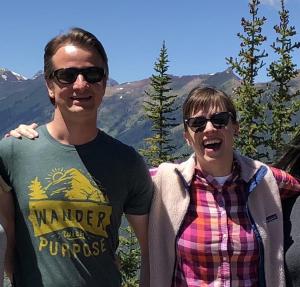
Mike Murawski and Michelle Dezember in Aspen, Colorado in June 2018 during the Aspen Art Museum Sustain retreat. Photo: Michelle Dezember

It can happen in backyards, parks, gardens, anywhere there is some greenery. At the Sustain retreat you hosted at the Aspen Art Museum, we took our shoes off during one of the sessions, and then we did a walking meditation as part of another experience. We should all do that more often, because there’s something in our DNA that responds positively to opening ourselves up to that kind of connection with nature and the world around us.

Back to your question about what we can learn from this connection to nature that could be applied to our work—I think it all starts with slowing down. Through much of the equity, inclusion, and accessibility work we’re doing at the Portland Art Museum, we frequently talk about how much we could achieve if we slow down and trust the process. What’s the worst that can happen if we don’t prioritize the same pace of deadlines and work flow, and we take the time to be in the moment and have the difficult and important conversations we need to be having (but often take time)?

The other thing that has been important to me is tactile, physical engagement with things. How many times have you gone on a hike and maybe not touched anything? We have an idea that getting dirty is bad, but in Santa Cruz I asked people to take their shoes off in the dirt (totally inspired by our walking meditation in Aspen). I invited people to rub the dirt in their hands, smell it, and let your body reconnect with what surrounds us. So often the white cube doesn’t invite that tactile engagement, but as educators we can open up a whole new range of experiences. We’re inviting a much closer relationship with objects and people when we engage in all of our senses, not just sight.

Michelle: You touched on the spirituality of experiences with nature. It seems that feeling humbled or part of something bigger might happen most easily in immersive experiences that disconnect us from our routine. What can people who don’t have easy access to expansive public lands do?

Mike: Living in the Pacific Northwest, I definitely have the privilege of living close to incredible old growth forests, and it’s part of the culture and identity of this place. It’s certainly not like that everywhere. Yet everyone has some sort of green space nearby. Botanical gardens or nearby parks are amazing places to visit and unplug. Go back to a place to watch how it changes through the seasons. One of the exercises in forest bathing is to think of a memory of a tree from your childhood, maybe one you would climb or build forts around. It shows us that all we need is one tree to form a connection. Visit a tree and make a leaf collection, draw some of the leaves, wonder how long that tree has been there, and think about the story it has to tell. Or, can you take your meetings outdoors for a walk around the block? All of these gestures ground us in the moment and provide us with the sense of connection needed to be present.

Michelle: Which is so important! Right now is autumn, which I love for the reminder to embrace change. What symbolism does autumn have for you?

Mike: Autumn has traditionally been the time of things dying, fading, or leaves falling off the trees. But in Portland, the summer is so dry that everything turns brown. When it starts raining in the fall, life comes back with green moss and mushrooms. Re-growth is the best way to describe it. It’s very restorative and powerful.

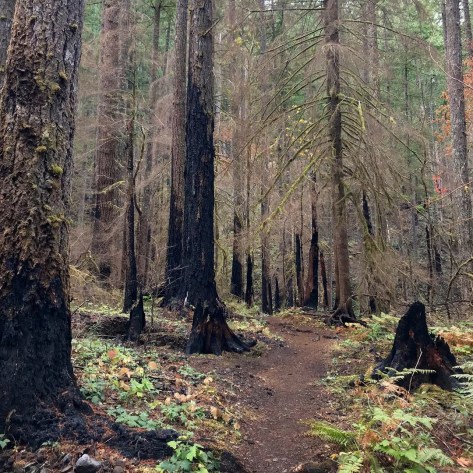
We had a bad wildfire last year outside of Portland that burned 50,000 acres, including many popular hiking trails. Just a couple of weeks ago, my partner and I took our first hike through the area since it has started to re-open. To walk through the forest and see the scarring of burn marks on the trees and then bright green ferns and moss growing all around them – that reminded me that nature can come back after terrible devastation with new life.

There’s a resilience that nature can teach us if we are paying attention. There is a gift that comes from dramatic change.

Things will grow back, and often even stronger.
IMG_1732
Pacific Crest Trail one year after the devastating Eagle Creek Fire. Photo: Mike Murawski.

*     *     *

Michelle Dezember is the Chief Program Officer of the Aspen Art Museum and serves on the Board of Directors for the Museum Education Roundtable.

Mike Murawski is the Director of Education & Public Programs for the Portland Art Museum and founding author and editor of ArtMuseumTeaching.com. He earned is MA and PhD in Education from American University, focusing his research on educational theory and interdisciplinary learning in the arts. He has also served in education departments at the Saint Louis Art Museum, the Mildred Lane Kemper Art Museum, and led workshops, lectures, and trainings at museums across the country. He is passionate about how we can come to see museums as agents of change in their communities as well as creative sites for transformative learning and social action.


Towards a More Community-Centered Museum, Part 3: Defining & Valuing Community

Written by Mike Murawski

Obviously, there is no single definition for the word ‘community.’  And it does not benefit this conversation to check with Webster’s dictionary, since the traditional definition of community is vague and outdated.  In his influential book Community: The Structure of Belonging (2008), Peter Block offers an exploration of community building and the ways that healthy, restorative communities emerge and sustain themselves.  Defining community as the experience of belonging, Block writes, “We are in a community each time we find a place where we belong.”  This core sense of belonging has two meanings.  It is about having a sense of relatedness and being a part of something, and it is about having a sense of ownership and acting as a creator or co-owner of that community.

First and foremost, then, community is about people.  At its core is a set of human relationships, not just a place, organization, idea, or internet platform. Second, it is important to recognize that people participate and identify with multiple communities at the same time.  We might belong to a church, feel affinity to people in our neighborhood, be connected with those at our school, and bond with others who share an aspect of our personal identity (age, sexuality, ethnicity, language, etc.)—all on the same day.  We all belong to many communities, some that we define for ourselves and some that are defined for us.  Our participation in certain communities might be deep, long-term, and really meaningful to us, while our involvement in other communities might be fairly thin and insignificant.

It’s also important to note that the social relationships that form communities are fluid, constantly shifting given time and changing circumstances.  While it seems obvious that formal institutions (schools, churches, museums, and non-profits) play an important role in forming communities, we also need to recognize the powerful role of informal institutions (the neighborhood barbershop, a local grocery co-op, a community choir group, or a gardening club).  Through each of these communities, we might come together to feel various degrees of shared belonging, trust, mutual interests, and safety.

On top of these ways to define community, I want to layer on the transformative belief in a ‘beloved community’ that comes from the teachings of Martin Luther King, Jr., as well as more recent writings by Grace Lee Boggs and bell hooks. It is the idea of community as an agent of change, engaged in the struggle for justice and the well-being of the whole.  In her book Killing Rage: Ending Racism (1996), hooks writes:

“Beloved community is formed not by the eradication of difference but by its affirmation, by each of us claiming the identities and cultural legacies that shape who we are and how we live in the world.”

This affirmative vision of community is based, in part, upon finding common ground through social justice and the possibility of radical change as well as the transformative element of shared responsibility.  Community is not merely a passive gathering of people around shared interests or shared geography, but rather the form through which these shared understandings take on life as collective action.

63-DSC_1936
artist Karina Puente with activists, community organizers, and warriors of justice Donna Hayes and Irene Kalonji at the Upstanders Festival, Portland Art Museum, May 2017.

This more active notion of community, or building community, also connects deeply to the concept of ‘bridging’ popularized by Robert Putnam, author of Bowling Alone: The Collapse and Revival of American Community (2000).  In this groundbreaking book that has been part of the conversations in museums for many years, Putnam examines how we might begin to strengthen a sense of connection through social networks and building social capital. While one form of social capital is created through “bonding” among homogenous, exclusive, inward-facing groups, another more powerful form of social capital is created through “bridging” diverse, heterogeneous, inclusive, and outward-looking groups through activities of sharing, exchange, and consensus building.

The Better Together report, published by the Saguaro Seminar in 2000, takes a look at the role of the arts and museums in successfully building social capital in the United States. Elizabeth Crooke discusses this report in her fantastic book entitled Museums and Community (2007), in which she describes in more detail he various concepts of social capital. The Saguaro report argues that arts and culture organizations can nurture connectedness and bridging by “strengthening friendships, helping communities to understand and celebrate their heritage, and providing safe ways to discuss and solve difficult social problems.”  Overall, the report recommended key principles to guide the arts, including to encourage initiatives that “form bridges across race, income, gender, religion, and generations” as well as including arts and culture in community planning and organizing.

The concepts of beloved community and the social capital of bridging both celebrate difference, and work toward bringing people together to form and strengthen new relationships. Overlap these defining characteristics of community with the ideas of a human-centered museum, and we find deep commonalities of human connection, social relationships, and a commitment to change.  For me, these overarching ideas form the basis for any productive discussion of community and how we then work to specifically define a local community and build an institution’s connection within that community.

As Elizabeth Crooke so perfectly writes:

“To be of value, museums need to find significance within these communities—without those connections, the museum and its collections will be of little importance. It is people who bring the value and consequence to objects and collections; as a result, if a museum cannot forge associations with people, it will have no meaning.” (131)

Valuing Community

When museums begin to develop relationships with certain communities, they must understand the power dynamics involved.  Most museums hold a great deal of institutional power and authority, so many relationships or partnerships with community groups begin in a situation of imbalance and inequity.  In her introduction to the edited volume Museums and their Communities (2007), museum scholar Sheila Watson recognizes that museums are understood “to represent those who have privileges in society, i.e., the educated, the relatively wealthy, those who are in control through either their status … or through direct political power.”  This power extends to a museum’s architecture, collections and collecting practices, exhibitions, scholarship, and interpretation.

It is also important to recognize the tension in most museums between traditional academic scholarship and community input.  Consulting with community knowledge holders can often be viewed as an erosion of scholarship and curatorial confidence, and working with community-based artists can be seen as lowering accepted standards of ‘quality.’  On top of all of this baggage, the Western colonial concept of museums may not necessarily be relevant or valued in many communities who have been excluded or oppressed by this system.

For community relationships to grow and thrive, museums need to step back their role as authorities and see community members as experts on their own needs and local assets.  Identifying community assets and valuing resident participation works to empower residents and legitimize these community partnerships.  Stacey Marie Garcia, Director of Community Engagement at the Santa Cruz Museum of Art and History, has both researched and enacted community and civic engagement practices, methods, and theories in museums.  In a post for Museum 2.0, she writes:

“it’s not solely about how museums can serve communities but rather what are the communities’ resources, knowledge and interests that can inform museum practice? Furthermore, how can museums and communities work together to share strengths in the community?”

23501550362_ce672bf47b_z
The Laundromat Project’s Kelly Street Housewarming Party. Photo by Osjua A. Newton, Copyright © 2015

At the core of our work with specific communities and local neighborhoods is the practice of identifying and embracing the strengths, creative skills, stories, languages, cultures, voices, and experiences that come from our communities.  In the overall research on community development, this is referred to as an “asset-based” approach or “capacity-focused” development.  This thinking runs counter to the mindset of a “needs-based” approach that focuses too much on problems and deficiencies in a community or neighborhood and, thus, how institutions can ‘serve their needs.’  “This phrase drives me nuts,” writes Nina Simon in her most recent book The Art of Relevance (2016). “It smacks of paternalism. As if it weren’t enough to be experts on our subject matter. Now we’re the experts on what people ‘need’ too?”  Rather than telling communities what they need and how they should do things differently, museums can instead center the gifts and creative capacities of communities as we work toward building relationships based in trust and mutual respect.

According to foundational work in the field of asset-based community development (check out “What is asset-based community development?”), this approach should focus on identifying community assets and strengths, and be both community-driven and relationship-driven.  Rather than asking ‘what are the needs of your community?,’ we can approach these conversations from a asset-based and community-driven approach.  Key questions might instead be: What do you value most about our community?  When was a time you felt our community was at its best?  What is the essence of our community that makes it unique and strong?

Finally, thinking about community development work through an asset-based approach tends to build relationships among community members.  As Graeme Stuart, community development specialist and activist, writes:

“The real value in asset mapping is bringing people together so they can discover each other’s strengths and resources, and to think about how they can build on what is already in the community. One way we can do this is by fostering the relationships, or the place, where assets can be productive and powerful together.”

Museums and cultural organizations hold the potential to be these places where community assets can be powerful together.  We just need to take bold steps to value the skills, interests, culture, and heritage of our communities and neighborhoods and begin to de-center the traditional power structures of museum institutions.

And as uncomfortable and messy as this might be for so many museums, we have got to start somewhere and make this change happen.

*     *     *

ABOUT THE SERIES: Through this series of posts, I am exploring a range of ideas, challenges, and strategies for building community-centered practices in museums and advocating for deeper connections between institutions and community.    What do we mean by ‘community’?  How can we value community?  What are some strategies for change that we can enact now in our institutions?

I’m open to all types of critiques and questions, as long as they are aimed at moving this collective work forward.  My ideas, thoughts, and questions have emerged from decades of meaningful conversations with others, so I don’t claim ownership of these ideas — I simply hope they can spark new conversations and allow us all to add to our learning and growth as we work to transform museums.

Other Posts in This Series:

*     *     *

About the Author

MIKE MURAWSKI: Founding author and editor of ArtMuseumTeaching.com, museum educator, and currently the Director of Education & Public Programs for the Portland Art Museum. Mike earned his MA and PhD in Education from American University in Washington, DC, focusing his research on educational theory and interdisciplinary learning in the arts. Prior to his position at the Portland Art Museum, he served as Director of School Services at the Saint Louis Art Museum as well as coordinator of education and public programs at the Mildred Lane Kemper Art Museum at Washington University.  He is involved in the Museums as Sites of Social Action (MASS Action) initiative, contributing author to the MASS Action toolkit, and co-created the #MuseumsAreNotNeutral tshirt campaign with LaTanya Autry to erase the myth of museum neutrality. As a cultural activist and museum professional, he is passionate about how we can come to see museums as agents of change in their communities as well as sites for transformative learning and social action. He has led workshops and presented at conferences and institutions nationally and internationally, including a keynote at the 2016 MuseumNext conference. Mike’s postings on this site are his own and don’t represent the Portland Art Museum’s positions, strategies, or opinions.
*

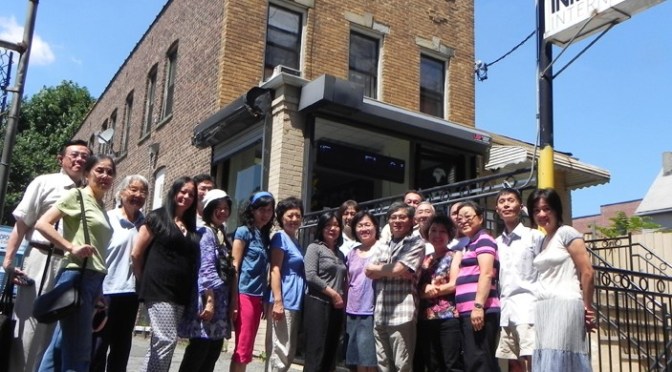
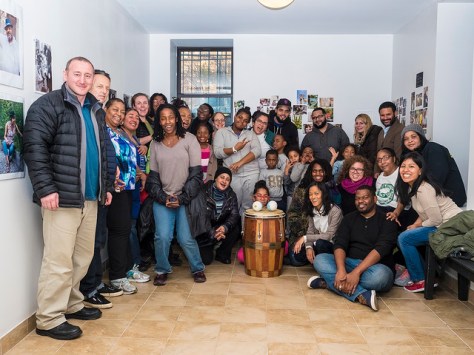
Header Photo: Queens Museum’s New New Yorkers Program student council at the Immigrant Movement International community gathering space.  Photo from https://queensmuseum.org/new-new-yorkers.