Dancing to Jackson Pollock: Exploring Multi-Modal Responses to Art

Originally posted on ArtMuseumTeaching.com on February 5, 2012 – the site’s inaugural post. 

As schools and museums work to meet the demands of the 21st century, there has been a renewed emphasis on developing an interdisciplinary culture of inquiry where teachers and students integrate insights and modes of thinking. Through my own teaching practice, I have frequently explored ways in which interdisciplinary inquiry can occur in the art museum, considering productive ways that we might bring musical, kinesthetic, and linguistic modes of thinking to the act of interpreting and making meaning of a work of visual art.  Responding to a single work of art through a process that involves multiple modes of thinking from across creative art forms, I continue to consider how each strategy makes meaning and asks questions in a different way–ultimately seeing how these approaches can be woven together to build toward more complex cognition as well as a deeper understanding of not just the artwork, but also of ourselves as learners/thinkers.

In November 2011, I led an in-gallery workshop for teachers at the High Museum of Art as part of the Project Zero/CASIE conference. The experiences centered around an extended engagement with  Jackson Pollock’s “Number 1A,” 1948, which was on loan from the Museum of Modern Art in New York as part of a special exhibition.

LOOKING: Bringing the group’s attention to Pollock’s painting before us, we spent some time looking and recording our initial observations and wonderings.  Since part of the goal of this workshop was to connect to Project Zero’s work (via Ron Ritchhart) with “making thinking visible,” participants were encouraged to record their thoughts and responses in a journal throughout the entire engagement with this painting.

SKETCHING WITH LINES & LANGUAGE: I framed the next stage of our experience with this painting around the ideas of Jack Kerouac, an experimenter of spontaneous language as well as a contemporary of Jackson Pollock.  In his “Essential of Spontaneous Prose” (1959), Kerouac writes that “sketching language is undisturbed flow from the mind of personal secret idea-words.”  This near-manifesto of spontaneous written response inspired me to develop some way for participants to be “swimming in a sea of language,” in Kerouac’s words, with the painting by Pollock. This process began with everyone drawing 2 or 3 significant lines that they find in the painting, then completing their “sketches” using only language and words. Following Kerouac’s method, there was no editing — just writing in a constant flow.

MAKING THE PAINT COME ALIVE THROUGH SOUND: Exploring Pollock’s canvas through sound originated in my own heightened interest in Pollock’s own passion and association with jazz music. Lee Krasner once remarked that Pollock thought that jazz “was the only other really creative thing that was happening in this country.” For the next phase of this workshop, we turned the gallery into a ‘sound lounge,’ breaking into small groups and experimenting with the spectrum of sounds we could create with just our bodies and the stuff in our purses, bags, and pockets. Each group was asked to create a sound composition in response to the painting. This ‘found sound’ exercise became a way of pulling out the basic structures of the painting that have a relationship with our sense of perceiving rhythms, tempos, and more improvisational structures embedded in the paint.

We finished this exercise with a quick reflection — what did people notice about this activity, and about the sounds each group performed?  Participants noticed that the sounds created were very rhythmic and controlled, despite the seemingly chaotic and disorderly nature of the painting. Others noted that this exercise allowed them to respond to the painting in ways not possible through words alone — that this acoustic response tapped into a new, almost unconscious element of the artwork as well as the creative process.

performing the sounds of the painting

MINING THE LAYERS OF PAINT THROUGH MOVEMENT: Examining a Jackson Pollock gesture-field painting without kinesthetic thinking would seem inadequate, especially if we think of the famous Hans Namuth films of Jackson Pollock dancing around his canvases, dripping paint across their surfaces. Dance critic Roger Copeland actually called Namuth’s film of Pollock “one of the world’s most significant dance films,” demonstrating that “the fundamental impulse behind abstract expressionism was the desire to transform painting into dancing.”

For this workshop, I decided to model various types of dynamic movement response, inviting volunteers to come to the front and improvise with the painting — then asking each small group to create a dynamic, three-dimensional moving response to the painting (adding words and sounds as needed).  Becoming the layers of paint allowed us to pull them apart, get inside them, and use our bodies to make meaning.
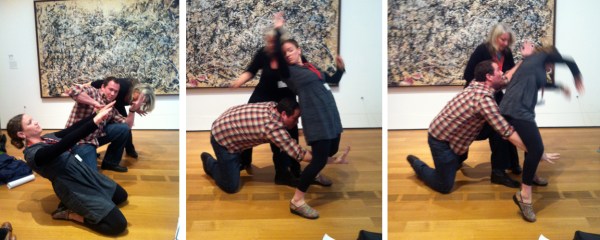
volunteers creating 3 types of dynamic movement
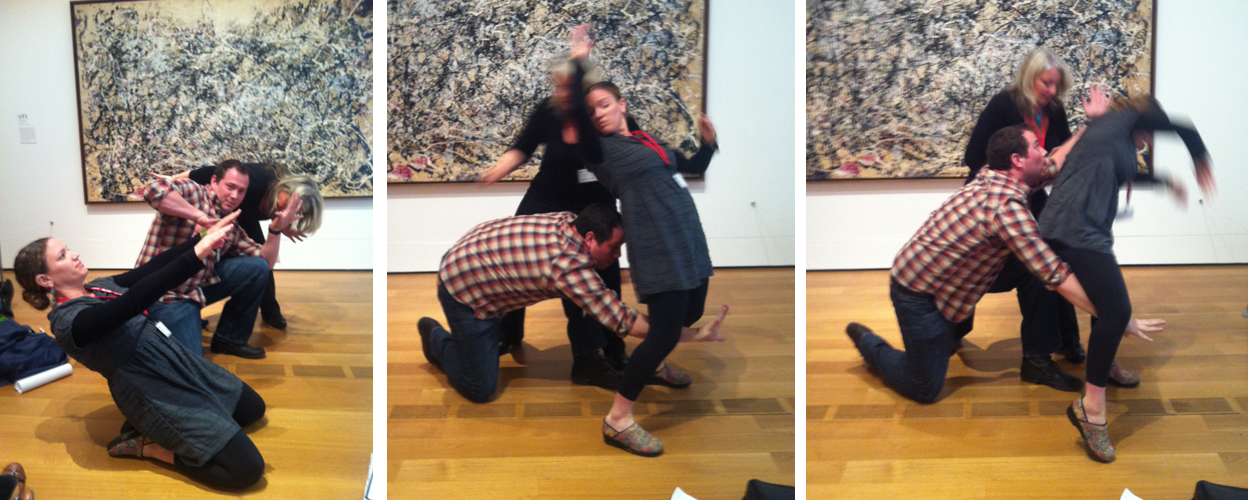
We let the group performances speak for themselves, not overtalking them or reducing these personal and embodied meanings to a set of art historical associations with Pollock and his process — and I will refrain from overtalking them here, as well.  Yet a key goal for this workshop was for teachers to become expressive participants in an artistic experience, pushing beyond mere “spectating” or “learning at a glance” toward something more aligned with enhanced engagement or participatory arts practice in which the creative mind is activated and the focus shifts from the product to the process of creation.

SO WHAT? ENVISIONING INTERDISCIPLINARY WORK IN THE CLASSROOM: With the few minutes we had remaining, I felt compelled to deal with the “so what?”  Why did we just do this?  In what ways might we bring this experience back to our own spaces of learning (museums, classrooms, etc.)? Much of our discussion centered around what interdisciplinary learning looks like: connected, collaborative, free, lots of parts coming together as a whole, and building toward something more meaningful.  The best culminating moment for me was when one teacher said that he felt the whole experience was about “synergy.”

The last few remarks before the workshop ended inspired us to wonder what Jackson Pollock had actually taught us about learning.  Weren’t the layers and topographies of this painting paralleled in our own landscapes of learning, and in this multidimensional and multi-modal experience with this painting.  I think we all left the workshop feeling that Pollock’s “Number 1A” was an essential part of the conversation about learning, and building to learn.

The workshop ended with the words of choreographer Merce Cunningham — click here for the quote.
Getting Uncomfortable in Museums

Guest post by Suse Cairns, doctoral candidate in the PhD Fine Art program at the University of Newcastle, Australia, and blogger at http://museumgeek.wordpress.com.

This post has been a long time coming. When Mike first contacted me about the possibility of doing a guest post for Art Museum Teaching many weeks ago, I was too busy to immediately do so. I thought it was just a lack of time and clear head space. But even after the deadline driven urgency of that time had passed, I still hesitated and put off writing. Why? I was writing amply on other things, so it was no longer time that was the problem, nor general inspiration. So what was it? What was preventing me from starting this project?

It turns out that my problem was one of elasticity, or more accurately, a lack thereof. I was feeling stretched, and my avoidance of writing this post was a tactic to avoid the discomfort that brought.

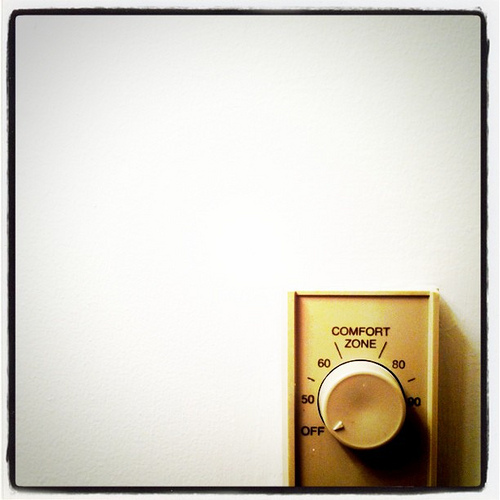
Photo by Redfishingboat

Let me explain. When I write for my own blog, I have a very definite comfort zone. I have defined the intellectual space, and I know intimately its boundaries.  In fact, its boundaries are my boundaries. I can stretch or push them, I can expand them as far as I am comfortable, and still exist within a very safe space. I recognise the likely readers and know their vocabularies and topical touch points. I know intimately what’s been covered before and what people have responded to, because it has all been within my own domain. The community of readers is my community; the space is my environment. Even when I am exploring ideas that are at times uncomfortable and that push me to consider things that I have not previously, I still retain a certain level of control.

But I don’t have the same sense of easy intimacy with the Art Museum Teaching website or audience. I know less who reads this site, and the sorts of topics and ideas they will respond to. I have not worked as a museum educator myself, and was uncertain what I could contribute that would be of interest to those who are.

So even though I was undertaking an act that I do regularly (writing), I was on edge. Unnerved. Stretched.

Such feelings, then, seem to resonate with two concepts that are at the very focus of the current investigations here on Art Museum Teaching.

The first of those is of art museum education itself.  When students come into a museum, or come into contact with art – sometimes for the first time – they may be out of their own comfort zones. That sensation can be in response to the physical space of the museum, where students might not know the rules or customs of the space; and it can be intellectual, when students have not encountered or don’t know about art and may not understand its language or how the art world is constructed. In many cases, students will feel both these sensations – out of place and uncertain of the context in which they find themselves.

The second way this sense of being stretched beyond comfort resonates is in the professional space of the museum, when ideas like the Elastic Manifesto that push for experimentation require that the museum itself, and its staff, make themselves deliberately uncomfortable.

Innovation and learning both require a certain amount of discomfort. They need a step into unknown territory, which will often be accompanied by a reciprocal jolt of fear. For some people who crave the new and who yearn to explore new spaces, this will be a great sensation. Such natural adventurers will likely thrive from these conditions. But there are many who will find such sensations stressful and do what they can to avoid them.

Henry Kissinger said that “The task of the leader is to get his people from where they are to where they have not been.” It is a useful angle for conceiving of the role of both art museum educators, and advocates for change and experimentation in the museum.

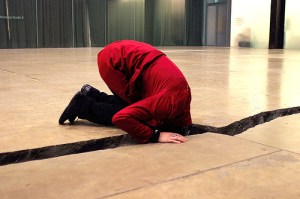
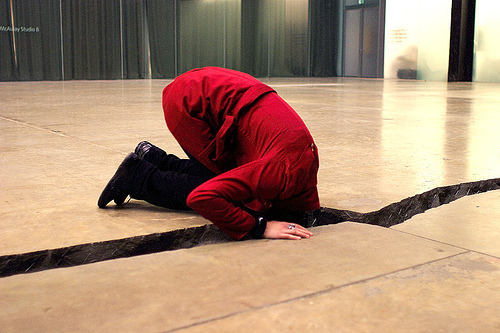
Visitor interacting with Doris Salcedo’s “Shibboleth” at the Tate Modern. Photo by truu.

Getting uncomfortable is important for growth, but mitigating that discomfort to keep it at an acceptable level is also useful. How can we provide scaffolding for that process, so that those who embark on the journey to somewhere new have the tools and permission to explore and accomplish, without fear that making an error will be cataclysmic? How can we make the museum space a safe environment for exploration and unknowning, both for students and staff?

I’d argue that one step in this process is for those who advocate for change in others spend a little time getting uncomfortable themselves, to remember the mildly unpleasant sensations the process can evoke. Stretching yourself, reaching beyond your normal boundaries can remind you that even small moves into unfamiliar territory can be challenging. Even writing this post, beyond my own ‘normal’ space, has required that I extend and stretch myself to find a creative solution. It has been a thoroughly rewarding process, but was neither easy nor fast. It required getting uncomfortable, and living in that state for an extended period of time. Being aware of such things is useful.

What do you think? How can we as museum professionals make sure that the museum is a safe space to get a little uncomfortable? How can we scaffold the process of experimentation, innovation, and learning, to draw out creativity and productivity, whilst mitigating the pain of the unknown?

(And if you don’t normally comment on posts, feel free to use this as an opportunity to get a little uncomfortable and step beyond your own safe space.)

Sometimes I sit and think, and sometimes I just sit.

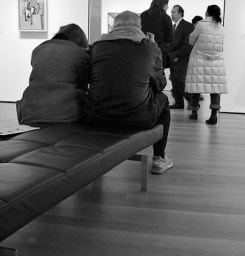
Resting at MoMA. Photo by Just Karen

How long can you spend in a museum gallery before you need to sit? Do you visit exhibitions with friends or family who take a lot longer to view artwork than you do? (Yes, mom, I love you, but even I, the museum professional, cannot read every word in an exhibition as you can.)

What kind of space is there in your institution for visitors to take a break? Is it inviting? Can people eat there? Can people talk on their cell phones there? How many people use the space?

At the Nasher Museum of Art at Duke University, we recently explored these questions in a rather thoughtful way. I must give most of the credit to the wonderful team of staff members that did the “heavy lifting” on this project. The manager of special events led the charge, and we were joined by the coordinator of academic programs, the membership manager, and the director of development and external affairs. (One thing I think we do really well at the Nasher is collaborate across departments like this.)

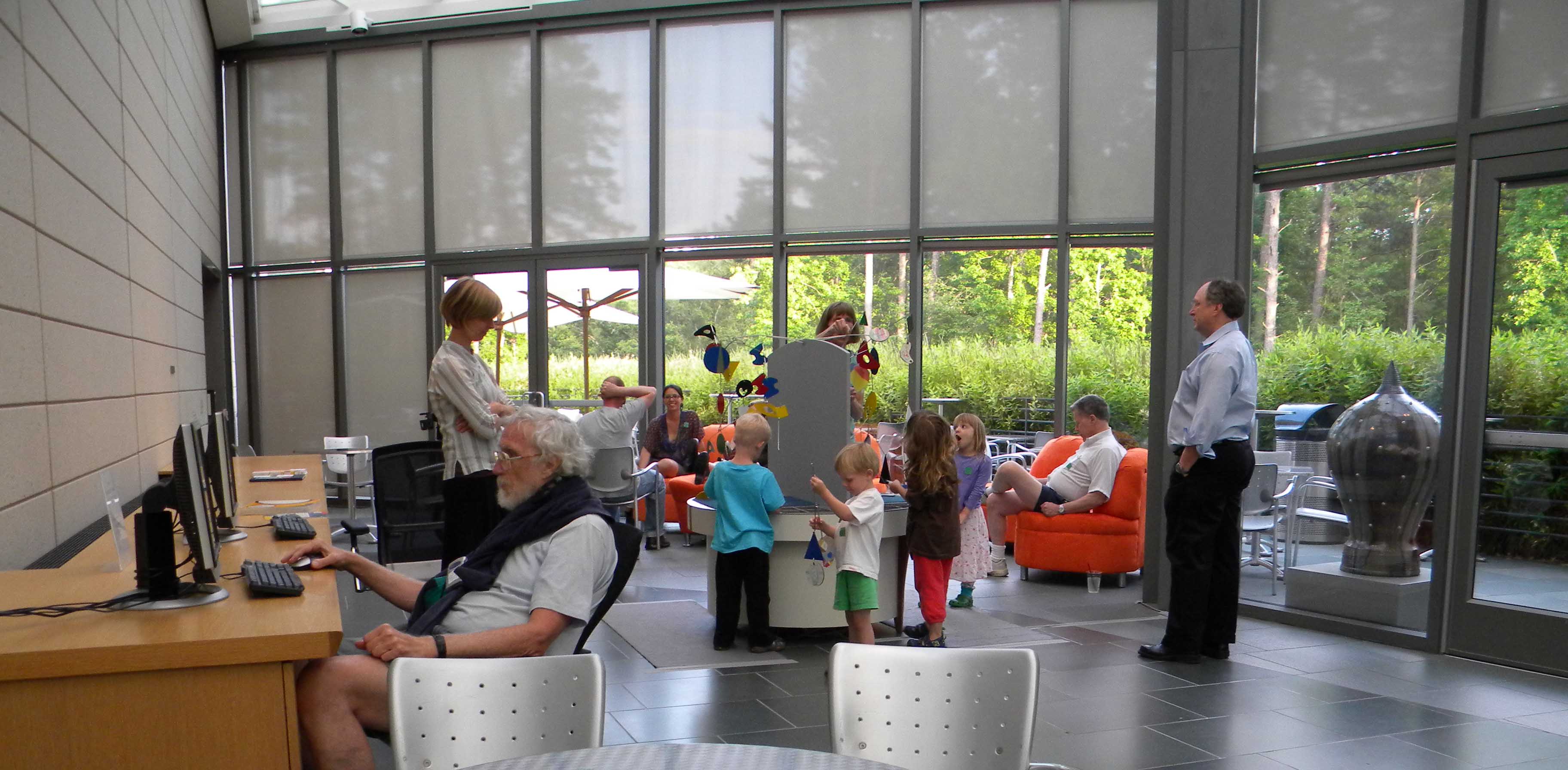
We have this space at the Nasher that we generally call “the computer alcove.” It is a nondescript area where there’s been a long wooden desk with 4 computers, some tables and chairs (furniture that is also used in our cafe) and access to an outdoor terrace. Students and general visitors check their e-mail at the computers, but not much else. Sometimes, during the school year, we see Duke students studying there, but not all that often, and we knew it could be much more than it was.

We wanted to offer our visitors several things in this space:

  • An inviting/welcoming place to sit and relax
  • A place where Duke students can study and work – ideally we’d like to be a destination spot for studying and hanging out
  • A place where staff can have informal meetings
  • A place where people can talk on their cell phones
  • A place where visitors can engage in a hands-on activity and/or explore supplemental reading materials

First, our manager of special events looked at the existing space with a critical eye and asked this question, “What can we do with what we currently have to make this a nice environment?” There were MANY simple things that instantly made the area more inviting. These included:

  • Raising the shades so people could see the terrace outside (and know they could go out there if they wanted)
  • Cleaning the terrace on a more regular basis
  • Moving the artwork on the terrace close to the windows, instead of at the far end of the space
  • Opening the umbrellas on the terrace so the space looked “open” instead of “closed”
  • Arranging the furniture in a more pleasing way – this included thinning out the amount of furniture and spreading it out a bit more

It was amazing to me just how big a difference simply raising the shades made. It’s important to remember that we all become “blind” to our museum environments. The more familiar we are with a space, the harder it is to see how it could be off-putting or unpleasant.

For the last weekend of our special ticketed exhibition “Alexander Calder and Contemporary Art: Form, Balance, Joy” (organized by the Museum of Contemporary Art, Chicago) we rented some fun furniture as an experiment. We knew there were going to be a lot of people in the museum, and we wanted to see what effect the furniture had. It made a huge difference.

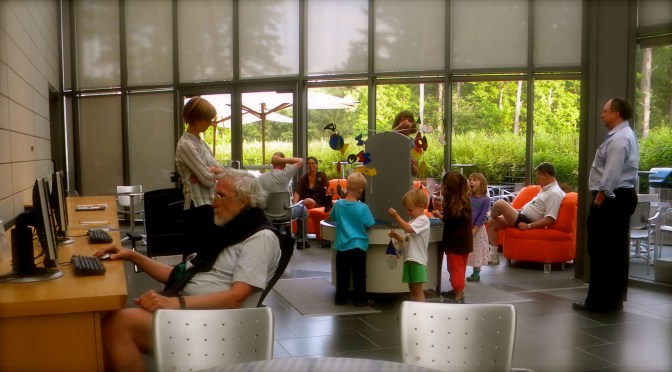
The Nasher Museum’s alcove/lounge with mobile interactive and rented orange furniture.

We had a summer intern track use of the space over four days. She started tracking before the furniture arrived, and once it was installed, the number of people in the space shot up. Around 20% of all visitors to the museum used the “lounge” over the fours days.

To me, that’s a big number. That means one in every five people spent some time there. And, most people spent an average of 15 minutes in the space. Our intern also interviewed people to see what they liked about the space, why they had come over in the first place, and what else we could do to make it more inviting. Many people said they wanted to know exactly what they were allowed to do there. This was especially gratifying to me, since I had suggested we put signs in the lounge that read “Welcome to the Lounge. What can I do here?” and then list all possible activities. Some in the group thought that was too limiting, but it seems like people want explicit information (something that’s not surprising.)

Sadly, we had to return the rental furniture, but we are now on a mission to find some permanent furniture that will be inviting, but also work for special events, be durable and not ridiculously expensive.

I am looking forward to continuing to track the use of the space, and find creative ways to make the museum an inviting location for all our visitors. And I re-ask my starting question to spark some conversation, and to hear more about what spaces you might have or be developing at your museum:

What kind of space is there in your institution for visitors to take a break? Is it inviting? Can people eat there? Can people talk on their cell phones there? How many people use the space? What can they do there?

How Do We Get to Know Our Students?

Photo by Christine Healey

Participatory museum experiences and museum visitor identity seem to be the focus of much attention of late in the museum educator community. It is something I have given a lot of thought to, and I have enjoyed some thought-provoking conversations on Twitter about it. I like to think that students are at the centre of the experiences I create for them at the museum, in the same way that student-centred learning is championed in school-based learning and teaching. But I wonder if student-centred teaching at the museum is something that can actually be claimed as part of our practice.

Placing the students at the centre of a learning experience means knowing who the students are and I wonder how many assumptions can be made about this before they become irrelevant or wrong. In the museum we can’t get to know or form relationships with the students easily. They come to us in batches of around 25 students, ranging from pre-school to high-school levels, staying for a short time, making it practically impossible to know them as individuals, as their school teachers do.

So how do we get to know our students?

I have noticed that I form assumptions about who students are before they arrive on site — that I create a fictitious or generic version of who I think they might be. The information that I base this on is mainly tacit. I know what year level they are and so have an indication of age range, although this may not be a good indicator of maturity. I consider how well prepared the teacher is for the visit and what they hope students get out of the experience. This assists me to understand the students previous learning and the anticipated outcomes of the visit. I know what the curriculum expectations of the visit are, and that these are often the justification for the visit. Experiences with my own and other children I know also informs how I relate to children. For each class or group that visits I test my assumptions to decide on the best level to pitch my discussion with them.

Photo by Christine Healey

My goal is to create an experience that will be meaningful for the students. I want to facilitate the students’ capacity to drive curiosity and find personal meaning, as well as awe and inspiration in the artworks that I choose to show them. I perform in (what I think is) an engaging or entertaining manner to maintain their attention and focus. I make sure I am present in the moment and pay careful attention to what they are interested in. I ask questions and ask for questions. I give and request feedback. I paraphrase to build on what students are noticing and thinking, encouraging others to contribute and find viewpoints of difference or similarity. I tell stories and share what I love about art and artists’ capacity to surprise and delight. I try to let them drive the experience and am willing to be adaptable and flexible to go along with it.

The ‘truth’ is that I don’t know my students. I can’t know them in a once off, one hour visit. But each new experience I have teaching informs the next, and I shape my practice so that I am creating experiences that are driven by the needs of the students generally.

What are some ways you get to know students before they arrive at your museum? As they tour the galleries? After they leave the museum? Before the next school visit?