8 Lessons About Teaching from the Canadian Museum of Human Rights

Editor’s Note: Given the meaningful ongoing dialogue about the role(s) of museums in society and our communities, I am thrilled to repost this piece by Jamie Harrison in which she reflects on her visit to the new Canadian Museum of Human Rights in Winnipeg —  the first museum solely dedicated to the evolution, celebration, and future of human rights.  From inviting multiple perspectives to embracing complexity, Harrison thinks deeply about core aspects of teaching and student learning through her experience of the exhibits and design of the Museum of Human Rights.  I am most excited to share her perspective as a classroom teacher since so many museum educators (paid staff and volunteers alike) are working toward similar goals, allowing for museums to be a place for learners to be challenged; where we can struggle to make meaning, recognize others’ perspectives, participate, and create personal relevance.  I encourage readers to click on links to the many teaching strategies that Harrison provides, and explore the resources of Facing History and Ourselves.

*     *     *     *     *

Written by Jamie Harrison, high school teacher, Brandon, Manitoba

Reposted from Facing Canada, a blog of the Facing History and Ourselves community dedicated to the idea that education is the key to combating bigotry and nurturing democracy.

Museums are invaluable to education. The carefully selected exhibits, information, and artifacts provide tangible and visual evidence for exploration, reflection, and dialogue that support lessons in the classroom. Museums allow students to build upon prior knowledge – to see things differently.

In late October 2014, I had the opportunity to attend an educator’s preview of the new Canadian Museum for Human Rights in Winnipeg, Manitoba. At the time of my tour, many of the galleries were still under construction, but what I was able to see led me to think deeply, and at times differently, about how I teach in my own classroom.

Here are 8 lessons I took away from my visit to the Canadian Museum for Human Rights:

 1. Take Students on a Journey

As you move through each of the museum’s eight levels, it becomes progressively brighter (a symbolic – and physical – movement from darkness to light).  It is thoughtfully and memorably planned to lead visitors in, to build knowledge, and to lead us toward hope. In the classroom, I take students on Facing History’s Scope and Sequence journey, exploring the role of the individual in society, the concept of “we” and “they,” the supporting history of human rights in Canada and throughout the world, the memory of those who were left voiceless, and the choice (and call) to participate in our own communities.

2.   Invite Multiple Perspectives

The Canadian Museum for Human Rights is highly interactive, with videos, games, and activities meant to encourage participation from all visitors. The space provides multiple perspectives that contribute to our understanding of human rights. Many of the events and issues explored in the museum stem from people, governments, and societies only seeing, or contemplating, a single perspective. As educators, we need to foster safe and respectful classroom environments, ensuring that students have the freedom to both contemplate and express multiple perspectives on a variety of issues. Doing so promotes personal growth and it allows students to see things beyond themselves – teaching strategies like contracting and fishbowl can help students to hear each other.

An interactive message of welcome greets all visitors to the museum. (Photo courtesy of Jamie Harrison)

3.  Give Students Opportunities to Struggle with Making Meaning

On the second level, visitors are greeted by a visual and interactive timeline of important moments in human rights history. There is a video screen that runs the entire length of the wall, posing the question: What are human rights?  Likewise, much of the art on display on this level – and throughout the museum – is open to interpretation, allowing each viewer to linger over their personal interpretations and meditate on the messages they draw from the pieces that they see. In our classrooms, we can use the working definitions teaching strategy to engage students in their own explorations of key issues. Analyzing visual images gives students a framework to interpret artwork.Giving students the opportunity to make their own meaning in the classroom promotes the intellectual involvement of students and recognizes that words and images can bear multiple, and often deeper, meanings as it is our beliefs, values, history, and understandings that give words and images value.
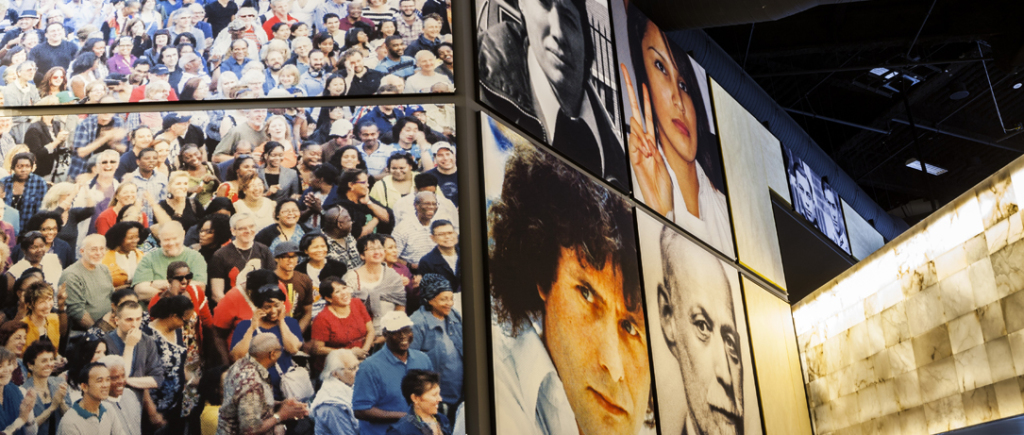
Photographs featured in the museum. (Photo courtesy of The Canadian Museum for Human Rights website)

4.  Make Room for Other Ways of Knowing and Learning

The second level of the museum also looks at the Indigenous perspective and Canada’s journey toward recognizing the human rights of all individuals and groups. The Indigenous artwork here reflects groups from each of Canada’s provinces and territories. The space allows room for performance, storytelling, and discussion, and is annexed by a space for ceremony and smudging meant to recognize, and encourage, the values and traditions of our First Nations peoples. If the medium is the message, how are we using different mediums in our classrooms to teach students about the past and about the world in which they live?

A look into human rights and the Indigenous perspective. (Photo courtesy of  Jamie Harrison)
A look into human rights and the Indigenous perspective. (Photo courtesy of Jamie Harrison)

5.  Students Need to Deal with Complexity Because Life is Complex

The third level of the museum examines the history of protecting human rights in Canada, including a look at the Canadian Bill of Rights. The exhibits on this level demonstrate that not all issues of human rights are easy to decipher – the processes involving human rights can often be lengthy and difficult. As we work to equip students for the complexities of our world, we can bring complex case studiesand resources into the classroom, and we can ask questions that perhaps have no “right” answers.

6.  Encourage Personal Connections

At the time of my visit, there was a temporary exhibit entitled “Peace” on the sixth level. Developed by the Canadian War Museum in Ottawa, the exhibit focuses on Canada’s role in peacekeeping and how that role has been challenged and has evolved throughout history. Two reflection walls encourage participation from visitors. Each provides a guiding question and asks visitors to make personal connections to the content. It provides an outlet for students to examine the impact that peacekeeping has on their identities and on the identity of Canada as a whole.
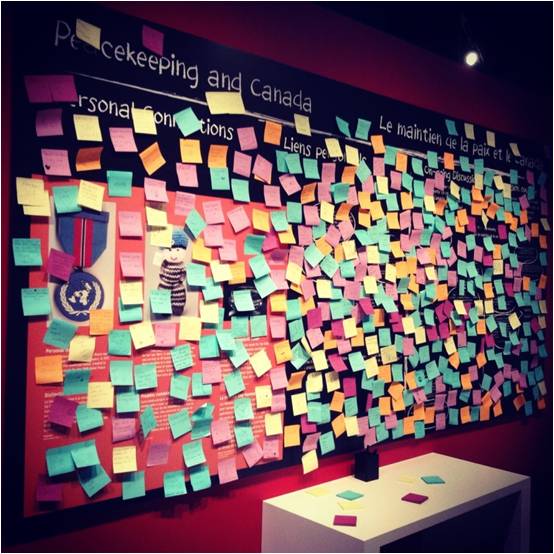
A reflection wall encourages participation and discussion on Canada’s role in peacekeeping. (Photo courtesy of Jamie Harrison)

7.  Choose to Participate

Level seven focuses on inspiring change – on choosing to participate. This level houses an exhibit looking at change and a communication wall where visitors are encouraged to reflect upon what they imagine the future to look like and how they can help to inspire positive change in that future.

Looking ahead…(Photo courtesy of Jamie Harrison)

8.  Help Students See Beyond the Classroom Walls

The final gallery in the museum leads to the tower of hope – the peak of the museum – meant to symbolize a merging with the sky. The tower’s viewing platform provides a breathtaking panoramic view of the city of Winnipeg: the now and the future. Here you are surrounded by warmth and light – a true journey from the darkness. We need to help our students take and apply their learning beyond the walls of the classroom. They need to carry their knowledge, beliefs, and values with them so that they can apply them throughout their lives.

An elevator leads to the tower of hope. (Photo courtesy of Jamie Harrison)

How do you use field trips and museum visits in your courses? What impact do such visits have on your students?

About Author

JAMIE HARRISON is a high school English and Social Studies teacher in Brandon, Manitoba. Having been fortunate enough to have had a teacher who believed strongly in interacting with history – in facing history as a way of learning about ourselves – she strives to carry that same enthusiasm forward in her own teaching. She does this through interdisciplinary learning, hands-on exploration, and educational travel. Jamie is married with two children.

Featured Header Image: Canadian Museum for Human Rights on Friday, May 24th 2013. Photo by Richard Ray, Flickr.com. CC BY-NC-ND 2.0
Hands-On Learning: Not Just for Kids

Written by Jessica Fuentes, Center for Creative Connections (C3) Gallery Coordinator, Dallas Museum of Art

“Every child is an artist. The problem is how to remain an artist once we grow up.” – Pablo Picasso

Reposted from the Dallas Museum of Art’s education blog DMA Canvas, where the museum’s fantastic education team writes about creativity, community outreach, technology, and insights into the field of museum education. 

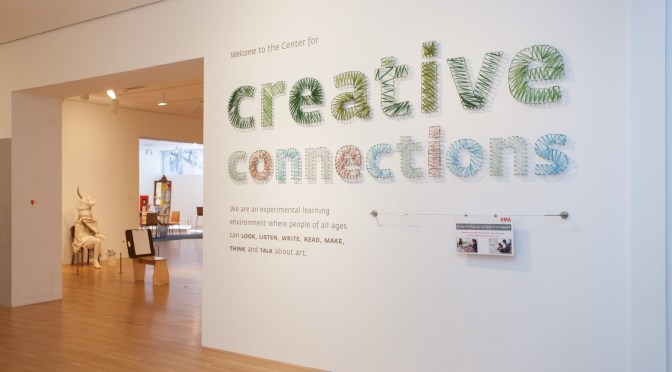
The Center for Creative Connections (C3) at the Dallas Museum of Art is unique because we focus on learning by doing. That means we design activities for people of all ages to learn about works of art from the collection by participating in a hands-on way. The activities we create to accompany works of art prompt visitors to engage in ways that are different from the standard didactic approach of a wall label. In C3, we want to provide experiences where visitors can make personal connections by drawing, writing, making, and discussing works of art with each other.

This kind of active engagement carries a certain stigma; many people assume that it’s only for kids, mainly because we are used to seeing activities like these in children’s museums. Part of our design process is to evaluate visitors’ experiences by observation, interviewing and counting. We’ve learned that half of our participants are adults and that there is a reoccurring theme in their comments regarding why they participate. So, why do adults flock to C3 to draw, write, make, and talk about art? Because it connects them to a childlike curiosity and creativity which, as an adult, often takes a backseat to other responsibilities and tasks.

jfuentes_image2

In January 2014, we installed a large table in the middle of the C3 Gallery, that hosts three activities that rotate on a monthly basis. As a part of the evaluation of these activities, we interviewed visitors about their motivations for participating, their past experience with art making, and their view of the value derived from participating in a making activity at the Museum. I was repeatedly intrigued by the responses of the adult participants.

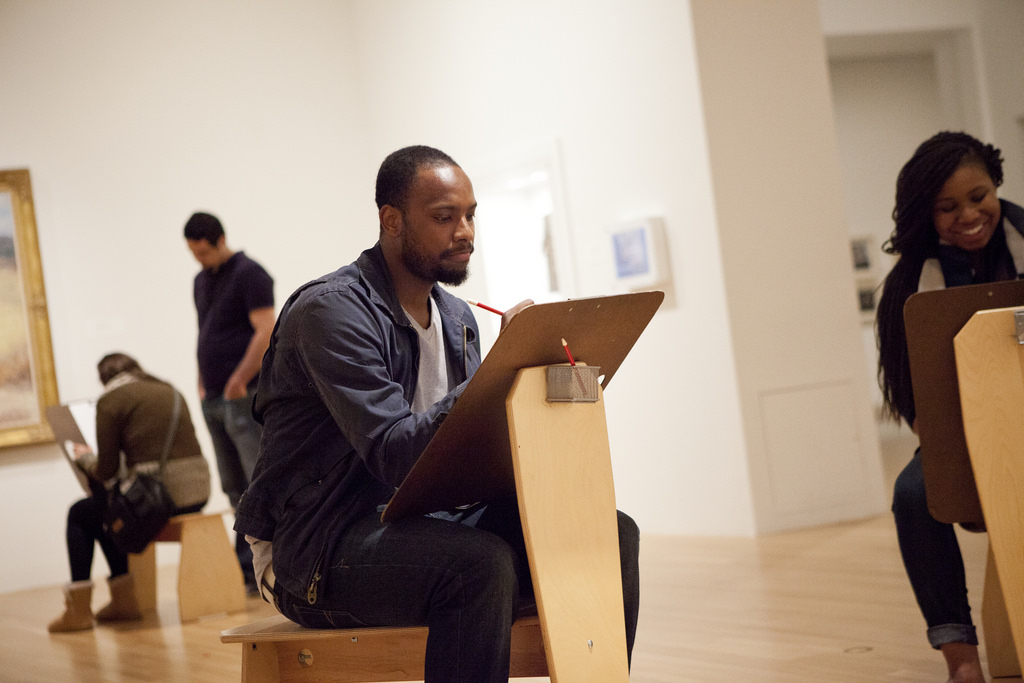
For example, I spoke with a couple participating in a portrait drawing activity which encouraged close looking at the proportions and scale of the human face.  The couple, in their mid-thirties, each claimed to have no artistic experience. Through our conversation, they divulged that they both graduated from arts-based college programs. “I went for fashion, like a BFA in Design, and he went for Graphic Design. We don’t really draw in our free-time though, I mean, he does for work,” the woman stated as she looked over at the man who accompanied her. He added, “Yeah, but just on the computer.” Then the woman broke in, “And I do for work, but it’s not the same. Like, I do fashion sketches, not this kind of drawing.” I prodded them a bit to understand what “this kind of drawing,” meant. “Well, it’s like… it’s fun. Like drawing before was so serious and it had to be perfect, cause you were doing it for a grade. But this is just for enjoyment.”

This idea was reinforced by further conversations with other adult participants: drawing, making, and discussing in C3 is fun in a freeing kind of way. I interviewed another thirty-something couple drawing at a light box activity designed to assist in the making of hybrid imagery. The man began with, “I’m guessing this was made for children? It’s fun and different and I didn’t expect to see this here.” The woman with him agreed, “Yeah, it’s like that spark of creativity, kind of… childlike. I didn’t think I’d spend as much time or get into it like I did.” A sixty-something man participating in the portrait drawing activity remarked, “I used to take art classes, but it’s been so long ago… it’s like I forgot that and I saw this and I remembered.” This feeling of nostalgia for something that is no longer a part of someone’s everyday life was also a common response from adults. Many adults responded that they enjoy drawing or making but, “don’t do it enough.”

jfuentes_image3

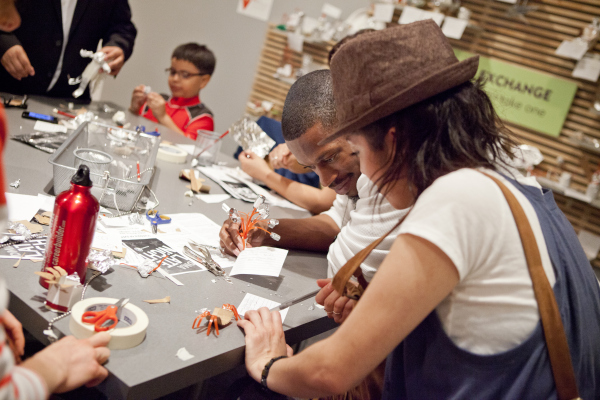
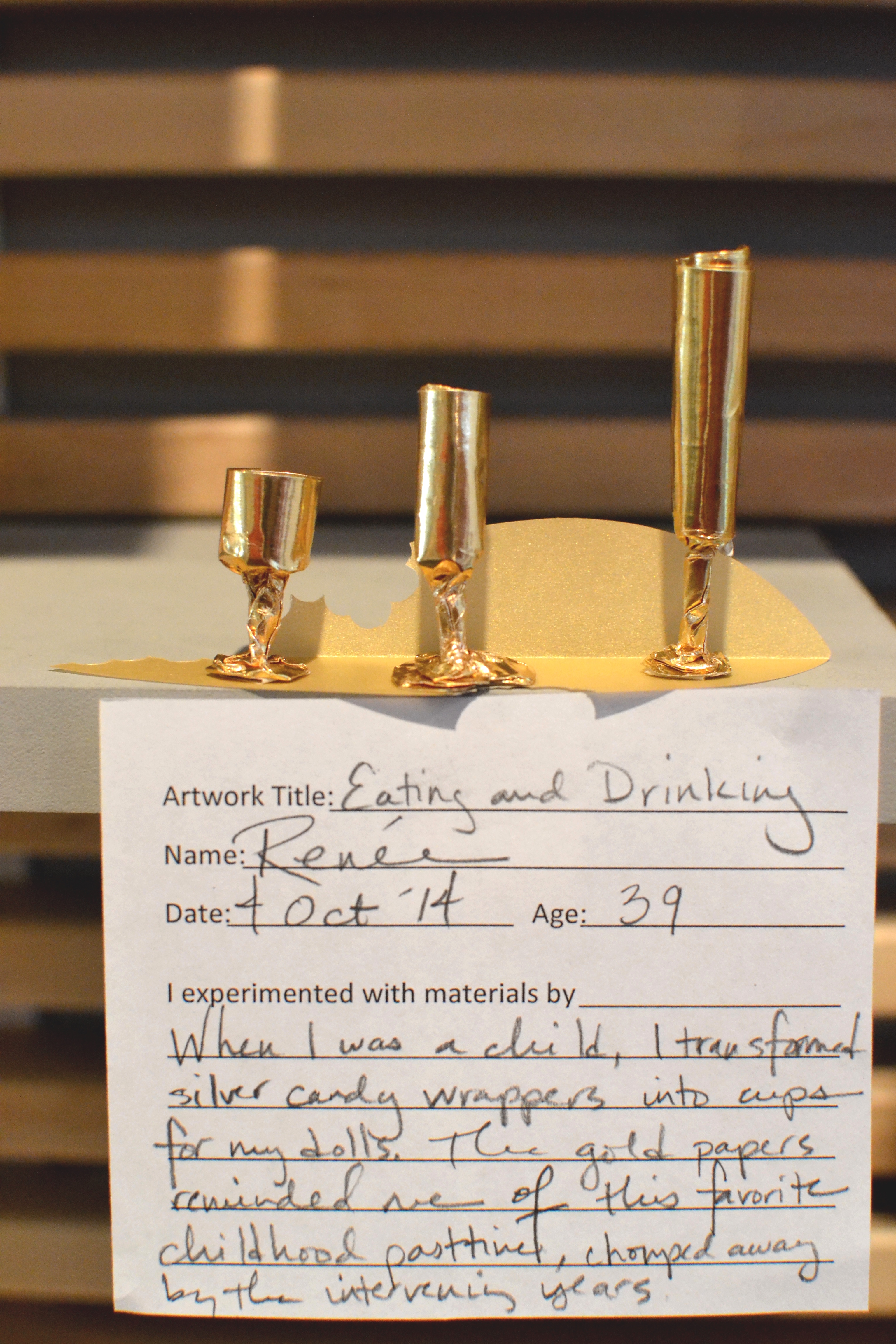
Aside from drawing-based activities, the Center for Creative Connections also has a drop-in art making area with large communal tables called the Art Spot, which we say is the place for “anytime art-making for everyone.” We invite visitors to explore their creativity by making creations out of unexpected or everyday materials. Every two months we change the materials and provide a prompt to inspire ideas. Each time I’m hesitant and wonder, “What will people make with this?” But, I am always delighted and surprised by the imaginative creations that are made and left behind. Children often come to C3 and head straight for the Art Spot, while adults can be a bit more tentative. However, regardless of age, most visitors stay anywhere from 5 minutes to two hours, with an average of about 20 minutes. Once they gather their materials they become immersed in their creation. For some it is a hands-on problem solving activity while for others it is about manipulating materials. How can you combine these objects (cups, spoons, paperclips, wire, egg cartons, cardboard, etc.) into something unique and surprising? This kind of open-ended activity, reminiscent of childhood playing and pretending, is not often made available to adults. I frequently watch my eight-year-old daughter take something like a toilet paper roll and turn it into a piano for her dollhouse, or repurpose a cardboard box to make an enormous rocket ship. This nostalgia for childhood play was brought perfectly into perspective by a recent Art Spot creation.

jfuentes_image4


At the DMA, learning can take many approaches and forms. We strive to be inclusive so that we can reach visitors with a multitude of interests and experiences and preferences for learning. In the Center for Creative Connections, our mission is to engage visitors of all ages with works of art and the creative process of artists. We hope that by designing participatory ways to learn we will provide fun and playful activities for all of our visitors, regardless of their age.

How Are You Engaging Adults in Unexpected Ways?

As museum education steps further away from a traditional didactic style and more towards an inclusive approach that attempts to reach a multitude of interests and learning styles, the question of how to engage adults is at the forefront of many educators’ minds. What if our adults want a lecture? What if they shy away from participatory activities? Will we isolate a large population of our adult audience by trying a new approach? These are valid questions to consider, and making a change does not imply that you have to make a 180-degree turn, but rather consider offering varying opportunities including these types of child-like playful activities. How are you engaging adults in unexpected ways? What successes and struggles have you come across as you experiment with offering new adult experiences?

Read more about the Dallas Museum of Art’s education programs, community outreach, and explorations in creativity through their educator blog: DMA Canvas.

About the Author

JfuentesJESSICA FUENTES: Center for Creative Connections(C3) Gallery Coordinator, Dallas Museum of Art.  Jessica received her MA in Art Education from the University of North Texas.  Her thesis was a collaboration with her then six-year-old daughter to explore self-guided family experiences in art museums.  Jessica’s daughter remains an important resource in her work developing interactives and activities which provide opportunities for visitors of all ages to engage with works of art through drawing, making, and discussion. Jessica is also an artist and a member of 500X Gallery, one of Texas’ oldest, artist run cooperative galleries.  In her down time, she can usually be found with her daughter enjoying an art museum or making art in their home studio. Jessica’s postings on this site are her own and don’t necessarily represent the Dallas Museum of Art’s positions, strategies, or opinions.

Responding to the Events in Ferguson and Beyond: The Northwest African American Museum’s Example

Exceptional post that I wanted to reblog from Incluseum about the Northwest African American Museum’s response to Ferguson and the lessons learned. Thanks to Chieko Phillips, Leilani Lewis, and everyone at the Incluseum for sharing these insights.

the incluseum's avatarTHE INCLUSEUM

In the weeks that have followed the grand jury’s decision not to indict Ferguson police Officer Darren Wilson in the shooting death of unarmed teen Michael Brown, museums and museum professionals across the country have been wondering how to respond. A twitter hashtag, #MuseumsRespondToFerguson, was launched the day after the verdict announcement to promote and document discussion on the topic. The Association of African American Museums (AAAM) released a statement and a group of museum bloggers collaborated on a response to the recent events (more on that soon). Examples of how museums have responded are few while questions about how to best respond abound. Given this situation, we are happy to share an article our friends Chieko Phillips and Lailani Lewis from the Northwest African American Museum (NAAM) wrote for the AAAM’s latest newsletter on how their museum responded to Mike Brown’s shooting back in August.  The article below, which was also…

View original post 1,734 more words

Joint Statement from Museum Bloggers & Colleagues on Ferguson

The recent series of events, from Ferguson to Cleveland and New York, have created a watershed moment. Things must change. New laws and policies may help, but any movement toward greater cultural and racial understanding and communication must be supported by our country’s cultural and educational infrastructure. Museums are a part of this educational and cultural network. What should be our role(s)?

Schools and other arts organizations are rising to the challenge. University law schools are hosting seminars on Ferguson. Colleges are addressing greater cultural and racial understanding in various courses. National education organizations and individual teachers are developing relevant curriculum resources, including the #FergusonSyllabus project initiated by Dr. Marcia Chatelain. Artists and arts organizations are contributing their spaces and their creative energies. And pop culture icons, from basketball players to rock stars, are making highly visible commentary with their clothes and voices.

Where do museums fit in? Some might say that only museums with specific African American collections have a role, or perhaps only museums situated in the communities where these events have occurred. As mediators of culture, all museums should commit to identifying how to connect to relevant contemporary issues irrespective of collection, focus, or mission.

We are a community of museum bloggers who write from a variety of perspectives and museum disciplines.  Yet our posts contain similar phrases such as  “21st century museums,” “changing museum paradigms,” “inclusiveness,” “co-curation,” “participatory” and “the museum as forum.”  We believe that strong connections should exist between museums and their communities. Forging those connections means listening and responding to those we serve and those we wish to serve.

There is hardly a community in the U.S. that is untouched by the reverberations emanating from Ferguson and its aftermath. Therefore we believe that museums everywhere should get involved. What should be our role — as institutions that claim to conduct their activities for the public benefit — in the face of ongoing struggles for greater social justice both at the local and national level?

We urge museums to consider these questions by first looking within. Are staff members talking about Ferguson and the deeper issues it raises? How do they relate to the mission and audience of your museum?  Do you have volunteers? What are they thinking and saying? How can the museum help volunteers and partners address their own questions about race, violence, and community?

We urge museums to look to their communities. Are there civic organizations in your area that are hosting conversations? Could you offer your auditorium as a meeting place? Could your director or other senior staff join local initiatives on this topic? If your museum has not until now been involved in community discussions, you may be met at first with suspicion as to your intentions. But now is a great time to start being involved.

Join with your community in addressing these issues. Museums may offer a unique range of resources and support to civic groups that are hoping to organize workshops or public conversations. Museums may want to use this moment not only to “respond” but also to “invest”in conversations and partnerships that call out inequity and racism and commit to positive change.

We invite you to join us in amplifying this statement. As of now, only the Association of African American Museums has issued a formal statement (show link) about the larger issues related to Ferguson, Cleveland, and Staten Island. We believe that the silence of other museum organizations sends a message that these issues are the concern only of African Americans and African American museums. We know that this is not the case. This is a concern of all Americans. We are seeing in a variety of media – blogs, public statements, and conversations on Twitter and Facebook — that colleagues of all racial and ethnic backgrounds are concerned and are seeking guidance and dialogue in understanding the role of museums regarding these troubling events. We hope that organizations such as the American Alliance of Museums; the Association of Science-Technology Centers; the Association of Children’s Museums; the American Association for State and Local History and others, will join us in acknowledging the connections between our institutions and the social justice issues highlighted by Ferguson and related events.

You can join us by…

  • Posting and sharing this statement on your organization’s website or social media
  • Contributing to and following the Twitter tag #museumsrespondtoFerguson which is growing daily
  • Checking out ArtMuseumTeaching which has a regularly updated resource, Teaching #Ferguson: Connecting with Resources
  • Sharing additional resources in the comments
  • Asking your professional organization to respond
  • Checking out the programs at The Missouri History Museum. It has held programs related to Ferguson since August and is planning more for 2015.
  • Look at the website for International Coalition of Sites of Conscience. They are developing information on how to conduct community conversations on race.

Participating Bloggers and Colleagues

Gretchen Jennings, Museum Commons

Aletheia Wittman and Rose Paquet Kinsley, The Incluseum

Linda Norris, The Uncataloged Museum

Nina Simon, Museum 2.0

Mike Murawski, ArtMuseumTeaching

Paul Orselli  ExhibiTricks: A Museum/Exhibit/Design Blog

Adrianne Russell, Cabinet of Curiosities

Ed Rodley, Thinking About Museums

Steven Lubar, On Public Humanities

Aleia Brown, AleiaBrown.org

Rainey Tisdale, CityStories

Jeanne Vergeront  Museum Notes

*     *     *     *     *

UPDATE: “Museums and social responsibility: A statement from New England Museums Association,” December 15, 2014.

UPDATE: “Practical and Compassionate Advice on Museums and Community Conflict,” December 16, 2014, written by Melanie Adams, Managing Director of Community Education and Events at the Missouri History Museum and President of the Association of Midwest Museums.