By Brinker Ferguson, Digital Media Fellow, Fine Arts Museums of San Francisco
In the past several months, many museums have begun using live video chat as a way to enhance and foster new online discussions and interactions between museum educators and the public. One of the most popular tools has been Google Hangouts which is part of the Google+ social network. It allows for up to 10 users to video chat together and gives them the ability to broadcast the video stream live to a large audience and even record the session for future viewing. The recorded video, which is archived on the museum’s G+ page and YouTube channel, can be shared on various social networks. In addition, the videos collect (limited) analytics information so museums can track the attention it receives. Users who express interest in a museum video session ahead of time can be alerted when it is about to begin via Google+ email messaging.
This use of video chatting has spawned a new online forum that helps to bring together museum curators, directors, historians and educators with different virtual communities for in-depth conversations of art and ideas. Rather then a YouTube video, which disseminates information in a “I talk, you listen” format, video chatting can enable a more flexible and collaborative seminar style discussion. This idea of accessible online videos is very much in keeping with many museums’ mission of providing an open space for dialogue, learning, and exploration for the public, and working toward developing meaningful online communities of practice.
Current Projects
Though relatively new, there have been a large number of museums using Google Hangouts from all over the globe. This past month alone, MoMA debuted its “Art Hang” series, which brings together art educators with other art enthusiasts to discuss topics surrounding art and identity. The Google Art Project began its #ArtTalk hangouts with the National Gallery on March 20th and more recently with the Metropolitan Museum of Art. The series, which discusses the stories behind famous works of art, will continue to take place each month at different cultural institutions such as the Museo Nacional de Arte in Mexico and the Museum of Islamic Art in Qatar.
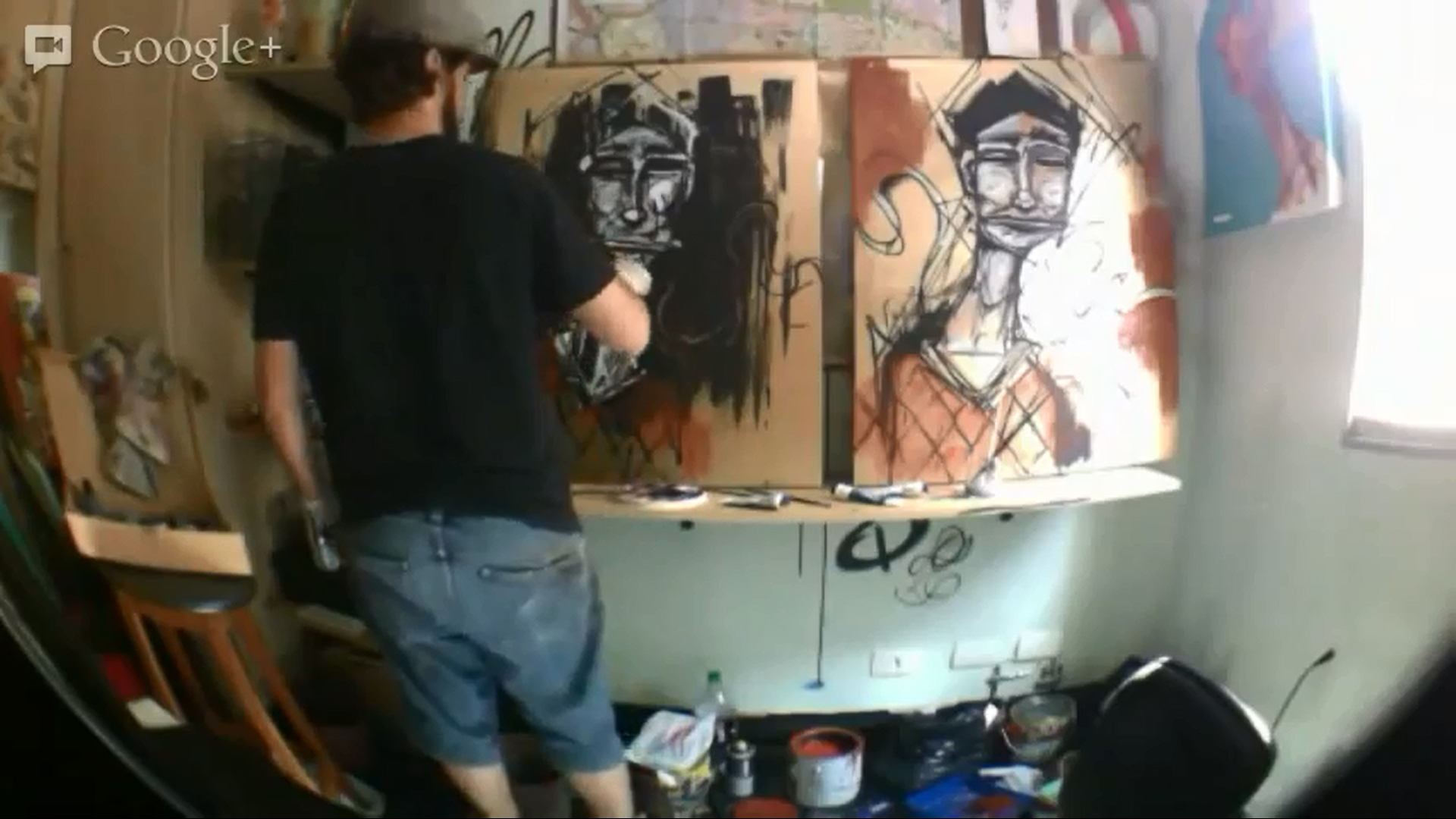
screenshot of Google Hangout of artist Felipe Iskor
Hangouts have also been leveraged in several other artistic ways. For example Google Brazil has used hangouts for their street art campaign, where artist Felipe Iskor created a mural live.
Likewise artists have conducted live studio visits, in which they talk with interested online groups about what inspires them, what their next artwork might look like, and get much needed critical feedback from online art communities.
Understanding Its Impact
Of course, use of a new medium brings new challenges. In trying to gauge the success of video chats, museums are learning how to interpret the relatively sparse analytics information provided by Google+ and YouTube. Statistics like “this video was viewed 5000 times” does not paint a full picture of just how beneficial the video was for the museum and its viewers. It is very clear, however, that hangouts have the ability to reach far greater percentage of the global online community and can do so in a more engaging way. And while it can be difficult to measure the success of these videos, museum educators know it is worth their time to continue exploring the limits of new this technology in order to captivate a broader audience and share more of the museum’s passion for art and cultural heritage.
Possible Uses in the Future
Tools associated with video chatting such as live commenting, image sharing, hash tags, and social media sharing have become additional ways of connecting online viewers with the live discussion. Recently, Mike Murawski of the Portland Art Museum brought up another possible use for video chatting. He suggested using Hangouts as a way of connecting living contemporary artists with museum visitors both in the gallery and online. What would it be like then to talk with an artist about his/her work right in front of the artwork in the gallery? Or watch an artist explaining his/her artwork online while you ask questions?
How can we use these new tools to better facilitate learning and interaction onsite and online in the future? Are there other ways that Google Hangouts or other chatting services will connect people, or perhaps help the museum’s visitors feel closer to its collection?
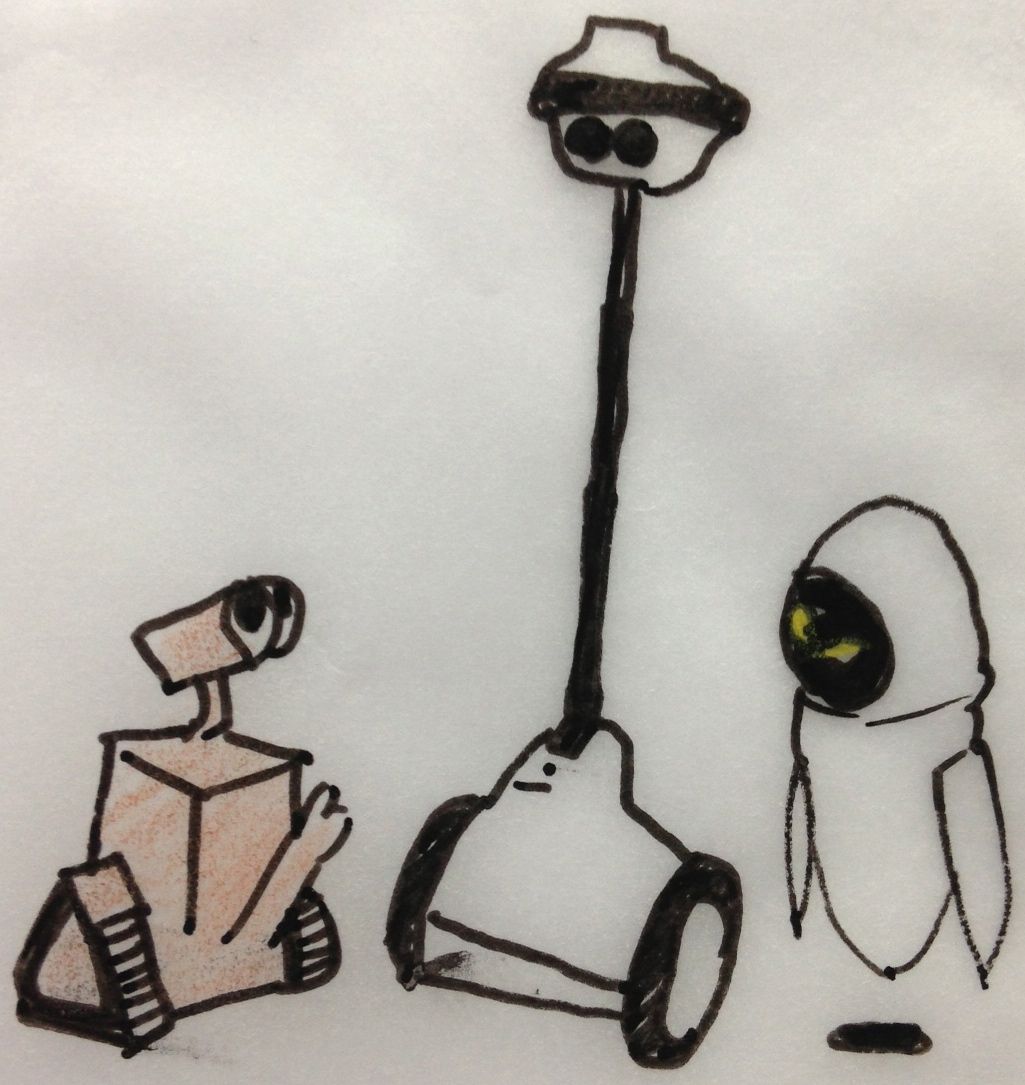
Anybots meets Wall-E and Eve.
Taking this question further in a mini-thought experiment, imagine what would happen if the video feed were not fixed to the wall. What would a more intimate conversation with an artist look like? While you ebb and flow around the gallery, could an artist virtually tag along with you?
One company exploring the idea of digital presence is Anybots, a team that has created a roving avatar robot with video screen projecting the face of a remote participant. The robot is controlled remotely and reacts to speech frequencies to directly address and react to questions or comments from multiple people. Right now, the Anybots are in the hypothetical realm (due to the hefty $15,000 price tag).
While video chatting environments will continue to develop (though at the moment we are not yet sure in what form they will appear) the strides taken by #ArtHang, Google Art Projects, and many other institutions and artist communities will continue to push online connection and conversation.
I am part of the team that has led the development of the Cleveland Museum of Art’s Gallery One and ArtLens iPad app. These new initiatives – blending art, technology, and interpretation – are garnering interest in the press and among museum colleagues. Many thanks to Mike Murawski for asking me to offer my perspective on the project, understanding that it is newly launched and we are in the process of gathering initial feedback. This project is the focus of a paper session at Museums & the Web 2013 in Portland (link to paper here). Responses so far have been enthusiastic as well as probing and have challenged us to think in new ways about what we’ve created and how we want to move forward. Recurring questions from reporters, colleagues, and visitors can serve as a way of introducing some of our goals and future ideas.
What was your plan behind integrating technology?
A view of Gallery One from the main lobby of the Cleveland Museum of Art. Photo courtesy of Local Projects.
Our plan conceives technology as an interpretive tool to drive active experiences with art at CMA. Creating Gallery One and the ArtLens app has been part of our mission to put visitors front and center. We wanted to build a gallery experience at the entrance to the museum that would welcome all visitors, with particular focus on families, college students, and young professionals – audiences that have not always seen CMA as their kind of place. We wanted to offer them new possibilities to experience art in a participatory way through the medium of interpretive technology. We also wanted visitors’ encounters in Gallery One to spark interest in the museum as a whole and to provide tools of understanding and enjoyment that could enhance their experience of art in the galleries.
On January 21, 2013, we opened Gallery One and went live with the ArtLens iPad app. Gallery One is a unique space just off the museum’s main lobby in which 55 top-quality art objects from the permanent collection are arranged in thematic groupings that cross time and cultures. This organization allows visitors to make connections across CMA’s comprehensive collection of world art. For example, sculptures of the human form from ancient Rome, Japan, Africa, and 19th-century France greet visitors as they enter the gallery, prompting them to experience how our bodies have inspired art differently over time. Another installation groups paintings and ceramics from Europe and Asia, asking visitors to engage with roots of our contemporary, global culture. Interactive, multi-touch screens interpret selected art installations, allowing visitors to engage actively with the works on view by virtually creating their own works of art, or by physically striking a pose inspired by a work of art they see. Gallery One also includes Studio Play, a dedicated family space with hands-on art-making activities, as well as interactive technology stations that provide young children and their families with fun ways to have first encounters with art and CMA’s collections.
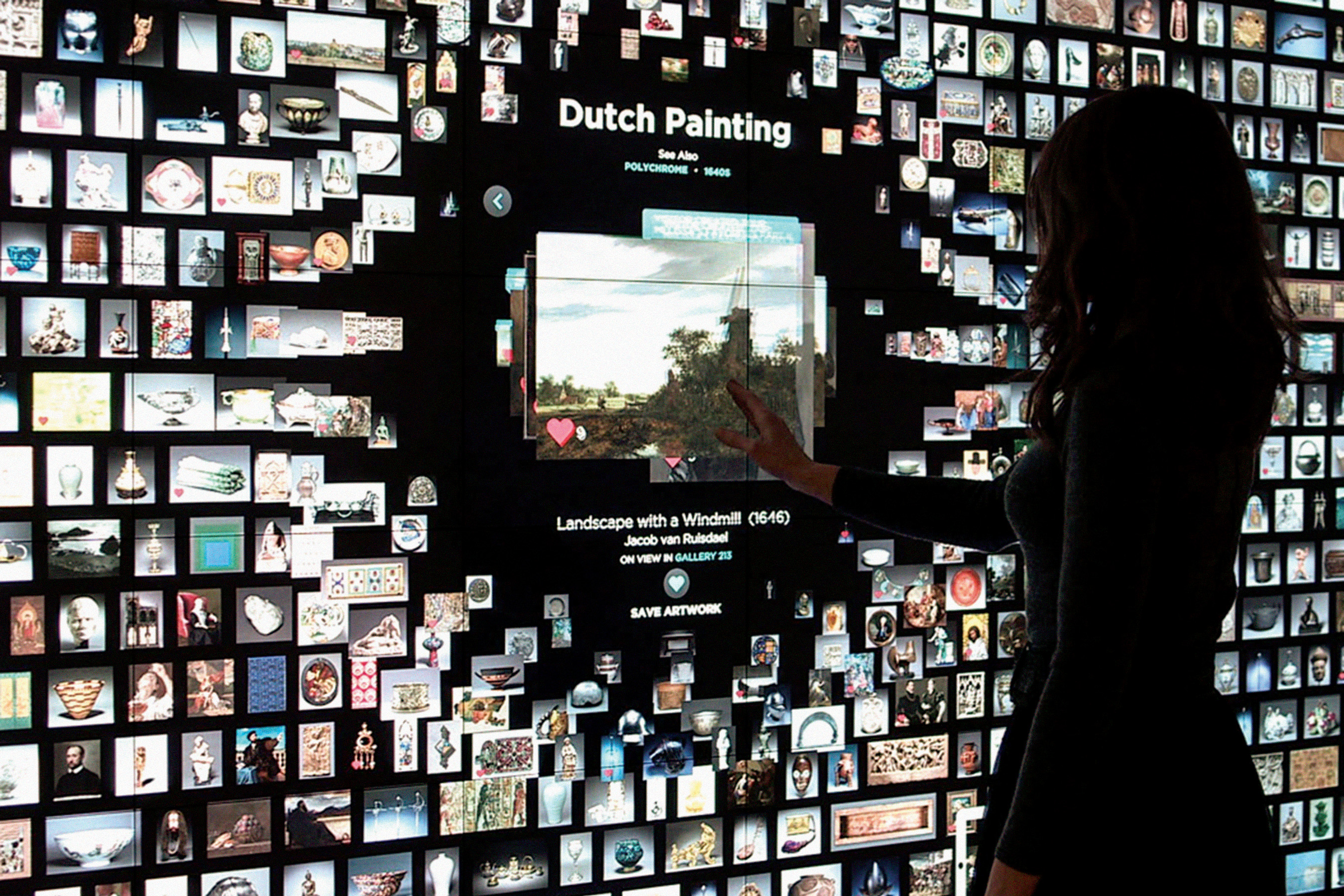
A detail of the Collection Wall in Gallery One. Photo courtesy of Local Projects.
Within Gallery One, just off our new central atrium, a one-of-a-kind, 40-foot multi-touch Collection Wall displays high-resolution images of almost 4,000 works of art from the permanent collection, most on view in the galleries. Every 40 seconds, the wall changes views, showing groupings of art objects based on themes, allowing visitors to see that the collection is dynamic, depending on how you view it. Visitors can touch and browse objects on the Collection Wall to discover other artworks that are related and to find tours that connect objects throughout the collection.
The Collection Wall functions as a place to organize a visit through the permanent collection galleries by way of a unique connection with the ArtLens iPad app. By docking their iPad (or one available for rent) at the Wall, visitors can save their favorite objects to the app and create a personalized tour through the museum. The app’s way finding system directs them to the objects on their tour or to other objects in the collection. They can also find CMA-created tours to organize their visit according to themes they like. Alternatively, they can browse through the galleries and find works of art that engage them, discovering text and video interpretation within the app, or even scanning two-dimensional objects through image recognition to find quick bites of text or video.
What are your learning goals for visitors?
Our goals for what visitors take away involve experience rather than content. We hope that:
visitors have fun with art
the interactive games and interpretation provide tools for understanding and spark social experiences with art
visitors find transformative moments of discovery about continuing creative traditions that make art relevant for them.
Above all, we want to refrain from providing a single, authoritarian guide but instead to offer a variety of choices for visitor engagement. Rather than designing content to meet our own goals for visitors, we have learned from our audience evaluation and responded to the way many of our visitors browse through our galleries, drawn to particular works of art based on their own visual interests and prior knowledge. We’ve been mindful of Jay Rounds’ prescient advice in Curator (2006):
“Visitors come to museums for their own reasons, and those reasons are not necessarily congruent with the goals of the museum. No doubt their browsing through exhibits is suboptimal when compared against [a] museum’s goal that visitors ‘engage in systematic study or exploration.’ But the same [browsing] behavior may prove to be an intelligent response to the situation when measured against the goals of the visitors themselves.” (p. 134)
Sculpture installation in Gallery One. Photo courtesy of Local Projects.
Gallery One and ArtLens were designed to honor browsing behavior. There’s no preferred path through Gallery One; visitors can move from one art installation to another, each with its own story. The Collection Wall asks visitors to browse rather than search: to find artworks they like visually, and to discover connections to related works by theme, medium, or time period. The “Near You Now” section of the ArtLens app follows browsers as they meander through the permanent collection galleries, indicating where they are in the building and the artworks near them. For objects with video interpretation, visitors can find a variety of short segments that they can choose according to their personal preferences rather than a prescribed sequence.
When visitor evaluation begins later this spring, we can find out how these tools are working for our visitors. In the meantime, we’ve been fortunate to have visits from a variety of museum colleagues who have shared initial responses. Following his on-site visit, Peter Samis of SFMoMA wrote to our CMA team:
“The Collection Wall reminds me of David Weinberger’s Everything Is Miscellaneous (2008): it makes every artwork equally available, democratizing the collection…, it enables me to create a tour that threads me like a needle through all the various parts of the building. It disappears the architecture, the molecules, and replaces them with a new organizing principle: visual interest.”
Cool! Interpretive technology serves visitors’ visual interests and democratizes the collection. The challenge comes in the connectivity between the Collection Wall and the iPad app. With the ability to save almost any object to their iPad, what will visitors expect when they reach the actual objects in the galleries? Currently only a portion have video and audio interpretation within the app, some draw web texts and label copy from our databases, but others feature only basic “tombstone” information. We’re eager to discover visitors’ expectations, and in the meantime, to develop priorities for creating new interpretive content.
How can visitors contribute their own art interpretation within the iPad app?
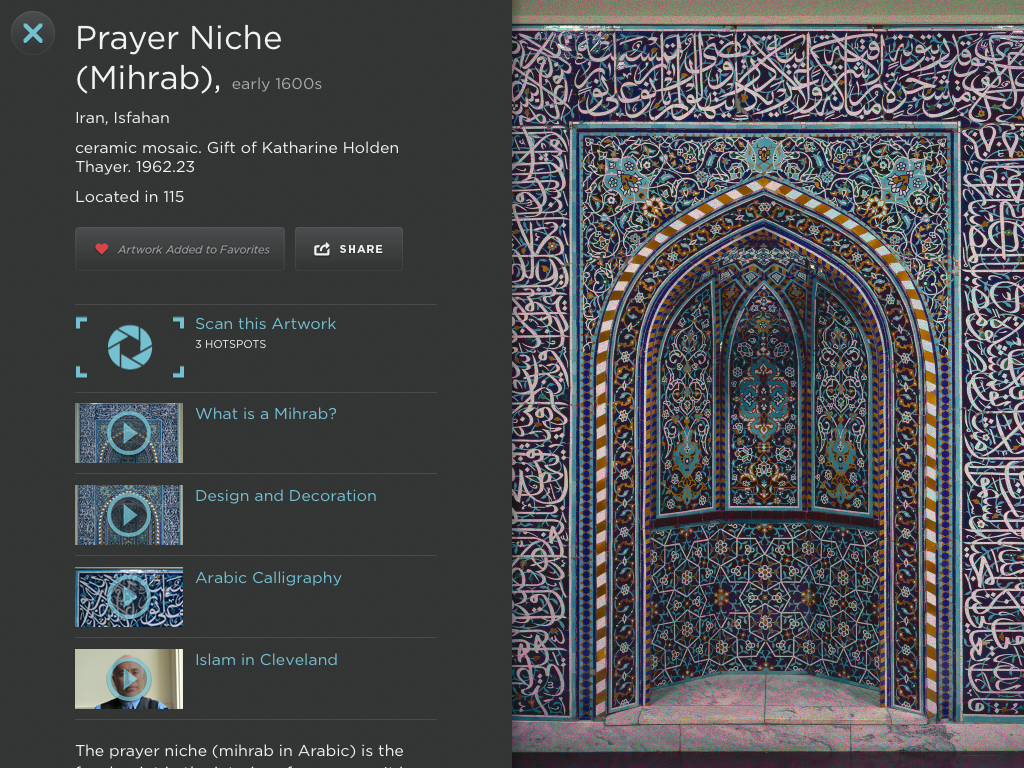
ArtLens video and audio content draws on conversations with curators, educators, conservators, and community members. We hope the variety of voices allows visitors to feel part of the conversation and to suggest that there is no single way to interpret or enjoy a work of art. The community voices are particularly important, as they call up continuing traditions that grow from the artworks on view and connect visitors with people in their community – like the Imam of the Cleveland Mosque for whom the Islamic prayer niche in our collection is part of a living tradition, or the Cleveland ballet dancer who brings his creative perspective to Degas’ Frieze of Dancers.
: Object page for CMA’s Prayer Niche (Mihrab) in ArtLens. Photo courtesy of the Cleveland Museum of Art.
ArtLens also allows visitors to create their own tours – playlists of their favorite objects with their own catchy titles: “Randomness and Variety,” and “Lightning Tour Before Dinner Dash.” They can share favorite objects through Facebook and Twitter. We conceived these as first steps toward more extensive visitor participation. We’ve discussed the potential for gathering visitors’ stories about CMA’s artworks and incorporating them into the app. We’ve also dreamed about the potential to capture visitors’ voices within the app, so that they can contribute their own insights about their favorite works of art from the galleries or from off site.
We encourage you to download ArtLens to your iPad and give us your feedback. Our project is ambitious – an interpretive system that reaches throughout CMA’s permanent collection. I’ve outlined some of our ideas and plans here, but there’s much more to come, so stay tuned!
I want to extend huge thanks to the members of my CMA team in Education and Interpretation responsible for the development of interpretive content in Gallery One: Seema Rao, Patty Edmonson, and Hajnal Eppely, and in ArtLens: Jennifer Foley, Lori Wienke, and Bethany Corriveau. They are part of CMA’s Gallery One development team, led by Griffith Mann in Curatorial, Jane Alexander in Information Technology, Jeffrey Strean in Design, and myself. Local Projects of New York is responsible for all media design and collaborated with us on the concept development. Earprint Productions of San Francisco produced the ArtLens app digital content, in collaboration with the CMA interpretation team.
ABOUT AUTHOR
CAROLINE GOESER currently serves as theDirector of the Department of Education and Interpretation at the Cleveland Museum of Art. Joining the museum in 2009, she reorganized the Education Department in 2012 to focus on two primary goals: 1) invigorating classroom experiences through object-based educational programs, and 2) creating vital experiences with works of art in the galleries through interpretive text, technology, gallery teaching, and public programming for visitors of all ages. Caroline collaborates with the Chief Curator and Directors of Information Technology and Design to oversee the new Gallery One, an interactive gallery for intergenerational visitors. She has facilitated and enhanced the museum’s collaborative interpretation program, which has garnered national recognition with the recent award of an NEH Challenge Grant. With colleagues at CMA and Case Western Reserve University, she has worked to re-envision the joint CWRU-CMA doctoral program in art history, which recently received a major grant from the Mellon Foundation to focus on object-based study. Caroline’s postings on this site are her own and don’t necessarily represent the Cleveland Museum of Art’s positions, strategies, or opinions.
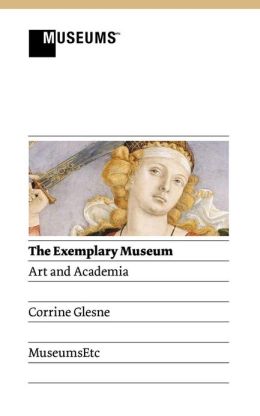
In The Exemplary Museum: Art and Academia, Corrine Glesne takes a far-reaching survey of the state of academic art museums throughout the United States, primarily by means of detailed interviews with the diverse makeup of these museums’ constituents, including directors, staff, students, faculty, administrators, volunteers, as well as public and school audiences. Though my own experience in working with academic museums is admittedly somewhat limited, I became interested in this book through my frequent work with university audiences in museums. I was looking to this book to provide fresh insights into the relationship between the museum and the academic community, and it certainly did provide them. Some ideas presented in the book may already be familiar to many of us, but it was still nice to see them being reinforced across the field. One of the big questions it raised for me is: how can we, as educators, regardless of institutional affiliation, learn from academic museums, which have traditionally focused much more on education at their core than the traditional public encyclopedic museum model of “preserve and collect”? What challenges and opportunities do we have in common with academic museums, and what challenges and opportunities are unique to these museums?
In determining just what makes a museum “exemplary,” Glesne, who was commissioned for this project by the Samuel H. Kress Foundation, narrowed her search by locating academic museums with objects donated from the Kress collection, and further refined her field of inquiry by identifying academic museums through surveys that seemed to be functioning as model institutions in terms of leading by example. This led her to a consideration of twelve institutions. While I would have liked to see a bit more information on the criteria that Glesne used to determine these museums’ “exemplary” status, this particular focus does lend itself to a manageable series of case studies. Tellingly, Glesne begins her analysis of the academic museum with an example of a docent-led high school tour of a Kress Foundation object, revealing her own personal emphasis on the educational role of the academic museum, as well as a somewhat obligatory focus on the role of the “great Kress giveaway” which is the subject of her first chapter. She also discusses how crucial outreach programs and K-12 educational programs became in the development of the academic museum’s history during the second half of the twentieth century, as they transitioned from private study collections to fully public institutions.
Connecting on Campus
Perhaps the crux of the book, in a chapter titled “Art Across the Curriculum,” Glesne discusses how academic museums have attempted to become embedded in the curricula of their parent institutions. For those of you who have worked with faculty before, many of these strategies for engagement in the museum might sound familiar, in terms of seeking out specific courses that mesh with a collection, networking with faculty at regularly-scheduled departmental meetings, and forming committees to develop curricula.
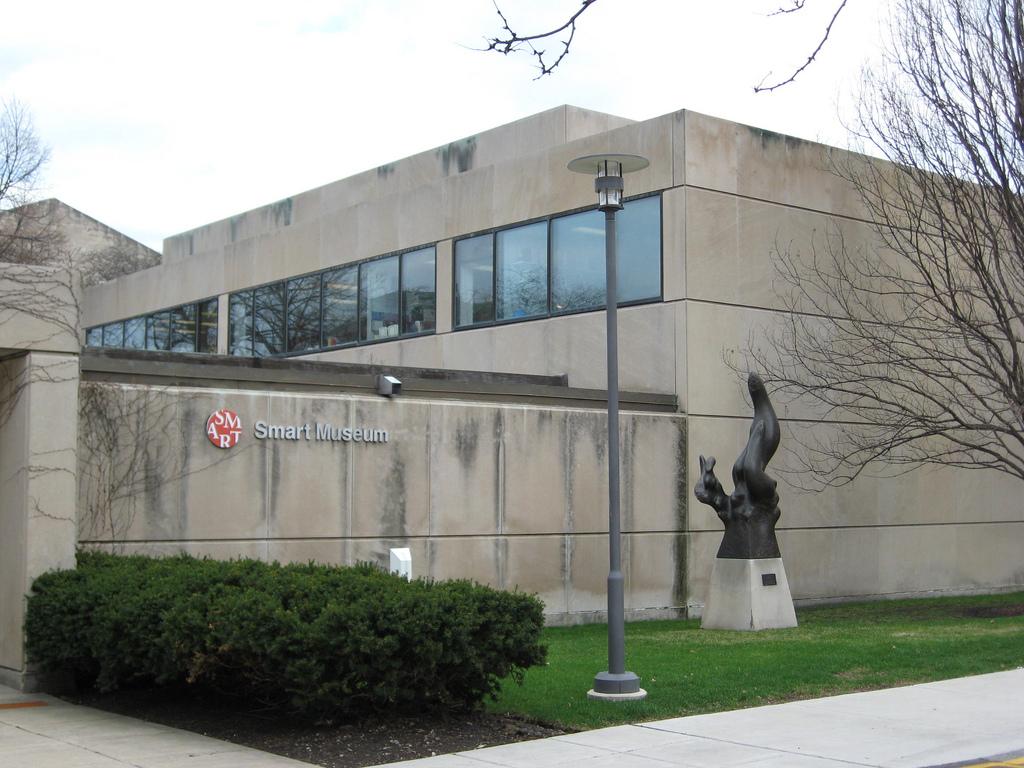
Smart Museum of Art, University of Chicago
For me, this chapter reinforced the challenges of finding meaningful, sustainable connections with classes and allowing faculty, especially those from non-art-related disciplines, to feel independent and at home in working with a collection on their own, rather than with a museum staff serving as a mediator. Glesne also suggests some very novel approaches to connecting with faculty, including emphasizing the museum’s presence at new faculty orientations so that they are aware of the possibilities a museum can offer before they have even designed their classes.
In a particularly useful section of this chapter, Glesne breaks down the ways in which museums connect with academic curricula by identifying specific categories of curricular involvement. These categories include:
“Skill development,” for example, a foreign language class that uses museum objects to provide structure to a conversation;
“Interdisciplinary analysis,” or using a museum’s collection to find meaningful cross-references to other, non-art-related aspects of history;
“Comparative analysis” which seeks to make connections around specific concepts, for example, how objects might communicate different messages about “love” across time and cultures;
“Social critique,” which is often a topic of engagement for classes, especially as academic museums are sometimes more in a position to take risks in terms of controversial exhibitions;
“Research,” or how the practice of art historical analysis can cultivate research skills around these objects as primary source documents;
And finally, “creative inspiration” as a platform for the creation of works in other forms or media.
Glesne also discusses the increasing role of the “academic curator” as it evolved out of the Mellon Foundation’s College and University Art Museum Program, and how this unique position has played a vital role in establishing stronger connections between academic museums and university faculty. As Glesne points out, this position has often had the effect of freeing up the academic museum’s other education staff to think in a more focused way about K-12 involvement. However, I am somewhat cautious about this split, as it could be seen to reinforce differences in the approach to these two audience segments, rather than seeking to address commonalities between them. On the other hand, I often wonder if public museums might find an academic curator to be a valuable position in terms of focusing on increased interactions with college audiences.
Alternative Forms of Campus & Community Engagement
Glesne’s next chapter, “Museum Art in Everyday Life,” considers the ways in which academic museums seek to connect to students and the public outside of the curriculum. She discusses the many ways in which campus art museums have tried to increase visibility through social events and informal learning. Some examples that stood out in my mind are the Snite Museum of Art’s desire to make the Museum a kind of alternative “tailgate” space to connect the Museum with Notre Dame’s much more visible football games, and the always-popular Art Rental Program at Oberlin College’s Allen Memorial Art Museum. I was particularly struck by how meaningful the ability to check out original works of art has been, not just for the students who rent these objects (for a mere $5), but for the greater Oberlin community, including a senior center that proudly displayed works from the program in its central building. Some of simplest, yet most effective programs involve turning over the programming to a student advisory council, allowing students to take ownership of the galleries. Glesne concludes this chapter by discussing the role that academic museums play in preparing people for careers in the arts. In surveying 79 museum workers, including staff, faculty, volunteers, and students, she concludes that while, admittedly, involvement in the arts is usually something that is inculcated at a very young age, experience with an academic museum in college can lead to further interest down the road in a career in the arts.
In the Periphery and at the Center
In the final section of The Exemplary Museum, Glesne ruminates on the larger role that academic museums play, both in academia and in the art world. She addresses the often peripheral nature of these spaces and the effects that the recent economic downturn has had on many campus art museums. However, she also addresses the ways in which these museums have been successful, through positioning themselves as centers of arts and culture on campus, and/or emphasizing the possibilities for collaborative, interdisciplinary education. For the public community, she notes that academic museums have been invaluable in providing arts access to regions that are either rural or are outside the coastal art centers of the United States.
Remarkably, Glesne first discusses the importance of the academic museum through metaphor, noting that her respondents often used words like “hidden gem, platform for narrative, catalyst, laboratory, library, and portal” in describing the changing role of the campus museum (p. 204). While these terms are certainly applicable to the twelve exemplary museums that Glesne surveys, they are also pertinent to the larger discussion about the shifting role of museums in the 21st century. Glesne also includes a useful bibliography and appendix section at the end of her book, including mission statements from participating museums, detailed responses to questions on why participants became interested in museums, and questions that she asked of museum directors. Of particular interest to the readers of this blog, she also includes an appendix on examples of educational technology in academic museums, which often tend to overlap with faculty projects involving these technology platforms.
Overall, The Exemplary Museum: Art and Academia provides a thorough and compelling survey of recent activities of academic museums around the country and the unique challenges and opportunities they encounter. While educators in public museums may find some of these ideas familiar, it is heartening to know that we are not alone in our work, and the unique role of the academic art museum provides a fascinating set of case studies for thinking about how any museum can make education at the center of its mission.
I am interested in hearing more on your thoughts on Glesne’s book in the comments below, especially from those of you who do work in academic art museums.
I was recently asked “What are your core values as a teacher?” For a moment I was stumped. I have taught students and colleagues about articulating clear and effective core values and the importance of using these to guide strategies and practices. I referenced established core values and used them in my own work as a museum educator. However, I realized that I had been thinking about institutional core values. What are the core values of your museum? What are the core values of your department? While I felt that I had a strong sense of who I was as a museum professional, it has been a very long time since I thought about and articulated mycore vales, separate from the institution where I worked. This process was eye opening and resulted in something very valuable—knowing my core values.
So what are core values? In their book Built to Last, Jim Collins and Jerry I. Porras define core values as “the essential and enduring tenets of an organization—the very small set of guiding principles that have a profound impact on how everyone in the organization thinks and acts.” The National Parks Service further defines core values as foundational values that are “so important to us that through out the changes in society, government, politics, and technology they are STILL the core values we will abide by.” I like to think of core values as:
Those things that you will go to the mat for and defend doing every time.
The things that you will keep doing even if you are penalized for doing so.
They must also have a consciously rejected but equally viable opposite (more on this later).
If we re-draft Collins and Porras’s definition for ourselves, core values are the essential and enduring tenets for our lives—the very small set of guiding principles that have a profound impact on how we think and act.
A key to this definition is the phrase “very small set.” I recently read, “If you have 10 core values, you don’t have core values, you have a shopping list.” Core values should be honed to get at the depths of your guiding principles. You should be able to remember and list your core values on one hand, or may one hand and a thumb, and be able to practice these values everyday, not just on the ideal, perfect once-in-a- lifetime day.
“What do you love to do?” or “How to find your core values?”
I must admit this took me a while. When I had done this work with my own museum colleagues or students it had always been generative group process, but on my own I found myself staring at a blank page. Clearly I had to stand for something, but what? Lots of museum and education jargon floated in and out of my mind. I decided to start making notes throughout the week. I kept an ongoing list on my phone of all the things that I did that were important to me or I felt good about doing, from job tasks, to how I acted in a meeting, to how I taught a program. I also looked for things that I saw in others that I appreciated and respected. In addition, I kept a list of all the things that upset and angered me, both in my own actions and those I saw exhibited in others. The latter I analyzed for what was upsetting me and considered what the opposite might be. From these lists I had a more honed and simplified one, but it was still a shopping list.
The next step was to really get to the core. I took each item on my list and asked a series of questions.
While seemingly silly at the outset, this is a very challenging exercise. Each questions requires deeper soul searching and greater clarity. The process asks us to challenge our assumptions and look deeper at the things that we do and why we do them.
Through this process many of my initial ideas remained on my list of core values, others merged, and some fell off all together because I realized that they were more about my own capacities or an institutional culture, not a personal core value.
The final step was to ask myself what was the viable opposite of each value, and did I consciously reject it. As with many things in life, knowing something’s opposite makes you understand it that much clearer. For example, if I value collaboration, the opposite of that would be to work alone without the help or contributions of anyone else and the belief that a single mind makes the best ideas and products. I consciously reject that idea. By the end I was able to be more articulate about why my personal core values were important to me and why I would be willing to defend them, no matter what.
You are probably asking, “What did you come up with?” I came up with a list of five core values. I share them with you only as an example. You core values must truly be your own.
Listening— It shows care and respect for others and builds trust. When teaching in the art museum trust is essentially to creating dialog around works of art. It enables people to feel safe to share their ideas, leading to greater understanding of each other and works of art.
Reflection—enables us to pause and a look back upon what we have experienced and learned. It is essential for improving our practice as teachers and the experience of our students. It is also critical to aligning our teaching with the goals and values of our programs, our institutions and ourselves.
Collaboration—enables us to create something that is stronger and better as the result of many people contributing to its creation. When teaching in the museum learning becomes a collaborative process in which all participants contribute to the experience, making it stronger and more meaningful than if the teacher solely directed it.
Acknowledging the skills, experiences and contributions of others—When we do this, we show respect for others and value what they bring. Although seemingly simple this is critical to open communication. In the workplace, in our partnerships and in our teaching, this practice can open dialogue, leading to more meaningful interactions, and a greater sense of agency.
Mentoring—mentorship and support can go in all directions, upward to our directors and managers, horizontally to our peers, and forward to a younger generation of practitioners. I am committed to the profession of art museum education and believe that as a practitioner I have a responsibility to contribute to the growth and improvement of the field as a whole. I also believe that I have not made it to where I am today in my career alone. I owe a debt to teachers, advisors, colleagues and the students I have taught. This cycle of mentoring invigorates and improves the field of museum education and thus the experiences of students, the value of works of art and art museums.
Why is THIS important to you?
So why should we do this work. As I said before it isn’t quick and it isn’t easy. But it is valuable.
Core values can help us make decisions. In “Ten Essentials for Getting Value from Values,” Rosebeth Moss Kanter explains that principles guide choices. While she is speaking about for profit businesses, this can also apply to us. When we know our core values, our decisions become clearer and simpler.
Core values can help us be our best selves and guide us in aligning our actions with our values. Rosebeth Moss Kanter also writes, “principles are codified, made explicit, transmitted in writing in many media, and reviewed regularly to make sure people understand and remember them.” While I don’t think you need to scream these from the mountaintop or put them on a t-shirt, I would encourage you to write them down. I keep mine tacked to the wall next to my computer. I see them everyday. As I wrote this I reviewed them and asked myself if they still held true. They guide me day-to-day, project-to-project, and keep me pointed in the right direction. If you are in a safe work environment I encourage you to share your core values with your colleagues. This process can build understanding and generate a discussion about how your shared work embodies the values of your team members.
For me, this process helped me better understand the kind of place I wanted to work and the kind of work that I wanted to be doing. Many of my core values share similar sentiments and ‘lead in a direction.’ Is that the direction that I am going?Is that the direction that this institution is going?Am I living my core values?When we ask ourselves these kinds of questions and live our core values we work smarter and more passionately, our work is more meaningful, and we are better educators.











 Art Museum Teaching