How Can Museums Change Teens — and Vice Versa?

Written by Chelsea Kelly, Milwaukee Art Museum

Over the past four years, I have worked with hundreds of Milwaukee-area teens who love art, and who, over their time in teen programs at the Milwaukee Art Museum, grow to love museums as well.

I have always had a sense that my students grow over their time at the Museum. This year, though, to really study that growth, we designed our longstanding Satellite High School Program as a year-long experience to explore exactly how weekly sessions at an art museum might change the thinking of our teen participants. To that end, our program outcome for students was that they would show an increased ability to reflect upon their own experiences and performance.

Evaluation is a grey area—much like teaching and interpretation—and we as educators need to use multiple methods in order to get a fuller picture of what’s going on with our students.

This means I’ve been thinking a lot about evaluation: How do we show change was made? Years ago, I thought evaluation was more or less a prickly, black-and-white, necessary evil that forced me to use altogether too much math. But over the past two years, I’ve come around to believe evaluation is completely the opposite (though math is still important!). Evaluation is a grey area—much like teaching and interpretation—and we as educators need to use multiple methods in order to get a fuller picture of what’s going on with our students. And further, these methods can be tools to help our teaching, improving programs and our impact on students.

In the end, I found I needed to use reflective practice myself to understand how my students were changing, and to explore and experiment with a number of different methods for articulating their growth. In this post, I’ll share a few of the methods we used in the Satellite High School Program this year to explore how our teen interns changed through reflective practice.

First… What is Satellite?

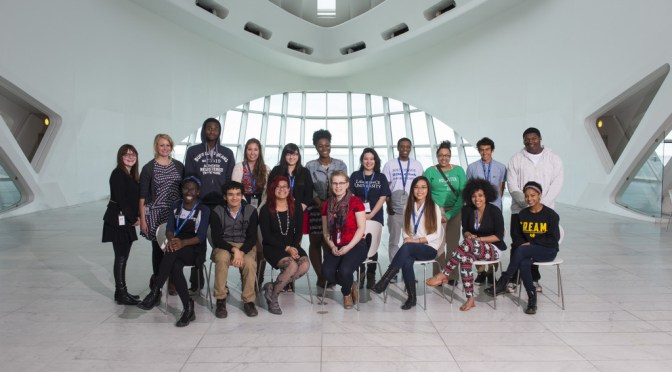
The Satellite High School Program is a year-long internship for sixteen teens ages 16 to 18 from diverse high schools all over the Milwaukee area. Once a week after school, they come together at the Museum and explore how art can be made relevant to our lives today. They participate in “object studies” (hour-long discussions on a single work of art), behind-the-scenes career talks with staff, and resume-writing workshops, and also mentor elementary school students in tours of the permanent collection.

Teens create a final project that has a real-world impact on the Museum. They choose a work of art in the Museum Collection, research it, and form their own interpretation of the piece. In past years, students have created responses in visual art, writing, or performance. This year, the students used iPads to create videos on their work of art, explaining what the work means to them and how it changed their thinking or art practice. You’ll see a few of those videos later in this post.
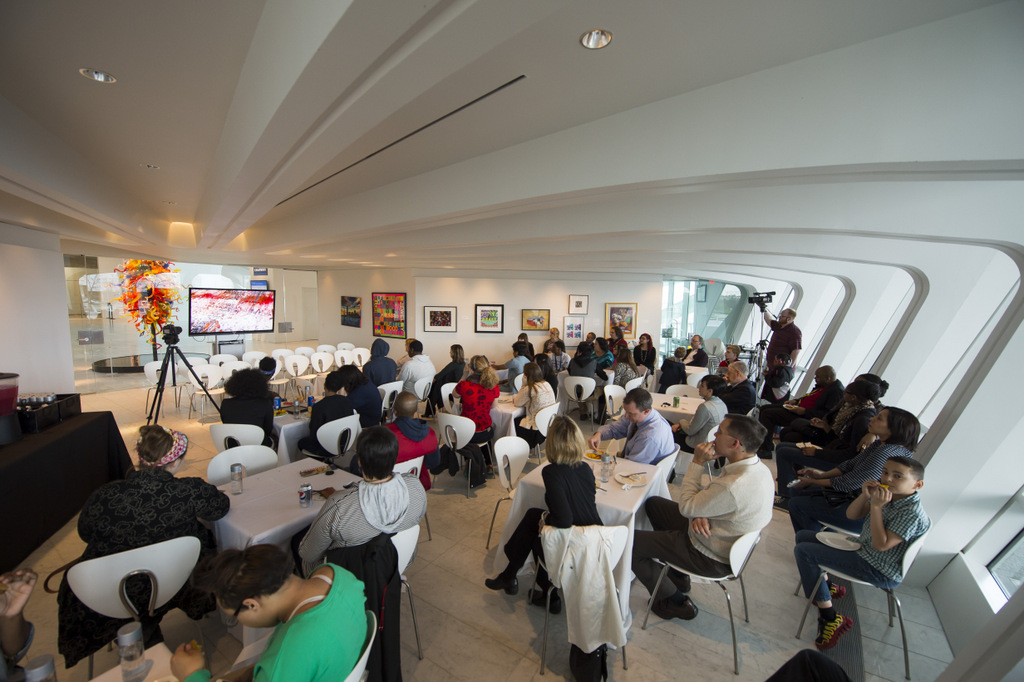
Friends, family, and teachers of the Satellite interns watch their final project videos at the program celebration. Photo by Front Room Photography

Core Evaluation

Let’s start with the core evaluation method we used for the program. We were lucky to work with one of our teen program funders, the Milwaukee Public Schools Partnership for the Arts & Humanities, and the University of Wisconsin-Milwaukee’s Center for Urban Initiatives and Research (CUIR) to develop the outcome above and to establish a tool to measure it.

We settled on one-on-one interviews, doing a “pre” interview on the first days of the program in October and a “post” interview on the final days of the program in May. Each student was privately asked the same set of questions in the pre- and post-interviews, meant to get at their ability to reflect on their experiences in the program. I scored each interview on a rubric that measured level of detail in their responses, and then we compared their pre-program score to their post-program score to see if they had improved.

At the end, every student did improve in their ability to reflect—their answers got significantly more detailed. As someone whose default is to be a more qualitative thinker, it was rewarding to use the rubric to see their interviews as data, in a quantitative, more tangible way.

But as helpful as this was, it’s still just one method of evaluation. Being able to explain in detail is certainly one aspect of successfully being able to reflect. But as I listened to their responses, and thought about what I had seen in the students over the course of the whole year, I realized there is much more to reflecting than just detail. Their responses used stronger vocabulary, they expressed sophisticated ideas, and they asked more and deeper questions. How could I articulate that kind of change?

Unexpected Data

Happily, along the way, we also found that we had collected some unexpected data which helped me more concretely see the change in my students.

Exit Slips

At the end of each session, teens used a web app on their iPads called Infuse Learning to fill out a quick exit slip survey. Exit slips are an easy way to take the pulse of your students at the end of a session. For Satellite, they answered the questions “What is something you learned today?” and “What are you still wondering about?” Though different from our interview questions, these certainly also support reflective practice by thinking back on the day’s session.

As the year went on, I noticed that the teens ‘ responses were growing more sophisticated: they were longer, they used more art vocabulary, and they realized that they might not be able to answer questions definitively, if at all. At the suggestion of Marianna Adams, who specializes in museum research and evaluation, I tried running these responses through two readability tests to see if that would quantify the sophistication of these responses. One test produces the sample’s Fog Scale Level, which measures syllable count and sentence length (a score of 5 being readable, 20 being very difficult). The other was for the Flesch-Kincaid Grade Level, which approximates the average grade level necessary to read and understand the text.

For the first question (“What is something you learned today?”), students’ scores jumped considerably in Fog Scale and Reading Level. Since these tests measure syllable count, sentence length, and grade level, this corroborates with what I found in the core evaluation.
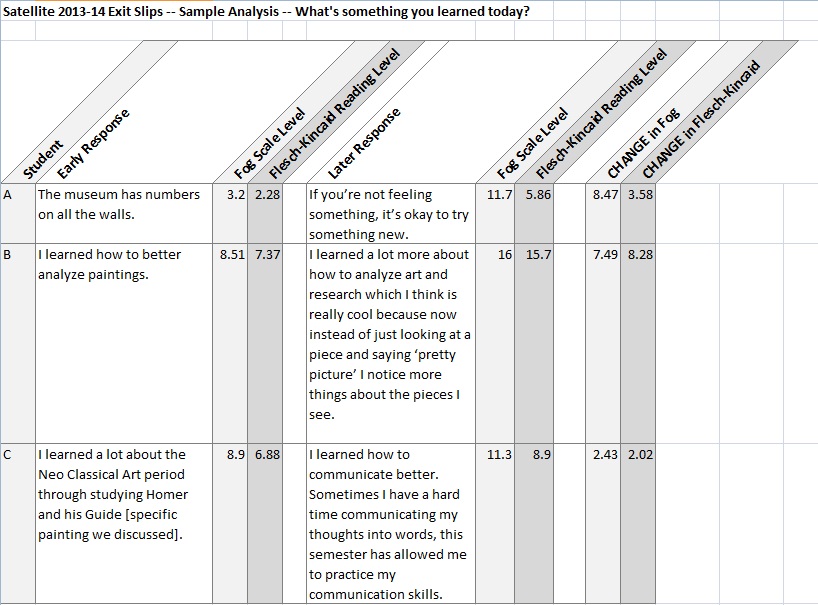
somethingyoulearnedtoday

But I was surprised to see that when I tested responses to the second question (“What are you still wondering about?”), students’ scores actually dropped! Yet if you read their responses, there is a drastic change—for the better.
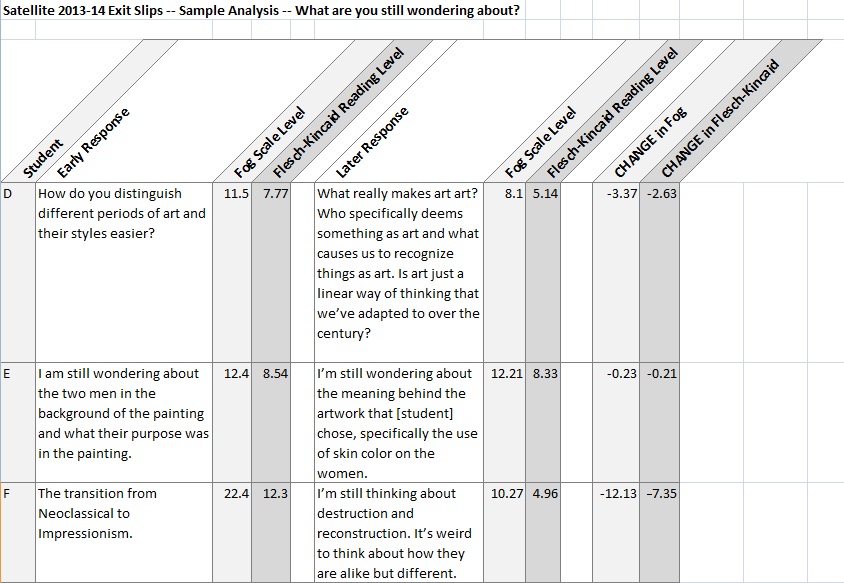
stillwonderingabout

Take Student D’s responses. In his early answer, he asks a relatively basic art historical question about distinguishing one type of art from another. In his later response, he is thinking deeply about the purpose of art and how we even decide what art is. And while Student F uses high-level art history vocabulary in her first response, it’s without context; later on, she’s thinking about how two seemingly opposite concepts may have something in common after all.

The scores of these comments may have decreased, but I’d argue that their reflective quality increased—the teens ask big questions that might not have an answer; they ditch high-level vocabulary to more informally muse on philosophical questions of art, destruction, and race. Running these responses through the tests helped me see, again, that while tools can be helpful, they’re ultimately just one tool—we need more than one to paint a bigger picture.

Videos

To round out that image, I’ll share one final unexpected evaluation tool: the teens’ final project videos as well as a talkback session they conducted at their video premiere.

For their final project, each student chose one work of art in the Museum Collection and looked at it, researched it, and talked about it with others for seven months. (Given that most visitors spend under 10 seconds looking at art in museum galleries, this is a feat in and of itself!) They distilled a school year’s worth of thinking into brief, 2-4 minute videos that answered what the work meant to them, what it had meant to others, and how their own thinking had changed as a result of looking at the piece—all questions with, of course, that familiar reflective bent.

The teens also participated in a talk-back/Q&A at the celebration where we premiered these final projects. Guests—museum staff, teachers, family, and friends—asked the group questions about their experience. If you like, you can watch the teens’ videos, along with the Q&A, in the YouTube playlist below.

Impact — Can Museums Change Teens?

So: does all the above—interviews, exit slips, readability tests, and final projects—add up to a full image of the impact that a year’s worth of reflective practice can have on students?
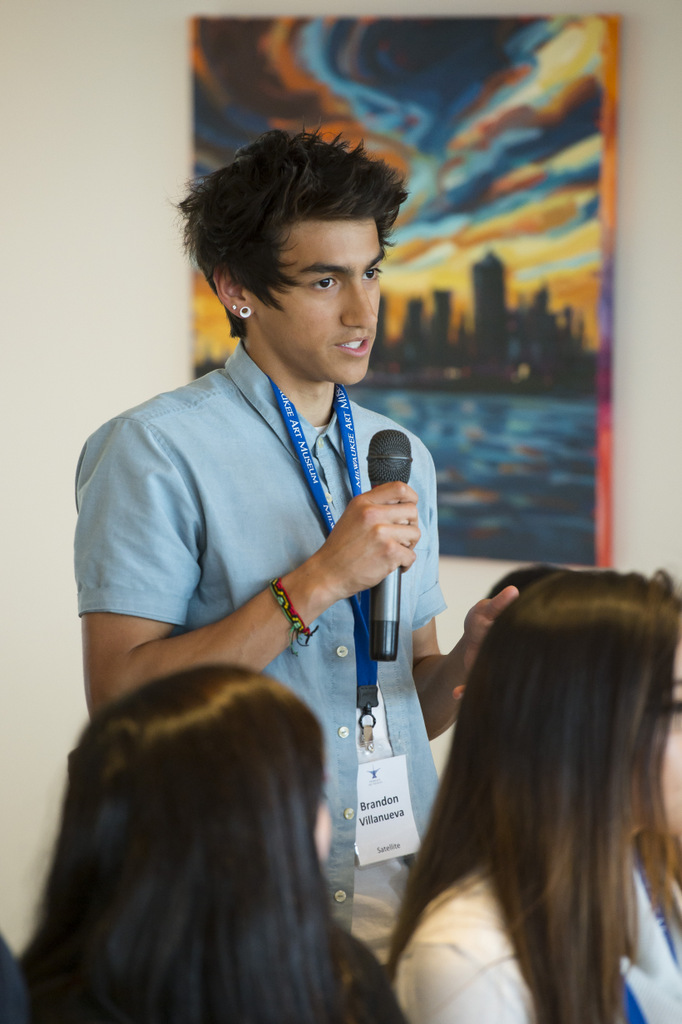
Brandon answers a question during the Satellite premiere Q&A session. Photo by Front Room Photography

I’m not sure we can ever paint a full picture of student growth in intensive programs such as this one. I do think combining all of these tools can help, though—especially if the evaluative tools actively support the goal of the program. The interviews, exit slips, and activities were all intentionally structured to be reflective, related to the outcome itself. This relevancy was key, not only in genuinely evaluating the program’s success, but also in supporting the students’ abilities through the methods themselves. It’s also important that we educators make the program goal transparent to the students. The Satellite interns knew from the beginning that they were working on reflective ability—this helped prime them to think reflectively from the get-go.

As far as impact beyond reflective capacity, I also want to share a few quotes from the teens themselves about their time in this program:

“The videos help us think deeper about what we do—so even in school I think deeper about what I’m doing or why this was made or why this happened.”
“I learned that I shouldn’t judge a book by its cover. When I first saw my piece I just thought it was a bunch of different colors and didn’t really think about it actually having a meaning. But now I’ve learned that it actually has a super cool meaning behind [it], and I never would have learned about that meaning if I hadn’t taken the chance to explore. So I shouldn’t be so quick to judge.”
“We had to give tours and I found out that I really like to work with children and art at the same time. I would like to pursue a career in art education for elementary school students.”
“I was able to change and evolve my way of thinking, now being able to look past the obvious… I learned that art holds all the answers to any questions anyone may have, you just have to search for it.”

From the other evaluation tools, we saw that the students developed their ability to reflect on themselves and their own performance. But as seen in the comments above, they were also able to develop skills reflecting on the world beyond them—the world of art history, their future careers, how they interact with other people. All of these are ways of thinking that are valuable for their futures, as they go to college, discover their passions, and pursue meaningful career opportunities.
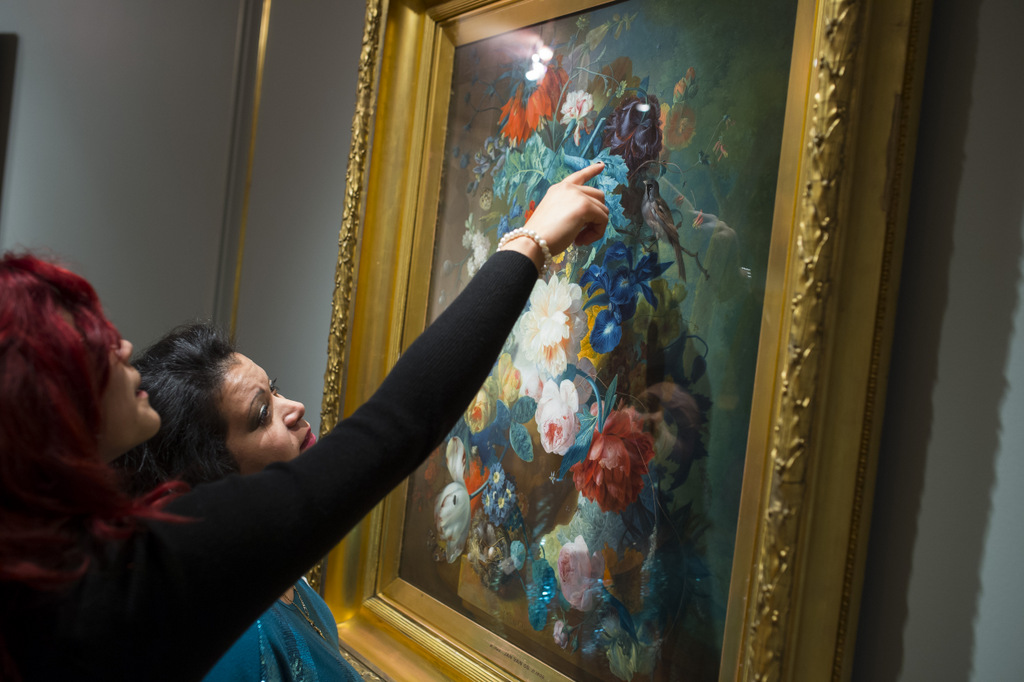
amt7_FRPhoto_140515N_C2_0135

Can Teens Change Museums?

I’ve shown how this program helped these students grow in many ways. What about the Museum itself? Have these students had an impact on our institutional practice?

Institutions move at a slower pace than most programs, and if change and impact are complex to measure in sixteen individual students, then it’s multiplied tenfold for an organization that serves hundreds of thousands visitors a year. Even so, over the past few years, the work of teens in our programs has slowly but surely worked its way into the daily fabric of the Museum. Teens have interviewed artists on behalf of the institution. They have advised docents on ideas for giving tours to high schoolers. Their video projects will be part of on-site and online Collection Resources at the Museum, as well as our Archives, for all visitors to access while learning about works of art.

Ultimately, evaluation and impact are ongoing, a grey area that has a lot in common with the act of teaching itself. When done well and intentionally, evaluation doesn’t just show if we’ve met a goal. The tools we use to evaluate ideally become part of our teaching practice, because they reinforce the very abilities we are trying to help our students develop.

As for what I’m still wondering about? This year, our evaluation methods for the most part required the teens to have specific existing skills, such as writing for the exit slips or proficiency in using an iPad (though we did have video-making workshops as part of the program). I’m thinking about other ways to holistically gather data. For example, given that much of our evaluation methods emerged from teaching tools, should I document or film our discussions with works of art and find ways to analyze them? I’d love to hear any ideas or tools you’ve used to evaluate your programs, just as I hope this post has inspired you to take a fresh look at your teaching practice and find unexpected ways to see the growth in your participants.

*     *     *     *     *

ABOUT THE AUTHOR
Milwaukee Commercial PhotographerCHELSEA EMELIE KELLY: Manager of Digital Learning at the Milwaukee Art Museum, where she develops educational technology initiatives and oversees and teaches teen programs. She is passionate about using gallery teaching and technology to foster relevancy for art museums in the 21st century. She has previously worked at the Frances Lehman Loeb Art Center, the Metropolitan Museum of Art, the Frick Art & Historical Center, and the Carnegie Museum of Art. Chelsea is a graduate of Vassar College and holds an M.S.Ed. in Leadership in Museum Education from the Bank Street College Graduate School of Education, where she was a Kress Foundation Fellow. She is also the founder and co-editor of The Art History BlogChelsea’s postings on this site are her own and don’t necessarily represent the Milwaukee Art Museum’s positions, strategies, or opinions.
Reflecting on a Hybridized Museum Practice

Editor’s Note: This post is part of a series on ArtMuseumTeaching.com during August that focuses on the recent book Multiculturalism in Art Museums Today (2014). Find links below to additional posts in this series by several of the book’s authors, and please join us for an Online Book Club via Google Hangout on August 20th.

Written by Marianna Pegno and Traci Quinn, University of Arizona

In our chapter entitled “Collaborating with Communities: New Conceptualizations of Hybridized Museum Practice” in Multiculturalism in Art Museums Today (2014), we explore Homi K. Bhabha’s ideas of hybridity and cultural translation as they apply to our own practices.  We focused on two programs — Peaceful Migrations and Giving Voice — wherein participant voice was key to creating content, programmatic structures, and exhibition design.  In this reflection we demonstrate how these guiding frameworks continue to inspire our practice as museum educators and researchers, and further explore how we utilized these ideas while developing an exhibition entitled [IN] Translation.  Focusing on the concept of hybridity, we reflect on three continuing issues:

  1. the difficulties of including many voices;
  2. persistent hierarchy and departmental separation in museums; and
  3. our desire to include the museum visitor as a key player in hybrid museum practice.

Bhabha (1994) explains hybridity as an act that “entertains difference without an assumed or imposed hierarchy” (p. 5).  Through this lens, we view the museum as a place of multiple meanings that produces a mixing and mingling of ideas, opinions, and creative visions. For museum educators, it can foster new ways of thinking about educational practice, programmatic structure, and exhibition content not as separate entities but as collaborating endeavors.   Thus, through the process of developing [IN]Translation, our goal was to work with audiences and artists to rethink how the museum pedagogy can be more experiential in nature.  We were working to transform the museum into an empowering environment that conversed with multiple narratives rather than simply our own curatorial or educational voice.

 Thoughts After Publication

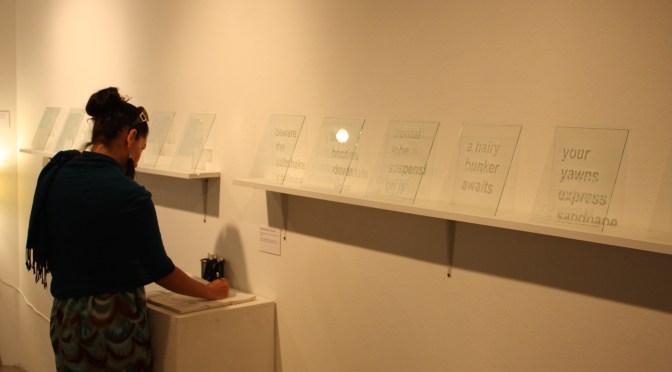
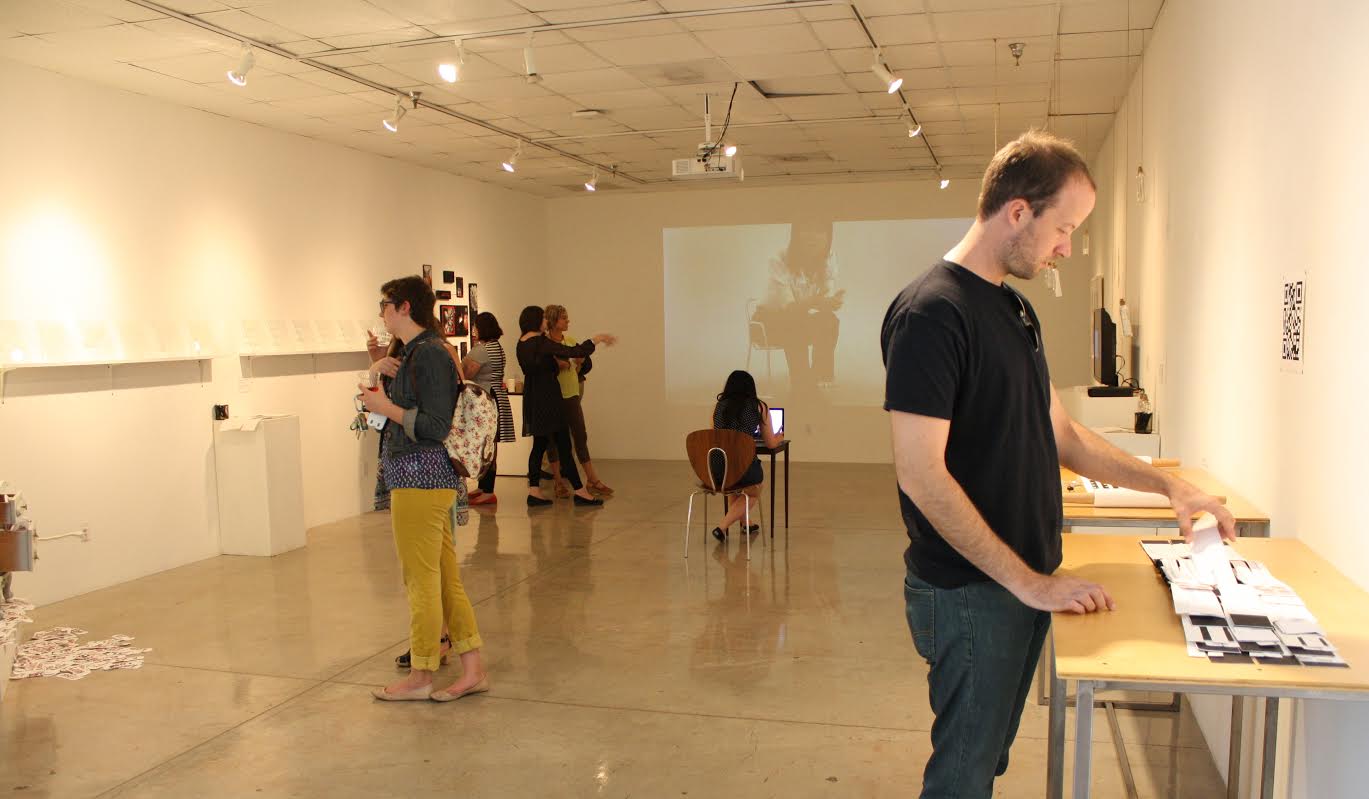
InTranslation installation view

We continue to grapple with hybridity as it relates to museum education and institutional structures.  In the development of educational programs we are trying to include as many voices as possible — which is not always easy.  We have continued working with refugee families who participated in Giving Voice to develop in-gallery activities in which participants collaboratively created narratives about artworks in the museum.  As a result, some of these reflections were affixed as a wall label next to the respective artwork, empowering refugee participants to display ideas about an artwork. While the institution has been more accepting of our work to reflect hybridity within the museum space, it is not as widely pervasive as we would like and only selectively displayed and included.

In relation, we constantly face inquiries and pushback from individuals and colleagues who are unfamiliar with the projects or who have no desire to make museum practice more collaborative across departments and with audiences.  The projects we discussed in the book chapter and the projects we continue to develop & research take significant effort and time in order to avoid falling back into the institutional habits of hierarchy.

Individuals that do not have a relationship with the projects are often reluctant to participate in shared planning – or simply cannot dedicate the necessary time. We believe that their experience in the field is invaluable to the success of collaborative efforts, and yet we are met with frustration when they remain separate from educational motivations and thus the program participants.

Another issue that emerged throughout the development of our chapter and ongoing practices was our inability to anticipate visitors’ responses to exhibitions and educational endeavors addressing racial, political, and cultural interpretations of hybridity.  When addressing such content, many visitors revert to stereotypical views that we are hoping to complicate through hybridized co-creation.  Thus, we have been pressed to develop new experiences in the gallery that foster hybridity within the audiences’ interaction with the museum space and artworks.   This idea of including visitor voice was one of the central components to the curatorial and educational design of [IN] Translation.

Thoughts on [IN] Translation

 Visitor participating with Kristen Cochran's "Notes to self" from the exhibition [IN]Translation ARTIST WEBSITE:  http://kristencochran.com/home.html
Visitor participating with Kristen Cochran’s “Notes to self” from the exhibition [IN]Translation
ARTIST WEBSITE: http://kristencochran.com/home.html
Through [IN] Translation, which was displayed in an exhibition space where were not beholden to a defined structure or hierarchy, we were able to explore these above concerns further and reflect upon our practice under conditions that fostered an ideal hybrid between education, curation, artist, and visitor voice.   More specifically, we designed educational installations to supplement the works of art, most of which included opportunities for visitors to add visual or text elements and share stories and reflections. The goal was for the works and the participatory elements to hold equal weight in the design of the exhibit.

[IN] Translation featured eight works of art: one commissioned multi-media work by collaborating curator and artist Anh-Thuy Nguyen, plus seven juried works.  The educational component of each artwork was planned with the artists throughout the development of the exhibition, in order to ensure that the artwork was not inappropriately changed or compromised by the educational elements.  This exhibition provided us an opportunity to challenge hierarchies within a gallery space. We were able to show how the multiple positionalities of educator, curator, artist, and visitor inform one another – migrate within, around, and through one another – in order to foster a different sense of a museum experience.

[IN] Translation was an opportunity to play with the boundaries that normally exist as impermeable divisions between curator, artist, educator, and visitor; we could question how these roles could be seen as transitional, or process based.  Within this exhibition we recognized how ideal this space was, especially considering that freedoms from hierarchical structures will not always be present in a more traditional museum or gallery setting. However, the instance of hybridity, in which these four voices were all present, gave way to dynamic conversations and learning opportunities and are worth noting for our future practice in more traditionally defined spaces.  As we evolve as researchers, museum educators, and collaborators, our goal is to continue to develop programming that positions experiential learning at the core of curatorial and educational design.

*     *     *     *     *

ABOUT THE AUTHORS

TraciQuinnTRACI QUINN: Doctoral student at the University of Arizona in the department of Art and Visual Culture Education. Traci’s research focuses on museum and community-based education.  Currently, she is researching instances that challenge the hierarchical structure of museums and exhibition design and how exhibition and program can be collaboratively developed.  After working in museums and community-based organizations for over 7 years, Traci has experience in the various facets of museum education including: program development, docent training, grant writing, community outreach, and institutional partnerships.   As an art educator and a researcher, Traci is committed to the development of museum-based education as a catalyst for culturally rich and dynamic experiences.

MARIANNA PEGNO: Doctoral student at the University of Arizona in the department of Art and Visual Culture Education. Marianna’s research focuses on community and museum collaborations exploring instances of decentered authority and equitable partnerships. Having worked in museums for more than 8 years, Marianna has experience in museum management, educational programming, and curatorial practice.  She has developed inclusive museum programming including tours for the visually impaired, K-12 enrichment programs for at-risk youth, and a multi-visit program for refugee families.  In practice and research, Marianna aims to transform the museum into a community-centered institution, which is responsive to the voices of its constituency.

OTHER POSTS IN THIS SERIES:

“Building Canopies for Multiculturalism: (Re)Turning to the Visitor,” by Joni Boyd Acuff & Laura Evans

“It’s Not Always about You: Facilitating Critical Self-Reflection in Others,” by Keonna Hendrick

“Eggs, Oreos, and Solidarity: MCRP in Our Daily Lives,” by Melissa Crum

*     *     *     *     *

Online Book Club Hangout (VIDEO)

On August 20th, ArtMuseumTeaching.com brought together a group of authors and editors of the book Multiculturalism in Art Museums Today for a live discussion via Google+ Hangout.  Those joining the Hangout included Joni Boyd Acuff, Marianna Adams, Briley Rasmussen, Alicia Viera, and Veronica Betancourt.  Please find the video archive of this conversation below, and enjoy!

Don’t Have Your Copy of the Book Yet?  No problem.  As part of this collaboration with Rowman & Littlefield Publishers through this series of posts about Multiculturalism in Art Museums Today, we are able to offer ArtMuseumTeaching.com readers a special discount.  To receive a 25% discount, go towww.rowman.com to order this book and enter the discount code: 4S14ACUEVA

Eggs, Oreos, & Solidarity: MCRP in Our Daily Lives

Editor’s Note: This post is part of a series on ArtMuseumTeaching.com during August that focuses on the recent book Multiculturalism in Art Museums Today (2014). Find links to additional posts in this series by several of the book’s authors, and please join us for an Online Book Club via Google Hangout on August 20th.

Written by Melissa Crum, PhD

Writing the chapter entitled “Multicultural Critical Reflective Practice and Contemporary Art” in the book Multiculturalism in Art Museums Today (2014) challenged Keonna Hendrick (Brooklyn Museum) and I to consider our roles as critical multiculturalists when our marginality is not the focus, and how multicultural critical reflective practice (MCRP) manifests in our daily lives. MCRP is an on-going theoretical framework and practice that requires educators to investigate and challenge their cultural beliefs and assumptions in order to become a more cognizant, critical, and culturally competent educator (Crum & Hendrick, 2014). We reflected on our experience and impact on teachable moments in and out of learning spaces.

In what follows, I explore how past traumas might be used to form allegiances with other marginalized bodies in order to offer Socratic engagement in microaggressions from others. As classroom and museum educators, our job is to offer new ways of thinking for our pupils and patrons when we discuss complex and emotionally wrenching topics. We often prepare for offensive comments from youth but not from adults. My reflection questions, what do we do when we hear uncritical comments from peers?

Eating Identity

I was attending a conference that marked the 50th anniversary of Freedom Summer of 1964. Freedom Summer was a project where over 1,000 volunteers from across the U.S. were trained to support Mississippians in non-violent disobedience to combat racist Jim Crow laws. The conference consisted of scholars, artists, and activists reflecting on the historic moment and imagining ways to organize for the future. Before the conference, three colleagues and I had brunch at a local restaurant that served an Asian twist on American dishes. When the waitress came to our table, a colleague asked the waitress’ opinion of the unique kimchi breakfast meal. The waitress offered a positive review and referred to herself as “an egg.” “Egg” is a metaphor for how she, a white woman, internalizes an Asian or “yellow” identity. Presenting herself as “an egg” was her way of aligning herself with Asian culture so we could view her food review as accurate. Upon her leaving, we questioned her statement, its purpose, and our role as scholars who critically interrogate presentations of identity. Each of us identify with different ethnicities – African-American, Mexican and Filipino, Pakistani, and Native American – and agreed that the statement was problematic. At the end of the meal, I decided to address the statement with her.

When she came to our table, I thanked her for the food review and great service. Then I said, “I have a question about a statement you made earlier. I was wondering what you meant when you said you were like ‘an egg.’” A bit flustered, she casually explained that it was a running joke and the restaurant owner, also a white woman, referred to herself as “an egg.” She added that the Asian cook also referred to her by this name. In between her retorts, I asked her a series of questions with a calm and genuinely inquisitive disposition absent of patronization: How did you expect us to feel after you made the statement? If any of us appeared Asian to you, would you have made the comment? If an Asian person were here, how do you think they would feel about your statement? Do you think Asians you encounter, like the cook, determine if your statement is appropriate? After some discussion, she noted that she is part Native American, reads Angela Davis, and concluded with an apology.

There were a few concepts at work in this moment: My empathy with other marginalized bodies and her assumed cultural clearance from them. I explained to the waitress that, “an egg” was similar to a Black person being labeled an “Oreo.” The idea that one’s exterior (skin color) contrasts their interior (cultural norms and sensibilities) doesn’t allow for complex identities and can be hurtful. But “egg” and “Oreo” are metaphors that operate in different ways.

“Oreo” is a derogatory term often used against African-Americans to signify the absence of language, mannerisms, and ways of life connected to stereotypical ideas of Blackness. To call a Black person an “Oreo” assumes they are mentally disconnected from a “true” Black identity and their supposed internalized whiteness makes them “safe” to those who may fear them. In contrast, the white of the egg hides any signs of difference represented by the yellow yolk. As a result, those who consider themselves “eggs” have the flexibility to hide or present their elements of difference on occasions that best suit their interests. Those who wear their difference on the outside (i.e. African-Americans) are not offered such leeway.

The white waitress referring to herself as an “egg” was not in an effort to demean herself in the way “Oreo” can. It was a way for her to validate her culinary tastes and do what bell hooks calls, ‘spice up the dull dish of whiteness’ (hooks, 1992). Calling herself an egg was her presentation of cultural clearance. For me, cultural clearance is a self-determined license to explore cultural tropes, stereotypes, and concepts through one’s own experiences as a way to make sense of one’s own identity and marginalized identities one chooses to appropriate. All cultural clearances require a back story to validate a connection to a foreign identity. The waitress’ back story – being “part Native American”, sharing the “egg” identity with the restaurant owner, the Asian cook using the term, and her familiarity with activist Angela Davis – was her way to align herself with marginalized bodies to validate her comment. As the white-owned restaurant is appropriating Asian flavors to “spice up” mundane American dishes, the waitress mimics the behavior in her self-presentation.

Our Responsibility

In practicing MCRP, we question individuals appropriating segments of culture and presenting them as identity accouterments to be displayed and removed at will. Such practices are reductionist in ways that do not allow for the cultural consumer to seek a deeper understanding of other cultures. Euphemisms like “egg” and “Oreo” are Enlightenment and Eugenic-eque attempts at categorizing identities, thus limits humanity. I believe, as an MCRP practitioner, I have the responsibility to speak up for other marginalized groups while locating my marginality in respect to theirs. At the restaurant, I connected to the trauma of African-American colleagues and students labeled “Oreo”, empathized with the absent Asian person whose identity was relegated to the consumption of fermented vegetables, and situated my identity along both groups in solidarity. Its important to do all three. If not, we risk supporting the causes of others to the detriment of our own. This solidarity acknowledges a larger interconnected social justice effort for which we are all responsible.

crum-changethemodel

MCRP can help us build solidarity so that we can imagine ways to organize for the future. As I continue to consider the role of MCRP in my daily life, I seek to operate in the spirit of the brave Freedom Summer members of CORE, SNCC, and their volunteers combating discrimination through critical education.

*     *     *     *     *

 ABOUT THE AUTHOR

crum-headshotMELISSA CRUM: Founder of Mosaic Education Network, a consulting firm that provides services to companies, non-profits, and educators for arts-based diversity training and social justice curriculum. Crum earned her Masters of Arts in African American and African Studies and her PhD in Art Administration, Education, and Policy from The Ohio State University. She offers services to businesses, non-profits, educators and school administrators to address individuals’ self-perceptions and misconceptions of their employees, patrons, and students so that they work together to create an inviting atmosphere. Additionally, her work connects culturally appropriate curriculum, community-based problem solving, and arts-based methods to build innovative education strategies to help parents, teachers, and other community stakeholders to transfer their knowledge into curriculum regardless of their level of formal education. 

REFERENCES & RESOURCES

  • hooks, b. (1992). Eating the other. In Black looks (pp. 21-40). Cambridge, MA: South End Press.
  • Crum, M & K. Hendrick (2014) Multicultural critical reflective practice and contemporary art. In Multiculturalism in art museums today (pp.271-298). Lanham, MD: Rowman & Littlefield.

OTHER POSTS IN THIS SERIES:

“Building Canopies for Multiculturalism: (Re)Turning to the Visitor,” by Joni Boyd Acuff & Laura Evans

“It’s Not Always about You: Facilitating Critical Self-Reflection in Others,” by Keonna Hendrick

“Reflecting on a Hybridized Museum Practice,” by Marianna Pegno and Traci Quinn

*     *     *     *     *

Online Book Club Hangout (VIDEO)

On August 20th, ArtMuseumTeaching.com brought together a group of authors and editors of the book Multiculturalism in Art Museums Today for a live discussion via Google+ Hangout.  Those joining the Hangout included Joni Boyd Acuff, Marianna Adams, Briley Rasmussen, Alicia Viera, and Veronica Betancourt.  Please find the video archive of this conversation below, and enjoy!

Don’t Have Your Copy of the Book Yet?  No problem.  As part of this collaboration with Rowman & Littlefield Publishers through this series of posts about Multiculturalism in Art Museums Today, we are able to offer ArtMuseumTeaching.com readers a special discount.  To receive a 25% discount, go towww.rowman.com to order this book and enter the discount code: 4S14ACUEVA

It’s Not Always about You: Facilitating Critical Self-Reflection in Others

Editor’s Note: This post is part of a series on ArtMuseumTeaching.com during August that focuses on the recent book Multiculturalism in Art Museums Today (2014). Find links to additional posts in this series by several of the book’s authors, and please join us for an Online Book Club via Google Hangout on August 20th.

Written by Keonna Hendrick, Brooklyn Museum

Melissa Crum (Mosaic Education Network) and I came together to develop multicultural critical reflective practice (MCRP) as a protocol because we shared the belief that the decisions museum educators make about our teaching practice — such as the artwork to discuss, language we use, expectations we set for learners — are informed by our willingness to move beyond our individual interpretations and values. When we teach, we may create opportunities for our biases to shape and limit learners’ perspectives on artworks, peers, and themselves. MCRP is a theoretical framework and ongoing practice in which educators identify, analyze, and challenge the cultural beliefs, values, and assumptions that color our interactions with artworks and learners. Leading others through MCRP while writing about the practice has challenged me to re-address my biases while reflecting on how my perspectives and values impact our teaching. I have facilitated practical applications of MCRP with many groups; however, my experience training a small group of emerging educators in a mid-sized art museum in this practice greatly impacted my engagement in the process.

Developing Critical Self-Reflection in Educators

Keonna Hendrick challenges learners to think critically about cultural representations in art.  Photo by Jonathan Dorado , Brooklyn Museum
Keonna Hendrick challenges learners to think critically about cultural representations in art. Photo by Jonathan Dorado , Brooklyn Museum

In the first of a two part-session focused on developing critical self-reflection in educators, I asked each educator to write a short autobiography at home, reflecting on a moment of their lives and writing freely for 30 minutes. I met with each of them individually one week later to discuss the process and to consider how their personal narratives might inform their work in museum education. Although they were not asked to share the details of their autobiographies, several chose to tell me about their personal experiences. They explored relationships, events, and expectations that informed the way they saw themselves in the past and present. I knew when I assigned the exercise it might trigger difficult memories, hard feelings, and even trauma that might be challenging for both participants and myself to work through.

As I listened to their stories, I was incredibly aware of the trust they vested in me to receive their personal truths and to guide them as they considered the intersection between their personal and professional lives. They were vulnerable, honest, passionate, and confused. I found it necessary to be present and aware of my own biases and experiences, and to resist responding from the feelings they may evoke. There were some moments when values were expressed that were in direct conflict with my own, and I had to remind myself that no matter how difficult reflections can be to hear, the purpose of exploring MCRP is to identify and address our attitudes (no matter how negative).  It took courage for these educators to share their autobiographies — without any certainty of how I might respond — and to challenge themselves to think critically about their experiences. And it challenged me to listen without judgment and to respond with care while encouraging them to engage in deep reflection. While the educators commented on the success of the workshop, I couldn’t help but feel exhausted, wondering how Melissa and I might assist others in preparing to facilitate such delicate discussions.

Promoting Critical Self-Reflection in Our Practice

Facilitating exercises that promote critical self-reflection is hard work but it’s worth it. Just as museum educators should be aware of information, teaching strategies, and audience, facilitators of MCRP should be comfortable with and actively engaged in this practice. Witnessing the courage of the participants and facilitating MCRP with many participants individuals has urged me to delve deeper in my own critical reflective practice and to ask: Why have I been afraid to acknowledge certain aspects of myself and others? Identifying these fears and their origins helps me understand why my progressing self-awareness may have been stifled at times and charges me to take responsibility for working through those fears towards an improved cultural consciousness.

Creative Commons image from www.worldette.com
Creative Commons image from http://www.worldette.com

Identifying fear is no small feat. Even taking the first steps of facing those fears while admitting to behaviors and attitudes that negatively impact others can be incredibly difficult. When we offer MCRP as a resource to others for improved pedagogy, we become more accountable for our own failings as educators. Learning from my failures in teaching, forgiving myself for poor decisions, and continuing to engage in the work to address the limitations of my actions and knowledge are challenges I have encountered as a practitioner and facilitator of MCRP. Through journaling, reading both scholarly writings and personal narratives, and engaging in a monthly peer group, I have grown to recognize some prejudices that I had not previously explored as a result of ignorance and limited conversation. Although I am not proud of these prejudices, my ability to acknowledge and work to overcome them has enabled me to be more patient with others and myself. It has helped me engage in an ongoing practice of forgiveness for others and myself. Educators may make poor choices from time to time; however, resisting the temptation to rest complacently in those decisions and repeat them with learners and with artworks disrupts educators’ potential to support learners in becoming self-actualized and expanding our cultural perceptions.

*     *     *     *     *

 ABOUT THE AUTHOR

HendrickHeadshotKEONNA HENDRICK: Senior Museum Educator at the Brooklyn Museum, Hendrick oversees the 10-month Museum Education Internship Program, a professional development opportunity for emerging museum educators working with school, youth, family, and adult audiences. She has also worked as a Family Programs Educator at the Museum of Modern Art and served as a board member for New York City Museum Educators Roundtable and Classical Contemporary Ballet Theatre. She holds a B.A. in History and Studio Art from Wake Forest University and a M.A. in Arts Policy and Administration from The Ohio State University. Hendrick is an innovative museum educator and arts administrator who develops practical applications for big picture ideas and issues. She is committed to exploring the transformative nature of art-centered experiences, promoting cultural understanding across communities, and engaging adults, children and adolescents in personally relevant experiences.  Keonna’s postings on this site are her own and do not necessarily represent the Brooklyn Museum’s positions, strategies, or opinions.

OTHER POSTS IN THIS SERIES:

“Building Canopies for Multiculturalism: (Re)Turning to the Visitor,” by Joni Boyd Acuff & Laura Evans

“Eggs, Oreos, and Solidarity: MCRP in Our Daily Lives,” by Melissa Crum

“Reflecting on a Hybridized Museum Practice,” by Marianna Pegno and Traci Quinn

*     *     *     *     *

Online Book Club Hangout (VIDEO)

On August 20th, ArtMuseumTeaching.com brought together a group of authors and editors of the book Multiculturalism in Art Museums Today for a live discussion via Google+ Hangout.  Those joining the Hangout included Joni Boyd Acuff, Marianna Adams, Briley Rasmussen, Alicia Viera, and Veronica Betancourt.  Please find the video archive of this conversation below, and enjoy!


Don’t Have Your Copy of the Book Yet?  No problem.  As part of this collaboration with Rowman & Littlefield Publishers through this series of posts about Multiculturalism in Art Museums Today, we are able to offer ArtMuseumTeaching.com readers a special discount.  To receive a 25% discount, go towww.rowman.com to order this book and enter the discount code: 4S14ACUEVA

Building Canopies for Multiculturalism: (Re)Turning to the Visitor

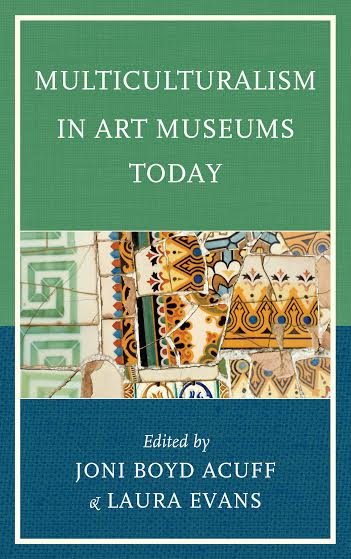
Written by Joni Boyd Acuff, Ohio State University, and Laura Evans, University of North Texas book-cover

As dear friends and colleagues, we met in the middle for the book Multiculturalism in Art Museums Today (Rowman & Litlefield, 2014). We — Joni, an expert in critical multiculturalism, and Laura, whose specialty is art museum education — had known each other for years and talked about just about everything, but never truly understood what the other researched in more than a cursory manner. The idea to collaborate came from this uncomfortable space of not really knowing what the other person did with their work. We decided to find out instead of to continue in our ignorance of what was really important to the other person. And, hence, this book was born. We realized as the Venn diagram of our research interests intersected, that there was a big gap in the literature on multiculturalism in art museum education. “Why?” we wondered. And, secondly, “What can we do about it?”

The book, Multiculturalism in Art Museums Today, is the result of this curiosity and our inquiries, as well as the diligent, creative, and groundbreaking work of our contributors (some of whom will also be posting here on ArtMuseumTeaching.com in the next few weeks). In this post, we will attempt to explain why we think multicultural practices in art museum education are important, and give a context for the book. We welcome your thoughts, comments, and questions, and hope that we can provide a welcoming space for stories and sharing.

Why is a Book on Multiculturalism in Art Museum Education Important?

First of all, what is critical multiculturalism, in brief?

Critical multicultural education works to investigate the maintenance of authentic cultural history, the subjugation of non-dominant cultural knowledge and the continuous movement, fluidity and evolution of culture (May, 1999). Multiculturalism in Art Museums Today aims to consider ways in which museums can work more effectively to become “social systems that enable the spaces of equitable educative possibility” (Dixon-Roman, 2012, p.3). We conceptualize equitable education as inclusive, comprehensive and “ubiquitous to the social process of thinking, feeling, being, and doing everyday human experiences” (Dixon-Roman, 2012, p.3), as per the tenants of critical multiculturalism. Unfortunately, as historic and existing debate suggests, museums struggle to meet the educational needs of its diverse patrons. If a museum is a suggested way of seeing the world (Macdonald & Fyfe, 1996); it is fair to assert that it must support various cultural frames of reference, as well as numerous versions and translations of the world. A practical and theoretical resource on multicultural museum education is important for two main reasons:

  1. the increasingly diversified population of the United States, and
  2. the heightened attention (due to economic, political, cultural, and ethical stimulus in the museum profession) and added importance placed on museum educators as representatives of their institutions, their field, and their communities.

These two realities provide the basis for this book and for the readers, who we hope will benefit from a deeper understanding of critical multiculturalism and its applications to museum education.

The U.S. is diversifying at a rapid rate and it is important that museum educators acknowledge, accept, and learn how to utilize the educational benefits of having such diverse populations to consider. According to the 2010 U.S. census:

  • 20% of the population over the age of five speaks a language other than English at home.
  • 19% of Americans have disabilities.
  • About 1.2 million Americans live with a same-sex partner and 11% of all unmarried partners are same-sex couples (Alternatives to Marriage Project, n.d.).
  • 72% of citizens are white, non- Hispanic; 16% Hispanic or Latino; 13% black or African American; .9% American Indian or Alaska Native; 5% Asian; 1% Native Hawaiian or other Pacific Islander; 5.5% another race; and 2.4% two or more races.
  • The projected racial composition of the United States in the year 2050 is 50.1% white, non-Hispanic, 24.4% Hispanic, 14.6% black, 8% Asian, and 5.3% all other races.

These statistics show that America is a vastly diverse nation and will continue to become even more so. Therefore, issues surrounding multiculturalism and equity will remain relevant and important as social and political issues. The above statistics are a stark reminder that art museums should be institutions of inclusivity, rather than exclusivity, and they show us why it is important for museum educators to understand the complexities and practicalities of critical multiculturalism. As stated by Winter (1992):

“At issue is the social and educational responsibility of public institutions in the face of cultural diversity, as opposed to the moral assumption of the museum as repository, both of ‘Art’ and of cultural values.”

Multiculturalism in Art Museums Today seeks to situate the educational role of the museum as one of multicultural expansion rather than abbreviation.

Context for Multiculturalism in Art Museums Today

Some people believe that “isms” (ex: racism, sexism, classism, ableism, etc.) are no longer relevant to the discourse around museums. In reality, the goal for museums and museum educators to engage in critical multicultural education work is relevant more now than ever. While some scholars and educators argue that issues of race, class, gender and sexuality are problems of the past, current data reveals that oppression based on these social indicators persist and have actually magnified well into the twenty first century (Weber, 2010).

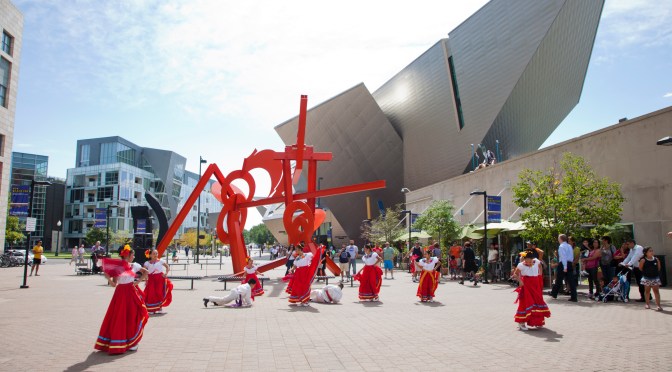
CelebrARTE at Denver Art Museum. http://denverartmuseum.org/calendar/celebrarte-chocolate

According to the U.S. Census Bureau and the National Center for Public Policy and Higher Education, since the year 2000, the international economic crisis has intensified inequities of race, ethnicity, gender, and class; specifically, accessibility to higher education decreased dramatically, as tuition and fees more than doubled, disproportionately affecting groups with low socioeconomic status most (Weber, 2010). In addition, sexual politics relating to same sex marriage and same sex adoption laws continue to be heavily contested in most states. Social inequalities are still heavily implicating the present and future of members of non-dominant groups (Weber, 2010). Therefore, it is imperative that we continue to call for critical pedagogies and praxis that “confront the racial, class, gender, and homophobic biases woven into the fabric of society” (Stuhr, Ballengee-Morris, and Daniel, 2008, p. 83).

Why are we attempting this call to action?

Because, if repetition is the precursor to establishing a habit, then we feel that it is necessary and important to continue checking in on issues of diversity in our museums so that, someday, things might change to a greater degree than the infinitesimal shift that has occurred so far in our museums. Eileen Hooper-Greenhill (2006) wrote a decade ago about the shift in museums, the “turn” towards the visitor. We would parenthetically like to add emphasis to Hooper-Greenhill’s call to action, to suggest that we need to (re)turn to the visitor. This shift in language alludes to the realization that, in turning to the visitor, we, as museum educators, need to revisit what turning to the visitor means in a rapidly diversifying society where museums are frequently being turned away from by public(s) that we do not serve. The authors who contributed to this book are a group of groundbreaking, talented, empathetic, creative, change agents. They are museum educators, researchers, writers, and human beings who care about the audiences they serve in deep and meaningful ways.

Through case-study examples, the authors of Multiculturalism in Art Museums Today address issues such as cultural misrepresentation in the museum, inequality as it relates to resources, and the exclusion of certain voices in the museum. They offer practical, contemporary educative practices that foster democratic, equitable museum practices. We believe that museums have the potential to be agents of social change and, in this way, our book is hopeful and inspiring, as it identifies and commends the effective practices that some museum educators and staff have enacted in an effort to be inclusive. We hope to show, through the chosen chapters, how the merger of museums and diversity initiatives can create positive change and can help guide, address, and suggest ways that museums can be more inclusive, supportive, and equitable spaces for all visitors.

Online Book Club Hangout (VIDEO)

On August 20th, ArtMuseumTeaching.com brought together a group of authors and editors of the book Multiculturalism in Art Museums Today for a live discussion via Google+ Hangout.  Those joining the Hangout included Joni Boyd Acuff, Marianna Adams, Briley Rasmussen, Alicia Viera, and Veronica Betancourt.  Please find the video archive of this conversation below, and enjoy!

Don’t Have Your Copy of the Book Yet?  No problem.  As part of this collaboration with Rowman & Littlefield Publishers through this series of posts about Multiculturalism in Art Museums Today, we are able to offer ArtMuseumTeaching.com readers a special discount.  To receive a 25% discount, go to www.rowman.com to order this book and enter the discount code: 4S14ACUEVA

*     *     *     *     *

ABOUT THE AUTHORS

Joni Acuff2013JONI BOYD ACUFF: Assistant Professor of Art Education in the Department of Arts Administration, Education & Policy at Ohio State University. Before joining OSU, Acuff was an Assistant Professor of Art Education at the University of North Texas. She holds an MA in Community Based Art Education from the University of Texas at Austin and her PhD in Art Education from Ohio State University. Acuff has published about her research in varying scholarly, peer-reviewed journals such as Art Education, Studies in Art Education, and Visual Culture & Gender. Her research agenda and scholarship attends to critical multicultural art education, critical race theory in art education, community-based art education and culturally responsive teaching and curriculum development. Joni’s postings on this site are her own and do not necessarily represent Ohio State University’s positions, strategies, or opinions. LauraEvans

LAURA EVANS: Assistant Professor of Art History and Art Education and the Director of the Art Museum Education Certificate at the University of North Texas.  Evans received her PhD in Art Education, with a Museum Studies specialization, at The Ohio State University, a Master’s in Museum Studies at the University of Toronto, and a Bachelor’s in Art History at Denison University. Previous to her PhD, Evans was a year-long fellow at the National Gallery of Art, Washington, DC, in the Department of Education.  She has also interned or worked at the Museum of Contemporary Art in Chicago, the Lodell Gallery in New Zealand, the Columbus Museum of Art, the Wexner Center for Contemporary Art, the Ringling Museum of Art in Sarasota, Florida, the Denison Museum of Denison University, and the University Art Centre at the University of Toronto. Laura’s postings on this site are her own and do not necessarily represent the University of North Texas’s positions, strategies, or opinions.

REFERENCES & RESOURCES

OTHER POSTS IN THIS SERIES:

“It’s Not Always about You: Facilitating Critical Self-Reflection in Others,” by Keonna Hendrick

“Eggs, Oreos, and Solidarity: MCRP in Our Daily Lives,” by Melissa Crum

“Reflecting on a Hybridized Museum Practice,” by Marianna Pegno and Traci Quinn

Evaluation Can Be Fun

Written by Marianna AdamsAudience Focus, 2014 Educator-in-Residence at the Isabella Stewart Gardner Museum

Cross-posted from mariannaadams.blogspot.com

One of the great luxuries I value about my time here at the Gardner Museum has been the opportunity to have rather leisurely and unstructured conversations with museum educators here and at other museums in the Boston area. I appreciate the value of not always having an agenda and not needing to solve a problem. We bounced ideas off each other and I always came away with a fresh perspective, a deeper conviction in my intuition, and lots of new ideas. Our talks often meander around the relationship between a museum experience or program and how we choose to evaluate it. A few themes have emerged from the conversations so far.

There is Life Beyond the Survey

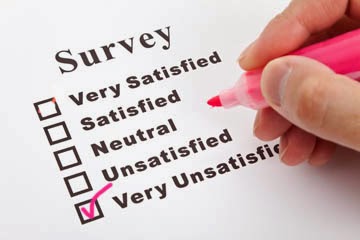
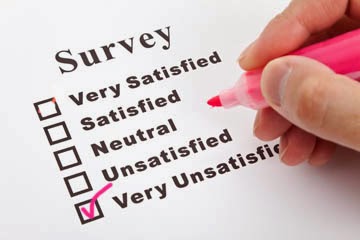
MA-SURVEYOver the years I have not made a secret of how much I don’t like written questionnaires, paper or online, despite how much I end up using them on evaluation projects. Why? The written survey is the most difficult methodology to do well. It’s the default methodology that most people think of when planning an evaluation and most of them are tedious and poorly focused. It’s a blunt instrument that cannot capture much in the way of subtlety and nuance (and life is so much about nuance). In recent years, with the plethora of online survey programs, we are drowning in surveys so survey-fatigue is a reality. Most surveys are really asking for the visitor to tell us that we did a good job (e.g., How satisfied were you with this experience?) and not enough about how the visitor values or benefits from the experience. Besides, the written questionnaire usually does not reflect the spirit of the experience we’re trying to evaluate, bringing me to my next point.

Match the evaluation method to the experience.

Imagine yourself at a museum’s “evening hours” event. There is a great band, wine, engaging activities going on throughout the galleries, good friends, and a happy crowd of people of all types and ages. The atmosphere is both relaxing and energized at the same time. As you stroll towards the door to leave the museum, someone hands you a piece of paper. It’s a survey asking you to evaluate this time you just had and it smacks you out of the pleasant, liminal state you spent several hours dropping into. That’s an example of how the survey methodology is not well matched to the quality of the experience you just had.

So what methodology might better align with the evening program experience you imagined yourself attending above?

First you start with what you want to know and why.

So often we select the methodology before we figure out what we want to know and why. We decide on surveys or focus groups when those may or may not be the best ways to collect the data. Often we collect more data than we know what to do with. Here’s an example that came up in a recent conversation:

Like many art museums, the Gardner offers several community nights with free admission throughout the year and these events are very well attended. Primarily, the Gardner wants to know if these events are indeed attracting people from communities close to the museum. Yes, we could easily get zip code information via a written questionnaire. The problem is that we tend to throw in a lot of other questions that we don’t really need the answer to. The other area of inquiry the Gardner would like to know about revolves around how visitors connect to the museum. So let’s keep those two data points in mind, residence and connection, as we think about how to get useful information.

Think creatively about ways to get that data and match it to the spirit of the experience.

How could we get zip code data and not make people fill out a survey?

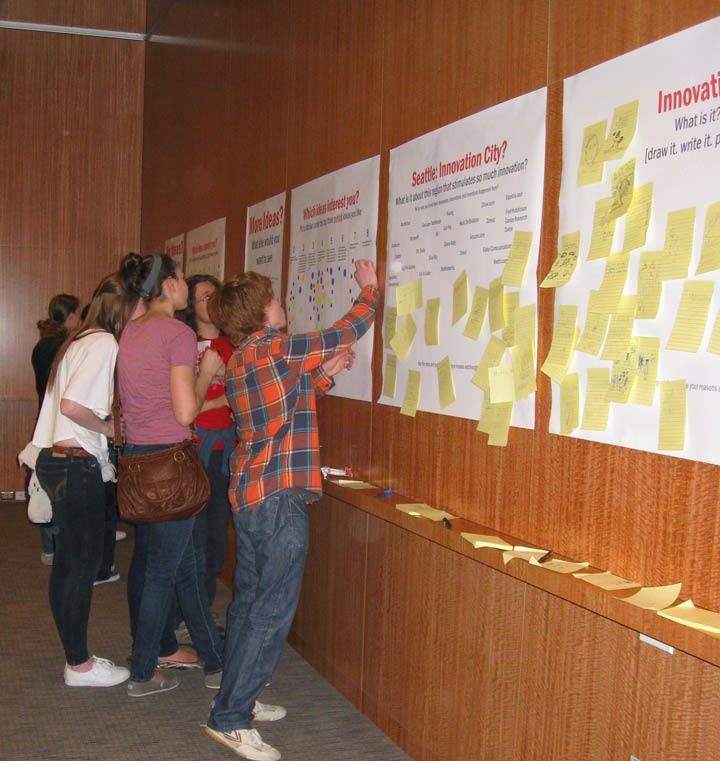
Imagine a big map (maybe near the wine bar because most everyone would go there), with zip code areas and neighborhoods clearly identified. Give people a small colorful adhesive file folder dot and invite them to put it on their zip code. It becomes a fun, social activity and, for some reason, people like to find themselves on a map. It’s simple and inexpensive. At the end you have a picture of the zip code distribution of your audience. You could do this for other evening events and compare the maps.

MA-response wall

What about the ways visitors connect to the museum?

One methodology that I love to experiment with is embedded performance assessment. This means that visitors don’t realize they are providing evaluation data, even when we tell them, because the process is engaging on it’s own. At a workshop for the Gardner Museum education staff this week, artist-in-residence Paul Kaiser inspired us all to explore new ways to engage visitors and possibly end up with some interesting evaluation data.

MA-galleryPaul first introduced us to the concept of collaborative writing, using the example of Japanese renga poetry. He then provided us with a set of words —  rising, distant, enclosed, fold, release — and asked us to take the spirit of renga into the galleries, substituting the verses for objects, spaces, or views based on that set of words. We did it and were struck by how beautifully the experience honored the spirit of what Mrs. Gardner did in the ways she arranged objects to suggest ideas or relationships.

We played with ways to use this activity with visitors, discussing ways to engage families and adult visitors at community nights in something similar. Perhaps if we created a more playful set of words to match the feel of these events, visitors would find it enjoyable. We brainstormed possibly having a place where people could post their responses and read what others thought about. Having these responses could be a rich data source that helps us better understand ways that visitors make connections to the museum. We were jazzed!

What are some unconventional ways that you have collected rich and useful data about the visitor experience?

OTHER POSTS IN THIS SERIES:

Towards a More Mindful Practice

Falling in Love with Your Visitors

Barriers to Family Engagement in Museums

*     *     *     *     *

ABOUT AUTHOR

AdamsMARIANNA ADAMS is President of Audience Focus Inc. Her professional roots began in K-12 public and private school teaching (fine art, English literature, social studies, and special education) and segued into museum education where she headed several education departments in Florida museums. She founded Audience Focus Inc., in 2007 after 12 years of conducting evaluation, research, professional development, grant proposal writing, and concept development for the Institute for Learning Innovation. Her degrees are from George Washington University (Ed.D.), University of South Florida (M.A.) and Mercer University (B.A.). In her spare time she is an avid yoga practitioner and teacher.