Designing an Inclusive Audio Guide, Part 1

Written by Desi Gonzalez, The Andy Warhol Museum

Reposted from The Warhol: Blog, the institution’s online presence for stories about the museum and its exhibitions, programs, education programs, and other news.  Check it out, and learn more about the exciting work happening at The Warhol!

This is the first post in a series on the development process of The Warhol’s new audio guide. 

In 1964, Andy Warhol moved to a new studio in a large New York City loft and covered its walls with silver paint and aluminum foil. Dubbed the Silver Factory, this space became known as a gathering place for artists, friends, and celebrities.

The “open-door policy” of the Factory is something that we’re inspired by at The Warhol as we endeavor to create a communal and inclusive environment within the walls of our museum. One way we’re becoming a more inclusive place is through our commitment to making the museum friendly to visitors of all abilities. Later this summer, we’ll be soft-launching a new audio guide that takes an inclusive design approach. According to the Canadian Museum of Human Rights, this is a philosophy that designs with all users in mind from the outset:

“The inclusive design approach will ensure the museum experience is not only accessible for all ages and abilities, but is enriching and satisfying for all. It is not a design style, but an orientation to design.”

Through a series of posts on The Warhol Blog (cross-posted here at ArtMuseumTeaching.com), we’ll dive into the process behind our new audio app, which soft-launches later this summer in a limited release and will be available to all museum visitors this fall.

The story starts in the summer of 2014, when my predecessors in charge of digital engagement partnered with the education department to develop experiences for visitors who are blind or have low vision. One component of the project was an audio guide in conjunction with the exhibition Halston and Warhol: Silver and Suede. We used low-energy Bluetooth beacons to push content out to visitors based on where they are located in the museum—no need to read numbers on a wall label and type them into a device! Instead, the iOS application notifies you when there is relevant audio nearby.

In conjunction with the app, we also partnered with David White of Tactile Reproductions, LLC, to produce tactile representations of artwork in The Warhol’s collection. Tactile reproductions reimagine the contours and colors of an artwork as different relief layers, allowing visitors to use touch to gain an understanding of what a work looks like. Together, the audio guide app and the tactile reproductions allow visitors with visual impairments to delve into Warhol’s life and practice through senses beyond sight.
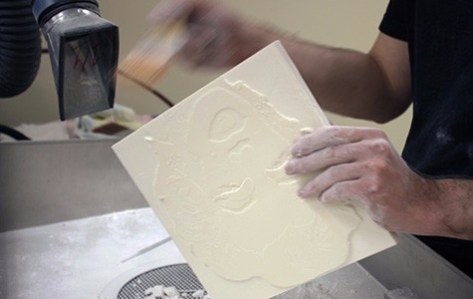
Working with our partners at Tactile Reproductions, LLC, to create the Andy Warhol artwork tactile reproductions. This one is a representation of Marilyn Monroe.

We learned a lot from these prototypes, but they were just the start. Since the beginning of this year, we’ve been hard at work to turn these prototypes into a reality. From the beginning of the process, we’ve kept four things in mind:

1. Put users first

We are committed to building an audio guide experience not just for community members with visual impairments, but with them as well. In our design process, we’ve worked closely with consultants with varying degrees of blindness. We talked to our partners even before we drew a single wireframe, exploring what makes a great museum experience and how they use technology. We also bring in our consultants to test prototypes at different stages of the process, allowing the findings from these sessions to guide the next step.

2. Don’t just build for accessibility

We strongly believe that if we design with different abilities in mind, we can craft a better experience for everyone. Even though we’re designing first for visitors with visual impairments, the audio guide will be available to all. Our consultants told us that they like to come to museums with friends and family, so whatever we design should be built for a social experience. Additionally, we currently don’t have an audio guide—and our front desk staff tells us this is one of the most common requests they get.

3. Reimagine the audio guide

Since we started from scratch with this audio guide, this was a great opportunity to depart from the usual way of doing things. We’re not the only ones rethinking the traditional audio guide: The newly-opened Broad Museum in Los Angeles is taking a cue from the irreverent and conversational tone of podcasts in their audio app; the British Museum has experimented with tours with longer audio files organized around themes rather than objects; and SFMOMA has designed a fully-immersive audio experience. In future blog posts, we’ll describe how we’re taking a different approach, splitting up audio content into smaller, modular stops and allow visitors to dive deeper if they’d like to learn more.
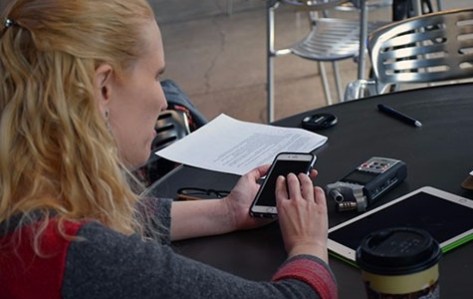
Testing the audio guide with our community partners.

4. Start small, dream big

Everything I’ve described above is a tall order! From the outset of the project, we decided getting it right was more than ticking off all the checkboxes. For version one of the app, we have focused on only one floor of the building—floor 7, which displays works and artifacts from Warhol’s birth through to the early 1960s—but we’ve made it as complete an experience as possible. After launching and refining version one of the app, we want to expand to other floors of the museum.

Reviewing an exhibition floor plan with our community partners.

Over the course of this blog series, we’ll be delving into everything from the user research we’ve done in conjunction with our blind and low-vision partners, to the process of imagining a new kind of audio experience, to the technical trials and tribulations of wrangling beacons and building our app from scratch. We’re glad you’ve joined us!

Accessibility initiatives at The Warhol are generously supported by Allegheny Regional Asset District, The Edith L. Trees Charitable Trust, and the FISA Foundation in honor of Dr. Mary Margaret Kimmel.

*     *     *

Header Image: The Andy Warhol Museum by Scoobyfoo, Flickr.com, minor cropping to fit header size. CC BY-NC-ND 2.0

Art museums as creative laboratories for children’s play, experimentation, and the co-creation of culture

Louisa Penfold is a children’s curator currently undertaking a PhD in the School of Education at the University of Nottingham in partnership with Tate (United Kingdom).

Art museums have not traditionally been sites for children’s creative experimentation and play but rather understood as places of collection and display. However, the past two decades have seen young audiences become an increasingly important audience for art museums around the world with many institutions developing new spaces and practices towards children. The philosopher and founder of the Reggio Emilia philosophy Loris Malaguzzi once stated ‘children learn most readily and easily in a laboratory-type environment where they can experiment, enjoy and find out things for themselves.’ If this notion is true, how does the idea of the art museum as a creative laboratory reaffirm or challenge previous curatorial, artistic and pedagogical notions?

The art museum as creative laboratory

An artist has their studio, a cook has their kitchen, a scientist has their laboratory yet there are very few places in their communities where young children can go to creatively explore, experiment and freely play with ideas and materials. A creative laboratory could be anywhere in a neighborhood — a makerspace as part of a community centre, a tinkering studio in a science centre, a fab lab within a children’s museum, a woodwork area in a secondary school or a digital learning space in a library. Many of these ‘laboratory’ spaces and practices have been and are being developed by interdisciplinary teams within cultural institutions, often in partnership with community groups and university research centres. However, art museums can make a very distinctive contribution. Art museums can draw upon the processes of artists and their curatorial practices to establish a uniquely creative social and spatial environment for the co-construction of art and culture between artists, curators, children, and their parents.

tate-liverpool-family-activity
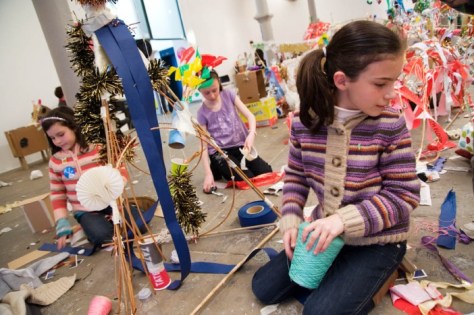
Family activity at Tate Liverpool. Copyright: Roger Sinek

The crucial quality of such environments is the presence of what Simon Nicholson once termed ‘loose parts’[1], these being open-ended materials such as blocks, clay, paint or design software that can be manipulated, adapted and transformed in a large variety of ways. This allows for deep, creative experimentation, questioning, explorative play and discovery-based learning. When such materials are presented in a curated creative environment where meticulous consideration has been given to their selection and presentation, combined with additional equipment and tools to assist experimentation of materials, vast and complex possibilities for exploring artistic phenomena are produced. These environments can also stimulate and support children to develop and express new creative processes and understandings of art and culture. But it is not just a matter of making materials available in a space, these need to be accompanied by artists, educators and curators who are experienced in facilitating young children’s creative play and experimentation. When they engage in careful and systematic observation and critical reflection, they can modify the spatial and social properties of the environment in response to children’s curiosities and discoveries.

The notion of art museums as creative laboratories within their community is built upon the premise that museums are not just for the transmission of culture but additionally a site for the construction of cultural knowledge and shared values. This requires a dialogic and collaborative process between artists, curators, children, their parents and the material environment. The understanding that art museums can also be places for cultural production offers an additional form of audience experience to object-centred and interpretation-based models in the gallery. Of course, transmission-based modes of cultural and artistic production should not be dismissed but rather this needs to be balanced with opportunities for individual and collaborative production of art. Child-centred practice in art museums fundamentally values children as co-creators of art and culture now, as opposed to seeing a value solely investing in the future development of children as adult museum visitors.

My interest in child-centred museum practice

I was first introduced to the interconnected ideas of child-centred practice, creative learning through play, and immersive environment design whilst working as a children’s curator at the Ipswich Art Gallery in Queensland, Australia. During this time I worked, as part of a team of highly passionate, intelligent, and creative artists, curators, industrial designers, researchers and creative practitioners, on the development of the children’s program. Collectively we were interested in exploring how the understanding of children as unique, complex, powerful, and creative beings [2] could intersect with new artistic and curatorial practices to construct immersive creative environments that deeply valued children’s artistry and creativity alongside artists.

Through my work in Australia, I continuously found myself asking: how can we construct a form of art museum practice that aligns with the notion of the ‘creative laboratory’ for children? What does it mean to children to experience these environments? In 2013, the children’s team at the Ipswich Art Gallery started to explore the complex concepts, theories and outcomes of these questions through a formal research project.

Atelier van Licht
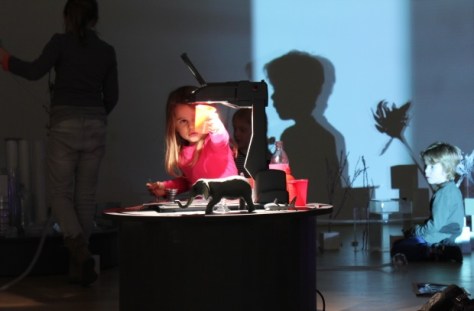
Atelier van Licht at Stedelijk Museum, Amsterdam. Image credit: Atelier van Licht.

I first met Dr. Emily Pringle, the Head of Learning Practice & Research at Tate at a conference in January 2014. We were both very interested in the concept, challenges and possibilities of child-centred practice and its possible intersections with artistic and curatorial practice in art museums. After a series of conversations I made the decision to relocate to England in September 2015 to undertake my PhD under Dr. Pat Thomson at the Centre for Research in Arts, Creativity and Literacies in the School of Education at the University of Nottingham. The research project is connected to the Tate Learning Research Centre where Dr. Pringle is my co-supervisor.  The focus of my PhD is on the construction of child-centred practice in early years (2-4 years) environments in art museums. My research asks:

  • What are the key conceptual, spatial, and social qualities of these environments?
  • What does it mean to children to experience them?
  • How can children’s experiences be used to inform the future construction of environments within the unique practice context?

My goal is to develop a process-led, critical and reflective heuristic thinking tool that can be used to support conversations between artists, curators, children and parents engaged in developing children’s creative environments. The research will draw on early year’s intra-active pedagogical theory [3] and social constructivism [4] to generate deeper understandings of children’s experiences with human (peers, parents, artists and educators) and non-human aspects (materials, architectural space and curatorial discourse) of curated immersive environments.

Pedagogical documentation, where young children’s learning and theory building is collected using predominantly visual research collection methods such as photography, film and field notes, will be used to guide practitioner learning and reflection during and after the program is presented [5]. This documentation will seek to make young children’s learning more visible within institutional conversations. The reflection will be used to feed into future curatorial, artistic and pedagogic practice and have the ability to be adapted to the unique gallery contexts in which the practice is occurring.  Critical reflection aims to give insights into ‘curation’ of early year’s immersive gallery environment design in regards to the intersection of curatorial, artistic and pedagogic practices. The project thus extends the notion of the art museum as a creative laboratory to the researching, questioning, experimentation and critical reflection of artists and curator’s shared practice.

My inquiry consists of four action research cycles. Each one develops, challenges and reflects on the construction of the reflective heuristic thinking tool. The second phase of the project begins in September this year and the first draft of the critically reflective framework will be presented to the education teams involved in the study late in 2017. After this, I hope to take what we have learnt to the wider art museum community.

By developing an approach that values experiential learning, discovery-based play and critical practitioner reflection, my research will support the construction of more dialogic and collaborative conversations between art museums, artists and the wider community. Through the PhD I will generate new findings on the practices that lead to meaningful experiences for young children in art museums, currently under-researched and under-theorised.

Reflection Questions…

Have you developed children’s creative environments around the ideas of child-centred practice, experimentation, and creative play? How does this reaffirm or challenge previous curatorial, artistic and pedagogical notions within an art museum context?
Please share your comments, experiences, challenges, and reflections.

References

  1. Nicholson, S 1971. How NOT to cheat children – The theory of loose parts. Landscape Architecture, 62, p.30-34.
  2. James, A., Jenks, C., & Prout, A. (1998). Theorizing childhood. Cambridge: Polity Press.
  3. Lenz Taguchi, H. (2010). Going beyond the theory/practice divide in early childhood education: Introducing an intra-active pedagogy, Oxon: Routledge.
  4. Vygotsky, L 1930. Mind in society: The development of higher mental processes. Cambridge: Harvard University Press.
  5. Reggio Children & Harvard Project Zero. (2005). Making learning visible: Children as individual and group learners. Reggio Emilia, Italy: Reggio Children publications.


LGBTQ Alliance’s Welcoming Guidelines for Museums

the incluseum's avatarTHE INCLUSEUM

Most of us agree that inclusion is important. However, we might be unsure how to activate this positive ideal in our daily professional practices. Where to begin when so much change and transformation seems needed? This week, we are excited to feature the Welcoming Guidelines that the LGBTQ Alliance, a professional network of the American Alliance of Museum (AAM), has been developing over the last couple years. These guidelines can certainly inform and help facilitate action. Thank you to Renae Youngs for introducing Incluseum readers to these guidelines that have been gathered in this document.

* * * *

Screen Shot 2016-05-30 at 11.16.16 AM

Over the past two years, an AAM professional network has been developing a broad set of Welcoming Guidelines to help museums be more inclusive of lesbian, gay, bisexual, transgender and queer staff and visitors. The Guidelines touch on all areas of museum work, are available for free online, and launched at

View original post 489 more words