How can museums & schools continue their relationship during & after COVID-19?

Written by Stephanie Downey

My career began at the intersection of museums and schools, and it will always be at the heart of why I do what I do.  I discovered museum education while working as a program evaluator for the District of Columbia Public Schools (DCPS).  I was doing that work because of my interest in equitable public education but discovered the wonders of object-based learning while evaluating a partnership between DCPS and the Smithsonian.  Through that evaluation, I found connections among my personal and professional experiences and interests that I didn’t even know existed before.  That project more than 20 years ago was a critical turning point that changed the course of my career and led me to museum evaluation.  To this day, even though my interests in museums has grown beyond object-based learning, and my work ranges from exhibition evaluation to audience research, it is the work focused on museum school programs that lights me up.  

The title of this post is a question that slowly came into focus for me in the last couple of weeks and sent me into a premature grieving for something I worry may never be the same again.  In the middle of March, we watched museums close and school districts across the country send students home. I was alarmed but assumed, like most of us, the closures would be a relatively temporary situation.  Yet as the pandemic has unfolded, it has become more and more clear that things in our country will not go back to the way they were before the virus, certainly not before a vaccine is widely available. 

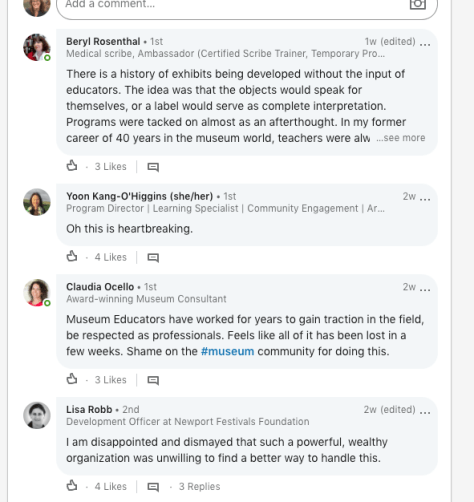
Through word-of-mouth, I’ve heard that school programs and field trips are very likely off the table for the rest of the 2020. And two weeks ago, Hyperallergic published this news—“MOMA Terminates All Museum Educator Contracts.”  We learned that the Museum of Modern Art told museum educators in an email “it will be months, if not years, before we anticipate returning to budget and operations levels to require educator services.”  Their projection of “months, if not years,” triggered a great deal of anxiety in me and among many others on social media. 
Screen Shot 2020-04-23 at 3.49.01 PM

As upsetting as it was to read those words from MoMA, I think most of us now realize there is not going to be a quick end to this.  A recent article by Ed Yong in The Atlantic quoted Devi Sridhar, a public-health expert at the University of Edinburgh:

“Everyone wants to know when this will end.  That’s not the right question. The right question is: How do we continue?”  

Following from this expert’s words, the question for me isn’t “will museums keep working with schools during this time?” but instead, how do museums continue working with schools throughout and beyond the pandemic?” 

I believe strongly in the power of museum visits for school children, some of whom may never have been to a museum otherwise.  There is something magical for students about entering a museum space surrounded by authentic artworks, objects, or artifacts they cannot see anywhere else.  But it’s not just me and my bias for these kinds of programs.  Over the years, numerous evaluation and research studies have examined the impact of museum programs on school children, and results show again and again that museum programs make a positive difference in the lives of students.  Most recently, two large research studies—a national study of single-visit field trips to art museums by the National Art Education Association and the Association of Art Museum Directors in 2018 and study of field trips at Crystal Bridges in 2012—both showed that a visit to an art museum has a measurable effect on students’ creativity, empathy, and to some extent, critical thinking.  

But, back to the “how” question.  While it is preferable for students to engage with museums in museums, I advocate for museums not to wait the many months or years it may take for things to go back to “normal,” but instead to prioritize finding alternative ways to keep schools engaged with museums during this time. 

I know many museum educators are already starting to do this, but I suspect it isn’t easy.  While distance learning exists in museum education, it is certainly not the norm and presents a potentially steep learning curve for both museum educators and classroom teachers.  Moreover, even when students go back to the classroom, schools may operate differently and be up against new challenges.  The answer to this question of “how” may require a re-imagining of the relationship between museums and schools. 

I wish I had the answers, but for now, I can only emphasize that, as a researcher and evaluator, I know the data tells us it would be a huge loss not to put resources toward sustaining and building museum-school relationships—first virtually, and eventually back onsite.  I’m sure many of you have already started doing that reimagining.  I would love to hear about it. 

Featured Image: Students in front of Damian Aquiles’ Infinite Time, Infinite Memory, Infinite Destiny, 2003-2005 at the Orlando Museum of Art. Photo by Amanda Krantz, managing director at RK&A.

*     *     *

About the Author

STEPHANIE DOWNEY: Stephanie brings more than two decades of research and evaluation experience to her position as owner and director of RK&A, a museum consulting firm.  She takes pleasure in working closely with museums and other informal learning organizations to help them make a difference in the lives of their audiences.  Stephanie has undergraduate and graduate degrees in anthropology and ultimately is driven by her lifelong interest in how humans behave and make meaning.  Prior to joining RK&A in 1999, she conducted educational research and program evaluation in public schools.  Stephanie serves as treasurer on the board of the Museum Education Roundtable, frequently presents at professional association conferences like the American Alliance of Museums and the National Art Education Association, and regularly peer reviews manuscripts for the Journal of Museum Education and Curator.  When not working, you can find Stephanie in the kitchen trying new recipes, cheering on her children in their various activities, and hiking trails along the Hudson River.
So what am I supposed to do now…?

Written by Zélie Lewis

It’s hard to accurately represent the magnitude with which the COVID-19 pandemic is affecting each one of us and disproportionately affecting black, brown, and low-income communities. Not only are we all worrying about staying healthy and protecting our lives, we have the compounding stress of worrying about our livelihoods and careers as unemployment rates soar. In a report released on Thursday, April 2, the Labor Department indicates that “…there are around 8.5 million more people on unemployment benefits today than there were two weeks ago.” The unemployment rate has been estimated to be at around 13 percent, according to further reportsThis is likely the worst period in history for all of us. 

As a graduate student two months away from earning my master’s in Museum Studies, I find myself circling back to a single, gut-wrenching question: what am I supposed to do now? 

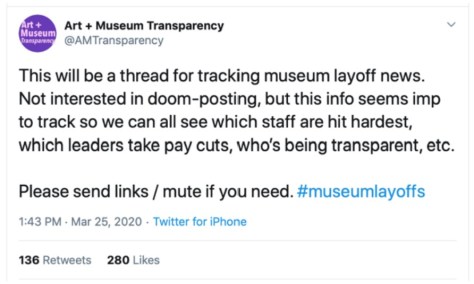
It’s also hard to ignore the impact COVID-19 is having – and will continue to have – on museums and cultural organizations across the U.S. I can’t scroll through Twitter or talk to a museum friend without hearing about more layoffs, teams struggling to generate revenue while closed, or people scrambling to generate something, anything to put out into the world. Worst of all, it’s hard to escape the constant anxiety and grief that surrounds the work that we do.

While the U.S. is understandably preoccupied with the worsening health emergency, the last few weeks have underlined the fact that museums and cultural institutions are extremely undervalued in American society (just think about the lack of emergency funding for arts and cultural organizations). Our institutions were not designed to handle a crisis like this – and we haven’t even dealt with the education, job, and economic crises that are yet to come. 

tweet1
Source: https://twitter.com/MichelleNMoon/status/1240992082484961280?s=20
tweet2
Source: https://twitter.com/AMTransparency/status/1242869675425443840?s=20

One perspective I have noticed is eerily absent from broader discussions about the impact of our current situation is that of the youngest generation of museum professionals. I’d like to create a space where our needs, concerns, and frustrations can be both shared and heard. I guess there’s no better way to do that than to start by sharing my own. 

The last few weeks have brought an onslaught of changes for all of us. Like virtually every other student in the country, I have watched my university close its campus and switch to entirely remote learning and work, tried to prepare my individual research for conferences that might not happen, and watched the museum where I work part-time close to the public before laying me and others off. 

I am tired. I am frustrated. But mostly I am anxious. Ironically, being a graduate student right now provides a certain amount of comfort; I have work to do, I have a community to lean on, and I have a sense of normalcy others may not have. Unfortunately, being a graduate student right now also emphasizes the uncertainty of the job market. I was in the midst of applying to countless positions before museums started closing and now…everything is on hold until further notice. Knowing that it can take several months to a year post-degree to land a full-time job in a museum, seeing the plight of the field unfold is petrifying. As an educator, watching museums announce sweeping layoffs of education and interpretation staff is especially worrisome. Getting a sustainable job as a museum educator was hard enough before COVID-19; if museums cut their education programs and have no plan for reinstating education staff, the outlook seems bleak. 

tweet3
Source: https://twitter.com/AMTransparency/status/1244961086048264192?s=20

And I am but one person. There are countless other graduate students and young professionals across the U.S. and around the world in the same position. In speaking with a peer from my graduating cohort, I quickly realized that the feelings of anxiety and fear are widespread among emerging professionals. Olivia Knauss, a second-year Museum Studies student at NYU specializing in development and fundraising, states: 

“Before the COVID-19 pandemic, I felt ‘on-track.’ I was working two different paid internships at two different NYC-based museums, while also reaching the final stages of my master’s thesis. I made it to the second round of interviews for three different full-time positions. But as in most industries, everything came to a screaming halt. Early on, I was laid off from one of my paid internships, losing valuable income I need to live in one of the most expensive cities in the world. All of my interviews have been suspended or postponed indefinitely. I’m back at square one…it’s hard not to feel helpless.”

Museum Studies students and those in related programs are not the only ones hurting right now. The programs themselves are facing mounting uncertainties. Will more students enroll this fall? Will these programs be able to stay open? What will this pandemic change how we pursue and complete graduate work? It’s hard to know what the next few years will look for professional training and graduate education. 

tweet4
Source: https://twitter.com/meglovesmuseums/status/1245147902399389696?s=20

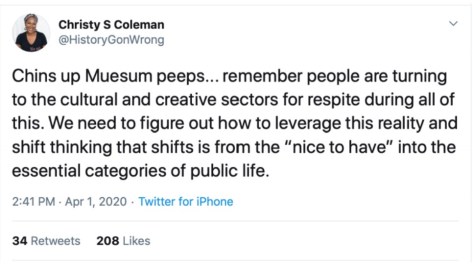
This is not to say that there aren’t incredible things happening in museums right now. More institutions are finally realizing how essential true digital engagement can be. The National Cowboy Museum in Oklahoma City and the Shedd Aquarium are leading the way with joy-inducing internet content. Leaders in the field continue to share advice on how to navigate this experience and biting critiques of inequity in the field. 

tweet5
Source: https://twitter.com/HistoryGonWrong/status/1245421097413197826?s=20

The only way out of this reality is through it, so we must keep pushing forward. I try to remain hopeful, to stay up-to-date on what is happening in the field, and to have faith that this degree will be worth it in the end. 

I try … but what am I supposed to do now? 

*      *      *

About the Author

Zélie Lewis: As an educator specializing in digital learning and engagement, Zélie is set to receive her MA in Museum Studies from New York University in May 2020. Prior to graduate school, Zélie served as a college advisor in a rural high school where she worked to improve student and community access to post-secondary resources. Zélie began her transition to the museum field as an Apprentice Museum Educator at the Rubin Museum of Art in New York and joined the Brooklyn Historical Society as the Education Administrative Assistant in 2019. Her research focuses on the role and effectiveness of museum-based distance education in serving rural K-12 educators and speaks more broadly to the role of distance ed in providing more equitable access to museum resources for low-access communities.

New Normals: A photo essay

Writing and Photography by Jessica Fuentes

When I first started hearing news about the coronavirus in China I didn’t understand the seriousness of this disease and how it would quickly come to change everything about our lives. I had taken vacation time to spend part of Spring Break with my family and when I returned to work on Thursday, March 12 I was surprised to hear that attendance had been low and people were opting to stay home. That evening and the next morning, conversations were brewing at the museum about potentially closing to the public. I attended a series of meetings on Friday, March 13 and felt like I was getting new updates every hour about what this would mean for our institution, staff, and community. 

That day felt like a whirlwind, and though I would still go into the office the following Monday to gather files and prepare myself and my team for working from home for the foreseeable future I knew everything had changed. As a photographer, I am always documenting my life and the world around me. Through the images below you can get a glimpse into the world as my family (husband, 13 year old daughter, 2 year old daughter, and various dogs) and I have experienced it the past few weeks. See the caption with each image for additional text.

This slideshow requires JavaScript.

This new normal for my family has had its ups and downs. Being (mostly) confined to our somewhat small home and trying to focus on work in a shared space with a teenager, a two year old, and my significant other has been difficult. Worrying about when the museum will reopen, when or if schools will be back in session, and if my loved ones or I will get sick has been a slow build-up of anxiety that I have never experienced before. But, I truly enjoy taking a lunch break and eating at the table with my family instead of eating at my desk as I work through lunch. It has been so nice to get outdoors more often whether we are going on walks, working in the garden, or running around the backyard with the dogs. 

How have you been managing work, family, friends, your own mental health during this time? What aspects of this new way of living do you plan to hold on to when this is all said and done? What aspects of the old way of living do you look forward to getting back? 

About the Author

JESSICA FUENTES: Manager of School and Community Outreach, Amon Carter Museum of American Art.  As an art educator with over thirteen years of experience Jessica has taught in both classroom and museum settings. She received her MA in Art Education from the University of North Texas. Jessica worked for six years at the Dallas Museum of Art as the Manager of Gallery Interpretation and the Center for Creative Connections prior to joining the Carter in 2018. Though much of her passion and work is focused on her local community, she serves on the Education Planning Committee for the Smithsonian Latino Center and as the Representative-Elect for the Western Region of the Museum Division of the National Art Education Association. In her downtime she can usually be found with her daughters out in nature, enjoying an art museum, or making art in their home studio. Jessica’s postings on this site are her own and don’t necessarily represent the Amon Carter Museum of American Art’s positions, strategies, or opinions.

Museum as space of opportunity, creativity & care: A perspective from Spain

Written by Fernando Echarri

In Spain, COVID-19 has caused and is causing sudden and overwhelming social change. Spain is one of the countries in the world that is suffering most from the effects of the pandemic at the moment. Effects that translate into new social and personal challenges, involving many factors including misinformation, manipulation, fear and catastrophism. This situation shakes the foundations of a way of living, of coexisting, of perceiving, of doing, of desiring, of dreaming.

This change has happened practically from one day to the next, when the Spanish Government declared a state of alarm. The change meant the closure of many public and private equipment, including all educational centres and museums. We work at the Museo Universidad de Navarra, located in the north of Spain. It is a recently created university museum of contemporary art (2015). With structures and procedures still being established and, therefore, also with the power of flexibility towards new scenarios. The museum’s closure has been very sudden, with the exhibition “Universes” by the artist David Jiménez just opened in March. It has taken place at the same time that the University has stopped its face-to-face activity, so that university students and other visitors from other segments of the population cannot physically visit the museum or carry out their various cultural and educational programmes.

And how does a university museum of contemporary art adapt to a situation that prevents the public from seeing its exhibitions and carrying out the rest of its cultural programme?

We try to raise 5 criteria that can help answer this question :

1.  It must be faced with a positive mind, which sees this situation as a generator of personal and social change that provides a new space of opportunity.

2.  Learn to work with uncertainty; with a continuous and changing uncertainty that the situation itself generates. Uncertainty that affects everything from the biology of the virus and the evolution of the disease to the political and regulatory measures that are taken and the social perceptions and new forms of behaviour that are being generated in real time. These new forms of behaviour will probably include a new emotional and affective state in terms of the relational aspect between people. And in this new generation of new forms of behaviour, the museum cannot be alien. It cannot miss this train, in a challenge that we do not know where it is going, but in which the museum has to be assembled, to travel together with society, to accompany it in the different situations and contexts that are being generated.

3.  Space for creativity. The uncertainty generated provides in turn a great ally, usually forgotten: creativity. Creativity can be a lifeboat when the waters are turbulent and the known capsizes. The undefined space is built with enabling bricks that are linked to the creative cement. New products are thus generated, at this time digital, that respond with contemporary art to the needs of the users.

4.  To focus on the value Care. This value is not usually the focus of most education programmes, and is not usually one of the main values considered in a transversal way in the programmes of museums. However, this word is currently one of the most mentioned in the media and has become one of the key words generated by COVID-19 and which people are taking into account the most. Personal, family and social care is now a trend topic. Perhaps this value has surpassed the value of respect, which is the one most often used in social work. The respect value has fallen short in this situation. If we understand the value respect as the consideration for others, the value care implies respect, but it is more than that value. It also implies concern, protection, solidarity and love.

We could simplify by considering that care = respect + love. In this situation generated by COVID-19, it is clear the numerous evidence of care that is being generated in society. Neighbours who previously did not speak to each other are now wondering how they are doing, how they are handling the situation, if they have any sick relatives, if they need anything. Anonymous people who help other anonymous people. It’s not a minor change. COVID-19 is possibly making society better, more humane. Or maybe it already was, but there were no opportunities to make it so obvious. In order to adapt to this situation, museums should integrate this value into the relational possibilities offered by their various programmes.

munencasa

5.  ‘Stay at home’. This is the communicative message that the Spanish Government is promoting during this period of confinement. This message has forced the Museo Universidad de Navarra to change its communication, dissemination and educational strategy. This new situation is a challenge for the University of Navarra Museum. It means devoting all its efforts to off-site activities. If the visitor does not come to the museum, the museum will look for the visitor. It means taking the museum to the people’s homes. That is why it has created the ‘MUNENCASA’, with the intention of providing artistic, cultural and educational support to the various people and groups that are currently confined.

*     *     *

This impediment to living physically in the museum has made it possible to develop a parallel, virtual museum, which offers users programmes, activities and tools such as virtual visits to the exhibitions, multimedia videos, digital gamification, a blog with recent history and current affairs, and classes for university students and the rest of the population. It also pays continuous attention to the different social networks, publishing not only news. The world of social networks has increased its volume of traffic these days and we must redouble our communication efforts. In record time, digital materials are generated that adapt existing analogue resources. Programmatic resources are generated, both exhibition and educational, which help people through art and culture.

This is what we have to do at this time: to approach each home and accompany, help, and care for our users as much as possible.

Society expects nothing less from us.


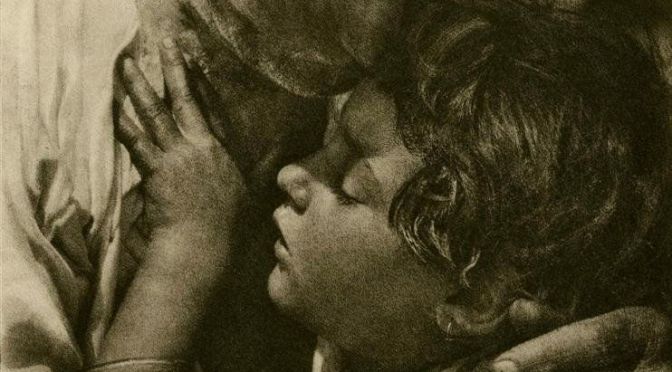
Header Image: José Ortiz Echagüe, “Tenura”


About the Author

FERNANDO ECHARRI IRIBARREN holds a degree in Biological Sciences (University of Navarra, 1989) and a PhD in Museum Education (University of Navarra, 2007). He is an associate professor of the University of Navarra (Pamplona, Spain) and teaches in the following areas: “Art Education”, “University Master’s Degree in Higher-Education Teaching” and “University Master’s Degree in Curatorial Studies”. Since 2014, he has been Head of the Education Department at the University of Navarra Museum. His interests include meaningful learning and significant learning experiences.