Written by Linda Forshaw, guest author
_______________________________________
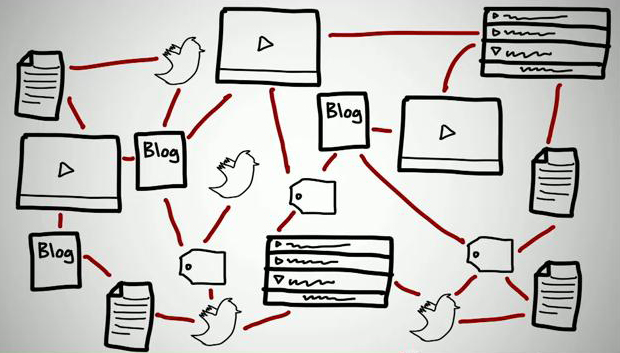
In recent years there has been a new player in the field of education. MOOC (massive open online courses) have taken the world (somewhat) by storm with various free courses from prestigious (and sometimes not so prestigious) universities and colleges. Here is a quick YouTube video describing the basic nuts and bolts of a MOOC, if you are thinking “What in the world is a MOOC?”
Despite there being some skepticism — mainly in relation to the quality of education, incidents of plagiarism, and low completion rates — the popularity of online education platforms continue to grow. In an article entitled “The Year of the MOOC,” Laura Pappano writing for the New York Times reports how the online learning revolution–that reportedly started when more than 150,000 willing students enrolled on an “Introduction to Artificial Intelligence” course back in the fall of 2011–has grown at an ever increasing pace. As an example, some 370,000 students signed up for the first official courses from edX, a nonprofit MOOC created by Harvard University and the Massachusetts Institute of Technology. edX is not alone in attracting record numbers of online students. Coursera, a for-profit MOOC created by Stanford professor Andrew Ng, has seen 1.7 million students sign up since its inception.
The pace at which online learning is traveling continues to grow. The year 2013 is set to herald a new offering from the UK’s Open University. Futurelearn, the country’s first real step into MOOC platforms is set to offer courses from Kings College London, the University of Warwick, and others. Meanwhile, back in the U.S., 2U (one of ten startups changing the world according to Forbes) is planning to advance the field of online learning even further by by offering paid, for-credit undergraduate degrees from the likes of Duke, Vanderbilt, and Emory Universities.
With online learning platforms showing no immediate signs of abating, the question remains how art museums can play a role in this sweeping open education movement? It seems that they already are to at least some extent . Initiatives to deliver art to the masses by the likes of the Khan Academy, Google Art Project, The Virtual Hampson Museum, The Giza Archives, and Europeana have been heralded by some as offering an opportunity for those alienated from the world of art to get involved and slated by others who argue that images of famous painting and other artifacts are all well and good, but fall short as an adequate substitution for the real thing.
Perhaps the best path forward for museums looking to make inroads in online learning is to create courses that can act as complementary to personal visits, but also provide more than enough information to be sufficient in their own right for those who cannot (for whatever reason) attend in person. Thanks to the Google Art Project and the expansion of the Khan Academy into art history, displaying works online is likely to become increasingly commonplace for museum and art galleries. Steven Zucker and Beth Harris, in their article explaining why the Google Art Project is important, report that other museums have started to make public domain images available for download – namely The Brooklyn Museum,, Metropolitan Museum of Art, and The National Gallery of Art. As a result, those who do not get involved may well be left behind.
While there is much discussion about what these open technologies are not, what we do know is that they are expanding opportunities like no other and it can be reasonably said that the museums themselves should join others in discussing the options for learning.
And isn’t learning what it’s all about?
Author
Linda Forshaw is a Business Information Systems graduate from Lancaster University in the UK. A contributor to Degree Jungle, she is a full time writer and blogger specializing in education, social media, and entrepreneurship. Contact her on Twitter @seelindaplay
“The value of museums begins and ends with the relationship with our visitors. It’s a contract that is renewed each and every time they engage with us, and if we don’t live up to it, we will be usurped.” — John Falk, speech to AAM (2010)
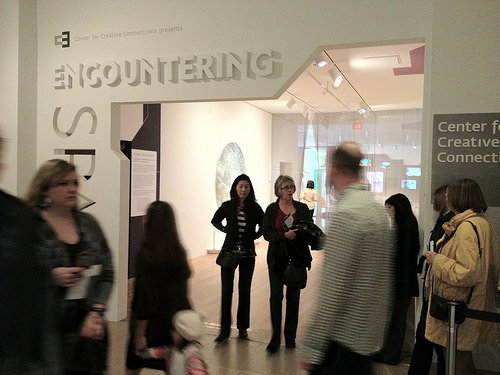
Encountering Space, Center for Creative Connections at the Dallas Museum of Art. Photo by Maria Mortati
Working in museums can be a messy, messy game, but I always love the conversations that crop up when you get a handful of museum educators together to talk ‘shop.’ A couple weeks ago at the National Art Education Association 2013 annual conference in Fort Worth, there was certainly a lot of that happening. I was fortunate enough to be invited to present — or rather have a public in-process conversation — about participatory culture in art museums with an incredible group of colleagues: Preston Bautista (Deputy Director for Public Programs & Audience Engagement, Indianapolis Museum of Art), Judy Koke (Director of Education & Interpretive Programs, Nelson-Atkins Museum of Art), and Susan Diachisin (Director of the Center for Creative Connections, Dallas Museum of Art). By far, the best part of preparing our presentation was the series of winding, organic conversations that led to Fort Worth.
Not only were we all wildly passionate about visitor engagement and participatory practice, but our own working environments were all changing rapidly — from my own move from St. Louis to the Portland Art Museum this past fall, to leadership changes and various grants & innovation projects. All in all, we were fairly hyper-motivated to talk about these issues with each other and, ultimately, to explore concepts of participation and exchange in our institutional cultures.
How does an institution’s hierarchy, leadership, and organizational structure actually enable (or disable) participatory practice? How could museum educators at various levels become more involved in fostering an institutional culture focused on visitor experience and engagement? Could these values find ways of ‘trickling up’ from participatory programs and smaller-scale education projects or exhibitions?
“If … museums must move away from assumed public value and begin to measure their impact, and if … museums must achieve impact for the community instead of impact for the museum, then the impetus is on museum education to rise to the challenge that lies before us and reposition the museum in the eyes of the public.” — Tina Nolan, JME (2010)
As we entered our NAEA session entitled “Toward an Even More Participatory Culture in Art Museums,” we had decided on a set of assumptions that were key to making this a valuable and productive conversation:
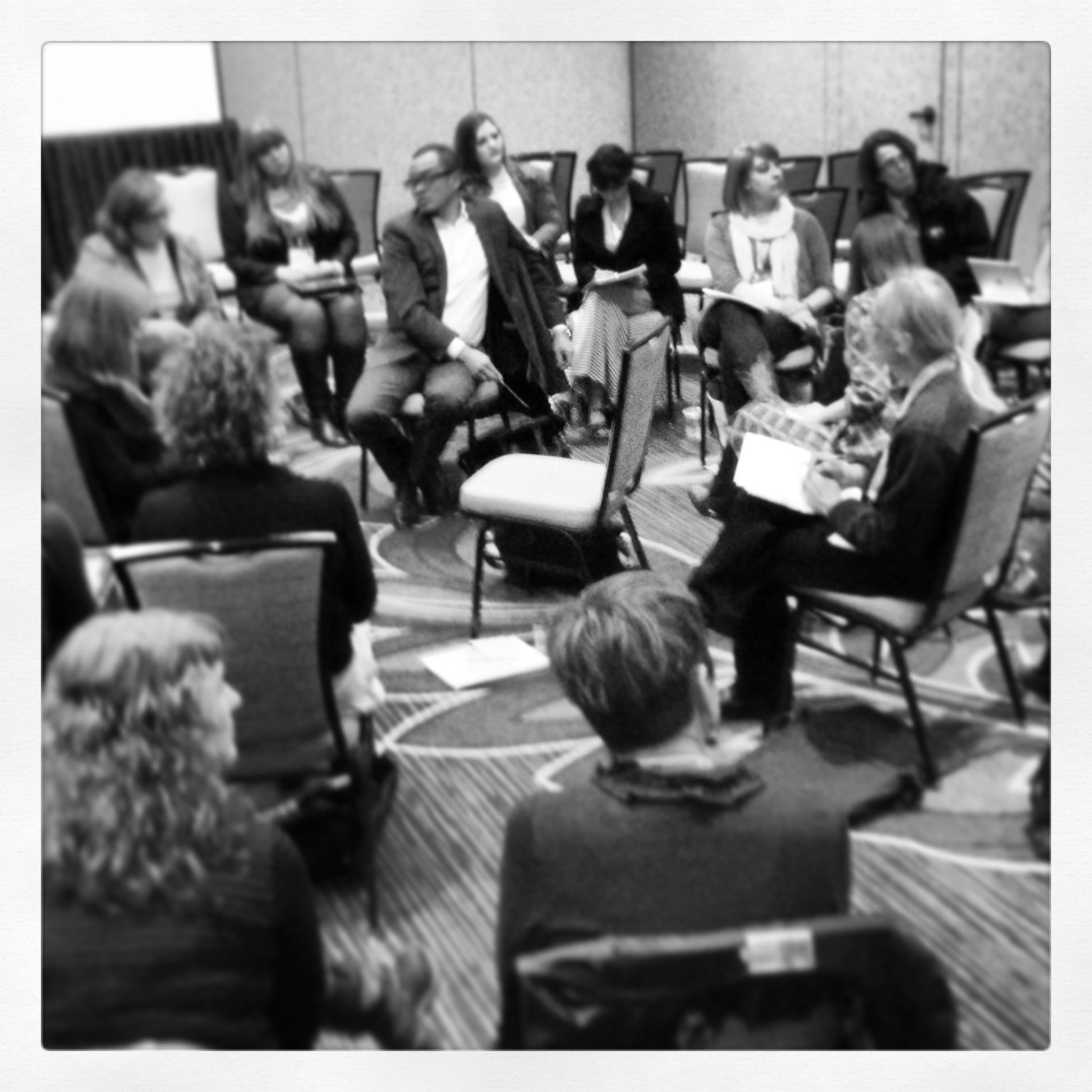
conversation at our session (yes, we exploded the traditional conference furniture layout)
There is a shift happening. Art museums across the continent are taking big steps to change the ‘business as usual’ model, creating structures to put the public’s expectations, needs, and experiences at the center of interpretive planning and exhibition development. We can see this in institutions such as the Detroit Institute of Arts (see great article by their Exec Dir of Learning & Interpretation), Art Gallery of Ontario, Denver Art Museum, Indianapolis Museum of Art, Nelson-Atkins Museum of Art, and the Philadelphia Museum of Art, among many others. In the specific realm of ‘participation’ and public engagement, it is always important to note the Irvine Foundation’s support for institutions such as the Oakland Museum, as well as museum “Innovation Stories” featured via EmcArts & ArtsFwd. If you still need convincing that change is afoot, watch this video compiled by the Innovatrium at their January 2013 ‘think tank’ of museum leaders.
We’re all in this together. Instead of anyone pretending to be an ‘expert’ about these changes in organizational culture, we wanted to be conscious of the fact that we are all co-learning with each other. It doesn’t matter the size of one’s museum or how involved your senior leadership is in this shifting landscape — we’re all working toward the greater public value and relevance of museums in our communities and beyond. And this needs to be an open, inclusive conversation if it is to be meaningful one.
You can’t talk about participatory practice without becoming participatory. I always feel like every lecture on “visitor engagement” and “participatory practice” is, in part, quite disingenuous if it does not attempt to actually ENGAGE. Even if an attempt to activate a lecture hall full of 200 spectators fails, I always feel that we should try — walk the walk, right?! So I was able to convince our group to do a crowdsourcing activity to engage those attending our session, and pull out their ideas in a participatory way.
“For a museum to truly engage its users, it must cease acting as a controlling gatekeeper to its collections and expertise. Rather, the museum must work with its users and communities to unlock the stories its collections hold, responding to the choices its users make. As such, it must give up its traditional authoritarian voice so that users are free to question, debate, collaborate, and speculate — seeking out those issues that most concern them — and are given the support and inspiration required to do so.” — Graham Black, Transforming Museums in the Twenty-First Century (2012)
After our initial discussion and framing of these issues, we jumped right into the crowdsourcing exercise to activate everyone’s thinking and to have the group generate ideas. To prevent this conversation from quickly deteriorating into a litany of complaints, barriers, and reasons why we might not be able to enact change at our institutions, we granted everyone in the room freedom from all of these restraints … with a magic wand. Therefore, without concern about budget cuts, personality conflicts, and perceived curatorial barriers, we invited each participant to take two or three minutes, envision some ways to engender a more participatory culture at their institutions, and then write down a “what if” statement on a small slip of paper. We collected more than 50 “what if” statements, crowdsourced them with the group, and then spent the final chunk of time opening up a conversation around these ideas. Here are the 4 statements that, at this moment and with this group, bubbled to the surface:
What if everyone in the museum understood everyone else’s job?
What if there was a real plan for interpretive team development of exhibitions and permanent collections? What if curators and educators didn’t feel like they were ceding territory when they worked together?
What if educators/interpreters and curators worked collaboratively on creating in-gallery participatory experiences?
What if I could include funds for “things I may think of after the budget process” [an “innovation” fund] when I’m writing my department budget?
sampling of the 50+ “what if” statements that participants brainstrormed for crowdsourcing
Rather than recount the conversation or provide my own opinions, thoughts, and perspectives here, I wanted to take this opportunity to open the conversation … to OpenThink the “what if” statements we collected during our NAEA session. So below is a link to all of the “what if” statements that we were able to collect, in no particular order. Feel free to peruse, and add Comments to the GoogleDoc if you choose.
I invite you to share these with colleagues, send this to others at your museums (yes, curators, too!), and let’s create a conversation in the GoogleDoc or below in the Comment area. Do you have a “What If” statement that you would like to add? Are these concerns about exhibition planning, community involvement, and staff development similar at your institution, or different? How can we engender more participatory practice/culture in our work? in our institutions?
If I were stitching a sampler about some of my recent museum education work, it might start like this:
A is for Anatsui. B is for Brooklyn. C is for collaboration.
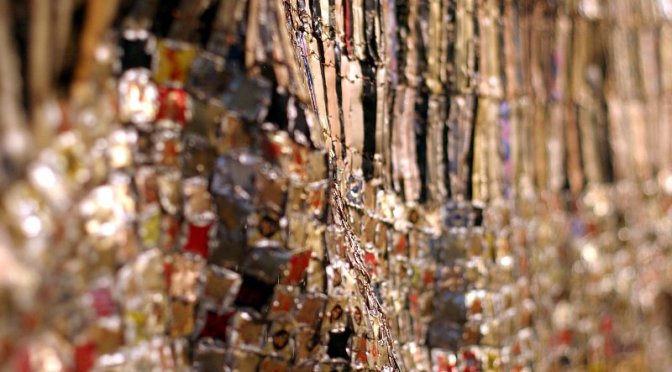
Photo by David Sky, seemsartless.com
Where the rest of the alphabet would go, I’m not so sure, but those first three letters reflect my experience working on Gravity and Grace: Monumental Works by El Anatsui, the retrospective exhibition at the Brooklyn Museum. Every show in every museum takes a dedicated team to pull it off, of course, but I’m taking this digital moment to highlight what’s been a particularly wonderful example of cross-departmental cooperation, which isn’t an easy thing, especially in a mid- or large-size institution. In this case, it led to a variety of ways to engage with the exhibition that ultimately (I hope) makes the show a great experience for our visitors.
We have a downloadable Teaching Resource for teachers who want to bring their students to see the show. We hosted a conversation between El Anatsui himself, Susan Vogel (filmmaker and author of El Anatsui: Art and Life), and Kevin Dumouchelle (the museum’s Associate Curator for the Arts of Africa and the Pacific Islands and curator of this show in its Brooklyn presentation):
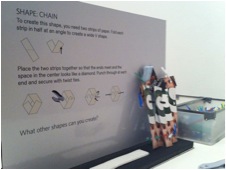
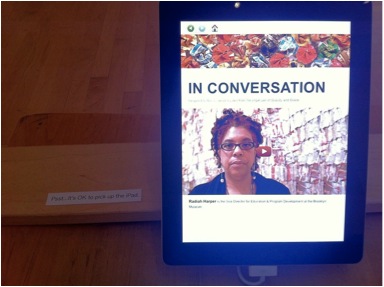
We have an in-gallery hands-on activity inviting visitors to use paper and twist ties to imitate some of the folds Anatsui and his assistants use to create his massive metal artworks (more on that in a bit). We have iPad kiosks that solicit visitor responses to the art on display using video questions posed by museum staff. We have QR Codes to scan for those seeking further context. And that’s in addition to our array of tours, workshops, and art-making classes designed for families, students, and adults. So many options for engagement!
So how did all this come about, and what made it so collaborative?
Photo by Rachel Ropeik
My part in it started when I took on the role of Project Educator for the show. The Education staff here divvies up a given year’s roster of special exhibitions to assign a Project Educator or two to each show. These folks represent Education’s voice in interdepartmental meetings and help shape education programming during the show’s run.
From the get-go, Kevin generously shared his knowledge, thoughts, and time with me and Matthew Branch, my fellow Project Educator. For Kevin, the collaboration inspiration started even earlier in the process: with Anatsui himself. “The work is so open ended,” Kevin says. “There was a real possibility for thinking big and thinking of options that we might have been a little bit more cautious about if we had more specific instructions from the artist.”
While some artists provide detailed notes for how their pieces should be installed, Anatsui likes to leave it up to the team at each location. “That filtered down to every aspect of the show,” Kevin adds. “Which made it a lot of fun.” Take a peek at this time-lapse video of the show’s installation. As you can see from the art handlers, designers, and conservators involved, it took a team to get the show up. Not to mention Robert Nardi in our Technology department, who made this video to share with the internet at large:
Go, team, go!
Adding her enthusiasm and creativity to the mix was Sara Devine, the museum’s Manager of Interpretive Materials, who made sure we had a hands-on activity in an exhibition full of objects that, oh man, do you ever want to touch. We can’t touch the art, but thanks to Sara’s input, we can do our own tactile experimentation. Physically embodied engagement? Check. Multimodal sensory inputs? Check. Music to the ears of any art educator.
Photo by Rachel Ropeik
Sara also enlisted representatives from our curatorial and education staff (and, again, Technology’s cooperation) to record several 30-second video clips that ask visitors questions about the exhibition and invite them to enter their responses on iPads throughout the galleries.
All in all, it’s an exhibition that offers visitors a range of ways of interacting, and it could only have been done by creative interdepartmental teamwork. As Sara states:
“I know it sounds pretty obvious, but what allowed this exhibition to be a good example of cross-departmental collaboration was an ongoing and open line of communication, which is surprisingly rare. I think we all very easily get caught up in our own part of the process and forget to reach out, ask for input, and keep others informed. We all made a conscious effort to communicate and I believe that is the biggest reason our collaboration was so successful.”
I couldn’t have said it better. This opening up of the closed doors–be they metaphorical or literal–between departments is a way many museums approach (or are starting to approach) their work, and it’s an exciting prospect to look forward to. In Mike Murawski’s recent post about the Museum Education Division sessions at this year’s NAEA Convention, he noted that we’re in “a moment when many major museums are re-imagining (and, in some cases, totally disrupting) the traditional relationships between education and curatorial.” Sure, it may be testing uncharted waters, but when it works (as it has with Gravity and Grace), it can produce amazing results.
How have you worked to open lines of communications across departments at your institution? Join the conversation below, and share some of the best collaborations you have been involved with.
Emily Shallman and I started talking about exclusion in arts and education while we were both working on our respective Master’s degrees. Lately, I have been eager to ask her to blog about her extensive research in inequitable access to the arts in public schools. Her findings suggest that museums, along with many non-profit arts organizations, are needed as key partners in providing equitable arts engagement and learning for students. Emily’s research prompts me to consider the museum’s place in the “landscape” of arts access, best practices for partnering with schools, and if museum’s are achieving their full potential to impact students. How are different art museums sustaining partnerships with public schools in high poverty areas? Are museums offering comprehensive arts education that represents art across cultures and communities? With more dialogue about these questions art museums can become more inclusive parts of this “landscape” themselves. – Aletheia Wittman, The Incluseum
You can also read this post in its entirety on The Incluseum website, including additional citations and notes. The Incluseum is a blog and project to promote social inclusion in museums coordinated by Rose Paquet Kinsley and Aletheia Wittman. Art Museum Teaching and The Incluseum are co-hosting this post in hope that Emily’s work and observations can catalyze a broader dialogue among museum professional and educators.
* * * * *
Arts education is a complex system today, as public schools–in conjunction with Parent Teacher Associations (PTA’s), local arts organizations, teaching artists, art specialists, volunteers, museums, school boards, the state legislature, and national policy–work in collaboration to deliver the arts to children. This intertwined web of arts advocates is a reaction to the worsening reality that the arts are no longer a stable piece of public school curriculum, with many schools excluding the arts altogether. The arts have had to react, and find a solution for inclusion in this landscape of severe budget cuts and focus on math and literacy. Rather than demanding to be included in the daily curriculum, with a mantra of “Do not cut the arts,” the arts have forged new partnerships to keep arts education alive in some public schools.
Let me paint the picture for you as best I can in an effort to make arts education more transparent, so that you can see how you fit into this landscape, and where there is room for improvement.
Schools, in the way they deliver (or do not deliver) arts education to children are highly diverse. This diversity means that public school A in Los Angeles, CA, is very different from public school B in San Francisco, CA, based on school population, size, parent involvement, student engagement and achievement, and of course, arts education. In the same way, public school B in San Francisco is also drastically different from public school C in San Francisco. Public schools are increasingly centered on the local, as arts education funding (at least in California) is distributed by local school districts. This distribution of funds, while on the surface entirely equitable, is not.
While each public school may get an equitable amount (based on school population and size, among other factors), PTA’s can quickly change the picture of arts education. More affluent schools tend to have more active PTA’s, and usually raise additional funds for academic programs that they value (and this sometimes includes the arts). Moreover, schools can decide how best to use the money they do receive—does this mean hiring a teaching artist for a week-long intensive for third graders in dance instruction, or does it mean buying new music stands and replacing outdated instruments, or does it mean using these funds to add to the overall school budget to help save a teacher from getting laid off (and hoping that teacher involves her students in arts learning)?
As you can see, arts education in public schools gets complicated quickly, and the picture can also seem rather bleak. However, I believe we are in a golden age of opportunity and collaboration.
Getting Arts Education into Public Schools
Local arts organizations, arts non-profits, and museums, have been afforded the opportunity to help deliver arts education to public school children. These institutions can provide a critical piece of learning to students, and if the success is documented, these collaborations can have a large impact on student learning. Unfortunately, there is no one model to follow when it comes to arts education delivery. As schools are centered on the “local” so is the delivery of the arts. The report from the President’s Committee on the Arts and Humanities (2011) summarizes this nicely, stating:
Photo by Michael Baltz
“Almost every community—indeed almost every school—that tries to address the vexing problem of how to get more arts into schools does so differently. A complex patchwork of arts education services across the country is the result, representing a mix of delivery models that include standards-based sequential arts curricula taught by arts specialists; formal and informal arts integration strategies; and short and long term teaching residencies for artists…There is no one model that works best for every community, and no single solution for the host of economic, pedagogic and logistical challenges faced by arts education advocates.”
Much progress is still to be made in terms of equitable and engaged learning with the arts, however. Interestingly (as based on my thesis research), a local elementary school in San Francisco with a high-poverty student population was a target of grant funding for the arts and actually had so many arts programs that the teachers were concerned about having enough time to teach other subjects. Comparatively, another elementary school in San Francisco, with an average socioeconomic student population (neither affluent, nor high-poverty) had very limited arts education, despite a very vocal and committed PTA full of arts advocates. Lastly, another elementary school in San Francisco, with an affluent student population and a highly involved and highly funded PTA, had hired a full-time art specialist (a very rare occurrence, I can assure you) to teach sequential visual art to all students for an hour each week. The national trend, however, is still that those students in the highest poverty areas are the ones with the least amount of arts education, and are those that could most benefit from them.
Pioneering Partnerships
There are substantial connections and programs to be cultivated with schools and outside organizations to bring quality arts education to all children. The arts, more than any other academic subject, is an area pioneering these partnerships. One successful example is seen at the Children’s Creativity Museum (CCM) here in San Francisco. At CCM, public and private elementary-school through high-school students can participate in creative field trips such as claymation, music studio, or innovation lab taught by museum educators.
High school students can work at the museum in the C.I.T.Y. (Creative Inspiration Through Youth) Teen Program, a paid employment opportunity, helping run exhibits and getting job experience in an arts non-profit environment. In addition, CCM has a growing outreach program, teaching claymation workshops at after-school programs in the Bay Area. While CCM’s programs are quite established and the link to childhood and youth arts education is evident, I know of other arts institutions that are taking baby steps toward inclusion. For example, some art museums now have field trip guides (sometimes just a folded pamphlet) for elementary students to learn about famous artworks in understandable language.
Arts advocates, one school at a time, are inserting the arts, sometimes briefly, to change the landscape of learning. Hopefully this trend will continue to gain momentum. I know that it takes a whole ecosystem of arts advocates, from those working at the national and state level who make policy that supports equitable and quality education, to those at the local level, who raise additional funds for arts education to be taught in public schools, to teachers who understand the importance of the arts, to researchers who publish this knowledge, to people who have been impacted by the arts who share their stories to create more arts advocates.
Wouldn’t it be wonderful to have a full-time arts specialist in every school, in addition to a visiting teaching artist and relevant field trips to museums, as well as after-school arts programs by local arts organizations? Just think of all those students could accomplish!
How are different art museums sustaining partnerships with public schools in high poverty areas? Are museums offering comprehensive arts education that represents art across cultures and communities? With more dialogue about these questions, art museums can become more inclusive parts of this “landscape” themselves.
EMILY SHALLMAN has a BA in Elementary Art Education with a Washington State Teaching Certificate and Reading Endorsement from Western Washington University, and a MA in Urban Studies from the San Francisco Art Institute. Emily has experience as an Art Specialist, teaching visual art to grades K-5. Her MA thesis researched the history of arts education in public schools, as well as case-study analysis of the inequality of arts education based on socioeconomic factors. Currently, she works at SFAI, serves as a Board Fellow for the California Alliance for Arts Education and runs a children’s illustration blog www.illustrationsby.com. She lives in San Francisco, CA with her husband and two cats.


 In recent years there has been a new player in the field of education. MOOC (massive open online courses) have taken the world (somewhat) by storm with various free courses from prestigious (and sometimes not so prestigious) universities and colleges. Here is a quick YouTube video describing the basic nuts and bolts of a MOOC, if you are thinking “What in the world is a MOOC?”
 Perhaps the best path forward for museums looking to make inroads in online learning is to create courses that can act as complementary to personal visits, but also provide more than enough information to be sufficient in their own right for those who cannot (for whatever reason) attend in person. Thanks to the Google Art Project and the expansion of the Khan Academy into art history, displaying works online is likely to become increasingly commonplace for museum and art galleries. Steven Zucker and Beth Harris, in their article explaining why the Google Art Project is important, report that other museums have started to make public domain images available for download – namely The Brooklyn Museum,, Metropolitan Museum of Art, and The National Gallery of Art. As a result, those who do not get involved may well be left behind.
 Linda Forshaw is a Business Information Systems graduate from Lancaster University in the UK. A contributor to Degree Jungle, she is a full time writer and blogger specializing in education, social media, and entrepreneurship. Contact her on Twitter @seelindaplay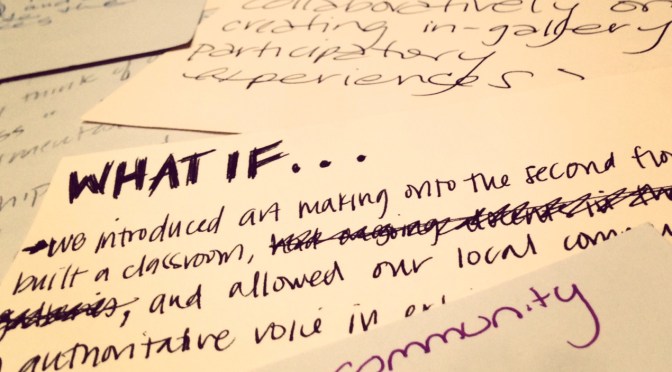


 Art Museum Teaching