
Written by Mike Murawski
“Talking in museums is one of the things that makes them matter, and the way in which we talk in museums is one of the things that define for us what they are.” – Adam Gopnik
Over the past 20 years, research in the fields of museum studies and museum education have firmly established the importance of the social dimension of visitors’ museum experiences and the learning that happens in museums (see this great 2012 post from Regan Forrest’s Interactivate blog). In addition, a wealth of research from more than 50 years of educational psychology speaks to the social and cooperative aspects of learning in more formal educational settings (see this extremely useful resource packet developed at Stanford on “Learning in a Social Context”). So whether sitting in a classroom or walking through an art museum, we learn and make meaning through our interactions and conversations with the people around us.
Last week, I was invited to the Crocker Art Museum in Sacramento to give a talk to their volunteer docents on the topic of “dialogic and conversational touring.” I have always been a strong advocate for conversational pedagogy in museums, practicing this form of teaching myself on a regular basis as well as spending considerable time these past several years thinking about how to bring conversation into the core of docent education and tours. Thrilled to have the opportunity to work with the docents at the Crocker, I used this as a way to crystallize some of my thinking about the learning power of conversation in museums. I thoroughly enjoyed my time with the Crocker’s docents and education staff (special thanks to Jill Pease and Stacey Shelnut-Hendrick), and I thought I would share some reflections here on the topic of conversation and museum teaching.
What Does ‘Conversation’ Mean to Me?
When I examine what ‘conversation’ means to me and my own practice of museum teaching, two unsuspecting people come to mind: critic and curator Michael Brenson and contemporary Anishinabe-Canadian artist Rebecca Belmore. Back in 1996 at the “Conversations at the Castle” series of discussions between artists, critics, and the public about contemporary art and audiences, Michael Brenson addressed the core democratic notions of conversation. The following quote from Brenson has resonated with me for years and best represents what I value about the powerful kinds of conversations we can facilitate in museums:
“In the best conversations, no one is used; ownership is shared. Everyone leaves with a sense that the ideas exchanged belong to each person present. Everyone also leaves respecting those who were part of the exchange, whether or not there was agreement. For me, conversation does make connections, it helps make connection possible.”
Since beginning my museum career in a largely contemporary art museum, I have formed so much of my own teaching practice from ideas of pedagogy and human connection advanced by contemporary artists. While didactic wall texts, curatorial essays, and academic lectures often over-intellectualize and dull the interests that contemporary artists have in education and public engagement, I continue to find that so many artists are constantly thinking about the ways that their work can bring people together to think, talk, exchange ideas, make connections, and have meaningful conversations about issues relevant to our lives.
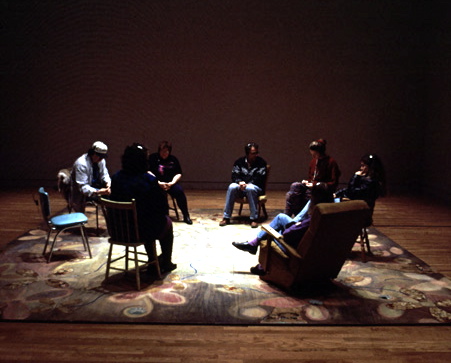
Rebecca Belmore is one artist whose work has powerfully ignited my own thinking about conversation, about whose voices get to be part of a conversation (or don’t), and about the role that power plays in the conversations we might have in institutions such as museums. I first encountered her performance and installation work during one of my feminist and gender studies courses in graduate school, specifically her 1992 piece entitled Mawu-che-hitoowin: A Gathering of People for any Purpose (shown above).
In this work, Belmore arranges a circle of chairs taken from her own kitchen and the living spaces of women closest to her. Viewers are invited to sit down, put on a pair of headphones dangling over each chair back, and listen to the stories of Belmore’s female community talking about their lives as native women in Canada. What strikes me most about this work is how Belmore welcomes participants into a circle of community, a form of talking circle that embraces voices that would likely otherwise go unheard.
Sparked from inspirations such as these as well as years of in-gallery experiences, I’ve developed some overarching frameworks that have helped me think about creating an environment for conversation while teaching in an art museum. First of all, I continue to find that the structures of engagement, or physical arrangement of people in the space of the gallery, has a strong correlation to the type of conversations that can occur. In addition to simply how we arrange our groups, there are certain power relationships that we create as we position ourselves as educators and facilitators of meaningful conversations. I’m going to briefly dive into both of these areas, but far more pixels could certainly be spilled about each topic — and I hope maybe we can have some discussion in the Comments section below to pull out more ideas.
Structures of Engagement
In preparing to speak about “conversational touring” at the Crocker Art Museum last week, I spent considerable time thinking about the underlying structures that can establish a conducive environment for meaningful conversations (or that can prevent them from happening). For me, the physical space we create with our group is always so important, sending an immediate message about the types of interactions we expect to have. I used the photos below (pulled randomly from Flickr and Google) to illustrate a few examples of how we, as educators, can create better structures of engagement in the galleries.
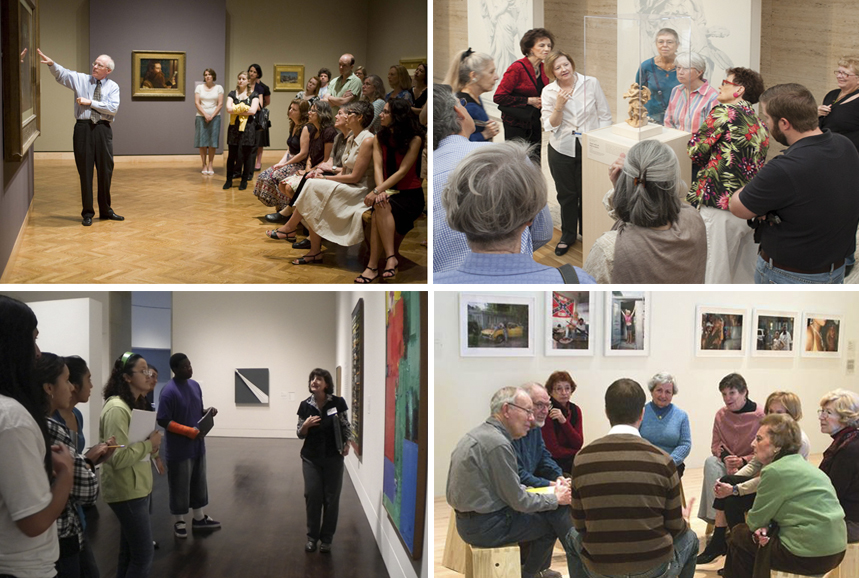
Of these four gallery teaching experiences, which do you think might have the best conversations taking place? Which of these photos looks most like tours that you have experienced, or even that you might lead yourself? (I, myself, have led plenty of tours that looked like the photos on the left)
The two images on the left show a much more traditional and common structure of engagement, with an educator or “tour leader” at the front near the artwork and then the group a bit farther away. While this is a completely valid and effective way to lead a tour, it just does not lead to lots of conversation. Any dialogue and exchange happening is between the tour leader and the participants, with very little participant-to-participant communication possible (the core of that social, cooperative dimension of learning). When the docents at the Crocker were examining these photos with me, they also noticed how much the participants body language seemed to support their mediocre levels of engagement.
By contrast, the two photos on the right show a very different structure of engagement — something that actually looks a lot more like Rebecca Belmore’s circle of chairs. The educator or tour leader becomes a part of the group, and the structure of the circle creates a more effective space of engagement where focused looking, questioning, and thinking can occur. It creates a better environment for conversation and discussion, as well as greater participation among the group (students and participants are not as detached from the experience — teachers and students all become learners in the gallery experience). While this subtle difference can seem fairly obvious, I could not even begin to count how many docents or educators I have observed that struggle with making connections with visitors — much of which could be solved with a simple re-arrangement of their group.
Power Relationships
As we make decisions about the physical arrangement of our groups, it is also important to be aware of the power relationships (often unintended) that we set-up between ourselves and our group, and among the group itself. In a good conversation, as Michael Brenson describes, “ownership is shared.” We aim to create a safe environment for open exchange and dialogue in which everyone’s voices and ideas are respected. This type of open conversation can be very difficult to achieve if we set-up a one-sided power dynamic with our group.
In the two photos on the left (below), we see fairly typical docent-led school tours. By standing and towering over their group, however, the docent or educator has established a traditional teacher-student power relationship that will not lend itself as well to open exploration, creative wondering, and meaningful conversations among the students. Feel free to try this out — have a conversation with someone in your office with one of you standing and the other person sitting on the floor. Yep … awkward at best.

The two photographs on the right (above) show exchanges in which the educator and students are closer to the same level; no one is towering over the other. These students likely feel more empowered to look, question, wonder, and discover along with their docent or educator, breaking down the traditional power relationships between ‘teacher’ and ‘student.’ In my own teaching experiences, this almost always rings true — as soon as we all sit on the floor and are at a level playing field, the conversation ignites and we are all more open to sharing our thoughts, insights, and questions. With adult groups, arranging a semi-circle of gallery stools is an easy way to establish this conducive environment for meaningful conversation.
How do you create meaningful conversations in your museum?
It was so great to have the afternoon last week to work with the Crocker Art Museum docents on these (and other) issues regarding conversational touring. We had lots of fun modeling the power dynamics of a tour through a quick theatre exercise on stage, and we worked on developing creative, participatory questions to spark meaningful conversations with works of art. I even had a chance to talk briefly about the role of artwork selection on a conversational tour, as well as something I like to call “researching for stickiness,” or how we can research information about artworks in a way that helps open up pathways to spark dialogue and thinking. Even with all of this, we were only able to scratch the surface in terms of “dialogic and conversational touring.”
I would love to hear some of your best strategies for igniting meaningful conversation in the galleries:
- How important is conversation for tours and education experiences at your museum?
- What is your favorite way to start a tour that will be focused on conversation?
- How do you set-up that expectation from the beginning?
- What types of teaching techniques do you find bring out the most interesting discussions (for students or adults)?
- How do you ensure that the diverse voices of participants and students can be heard?
 Art Museum Teaching