
Written by Jen Oleniczak, Founder and Artistic Director, The Engaging Educator
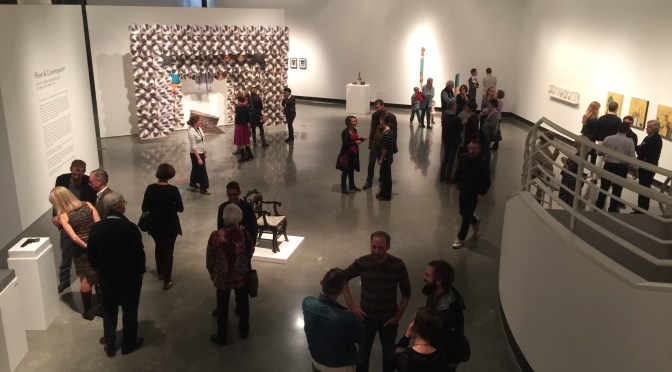
On October 16th, Museum Mashup, Triad Style took place at the Southeastern Center for Contemporary Art. Individuals from all over the state came to experiment and meet new friends, all with the idea of experimenting with cultural experiences. As this is at least the 7th experimental museum teaching event like this in the past year or so (they have happened in New York, Brooklyn, San Diego, New Orleans, Cleveland, Denver, and now Winston-Salem), I wanted to share more on how to plan your own Museum Mashup, as well as some reflections from our recent SECCA Mashup.
How We Plan a Museum Mashup
The impetus behind this is simple: empowerment and ownership. People on Twitter (encouragingly using #MuseumEdMashUp tag) reached out to me asking if they could do a Mashup and/or I or someone from my organization could come out and lead one at their museum. People here were asking if they could come since they weren’t an educator and others asked if they could invite non-art educators. My answer is and always will be yes. Yes, invite non-art educators. Yes, come even if you are scared. Yes, do one anywhere and everywhere. Yes.
When I did the first experimental teaching adventure with Mike Murawski and Rachel Ropeik over a year ago, it wasn’t this. It’s evolved into this, because of circumstance, need, new places, new people – and my guess and hope is it will keep evolving, beyond this ‘how-to’ and the Mashups that have happened. The Mashup doesn’t belong to any person or museum – and it doesn’t have to be about good teaching or developing programming or pedagogy. It focuses, in my opinion, on the creation of experiences with objects, people, stories, and surroundings. So folks asking “can we…?” the answer with me will always be “yes!”
Which leads to the thought that this isn’t so much of a ‘How-to’ as a ‘How-we’. And if we keep sharing this ‘How-we’ then we, as a community, can use this experimentation in the best possible way for ourselves.
So without further ado, the How-we:
-
Found a group of people.
As some of you may know, I just moved from NYC to Winston Salem, NC. I knew a handful of people, museum people mostly, through traveling and my partner. After chatting with Debbie Randolph of the Southeastern Center for Contemporary Art, who was part of the NOLA NAEA Mashup at the Ogden, I emailed a group of people I knew in the Triad museum world and told them about the idea. I asked them to ask people they knew, and we had a group.
-
Found a place and date.
Lucky for us, Debbie had done the Mashup in NOLA and knew how successful it could be. She offered to host the first at SECCA. As a group, we did a Doodle poll and found a date and time frame that worked for the majority.
-
Promoted away!
Yep, promotions before logistics. Since the basic idea was experimentation, and because I had done a Mashup before, I wrote a quick blurb and put up a Facebook Event. The Engaging Educator wrote a press release and shared it with SECCA’s Marketing Director, who shared it with their press contacts.
-
Just did it.
Logistics were a big part, and the part that always stresses me out. I broke it down into a few key areas when planning for this Mashup:
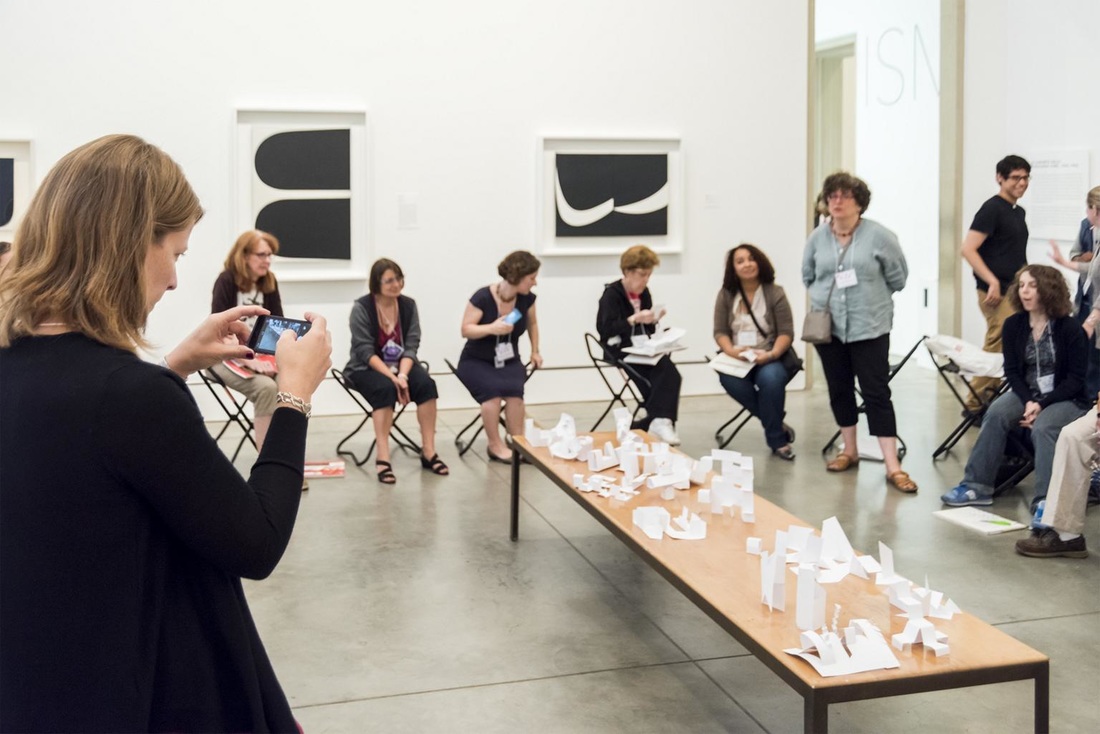
The Schedule: Mashups are fast. There was 15 minutes alloted for greetings, groupings and a quick warm-up, about 35-45 minutes for the participants to create a 5-7 minute experience, and then the time for the experiences. That last time frame is flexible, based on the number of participants.
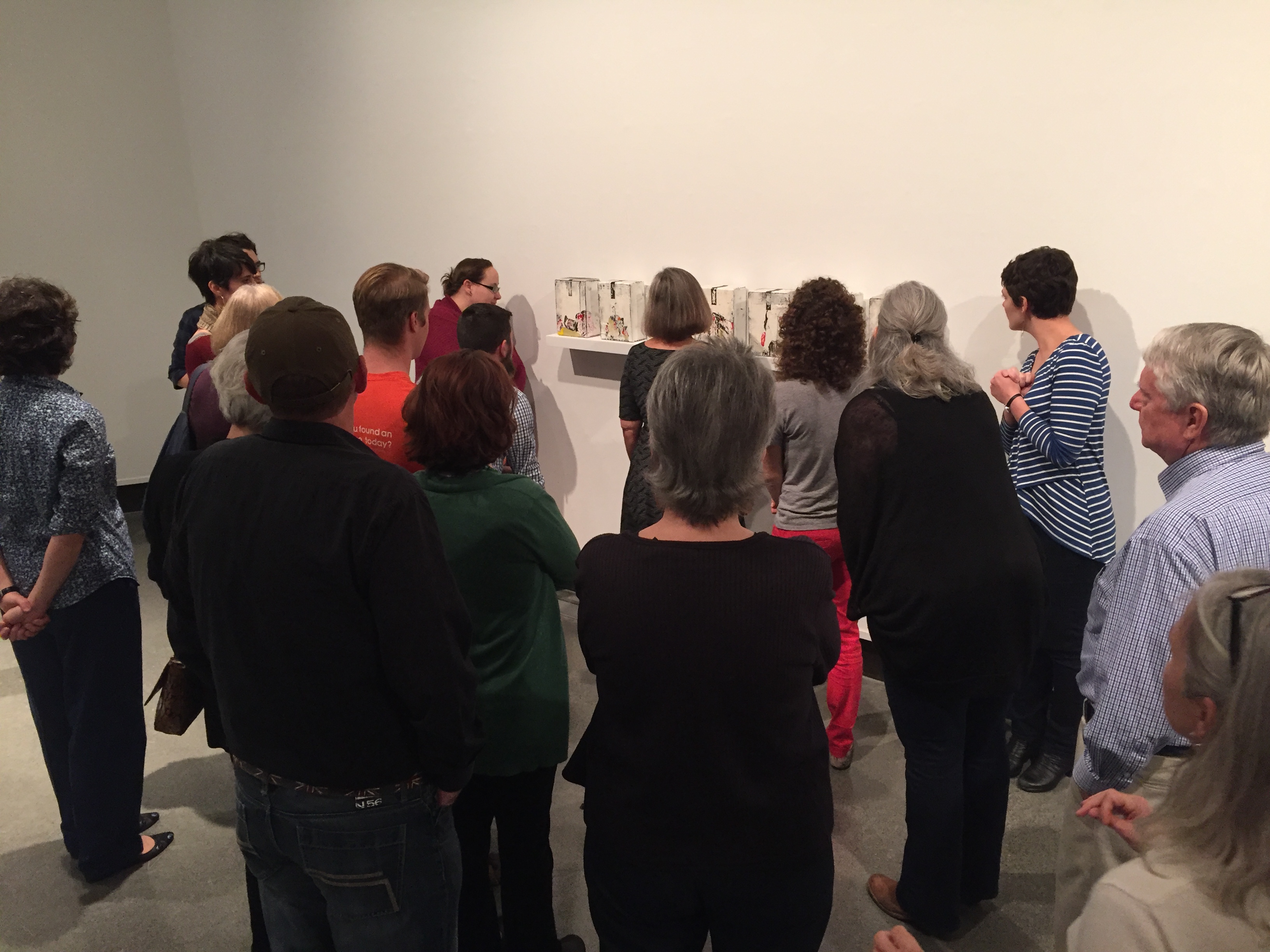
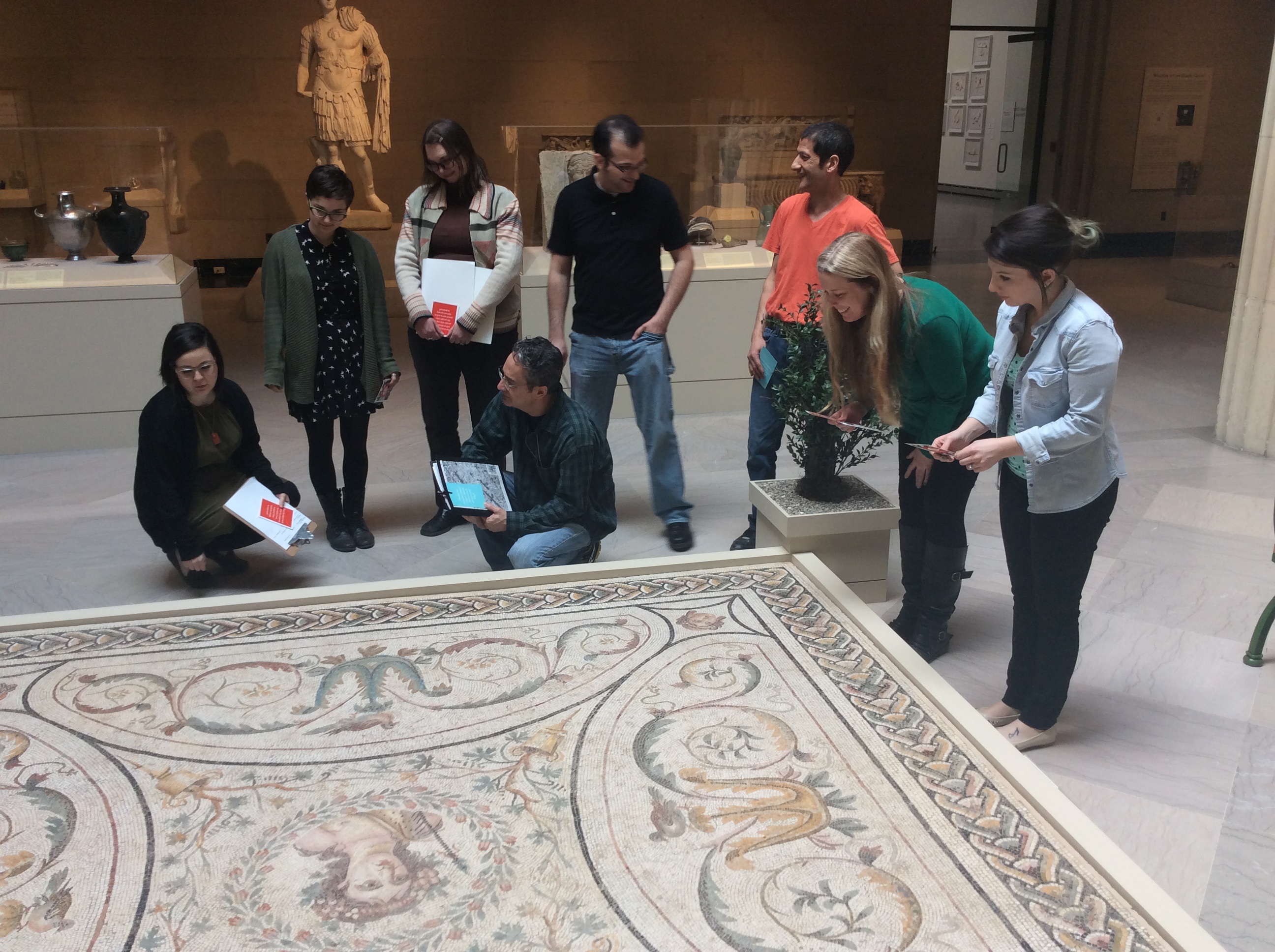
The Works: Since the exhibition at SECCA, Point & Counterpoint has 18 artists on display, it was natural to use them all, since we didn’t know exactly how many people would be attending. Alex Brown from SECCA printed out cards with the artist names, and the groups would randomly choose which artist they would be working with. Some artists had multiple works, but ultimately it was up to the group to decide what they wanted to create.
The Groups: As people walked in, they signed in. Taking the total number and dividing by three people per group, people were assigned into six groups in the good old fashioned method of ‘1, 2, 3, 4, 5, 6…1, 2, 3, 4, 5, 6…ok all the 1’s over here, the 2’s over there.’ I ended up doing this in a notebook and just calling out each group, but that elementary school grouping happened in a tiny moleskin.
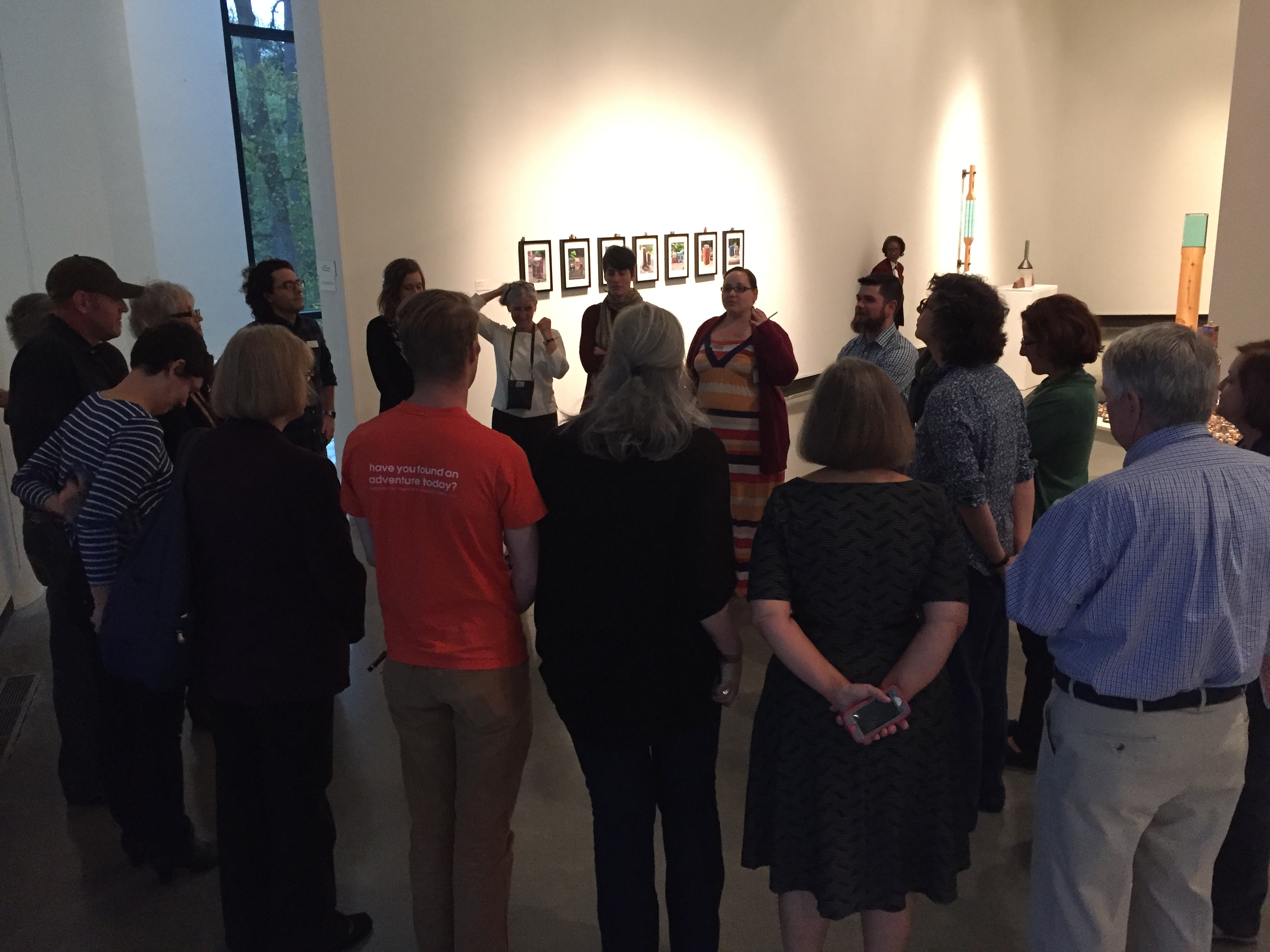
Facilitation: The facilitator is crucial, but the lack of facilitator voice is even more important – it isn’t their show. Debbie introduced SECCA and the exhibition, and I explained the Mashup goals – random groups would randomly be assigned a work, they would have a finite amount of time to create an experience with the work. This experience would have to be experimental – that is, no VTS, inquiry, traditional teaching styles, and ideally something that could fail. Aside from instructions, the facilitator needs to push the event along, but not comment. While I did lead the group in an improv warmup (everyone felt scared! I feel energies too often in rooms, so I had to fix it!), I timed groups, cut them off when they went over time, and turned the attention over to the next group.
On a personal note, I leave things vague and don’t like to give the group ideas, suggestions, props – I want them to define experience themselves, the interpretation to come organically and the experience to be group driven, not agenda driven. Yes, I would love to see everyone do crazy out there experiences – but risk to me is very different than risk to others.
Lunch: Lunch was provided for the participants. This is optional, clearly, and our next one (YES, we have another planned!) will happen after lunch. I’m a fan of giving people some kind of treat after positive-risk taking.
Reflection: They came, they created, they presented, they ate, and they reflected. Below, you can read the reflections of several participants – I left it optional to submit a written reflection, but post-lunch we chatted about a few key things. I asked the group to think about how they felt before, during and after the Mashup, what successes and failures they saw and had, and what can they do today, tomorrow or eventually with what they saw today. Those questions were also posed to the group for the written response.
-
Wrapped it up, and said where next…
I’m a big believer of striking while the iron is hot – I immediately emailed the group post-weekend, and asked where the next Mashup would take place. Full disclosure, I asked AT the Mashup, post reflection, because I am still an abrasive New Yorker. Worked well, because the New Winston Museum and North Carolina Museum of Art offered to host the next two. I set a date for the participants and myself regarding reflections. It’s 4:30pm on October 26th, and my self-imposed deadline was October 27th at 5pm. I also started a Facebook group to keep everyone together, post photos, plan the next one – with the simple description of “To plan, execute and reflect on cultural experience experimentation in NC.”
Because that’s exactly what we are doing.
This wasn’t my first Mash Up, but this might have been my favorite one, only because of the domino effect that happened after. People are excited – we had educators, but we also had a curator, a chef, an owner of a new makerspace, artists, retired teachers, a poet – and that energy around connecting with objects and works is incredible. So YES, do these all over…AND share what happened!

Participant Reflections: Museum Mashup, Triad Style, October 16
Before the Mashup at SECCA, I was feeling slightly anxious. I had seen a mash-up in New Orleans, but wasn’t exactly excited about doing it myself. What if I didn’t have any ideas? What if I let my group down? What if I was assigned some artwork that I couldn’t find a connection with? I felt better knowing that I wasn’t going into it alone and that everyone would be encountering their assignment at the same time. Mostly before the mash-up I was feeling reluctant to go and trying to make an attitude adjustment so that even if I didn’t have fun, I wouldn’t bring an attitude that would encumber anyone else from having a great time.
Appropriately, Jen rounded up the group for a collective experience to get us started. This was crucial, as warm ups can be. I knew most of the people there, but there were some I didn’t and it was not a gathering that had existed before. We needed a shared experience before beginning the task. Simply gathering in a circle helped, Zip-Zap-Zop further supported a new dynamic and preparation for us to move forward.
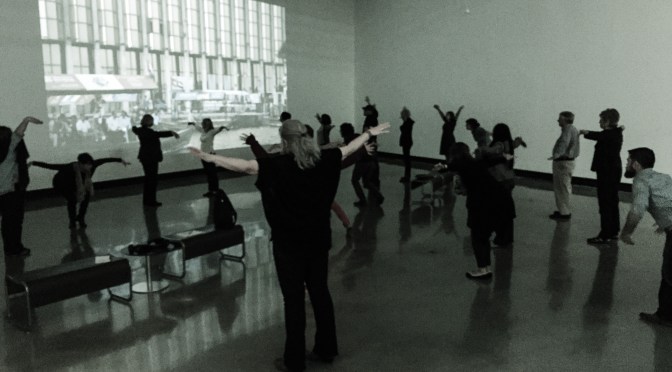
I felt better when assigned my group; I’ve been on a committee with Katherine for the better part of this year and I had met Emily before at other museum educators events. When we received our artwork, I felt a little anxious again: it was a video work. How would we incorporate a piece of art that was so dependent on time? When we went to the video, however, I began to relax again. It was beautiful. My fear of connecting with the work was quickly assuaged and the next challenge was to figure out how to create a corporate experience. I felt blank. What on earth would we do? When Emily suggested sharing our thoughts in flashes while we watched, I again felt better and knew I could trust the process. We were sharing ideas; we had similar observations and some of the same ideas were resonating with us. The film was short and looped through several times as we formulated our own responses and began to brainstorm our approach. I kept finding myself thinking, what do I want people to notice and learn and had to remind myself I wasn’t teaching. Our goal was to create an experience. When watching the film that showed falcons and Arabian desert, I felt compelled to move. And movement became part of the experience.
We worked together to create an experience; while we didn’t require our visitors to look closely at the video or experience it in full, we did use the elements of the video to inform the experience. And, it served as a backdrop, visual and auditory, as we proceeded. I hope that people were able to see it and make connections while participating in the activity we led, even if the connection to the art was necessarily soft.
There was a moment, as we wrapped up our “experience,” when I realized that everyone in the gallery had jumped right in and trusted us all the way through the activity. They trusted us and each other (it might have helped that the room was darkened for video) such that at the end we were all standing as falcons and emitting a piercing cry of a bird of prey into the gallery. I was grateful for their trust in us and I think they were rewarded for it; the positive energy in the room was palpable.
I left the day feeling energized and like I had had a good mental/professional workout.
While in some ways, I feel like I am constantly experimenting in my own teaching in the process of figure out what works, I also experience limitations. Some of these are institutional, some are self-imposed. What I saw from my group’s gallery experience is how movement can be a really important thing to do in an art museum. It helped me respond to the video and it further shifted the energy of the collective group. I can thus push more to incorporate movement in the context of my museum teaching–trying to find ways to do it safely and structure experiences so that it is included.
In terms of structure, I think it was great to have the length of time (5-7 minutes) that we had and the number in each group (3). Also, as one of my colleagues said, it’s so fun to get to work with other people’s art!
Julia Hood, Coordinator of Education, Reynolda House Museum of American Art
* * * * *
The Museum Mashup is a really fun and fresh way to connect with one’s creative side and to collaborate with museum and art professionals. Mediation is the sacred key to what Curators and Educators do–it’s our shared ground. The Mashup brought us together and helped bring about a variety of responses, approaches to mediation, and conversation showing that good things happen when you play.
Cora Fisher, Curator of Contemporary Art, Southeastern Center for Contemporary Art
* * * * *
When I first signed up for the Museum Mash-up I really had no idea what to expect, but I had met Jen a week or two before and I knew that it would be an exciting event. I met some interesting new people, which is rare for me. I know everyone in town! I was surprised by how some of the groups gave me a new and very interesting way to view some of the art installations. I think I made some new friends at the Mash-up, and I plan to take a closer look at the exhibits at SECCA and explore some new perspectives.
Alan Shelton, Co-Founder/CEO, Winston Salem Mixxer
* * * * *
It’s not always easy to break away from what “works”, but I believe it is always worthwhile to step back and look at things in new ways and through different perspectives. By encouraging collaboration between educators and non-educators from the Triad, the Museum Ed Mashup at SECCA gave me the opportunity to play with a group of individuals that value experimentation and play as much as I do.
In the field of museum education it is often all too easy to stop experimenting and become complacent when you find something that “works” well enough. This could be a tour program, an art activity, a scripted speech, or a way of looking at or experiencing artwork. While there is nothing inherently wrong with repeating programs or experiences, repetition in isolation and without experimentation can lead to complacency, and ultimately stagnation. This problem is exactly what the Museum Ed Mashup was created to combat. And that is exactly what it did.
By bringing together educators and non-educators together from varied backgrounds it gave everyone the ability to experiment freely and experience the world through different perspectives. This, I think, is the greatest gift the Mashup has to offer. It reminds us that not everyone thinks alike.
Alex Brown, Programs Coordinator, Southeastern Center for Contemporary Art
* * * * *
The time spent at MuseumEd Mashup, far exceeded my expectations. In a world of meetings, planning, lectures and programming, it was refreshing to step away and look at exhibits in a more provocative way. I was inspired to explore the artist and medium in new and creative ways, with others! Thank you for stepping outside of the box and taking risks with your audience.
Amy Jordan Kincaid, Graphics and Special Projects Coordinator, Sawtooth School for Visual Art





 Art Museum Teaching