Tag Archives: reflective practice

Purposeful Praxis: Reflections on a School Partnership

Written by Sara Egan, Isabella Stewart Gardner Museum, and Michael Baulier, Edward M. Kennedy Academy for Health Careers

The School Partnership Program at the Isabella Stewart Gardner Museum is like a laboratory for museum education, through which we work for multiple years with a diverse range of students and teachers with a collection of art that never changes. This combination of stable and changing variables has allowed the Gardner Museum to maintain a cycle of theory, practice, research and reflection. The School Partnership Program uses Visual Thinking Strategies (VTS) as the primary teaching and assessment method, responding to findings from our 2007 U.S. Department of Education study, Thinking Through Art. We’ve continued to learn and grow since that study, most recently through our work with the Edward M. Kennedy Academy for Health Careers (EMK), an in-district charter school in Boston. We started partnering with the English Language Arts and History teachers in 2012 and this year added Spanish teachers. While the successes and challenges we encounter working with EMK are specific to our partnership, we hope you will use our example to consider how praxis (the practical application of theory) and research can contribute to your own programs.

Research: Getting to know our audience

Working with the same audience over time is a luxury, but also crucial in our pursuit to consistently tailor our program to the specific needs of our partner students and teachers. Since we work with the students throughout their high school careers, we see the EMK 11th grade students respond to the Museum very differently than they did in 9th grade. We see changes through a variety of data collection methods: surveys, writing samples, long and short interviews, observations, and more. Our program goals include developing visual literacy and critical thinking and communication skills, so we mine the program data to determine how the students are making meaning from works of art and quantify the frequency of critical thinking that they deploy in that quest. The quantitative research tells us where the students are, while the qualitative data helps us to understand the context and explain how, when and why students develop these skills. So, how do we respond when we see that students shift over time from 9th grade comments like,

“Yeah. It’s a nice picture. It’s nice and, I don’t know, it’s colorful”

to interpretations from 11th graders such as,

“This room looks dark and mysterious. Kind of like a church because of all the holy statues and religious references. Maybe it means you can find light even in the darkness?”  
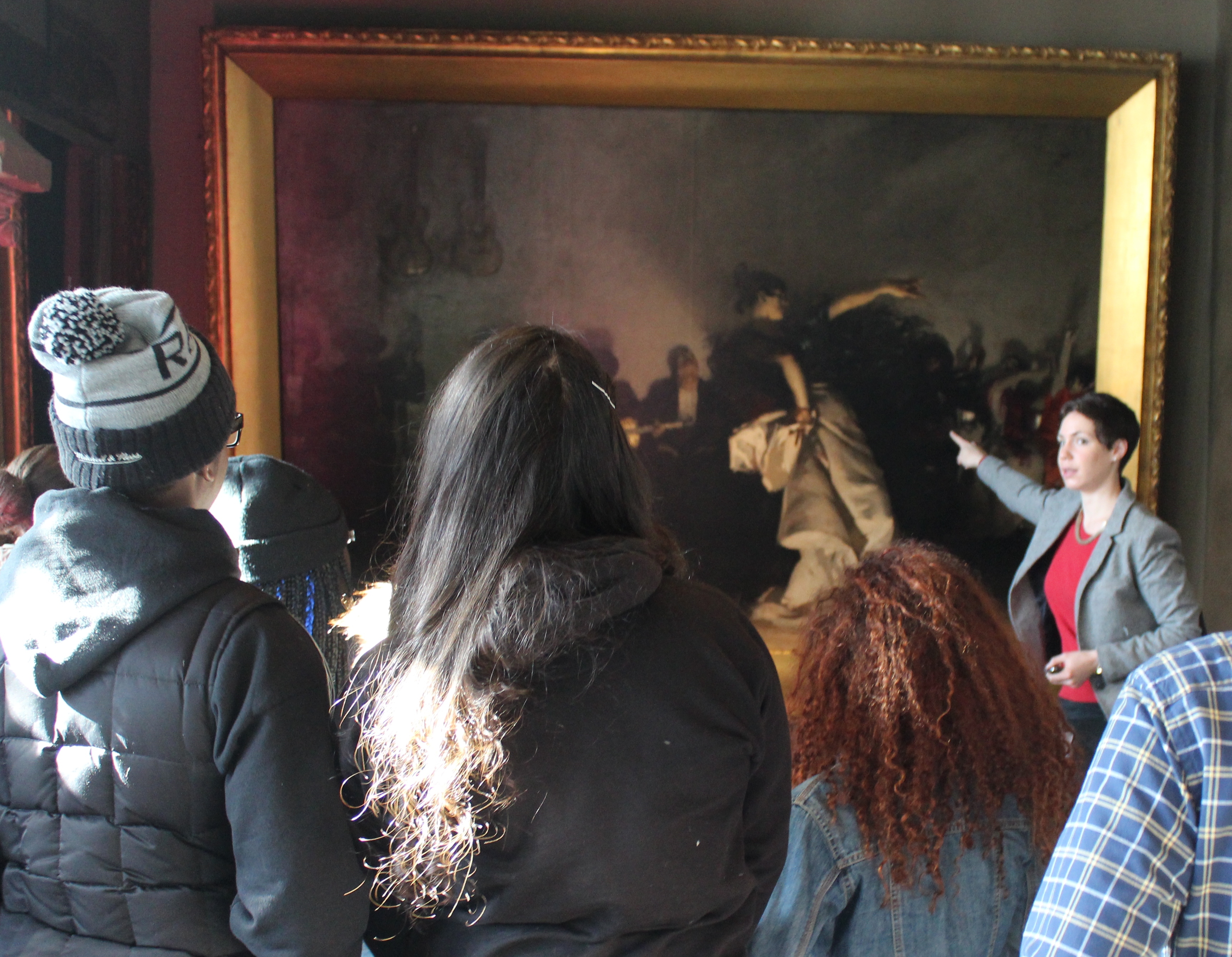
EMK students using VTS to discuss El Jaleo by John Singer Sargent, 1882, Isabella Stewart Gardner Museum, Boston.

Theory: Making sense of the data

The work of constructivist theorists like Piaget, Vygotsky and Duckworth, Abigail Housen’s theory of Aesthetic Development, in addition to our own personal theories of learning and change inform our interpretations of our research. Viewing the raw data through the lens of theory helps our team of educators explain what we see while validating the theories that we are considering. Returning to the EMK example, we know from our research that as these high school students are introduced to the Gardner Museum and begin discussing art using VTS they are primarily concerned with their own observations and prior knowledge. After two years of monthly discussions of art in the classroom and at the museum, they start to wonder about the intent or history of the artist. Housen’s theory tells us that through extensive experience looking at art there will be a development from storytelling to considering new kinds of information such as art history. Piaget’s theory of childhood development contributes to our understanding of why this happens more quickly in high school students than elementary-aged students. We use these frameworks to understand where the EMK 11th grade students are now, and then estimate where they are likely to go next and what kinds of questions they will pose in the months ahead.  The students are capable of abstract reasoning and are interested in the way that an artist’s intentions play out in a work of art. They are also thinking about the VTS process itself and questioning the boundaries of its usefulness with art and across disciplines.

Practice: Putting it all into action

With a solid grounding of data and theory, our next step in August 2014 (Year 3 of partnering with EMK) was to adjust our practice to fit the new reality of these more experienced students’ needs and interests. First we began experimenting with new types of information when the students visited the Museum, for example providing more context about a special exhibition or asking probing questions like, “What do you think might have interested the artist when making this artwork?”  Next, we held intensive professional development for our partner teachers at EMK, collaborating to create “VTS extensions” that use VTS skills to explore new concepts, for example predicting the themes of a new novel or unit of history by examining images.

Collaboration: Insights from Michael Baulier, 9th grade English Teacher

As a STEM school with a strong focus on math and science, EMK relies heavily on relationships with peer institutions to offer opportunities for students to engage in the arts. I embraced VTS because I view this instructional approach as an opportunity to address the dearth of arts education in our school.  What I did not anticipate was the extraordinary impact VTS would have on the daily instruction that occurs in my classroom.

VTS fits seamlessly into my teaching as an instructional strategy that promotes whole-group discussions grounded in visual evidence.  When I ask students the first VTS question, “What’s going on in this image?” I am cuing them to develop claims based on a visual text.  The follow-up question, “What do you see that makes you say that?” requires students to provide visual evidence to support their claims.  In ELA class evidence-based reasoning is at the core of everything we do, whether a student is discussing a visual text during VTS, making an inference while reading a short story, or writing a paragraph to support a thesis statement in an essay.  VTS also aligns nicely with the ELA Common Core Standards’ emphasis on student-centered exploration over teacher-directed instruction, and the development of listening skills and oral proficiency are beneficial to students who are English Language Learners or receiving Special Education.  Instead of frontloading tasks with teacher-generated content knowledge, students engage with texts, take risks, and uncover meaning collaboratively.  Because the subject of VTS is an image, all students have an opportunity to contribute to the discussion in a low stakes environment.  The deliberate focus on active listening and high volume of oral language input for students to process leads over time to increased language output.   I have observed students who are typically reluctant to speak aloud share detailed responses to complex images in the classroom or at the Museum.

In the third year of our partnership with the Gardner Museum we are collaborating more than ever to explore new opportunities for using VTS to enhance teaching and learning in our school.  In November my students visited the Museum to brainstorm ideas for image-based short stories written as part of a VTS extension project.  In April we look forward to hosting our first family event to showcase student work inspired by the Gardner Museum.  The Museum’s eagerness to engage our school community through so many unique learning opportunities makes this partnership especially exciting, because it speaks to the creativity that is so vital to both the arts and education.
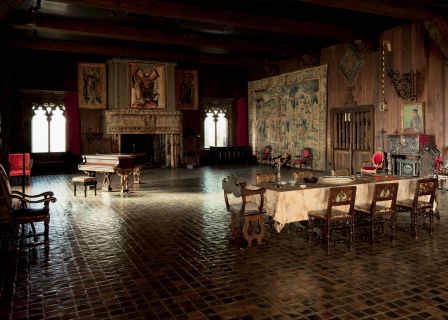
Tapestry Room, Isabella Stewart Gardner Museum, Boston, Photo: Sean Dungan.

Reflection: What did we learn from the cycle of praxis?

The contours of this partnership have changed over time as we listen to our audience through research, interpret what we hear through the lens of theory, and translate our understanding into practice.  Rather than automatically replicating practices that have worked in the past we continually strive to improve and to justify, to ourselves as well as all other stakeholders, the value and relevancy of our program.  At EMK, our partnership is a component of school culture and the value of the arts and critical thinking are infused at every grade.  Teachers and students consider the Gardner Museum as an active part of their campus, visiting independently and attending the Museum’s other programs.  This cycle keeps the work always fresh and exciting, as there is always more to learn from and with our partners.

*     *     *     *     *

About the Authors

Sara Egan and Michael BaulierSARA EGAN: School Partnership Manager at the Isabella Stewart Gardner Museum, where she connects Boston students and teachers to the Gardner through Visual Thinking Strategies (VTS). She teaches preK-12th grade students in the galleries and the classroom, trains and coaches teachers to use VTS, and researches the impact of the School Partnership Program.  Sara also manages the Gardner Museum’s paid Teens Behind the Scenes. She holds a BA from Vassar College and an Ed.M. in Arts in Education from the Harvard Graduate School of Education.

MICHAEL L. BAULIER: Educator at the Edward M. Kennedy Academy for Health Careers, where he teaches English Language Arts to ninth grade students.  Michael is an inclusion teacher who is licensed to teach students receiving Special Education (SPED) support services as well as English Language Learners (ELL).  He earned his National Board Certification for Professional Teaching Standards (NBCT) in 2014.  Michael holds a BA and MAT from Northeastern University and is currently studying at the University of Massachusetts Boston to become a school administrator.

*     *     *     *     *

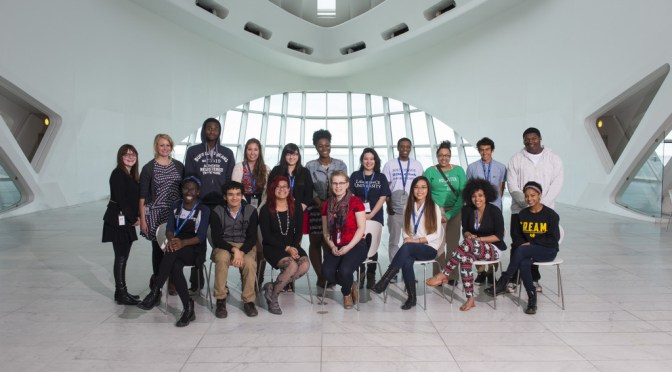
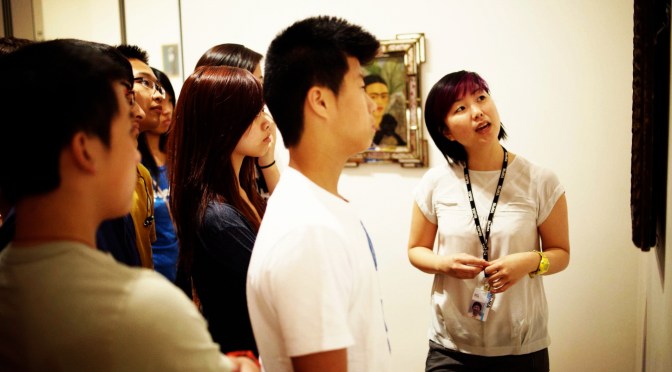
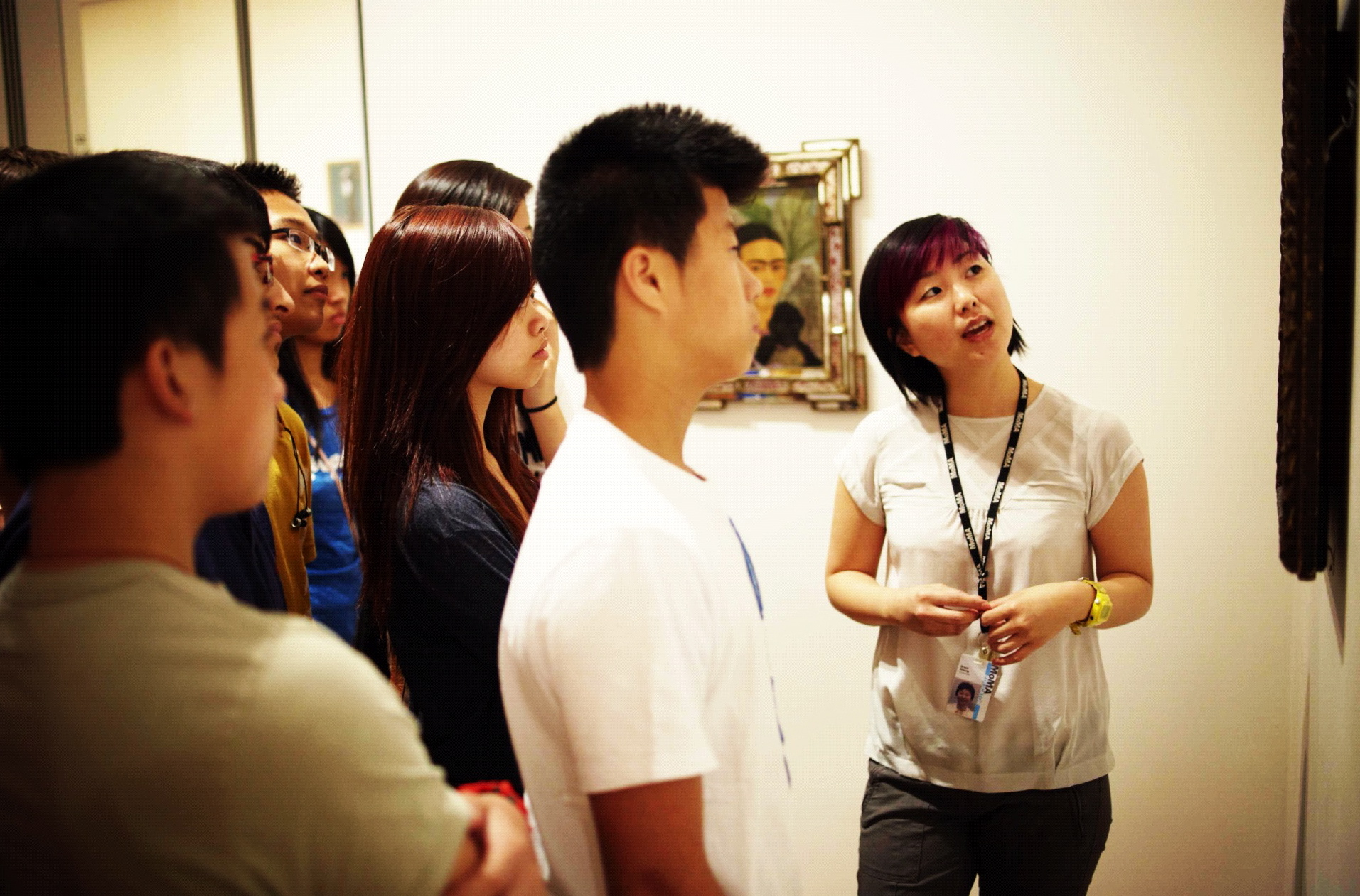
Header Image: Sara and 9th grade students from the Edward M. Kennedy Academy for Health Careers in the Courtyard of the Isabella Stewart Gardner Museum, Boston.

Status Update: Facebook as a Reflection Tool

Written by David Bowles, Assistant Museum Educator for School Programs, Metropolitan Museum of Art

Cross-posted with Museum Questions, a blog authored by Rebecca Herz that is dedicated to questions about museums and thoughts on creating a reflective practice.

This blog post is about listening and reflection. As a museum educator, my job is to listen. On a good tour, I learn about as much about art from visitors as they learn from me. I also learn something about their lives. But often it seems like these moments evaporate. So for the past two years, I have been posting some of the most indelible teachable moments from my gallery experiences on Facebook.

I limit myself to one moment per tour. I try to stick to the facts, and not interpret the child’s ideas in my own words. I describe the context succinctly, and stick to a few sentences at most. I imagine reflecting on the teaching experience with someone who has never heard of the field of museum education – so no jargon allowed. When it makes sense, I include a visual of the artwork that sparked the teachable moment.

The moments I capture tend to be funny, which is why they make good Facebook posts. But they also highlight important moments of discovery, and often mark pivot points in gallery conversations. I try to focus on what Piaget might have called moments of disequilibrium – those wonderful, maddening moments when you discover for yourself that what you thought was simple, is not.

Here are three such experiences, some thoughts on what I’ve learned about school tours and student visitors along the way, and tips for anyone interested in giving this a try.

1.  Fear of the Unknown

Bowles-FB1

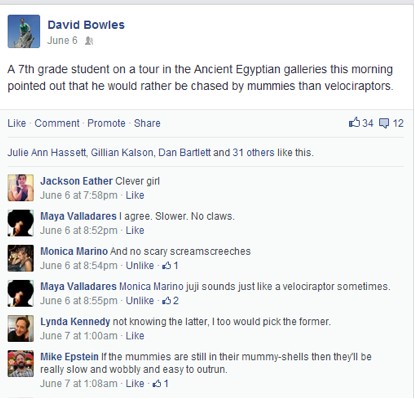
“A 7th grade student on a tour in the Ancient Egypt galleries this morning pointed out that he would rather be chased by mummies than velociraptors.”

I think the young man’s logic was that mummies chasing him through the Museum were likely to shuffle along slowly, while raptors are nimble pack hunters (as anyone who saw the kitchen scene from the original Jurassic Park can attest). He makes a valid point. This comment sparked a stimulating conversation among the class about fear of the unknown. We sat in the dimly lit gallery surrounded by sarcophagi and other tomb equipment unearthed along the Nile, and other classmates chimed in with their honest reactions to the unfamiliarity of the experience. After several other students also expressed fear, one young lady allowed that she “sort of liked being scared.” I asked her if it felt “safe scary” and she nodded. The young man whose comment started the conversation smiled at her and nodded as well.

These students feel slightly scared by the unknown Egyptian galleries filled with mummies and other ancient artifacts. But they are attracted to the unknown. The unknown in a museum setting, like the unknown in movies, is “safe scary.” For them, what is interesting about this space at the Met is not the connections they can make to their school curriculum, or the comparison between the ancient and the contemporary, but the opportunity to exist temporarily and safely in a space outside of the safety and routine of the everyday.

2. Time Travel

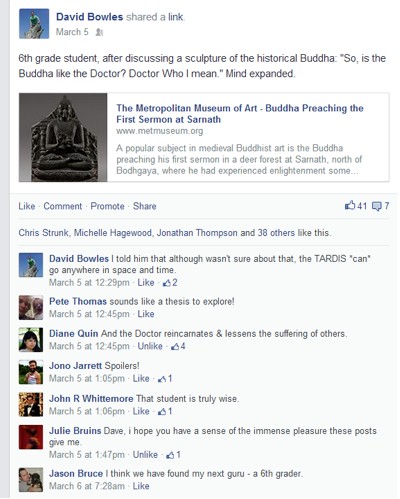
Bowles-FB2

“6th grade student, after discussing a sculpture of the historical Buddha: “So, is the Buddha like the Doctor? Doctor Who I mean.” Mind expanded.”

If you’ve never watched Doctor Who, close this browser and go watch some. The Doctor is an extravagant, brilliant, and charismatic alien who explores the universe trying to help the helpless, ease suffering, and generally leave things better than he found them. His ship, the TARDIS, can travel anywhere in space or time. Since he seems to like Great Britain, he comes to Earth a lot. Coincidentally, the show is produced by the BBC, so the Doctor is invariably British, as are his plucky human companions. The Doctor is a troubled hero, whose views on the universe are often transcendent as well as maddening.

On some level, the young lady who asked me if the Buddha was anything like the Doctor understood that the story of the Buddha, like the story of Doctor Who, is about creating an impossible narrative of characters who can save the world. On another hand, she may have been reaching for a way to connect historical information about the Buddha (i.e. he really existed, he was a prince, he traveled throughout India and Nepal, etc.) with the more incredible aspects of his story (i.e. his description of concepts like samsara and nirvana, his awakening or enlightenment, etc.) She seemed interested in the Buddha not as a representative of another culture but as a superhero, an embodiment of the type of figure that could save the world. In short, I think she saw a role model.

3. Love and Marriage

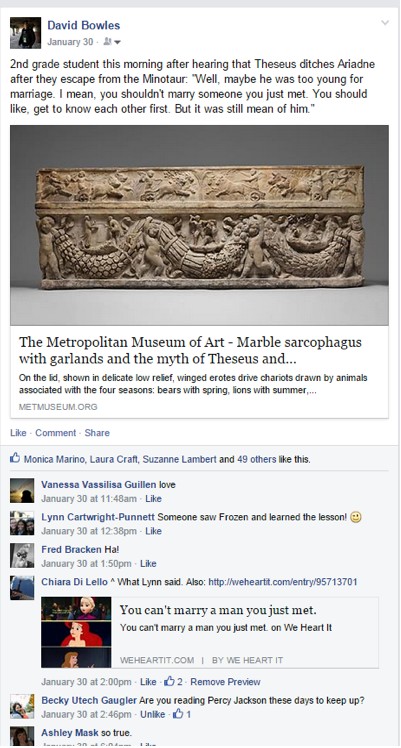
Bowles-FB3

“2nd grade student this morning after hearing that Theseus ditches Ariadne after they escape from the Minotaur: “Well, maybe he was too young for marriage. I mean, you shouldn’t marry someone you just met. You should like, get to know each other first. But it was still mean of him.”

Like the Greek myths that inspired it, this discussion offered an interesting analysis of human behavior. After telling these students the myth of Theseus and Ariadne, I asked students what they thought of the story’s ending. The first flurry of responses focused on abandonment and notions of fairness; everyone agreed that Theseus made a bad choice. Well, nearly everyone. I pushed for dissent, and asked if anyone had another point of view. This young lady had been sitting silently for a while, and when she did speak it was with energy.

On some level she was trying to make Theseus’ decision to abandon Ariadne acceptable. On a deeper level, I wonder if this student, like the young lady who compared the Buddha to the Doctor, was thinking about role models. As you can see in the comments left by my Facebook friends, Disney’s ‘Frozen’ explores these ideas very effectively as well. Whether or not this student had seen the movie (and I suspect she had), it was a powerful reminder to me about making room for respectful dissent when interpreting works of art. Students really absorb the lessons that they learn from movies, so it makes good sense to keep tabs on what those lessons are – and what ambiguities they might offer.

So what patterns have I noticed about kids’ interests at the Met?

The Unknown

Many of these conversations involve discovering new frontiers, and the thrill and fear that accompany real, authentic exploration. As long as the fear of the new doesn’t overwhelm the group, it can be very productive if acknowledged. There’s a lot to be said about the transformative power of discomfort; just ask an oyster.

Role Models

Humans are social animals; we look to others for tips on how to behave. Many students are searching for role models, and some have found them in fictional characters. These young people are looking for ways to connect these characters and their worlds to the real world around them, and they will do so at the first opportunity.

Contemporary Connections

Museum educators often talk about contemporary connections: strategies or concepts that help visitors understand something unfamiliar by tying it to something personally familiar from today. When students initiate their own contemporary connections, they often do so in unpredictable ways that can be surprising, humorous, or subversive. There is something to be said for letting students make their own connections instead of doing it for them. Kids will bring pop culture with them into the museum regardless, so ignoring its power means missing opportunities for authentic discussion.

Keeping up-to-date on popular trends among young learners can really help make genuine connections that make complex ideas accessible. It can also highlight key misunderstandings about objects or the stories objects tell. For example, the idea that you should get to know your future partner well before committing is a very particular approach to marriage, presumably not one endorsed in most ancient societies.

Some Takeaways for Museum Educators

1. Listen. Really Listen.

Focus on what students are really saying when they respond to your questions, not just what you think they mean. This is hard. Use the words they use to define academic terms and abstract concepts. If a student’s comment strikes you as snarky or disruptive, lean in to it. Find out more. Let them know you’re interested in their thinking. Give them space to explain. If they don’t want to explain to you, consider asking them to turn and talk with some of their peers. Listen to what you hear, and think about how it connects to your own ideas about the content or lesson.

2. Let students drive the conversation.

My boss sometimes talks about how effective museum educators need to be a ‘Guide on the Side’ rather than a ‘Sage on the Stage,’ and this is vital to effective gallery teaching. Use a light touch to keep the conversation moving. Stay goal-oriented, but don’t get so attached to your goals that you lose sight of the importance of the process of discovery for your participants.

3. Ask for divergent thinking

Seek out dissenting ideas so that you are encouraging participants to think both deeply and individually. Some works of art open themselves up to a wide range of possible interpretations without ever committing to just one – examples might include many modern and contemporary art objects. Other works of art, like a Gupta period Buddhist sculpture or ancient Roman sarcophagi, have very specific meanings that their makers intended; there are incorrect understandings of some works of art, and that is important for us to acknowledge. Those misunderstandings are often great starting points for real inquiry if you can help students ground their misunderstandings in the visual elements of the artwork! Either way, seeking out divergent thinking empowers students to discover and craft the complexity of interpretation for themselves.

4. Reflective Practice needs others

I think the capacity to reflect in action (while doing something) and on action (after having done it) is an important part of professional practice. Both are hard to do, and both benefit greatly when other people can be sounding boards. I find these status updates help me slow down and think about the choices I’ve made. Better yet, doing so gives me immediate informal feedback.

Give it a try!

About the Author

BowlesDAVID BOWLES: Assistant Museum Educator for School Programs, Metropolitan Museum of Art.  David oversees the strategic planning, staff and volunteer training, program implementation, and evaluation of all aspects of guided K-12 school tours at the Metropolitan Museum of Art. In collaboration with colleagues, he also develops resources for educators, in particular for educators who are bringing students to the Museum on guided or self-guided visits. David also teaches across a range of audience areas, including K-12 educator programs and adult gallery talks. Before this, he worked at the Rubin Museum of Art as Manager of School Programs. He earned his M.S.Ed from Bank Street College and a B.A. with Honours from McGill University. David’s postings on this site are his own and don’t necessarily represent the Metropolitan Museum of Art’s positions, strategies, or opinions.

Beyond Digital: Open Collections & Cultural Institutions

This past June, I participated in a two-week workshop at Harvard University’s metaLAB called Beautiful Data: Telling Stories with Open Collections. Thanks to a grant from the Getty Foundation, the metaLAB brought together over twenty curators, technologists, educators, and scholars to grapple with how we might use publicly available data from museum collections in our work. In the first week, speakers as varied as digital museum specialists to experience designers to scientists who study vision all pressed us to think of our work in unexpected contexts. In the second week, we took what we’d discussed and applied them to projects of our own.

Over the past four months, I’ve let the ideas and theories of Beautiful Data percolate in my visitor-centered soul, and I’ve come to realize this: although open collections is a movement born in the digital realm, I believe its principles are essential to how a 21st-century cultural institution can reach visitors today—whether virtual, physical, or personal.

What are Open Collections?

“Open collections” is a museum technology term that refers to a museum (or more appropriately, a GLAM—gallery, library, archive, or museum) “opening” all of collections data for anyone to freely use, reuse, or distribute it. In this context, data refers not only to an image of an artwork in a collection, for example, but all of an object’s “metadata” or supporting information, such as artist, time of creation, subject matter, size, medium, and so on. If the collection of your museum is digitally open, you release an API (application programming interface) that allows programmers to easily pull that data into lots of different contexts, such as websites or apps. The idea, according to the OpenGLAM movement, is that it allows “users not only to enjoy the riches of the world’s memory institutions, but also to contribute, participate and share.” (For a more in-depth explanation of museum APIs, check out this blog post from the SFMOMA Lab.)

Metadata sounds like tombstone information—in other words, that basic information that lives on a museum label, and on its own, might not necessarily be that compelling. The magic of open collections data, though, is that through technology, all those individual bits of information can be packaged together and unpacked, visualized and disseminated in different ways. In short, like many of our most successful museum education programs, the cool stuff happens when you release it into the wild and let people play.

Perhaps the most famous example of a museum opening up its collection is the Rijksmuseum, which in 2011 published an API and allowed free access to high-quality images of its artworks. But most stunningly, it not only allowed, but loudly encouraged anyone who wanted to create new interpretations of those artworks, from coffee cups to clothing. They even hosted a contest on the huge handmade marketplace website Etsy.

Another great example is by Florian Kräutli, one of my fellow Beautiful Data participants, who took Tate’s open collections data and visualized it—noticing that over half its collection is by J. M. W. Turner, prompting him into a rabbit hole of discovery into exactly why that is (you can read his blog post on the project to find out more). Museums are supporting this type of play in-house, too: the Cooper-Hewitt team has a treasure trove of ways they’ve used their collections data on their blog, including a search-by-color tool and “Robot Rothko” (which is just as awesome as it sounds). As his final project, Beautiful Data participant Richard Barrett-Small, formerly of Tate, built on the Cooper-Hewitt’s color tool to create Colour Lens, a color visualization explorer for multiple museum collections.

In short, the big idea here is that open collections allow cultural institutions to complete their educational missions: not only showing our objects to as many people as possible (no matter where they are in the world—thanks, internet!), but giving people ownership of our collections and spaces by welcoming them to engage in any way they can dream up.

beautifuldata2

Investigating Transformative Experiences with Art

Let’s turn back to my personal experience at Beautiful Data. It’s rare that museum staff are ever able to think about the what ifs and why nots, to set aside time to imagine, play, and prototype. Happily, at Beautiful Data, we had two full weeks to do exactly that.

As a visitor-centered museum educator, I think a lot about the humans experiencing our institutions. As a visitor-centered museum technologist, I think about people too, albeit those in the ether of the web—no less real than my students, though often more anonymous. At Beautiful Data, though, we went extremely big-picture—this meant discussions of data visualizations (graphical ways to show stories about data), institutional collecting patterns and preferences, and thinking about how not just staff but organizations could collaborate together through comparing and sharing their collections data.

To be honest, this sometimes frustrated me. As one of two educators in the group, I was always asking, “but what about the people who will actually use this information?” That question was certainly on the minds of other participants, but I came to realize that “users” could just as often mean internal staff members as external visitors.

With all this in mind, for my Beautiful Data final project, I decided to tackle an idea that has been a seed in my work for some time: amassing stories or personal connections with works of art from museum visitors, and seeing what patterns I could find about how people interact with collections. I posted a survey asking people to share their “transformative experiences with works of art,” and waited to see what I’d get.

I was struck by the stories I received. Regardless of length or whether the respondent was a museum professional or a scientist, even if they had only seen the work one time, each story was full of heart—beautiful, nostalgic, sometimes wrenching connections between a work of art and the person’s own life.

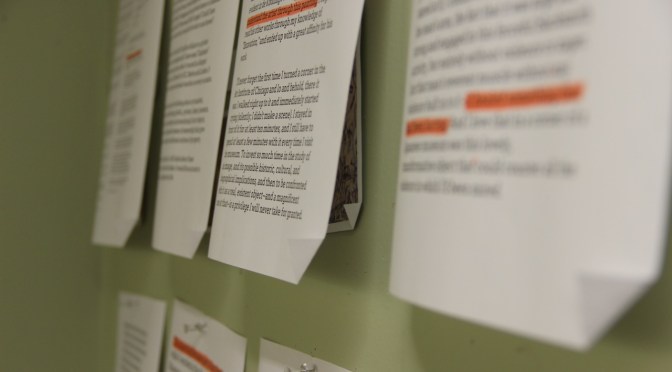
Despite a week blissfully surrounded by all things nerdy-tech (read: 3D printers, APIs, and Lytro cameras), instead of building a minimal website or massaging the words into data, I instead was compelled to handwrite key phrases on paper, print out full responses and images of their chosen piece, and pin them to a wall. My project quickly turned into a completely physical installation: a purposefully unscientific data visualization of the responses people had submitted.

Documentary photos of my installation can be seen through the photo gallery below, or you can visit my album on Flickr.

Some stories were long, others just a handful of cryptic sentences. Some had art historical, factual descriptions backing up their thoughts; others never looked up a single extra bit of information about the artwork after they saw it. Some ruminated on the object for many years; others were hit in the gut all of a sudden upon turning a corner.

For all that, every single story had two things in common. In each, there was a deeply personal reason behind the individual’s connection to the artwork, and each was written in a tone of reverence—towards the power of these images to arrest a person, to stir up unexpected thoughts or feelings, to stick in their mind for years and years afterward.

Open Collections—Beyond the Digital

When my teen program started up again this fall, I brought my students into the Milwaukee Art Museum galleries to look at a single work of art for an hour (you can read more about this process here.) As usual, I noticed the high schoolers opening up to each other, to new ideas, and to finding ways that art relates to their everyday life—whether a photograph of Milwaukee or a landscape by a Baroque Italian painter. These discussions are guided by the students—I might throw in some useful facts to open up the conversation, but they take the lead. As a result, on any given day, we might relate artworks to religion, politics, narratives, families and friends, or even moods and feelings.

During these sessions, the teens are given permission to engage with these objects in a manner entirely new to them: instead of the 7-second “drive by” glance, they’re encouraged to bring their own opinions, thoughts, and questions to these artworks.

This fall, as I watched the students unfold these pieces and their own thoughts every week, and as I thought about my own project at Beautiful Data, I started to realize how intimately connected my discussion-based teaching style and experience-based project are to the big ideas behind the open collections movement.

In the realm of digital, opening collections data and encouraging people to play with it allows for deeper engagement in and participation with our collections. For my teen programs, which take place physically in the museum, the same goal holds—for my students to feel comfortable engaging with and connecting with the collection. For my Beautiful Data project about transformative experiences with works of art, each respondent was open to having an experience with a work of art that turned out to be intimate and meaningful.

Too often in the museum field, we become siloed. The cross-pollinated conversations and projects at Beautiful Data with folks from many different museum departments helped me see that most of the time, we’re all saying the same thing.

We all want our collections to be open to the public. We all want to give visitors opportunities to engage with objects. All that said, the devil’s in the details, as they say, and, as I learned from fellow participants at Beautiful Data, “openness” might mean different things in different contexts, or to different people within our institutions. For a museum technologist who’s part of the OpenGLAM movement, it might mean creating an API for her institution’s collection. For a curator, it might mean presenting art with minimal labels to allow visitors to bring their own thoughts to the work. For an educator, it might mean hosting a monthly “slow art” day, facilitating a one hour conversation about a single work of art. For a visitor, it might mean taking a selfie with a work of art to share with friends on Instagram—or perhaps having a life-changing, transformative moment with an object—or maybe exploring the collection online even though they live halfway around the world from the institution itself.

If we’re all saying the same thing, then why does it sometimes seem like we’re not on the same page? It might be because we’re speaking slightly different languages (after all, our departments borrow from our content areas—whether technology terms, art history/academic jargon, or educator-ese). It might be because when we are speaking together, we’re only hearing what we want to hear instead of what the other person is actually saying. It might be because we’re not taking time to speak to each other at all.

I can tell you firsthand with Beautiful Data under my belt that it’s worth it to step outside the comfort zone of our own department. Internally, let’s challenge ourselves to learn new vocabulary and have discussions with others outside of our own departments. That way, our principles and beliefs can start to be shared among staff in different areas. When we speak the same language internally, we’ll have the power to push our institutions into a new paradigm, as Jay Rounds discusses in a recent article on Museum Questions, or as Mike Murawski suggests in his article about museums embracing a “digital mindset.”

And externally? Open collections, at its core, is about access to our institutions—whether digitally through collection APIs, physically through innovative programming in our galleries, or personally through highlighting the stories of people who have had powerful experiences with objects. Opening access in this way can be scary, because it can sometimes mean giving up some control, such as rights, an authoritative institutional voice, or even the context and purpose of looking at artwork. But those risky moments are also when great change has the potential to occur. If we want our collections to be relevant and meaningful in the 21st century, we must be brave enough to open up our doors—physically and virtually—to support, encourage, and celebrate the profound and magical experiences with art that happen next, whatever they might be.

How Can Museums Change Teens — and Vice Versa?

Written by Chelsea Kelly, Milwaukee Art Museum

Over the past four years, I have worked with hundreds of Milwaukee-area teens who love art, and who, over their time in teen programs at the Milwaukee Art Museum, grow to love museums as well.

I have always had a sense that my students grow over their time at the Museum. This year, though, to really study that growth, we designed our longstanding Satellite High School Program as a year-long experience to explore exactly how weekly sessions at an art museum might change the thinking of our teen participants. To that end, our program outcome for students was that they would show an increased ability to reflect upon their own experiences and performance.

Evaluation is a grey area—much like teaching and interpretation—and we as educators need to use multiple methods in order to get a fuller picture of what’s going on with our students.

This means I’ve been thinking a lot about evaluation: How do we show change was made? Years ago, I thought evaluation was more or less a prickly, black-and-white, necessary evil that forced me to use altogether too much math. But over the past two years, I’ve come around to believe evaluation is completely the opposite (though math is still important!). Evaluation is a grey area—much like teaching and interpretation—and we as educators need to use multiple methods in order to get a fuller picture of what’s going on with our students. And further, these methods can be tools to help our teaching, improving programs and our impact on students.

In the end, I found I needed to use reflective practice myself to understand how my students were changing, and to explore and experiment with a number of different methods for articulating their growth. In this post, I’ll share a few of the methods we used in the Satellite High School Program this year to explore how our teen interns changed through reflective practice.

First… What is Satellite?

The Satellite High School Program is a year-long internship for sixteen teens ages 16 to 18 from diverse high schools all over the Milwaukee area. Once a week after school, they come together at the Museum and explore how art can be made relevant to our lives today. They participate in “object studies” (hour-long discussions on a single work of art), behind-the-scenes career talks with staff, and resume-writing workshops, and also mentor elementary school students in tours of the permanent collection.

Teens create a final project that has a real-world impact on the Museum. They choose a work of art in the Museum Collection, research it, and form their own interpretation of the piece. In past years, students have created responses in visual art, writing, or performance. This year, the students used iPads to create videos on their work of art, explaining what the work means to them and how it changed their thinking or art practice. You’ll see a few of those videos later in this post.

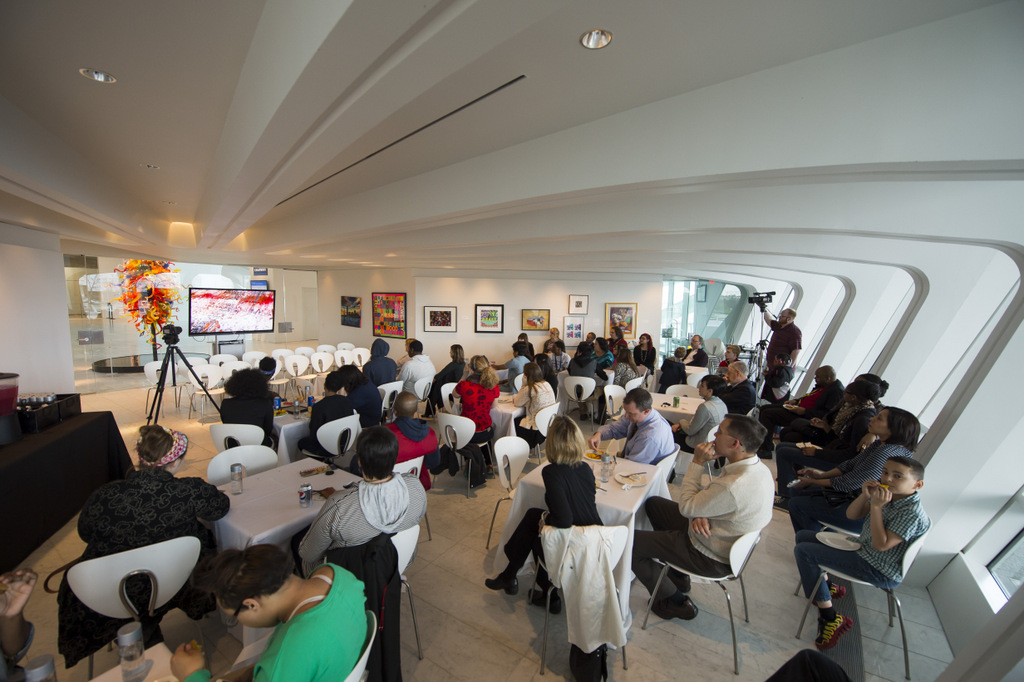
Friends, family, and teachers of the Satellite interns watch their final project videos at the program celebration. Photo by Front Room Photography

Core Evaluation

Let’s start with the core evaluation method we used for the program. We were lucky to work with one of our teen program funders, the Milwaukee Public Schools Partnership for the Arts & Humanities, and the University of Wisconsin-Milwaukee’s Center for Urban Initiatives and Research (CUIR) to develop the outcome above and to establish a tool to measure it.

We settled on one-on-one interviews, doing a “pre” interview on the first days of the program in October and a “post” interview on the final days of the program in May. Each student was privately asked the same set of questions in the pre- and post-interviews, meant to get at their ability to reflect on their experiences in the program. I scored each interview on a rubric that measured level of detail in their responses, and then we compared their pre-program score to their post-program score to see if they had improved.

At the end, every student did improve in their ability to reflect—their answers got significantly more detailed. As someone whose default is to be a more qualitative thinker, it was rewarding to use the rubric to see their interviews as data, in a quantitative, more tangible way.

But as helpful as this was, it’s still just one method of evaluation. Being able to explain in detail is certainly one aspect of successfully being able to reflect. But as I listened to their responses, and thought about what I had seen in the students over the course of the whole year, I realized there is much more to reflecting than just detail. Their responses used stronger vocabulary, they expressed sophisticated ideas, and they asked more and deeper questions. How could I articulate that kind of change?

Unexpected Data

Happily, along the way, we also found that we had collected some unexpected data which helped me more concretely see the change in my students.

Exit Slips

At the end of each session, teens used a web app on their iPads called Infuse Learning to fill out a quick exit slip survey. Exit slips are an easy way to take the pulse of your students at the end of a session. For Satellite, they answered the questions “What is something you learned today?” and “What are you still wondering about?” Though different from our interview questions, these certainly also support reflective practice by thinking back on the day’s session.

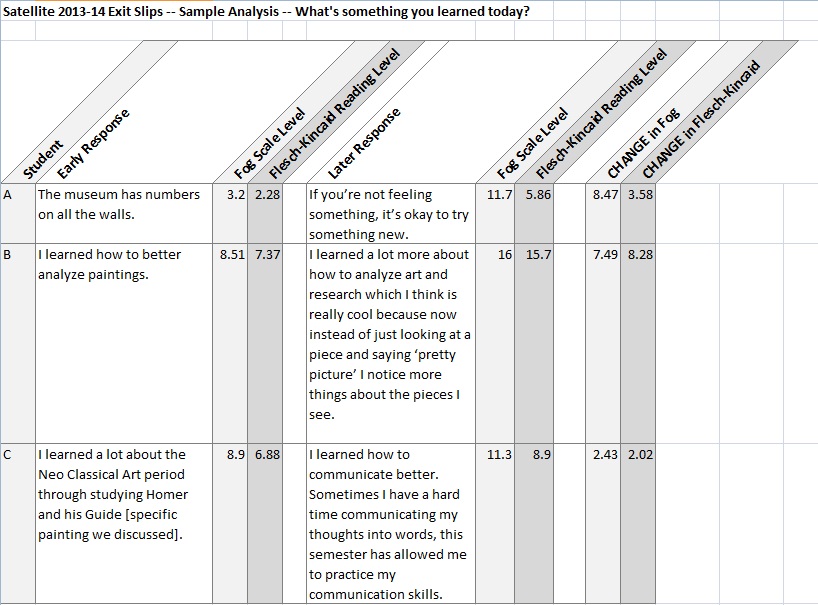
As the year went on, I noticed that the teens ‘ responses were growing more sophisticated: they were longer, they used more art vocabulary, and they realized that they might not be able to answer questions definitively, if at all. At the suggestion of Marianna Adams, who specializes in museum research and evaluation, I tried running these responses through two readability tests to see if that would quantify the sophistication of these responses. One test produces the sample’s Fog Scale Level, which measures syllable count and sentence length (a score of 5 being readable, 20 being very difficult). The other was for the Flesch-Kincaid Grade Level, which approximates the average grade level necessary to read and understand the text.

For the first question (“What is something you learned today?”), students’ scores jumped considerably in Fog Scale and Reading Level. Since these tests measure syllable count, sentence length, and grade level, this corroborates with what I found in the core evaluation.

somethingyoulearnedtoday

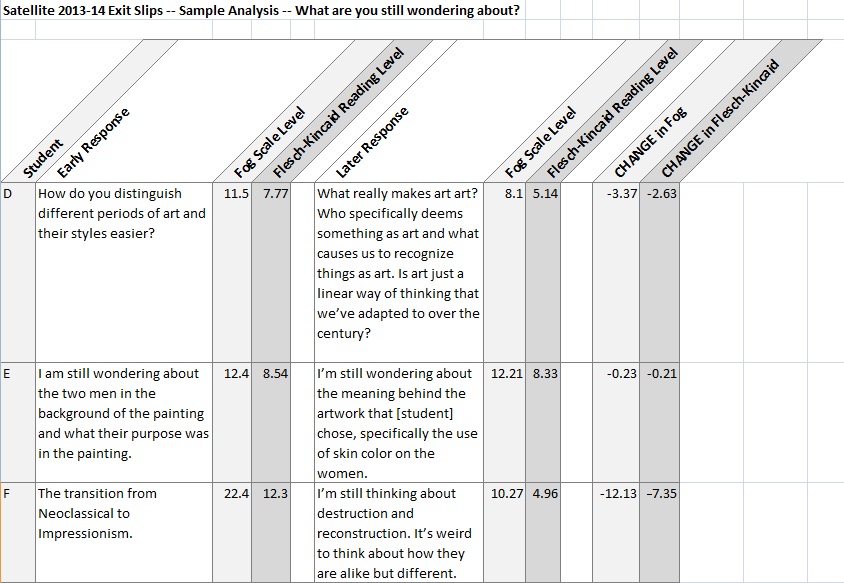
But I was surprised to see that when I tested responses to the second question (“What are you still wondering about?”), students’ scores actually dropped! Yet if you read their responses, there is a drastic change—for the better.

stillwonderingabout

Take Student D’s responses. In his early answer, he asks a relatively basic art historical question about distinguishing one type of art from another. In his later response, he is thinking deeply about the purpose of art and how we even decide what art is. And while Student F uses high-level art history vocabulary in her first response, it’s without context; later on, she’s thinking about how two seemingly opposite concepts may have something in common after all.

The scores of these comments may have decreased, but I’d argue that their reflective quality increased—the teens ask big questions that might not have an answer; they ditch high-level vocabulary to more informally muse on philosophical questions of art, destruction, and race. Running these responses through the tests helped me see, again, that while tools can be helpful, they’re ultimately just one tool—we need more than one to paint a bigger picture.

Videos

To round out that image, I’ll share one final unexpected evaluation tool: the teens’ final project videos as well as a talkback session they conducted at their video premiere.

For their final project, each student chose one work of art in the Museum Collection and looked at it, researched it, and talked about it with others for seven months. (Given that most visitors spend under 10 seconds looking at art in museum galleries, this is a feat in and of itself!) They distilled a school year’s worth of thinking into brief, 2-4 minute videos that answered what the work meant to them, what it had meant to others, and how their own thinking had changed as a result of looking at the piece—all questions with, of course, that familiar reflective bent.

The teens also participated in a talk-back/Q&A at the celebration where we premiered these final projects. Guests—museum staff, teachers, family, and friends—asked the group questions about their experience. If you like, you can watch the teens’ videos, along with the Q&A, in the YouTube playlist below.

Impact — Can Museums Change Teens?

So: does all the above—interviews, exit slips, readability tests, and final projects—add up to a full image of the impact that a year’s worth of reflective practice can have on students?

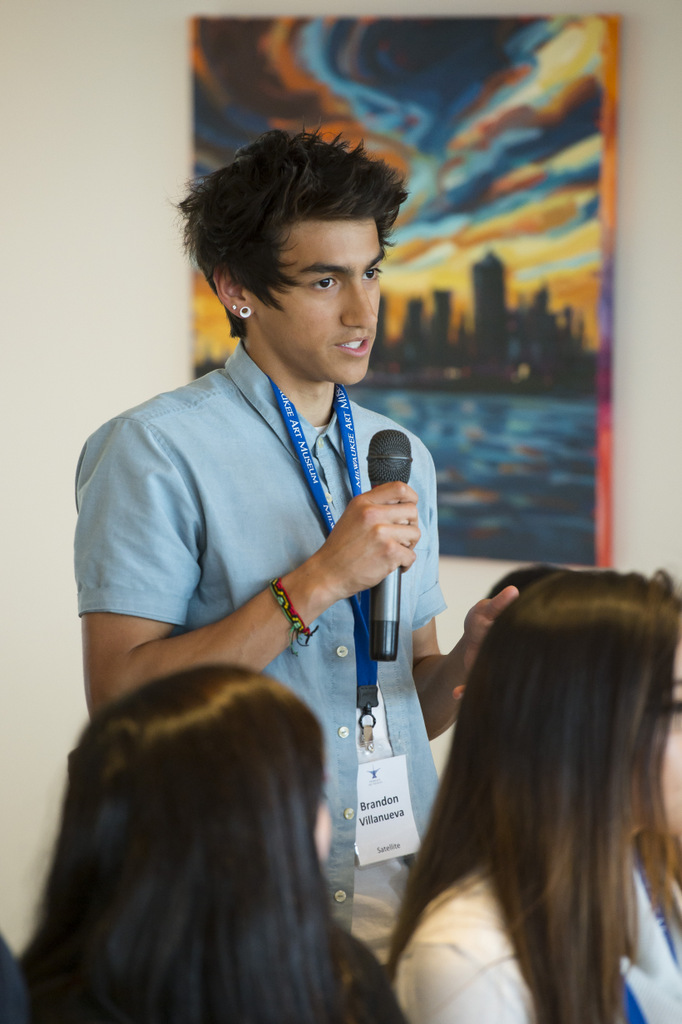
Brandon answers a question during the Satellite premiere Q&A session. Photo by Front Room Photography

I’m not sure we can ever paint a full picture of student growth in intensive programs such as this one. I do think combining all of these tools can help, though—especially if the evaluative tools actively support the goal of the program. The interviews, exit slips, and activities were all intentionally structured to be reflective, related to the outcome itself. This relevancy was key, not only in genuinely evaluating the program’s success, but also in supporting the students’ abilities through the methods themselves. It’s also important that we educators make the program goal transparent to the students. The Satellite interns knew from the beginning that they were working on reflective ability—this helped prime them to think reflectively from the get-go.

As far as impact beyond reflective capacity, I also want to share a few quotes from the teens themselves about their time in this program:

“The videos help us think deeper about what we do—so even in school I think deeper about what I’m doing or why this was made or why this happened.”
“I learned that I shouldn’t judge a book by its cover. When I first saw my piece I just thought it was a bunch of different colors and didn’t really think about it actually having a meaning. But now I’ve learned that it actually has a super cool meaning behind [it], and I never would have learned about that meaning if I hadn’t taken the chance to explore. So I shouldn’t be so quick to judge.”
“We had to give tours and I found out that I really like to work with children and art at the same time. I would like to pursue a career in art education for elementary school students.”
“I was able to change and evolve my way of thinking, now being able to look past the obvious… I learned that art holds all the answers to any questions anyone may have, you just have to search for it.”

From the other evaluation tools, we saw that the students developed their ability to reflect on themselves and their own performance. But as seen in the comments above, they were also able to develop skills reflecting on the world beyond them—the world of art history, their future careers, how they interact with other people. All of these are ways of thinking that are valuable for their futures, as they go to college, discover their passions, and pursue meaningful career opportunities.

amt7_FRPhoto_140515N_C2_0135

Can Teens Change Museums?

I’ve shown how this program helped these students grow in many ways. What about the Museum itself? Have these students had an impact on our institutional practice?

Institutions move at a slower pace than most programs, and if change and impact are complex to measure in sixteen individual students, then it’s multiplied tenfold for an organization that serves hundreds of thousands visitors a year. Even so, over the past few years, the work of teens in our programs has slowly but surely worked its way into the daily fabric of the Museum. Teens have interviewed artists on behalf of the institution. They have advised docents on ideas for giving tours to high schoolers. Their video projects will be part of on-site and online Collection Resources at the Museum, as well as our Archives, for all visitors to access while learning about works of art.

Ultimately, evaluation and impact are ongoing, a grey area that has a lot in common with the act of teaching itself. When done well and intentionally, evaluation doesn’t just show if we’ve met a goal. The tools we use to evaluate ideally become part of our teaching practice, because they reinforce the very abilities we are trying to help our students develop.

As for what I’m still wondering about? This year, our evaluation methods for the most part required the teens to have specific existing skills, such as writing for the exit slips or proficiency in using an iPad (though we did have video-making workshops as part of the program). I’m thinking about other ways to holistically gather data. For example, given that much of our evaluation methods emerged from teaching tools, should I document or film our discussions with works of art and find ways to analyze them? I’d love to hear any ideas or tools you’ve used to evaluate your programs, just as I hope this post has inspired you to take a fresh look at your teaching practice and find unexpected ways to see the growth in your participants.

*     *     *     *     *

ABOUT THE AUTHOR

Milwaukee Commercial PhotographerCHELSEA EMELIE KELLY: Manager of Digital Learning at the Milwaukee Art Museum, where she develops educational technology initiatives and oversees and teaches teen programs. She is passionate about using gallery teaching and technology to foster relevancy for art museums in the 21st century. She has previously worked at the Frances Lehman Loeb Art Center, the Metropolitan Museum of Art, the Frick Art & Historical Center, and the Carnegie Museum of Art. Chelsea is a graduate of Vassar College and holds an M.S.Ed. in Leadership in Museum Education from the Bank Street College Graduate School of Education, where she was a Kress Foundation Fellow. She is also the founder and co-editor of The Art History BlogChelsea’s postings on this site are her own and don’t necessarily represent the Milwaukee Art Museum’s positions, strategies, or opinions.

It’s Not Always about You: Facilitating Critical Self-Reflection in Others

Editor’s Note: This post is part of a series on ArtMuseumTeaching.com during August that focuses on the recent book Multiculturalism in Art Museums Today (2014). Find links to additional posts in this series by several of the book’s authors, and please join us for an Online Book Club via Google Hangout on August 20th.

Written by Keonna Hendrick, Brooklyn Museum

Melissa Crum (Mosaic Education Network) and I came together to develop multicultural critical reflective practice (MCRP) as a protocol because we shared the belief that the decisions museum educators make about our teaching practice — such as the artwork to discuss, language we use, expectations we set for learners — are informed by our willingness to move beyond our individual interpretations and values. When we teach, we may create opportunities for our biases to shape and limit learners’ perspectives on artworks, peers, and themselves. MCRP is a theoretical framework and ongoing practice in which educators identify, analyze, and challenge the cultural beliefs, values, and assumptions that color our interactions with artworks and learners. Leading others through MCRP while writing about the practice has challenged me to re-address my biases while reflecting on how my perspectives and values impact our teaching. I have facilitated practical applications of MCRP with many groups; however, my experience training a small group of emerging educators in a mid-sized art museum in this practice greatly impacted my engagement in the process.

Developing Critical Self-Reflection in Educators

Keonna Hendrick challenges learners to think critically about cultural representations in art.  Photo by Jonathan Dorado , Brooklyn Museum
Keonna Hendrick challenges learners to think critically about cultural representations in art. Photo by Jonathan Dorado , Brooklyn Museum

In the first of a two part-session focused on developing critical self-reflection in educators, I asked each educator to write a short autobiography at home, reflecting on a moment of their lives and writing freely for 30 minutes. I met with each of them individually one week later to discuss the process and to consider how their personal narratives might inform their work in museum education. Although they were not asked to share the details of their autobiographies, several chose to tell me about their personal experiences. They explored relationships, events, and expectations that informed the way they saw themselves in the past and present. I knew when I assigned the exercise it might trigger difficult memories, hard feelings, and even trauma that might be challenging for both participants and myself to work through.

As I listened to their stories, I was incredibly aware of the trust they vested in me to receive their personal truths and to guide them as they considered the intersection between their personal and professional lives. They were vulnerable, honest, passionate, and confused. I found it necessary to be present and aware of my own biases and experiences, and to resist responding from the feelings they may evoke. There were some moments when values were expressed that were in direct conflict with my own, and I had to remind myself that no matter how difficult reflections can be to hear, the purpose of exploring MCRP is to identify and address our attitudes (no matter how negative).  It took courage for these educators to share their autobiographies — without any certainty of how I might respond — and to challenge themselves to think critically about their experiences. And it challenged me to listen without judgment and to respond with care while encouraging them to engage in deep reflection. While the educators commented on the success of the workshop, I couldn’t help but feel exhausted, wondering how Melissa and I might assist others in preparing to facilitate such delicate discussions.

Promoting Critical Self-Reflection in Our Practice

Facilitating exercises that promote critical self-reflection is hard work but it’s worth it. Just as museum educators should be aware of information, teaching strategies, and audience, facilitators of MCRP should be comfortable with and actively engaged in this practice. Witnessing the courage of the participants and facilitating MCRP with many participants individuals has urged me to delve deeper in my own critical reflective practice and to ask: Why have I been afraid to acknowledge certain aspects of myself and others? Identifying these fears and their origins helps me understand why my progressing self-awareness may have been stifled at times and charges me to take responsibility for working through those fears towards an improved cultural consciousness.

Creative Commons image from www.worldette.com
Creative Commons image from http://www.worldette.com

Identifying fear is no small feat. Even taking the first steps of facing those fears while admitting to behaviors and attitudes that negatively impact others can be incredibly difficult. When we offer MCRP as a resource to others for improved pedagogy, we become more accountable for our own failings as educators. Learning from my failures in teaching, forgiving myself for poor decisions, and continuing to engage in the work to address the limitations of my actions and knowledge are challenges I have encountered as a practitioner and facilitator of MCRP. Through journaling, reading both scholarly writings and personal narratives, and engaging in a monthly peer group, I have grown to recognize some prejudices that I had not previously explored as a result of ignorance and limited conversation. Although I am not proud of these prejudices, my ability to acknowledge and work to overcome them has enabled me to be more patient with others and myself. It has helped me engage in an ongoing practice of forgiveness for others and myself. Educators may make poor choices from time to time; however, resisting the temptation to rest complacently in those decisions and repeat them with learners and with artworks disrupts educators’ potential to support learners in becoming self-actualized and expanding our cultural perceptions.

*     *     *     *     *

 ABOUT THE AUTHOR

HendrickHeadshotKEONNA HENDRICK: Senior Museum Educator at the Brooklyn Museum, Hendrick oversees the 10-month Museum Education Internship Program, a professional development opportunity for emerging museum educators working with school, youth, family, and adult audiences. She has also worked as a Family Programs Educator at the Museum of Modern Art and served as a board member for New York City Museum Educators Roundtable and Classical Contemporary Ballet Theatre. She holds a B.A. in History and Studio Art from Wake Forest University and a M.A. in Arts Policy and Administration from The Ohio State University. Hendrick is an innovative museum educator and arts administrator who develops practical applications for big picture ideas and issues. She is committed to exploring the transformative nature of art-centered experiences, promoting cultural understanding across communities, and engaging adults, children and adolescents in personally relevant experiences.  Keonna’s postings on this site are her own and do not necessarily represent the Brooklyn Museum’s positions, strategies, or opinions.

OTHER POSTS IN THIS SERIES:

“Building Canopies for Multiculturalism: (Re)Turning to the Visitor,” by Joni Boyd Acuff & Laura Evans

“Eggs, Oreos, and Solidarity: MCRP in Our Daily Lives,” by Melissa Crum

“Reflecting on a Hybridized Museum Practice,” by Marianna Pegno and Traci Quinn

*     *     *     *     *

Online Book Club Hangout (VIDEO)

On August 20th, ArtMuseumTeaching.com brought together a group of authors and editors of the book Multiculturalism in Art Museums Today for a live discussion via Google+ Hangout.  Those joining the Hangout included Joni Boyd Acuff, Marianna Adams, Briley Rasmussen, Alicia Viera, and Veronica Betancourt.  Please find the video archive of this conversation below, and enjoy!


Don’t Have Your Copy of the Book Yet?  No problem.  As part of this collaboration with Rowman & Littlefield Publishers through this series of posts about Multiculturalism in Art Museums Today, we are able to offer ArtMuseumTeaching.com readers a special discount.  To receive a 25% discount, go towww.rowman.com to order this book and enter the discount code: 4S14ACUEVA

What’s at Your Core? Knowing What’s Important to You and Why It Matters

Photo by tiff_ku1

I was recently asked “What are your core values as a teacher?” For a moment I was stumped. I have taught students and colleagues about articulating clear and effective core values and the importance of using these to guide strategies and practices. I referenced established core values and used them in my own work as a museum educator. However, I realized that I had been thinking about institutional core values. What are the core values of your museum? What are the core values of your department? While I felt that I had a strong sense of who I was as a museum professional, it has been a very long time since I thought about and articulated my core vales, separate from the institution where I worked. This process was eye opening and resulted in something very valuable—knowing my core values.

So what are core values? In their book Built to Last, Jim Collins and Jerry I. Porras  define core values as “the essential and enduring tenets of an organization—the very small set of guiding principles that have a profound impact on how everyone in the organization thinks and acts.” The National Parks Service further defines core values as foundational values that are “so important to us that through out the changes in society, government, politics, and technology they are STILL the core values we will abide by.” I like to think of core values as:

  • Those things that you will go to the mat for and defend doing every time.
  • The things that you will keep doing even if you are penalized for doing so.
  • They must also have a consciously rejected but equally viable opposite (more on this later).

If we re-draft Collins and Porras’s definition for ourselves, core values are the essential and enduring tenets for our lives—the very small set of guiding principles that have a profound impact on how we think and act.

A key to this definition is the phrase “very small set.”  I recently read, “If you have 10 core values, you don’t have core values, you have a shopping list.” Core values should be honed to get at the depths of your guiding principles. You should be able to remember and list your core values on one hand, or may one hand and a thumb, and be able to practice these values everyday, not just on the ideal, perfect once-in-a- lifetime day.

“What do you love to do?” or “How to find your core values?”

I must admit this took me a while. When I had done this work with my own museum colleagues or students it had always been generative group process, but on my own I found myself staring at a blank page. Clearly I had to stand for something, but what? Lots of museum and education jargon floated in and out of my mind. I decided to start making notes throughout the week. I kept an ongoing list on my phone of all the things that I did that were important to me or I felt good about doing, from job tasks, to how I acted in a meeting, to how I taught a program. I also looked for things that I saw in others that I appreciated and respected. In addition, I kept a list of all the things that upset and angered me, both in my own actions and those I saw exhibited in others. The latter I analyzed for what was upsetting me and considered what the opposite might be. From these lists I had a more honed and simplified one, but it was still a shopping list.

The next step was to really get to the core. I took each item on my list and asked a series of questions.

  1. Why is that important to you?
  2. Why is that important to you?
  3. Why is THAT important to you?

This exercise is based on one presented by Geoffrey M. Bellman in “Getting Things Done When You Are Not In Charge” and “Your Signature Path: Gaining New Perspectives of Life and Work.”

While seemingly silly at the outset, this is a very challenging exercise. Each questions requires deeper soul searching and greater clarity. The process asks us to challenge our assumptions and look deeper at the things that we do and why we do them.

Through this process many of my initial ideas remained on my list of core values, others merged, and some fell off all together because I realized that they were more about my own capacities or an institutional culture, not a personal core value.

The final step was to ask myself what was the viable opposite of each value, and did I consciously reject it. As with many things in life, knowing something’s opposite makes you understand it that much clearer. For example, if I value collaboration, the opposite of that would be to work alone without the help or contributions of anyone else and the belief that a single mind makes the best ideas and products. I consciously reject that idea. By the end I was able to be more articulate about why my personal core values were important to me and why I would be willing to defend them, no matter what.

You are probably asking, “What did you come up with?” I came up with a list of five core values. I share them with you only as an example. You core values must truly be your own.

Listening— It shows care and respect for others and builds trust. When teaching in the art museum trust is essentially to creating dialog around works of art. It enables people to feel safe to share their ideas, leading to greater understanding of each other and works of art.

Reflection—enables us to pause and a look back upon what we have experienced and learned.  It is essential for improving our practice as teachers and the experience of our students. It is also critical to aligning our teaching with the goals and values of our programs, our institutions and ourselves.

Collaboration—enables us to create something that is stronger and better as the result of many people contributing to its creation. When teaching in the museum learning becomes a collaborative process in which all participants contribute to the experience, making it stronger and more meaningful than if the teacher solely directed it.

Acknowledging the skills, experiences and contributions of others—When we do this, we show respect for others and value what they bring. Although seemingly simple this is critical to open communication. In the workplace, in our partnerships and in our teaching, this practice can open dialogue, leading to more meaningful interactions, and a greater sense of agency.

Mentoring—mentorship and support can go in all directions, upward to our directors and managers, horizontally to our peers, and forward to a younger generation of practitioners. I am committed to the profession of art museum education and believe that as a practitioner I have a responsibility to contribute to the growth and improvement of the field as a whole. I also believe that I have not made it to where I am today in my career alone. I owe a debt to teachers, advisors, colleagues and the students I have taught. This cycle of mentoring invigorates and improves the field of museum education and thus the experiences of students, the value of works of art and art museums.

Why is THIS important to you?

So why should we do this work. As I said before it isn’t quick and it isn’t easy. But it is valuable.

Core values can help us make decisions. In “Ten Essentials for Getting Value from Values,” Rosebeth Moss Kanter explains that principles guide choices. While she is speaking about for profit businesses, this can also apply to us. When we know our core values, our decisions become clearer and simpler.

conquerCore values can help us be our best selves and guide us in aligning our actions with our values. Rosebeth Moss Kanter also writes, “principles are codified, made explicit, transmitted in writing in many media, and reviewed regularly to make sure people understand and remember them.”  While I don’t think you need to scream these from the mountaintop or put them on a t-shirt, I would encourage you to write them down. I keep mine tacked to the wall next to my computer. I see them everyday. As I wrote this I reviewed them and asked myself if they still held true. They guide me day-to-day, project-to-project, and keep me pointed in the right direction. If you are in a safe work environment I encourage you to share your core values with your colleagues. This process can build understanding and generate a discussion about how your shared work embodies the values of your team members.

For me, this process helped me better understand the kind of place I wanted to work and the kind of work that I wanted to be doing. Many of my core values share similar sentiments and ‘lead in a direction.’ Is that the direction that I am going? Is that the direction that this institution is going? Am I living my core values? When we ask ourselves these kinds of questions and live our core values we work smarter and more passionately, our work is more meaningful, and we are better educators.

Challenging Ourselves: Strategies to Reflect on Our Practice

As managing museum educators, it’s often difficult to find new ways to help our educators grow. Often we work with seasoned, experienced, and creative educators who are teaching in the schools as well as the museum and planning with teachers every day. How do we, as managers, support them to do their best teaching every day?

Photo by Jason Brownrigg

At The Museum of Modern Art in New York, we welcome 30,000 K-12 students in guided programs every year. With a volume such as this, our eleven educators are teaching multiple lessons a day. Educators have to be flexible, quick on their feet, and communicate really well with the classroom teachers. Often, there is not a lot of time for planning or reflection. So we use our monthly meetings as a chance to plan lessons, brainstorm ideas, and reflect on our teaching.

In an effort to formalize the training and professional development we offer the educators, along with other tactics, we experimented this year with Monthly Challenges. Each month, as a group, we explore one aspect of our teaching or experiment with a new teaching tool. These ideas are shared amongst the educators over the course of the month, through an Educator Network site, which is essentially a WordPress blog. A lead educator is assigned to each challenge and that educator starts off a blog conversation around the topic.

Below are three examples of recent Monthly Challenges and some snippets of educators’ reflections:

1. Movement Challenge: Offering kinesthetic opportunities for students in the galleries

As a final activity, I asked the students to pose like characters in a work they saw on the tour. We had two students do this at once, combining two poses from different paintings to create a new situation. The rest of the group had to write down what action or drama is taking place. In this way they created new stories.

It was fun to create associations through movement rather than language. And I loved that we stood and used our whole bodies (something we so rarely get to do in the galleries!).

Before I even had the chance to introduce the activity they started to respond to it with movement. Therefore, I just went with what was happening naturally with the students. They all did different movements for different parts of the sculpture simultaneously.

One other thing I’ve been trying out since our workshop, is acting out the artistic process itself and/or how the materials move. I’ve had kids in small groups mimic with their bodies how an artist might make an assemblage style sculpture by bringing together, overlapping, and interconnecting different parts of their bodies; I’ve had kids act out drippy paint with their bodies, etc

2. New Works Challenge: Lessons comprised of all new works the educator had never taught with.

Overall, I would say that I think the benefits of new pieces are that they add a freshness to your conversation and an unpredictability that keeps you on your toes. I think the students sense this excitement and openness.

After years of developing new lessons, it is satisfying to have store of activities and strategies to draw from.

There was a moment during the tour when I wanted to change things based on what was happening with the students but realized I couldn’t go to the old stand-bys. I was happy to try out some new objects but will need to use them a few times to figure out their full potential. I think the best tours happen with the objects I am most familiar with but I have also had great moments with new works when I spontaneously select an object because another group is having a conversation in front of one I had planned to use.

If was fun and challenging for me to not be able to quite anticipate where these conversations would go… I agree, in general, with the comments already expressed — that maybe 1 or 2 new objects with an old tried and true piece could work better. There’s good reason why certain works are so well-worn and this challenge reinforced that idea for me.

3. Student Questions Challenge: Creating space in lessons for students’ questions about big ideas or works of art.

The questions that they shared with me were: “What are the artist’s intentions?” and “How do we know if a modern work of art is good or not?” Questions that i think are perfectly suited to the bicycle wheel.

In terms of generating questions – it’s harder than it looks. A genuine question comes out of genuine curiosity and questions often need space to form (and require risk to put forth). I know that I often get many questions during post-visits and I wonder if teachers notice this too – Do students need time to digest and reflect on the experience of the museum?

I definitely believe that entertaining and exploring their questions has to be balanced by my guiding the discussion in certain directions and meeting certain goals… But touching on what R said in her post, I think of the museum as a serious, but informal learning environment; whereas in a classroom, kids are generally supposed to stay on task, I think it’s nice in the museum environment to indulge the students’ curiosities — and basically invite the inevitable tangent/sidebar- type lines of questioning.

It’s important to me to create an environment for our educators where we never stop reflecting.  We continue to consider what we deliver and how we deliver it to students, to serve their needs as best we can. These Monthly Challenges give us chance, as a group, to hone in on one aspect of our teaching. We can dig deeper into the benefits and challenges of how we do what we do, while also brainstorming and sharing with each other. We benefit greatly from each other’s creative ideas, reflections, and approaches. Some challenges were more successful than others, but focusing deeply for a time on one aspect of our teaching, helps us to think differently about that aspect the next time.

What are some ways in which you work at your institution to reflect on teaching practice?  I would love to hear from others who have managed similar types of exchanges among their staff.