Category Archives: Experimenting in Museums

Long Live the Spirit of Play: Tracking a Theme through NAEA 2014

By Rachel Ropeik, Brooklyn Museum
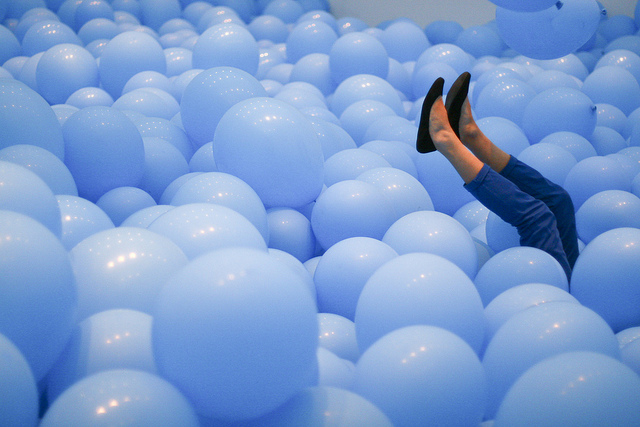
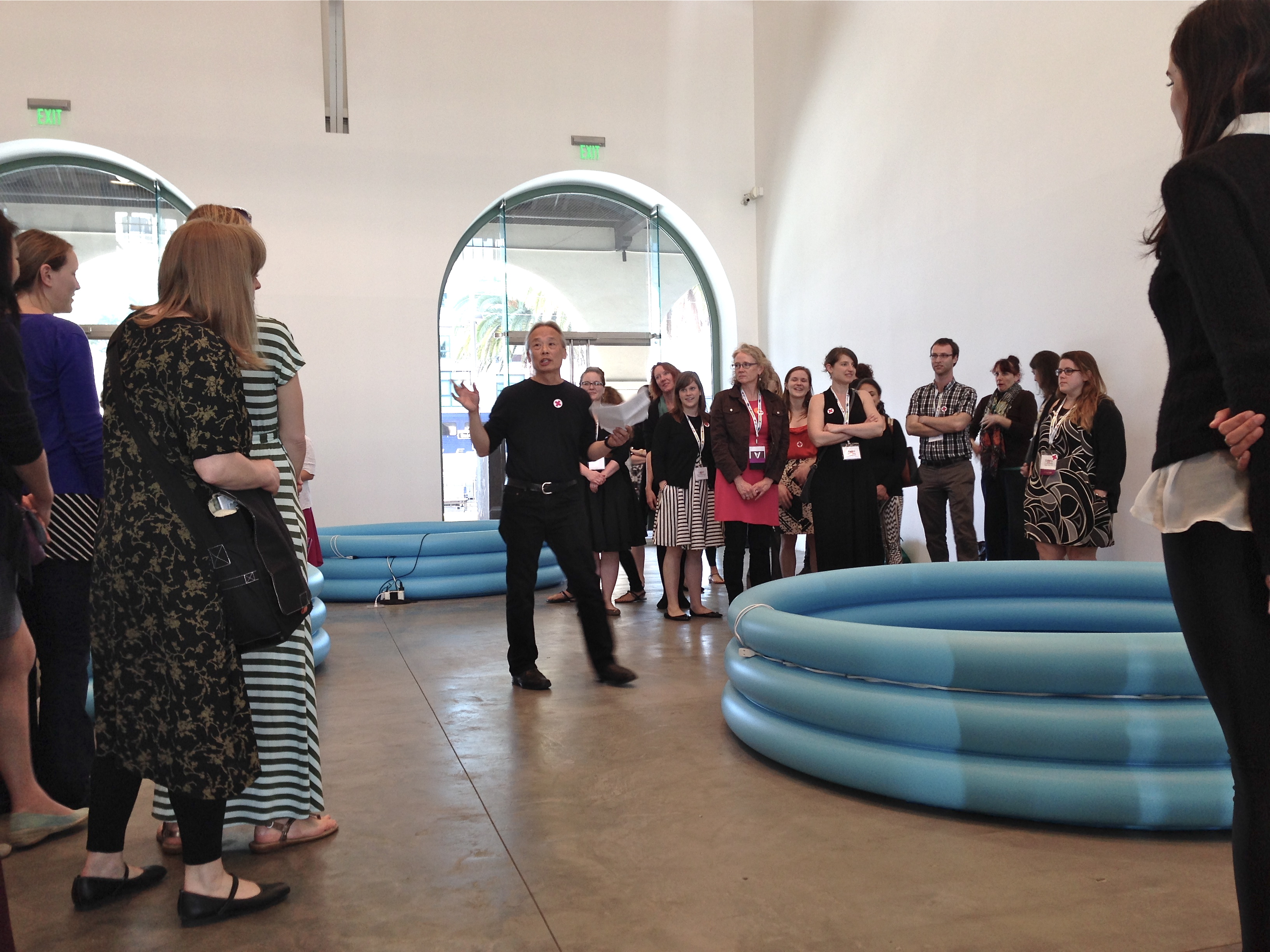
Nothing signifies 'play' like this installation by Martin Creed. Photo by Nicolas Mirguet.
Nothing signifies ‘play’ like this installation by Martin Creed. Photo by Nicolas Mirguet.

What do maker spaces, bodily collisions with strangers, and sculptures made of Turkish delight have in common?  They were all part of sessions at the recent 2014 National Art Education Association Convention in San Diego.  To be more specific, they were all part of sessions that focused on a theme threading through the four days of sun and arts teaching: the spirit of play.

That’s how I’m referring to it, at least.  The same idea was talked about as “being OK with failure”, “going in without predetermined outcomes”, and “iterative approaches”, but it was all shades of the same thing, and it was popping up everywhere.  (Side note: The importance of play in our work lives has been a topic beyond the museum sphere for a while.  Here’s a nice, clear Psychology Today article from 2008 that talks about what play means for our brains.)  People are interested in testing new ideas without knowing how they’ll end up, and I love it.  Like my theme tracking after the last AAM Annual Meeting, I want to follow this one through the NAEA Convention, highlighting some (though by no means all) of the conversations, actions, and tweets that made it one of my top conference takeaways.

Talking about play started out at the Museum Education Division Preconference, which was hosted at Balboa Park, home to some inspirational collaborations between cultural institutions.  Collaboration was the theme of the Preconference, and the very first session of the day, a keynote panel of experienced museum collaboration facilitators, included advice like:

and

Conference attendees were excited about this theme, too, and talked/tweeted about it throughout the day.

Seema Rao of the Cleveland Museum of Art reminded us about taking chances.

David Bowles from the Metropolitan Museum of Art talked about what motivated him to take part in the Noguchi Museum’s Teacher Think Tank (a program that started with the open-ended goal of getting museum educators and K-12 teachers together to think about museums and schools working together).

On Saturday morning, a session called Museum Maker Spaces: Creating and Play for Adults (not to be confused with “adult play”) took up the playfulness banner.  I’m sorry to have missed that session, but thanks to colleagues like Emily Holtrop (from the Cincinnati Art Museum) and Cate Bayles (from the John Michael Kohler Arts Center), I heard about some of its key themes on Twitter.

https://twitter.com/EmArtGirl/statuses/449944722451083266

https://twitter.com/FreshInTheField/statuses/449948897473875969

No pressure for an end product?  What do we get out of play?  As the larger debate continues about how to make museums relevant, I’m glad these are some of the issues being posed.  I’m a firm believer that the museum can be a space for more than an in-depth, object-centered experience.  As a museum educator, yes, that’s at the heart of what I do in many ways, but is it the only thing I do?  No.  The only—or, dare I say best—thing visitors can experience when they come to a museum?  Heck, no!

Museums can be many things to many people.  For those of us dedicated to making museums meaningful, setting up experiments and pushing the boundaries of what makes a “good museum visit” is a great way to find out what some of those many things might be.

That was exactly the spirit of the Gallery Teaching Marathon, organized by this site’s Mike Murawski and hosted at the Museum of Contemporary Art San Diego on Sunday of the NAEA Convention.  As any regular reader of ArtMuseumTeaching.com knows, Mike is a voice for pushing our museum education practice, and he invited us to do just that through in-gallery sessions throughout the day.  In his original email looking for educators interested in leading a session, here’s how he put it:

“I would encourage people to think of this as an opportunity to try something new, take risks, and know that you will be among supportive colleagues, peers, and educators.”

And for those who ventured into one or two or all of the Gallery Teaching Marathon sessions, risks and newness were there for them to find.  Without speaking for my talented fellow educators who offered a wide range of experiences in the galleries that day, I will say the session I facilitated was exciting and invigorating to lead, and I hope fun to take part in.
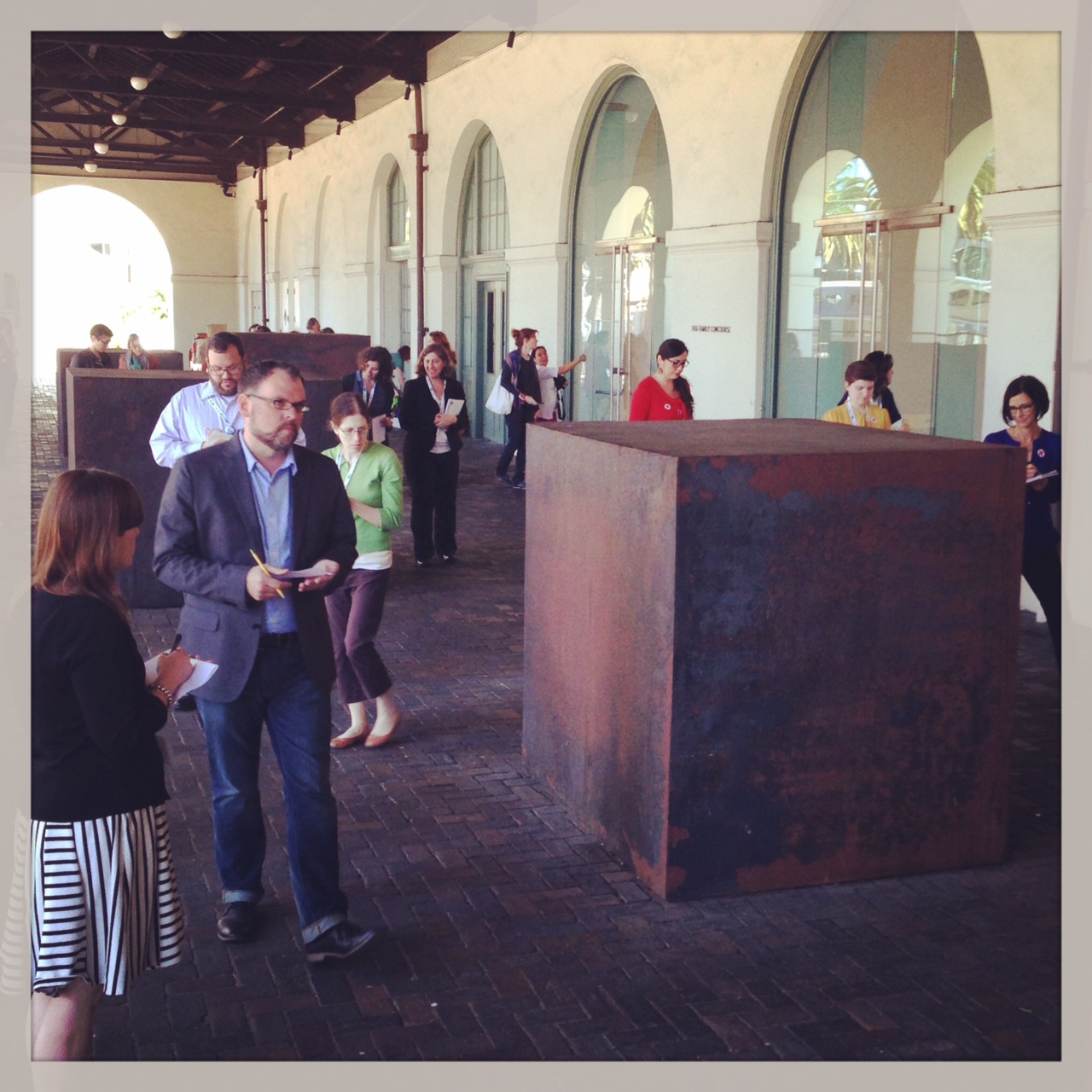
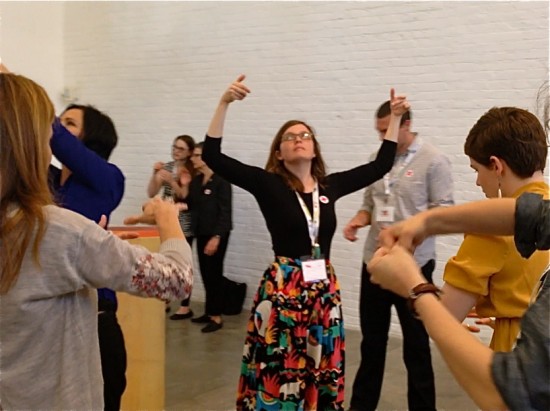
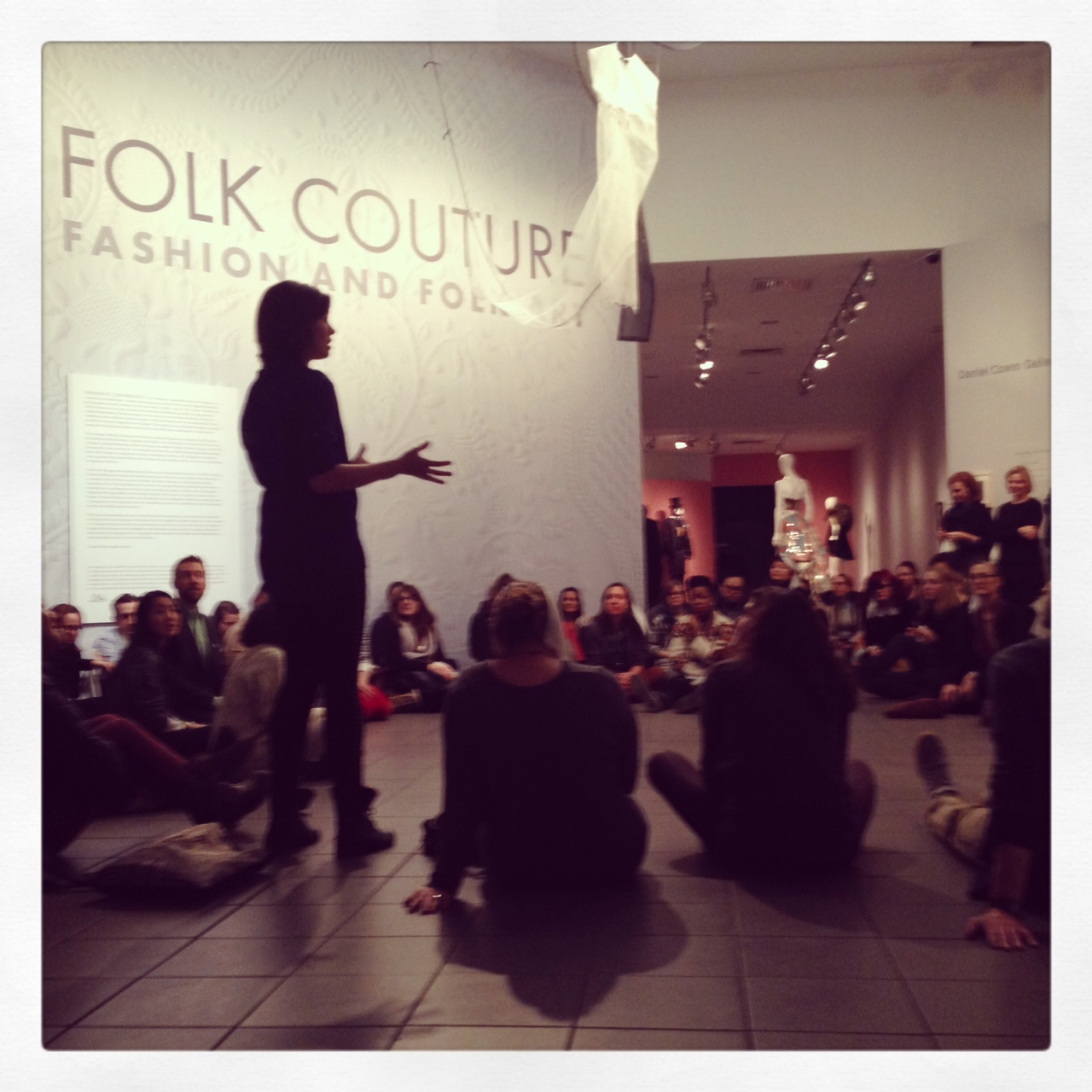
photoWe used Richard Serra’s site-specific work, Santa Fe Depot to inspire us to write found poems, to focus on the environment around the work (up to and including the tourists dancing on top of Serra’s forged steel blocks, the commuter trains arriving and departing immediately next to us, and the pile of “organic sculpture” a dog had left behind next to the artwork), and finally, to create our own interpretive movements based on the words we’d generated.

Throughout the day, the Marathon sessions were full of eager, interested attendees, gung-ho for all the weirdness that might come their way and then ready to reflect on it. For my part, I found it incredibly liberating to be trying something with no idea how it would go over.  I liked explaining to the experimental adventurers at my session that I’d never done this before and talking about which elements of what we did made them uncomfortable and why.  It felt like an exciting deviation from what I expect from my own teaching, which led directly to me thinking about how to make it less of a deviation.

How can I take that spirit of fun, unexpected experiences in the museum and layer it into my job?  How can I give the teachers I work with—especially now, when so many are stressed over standards and evaluation—the same kind of joyful, playful invigoration that I felt from all these NAEA sessions and colleagues?  How can I spread my own belief that sometimes the most fun you can have in a museum comes from doing something within its walls that you would never have expected to do?

That’s what I’ve come home thinking about, and I’d love to hear if this idea affected any of you, too.  Any anecdotes to share about how the spirit of play has impacted your museum work?  Any advice for spreading the enjoyably surprising?  Any other NAEA sessions you attended that connected to this idea?  Share your thoughts in the comments.

If you want to read more about some of the things I’ve mentioned, check the Twitter hashtags #naea14, #naeamused14 (for museum-related content), and #galleryteachingmarathon.  There’s also my complete Storify account of the Convention, which has plenty more tweeting about the spirit of play, and Olga Hubard’s recent reflection on the Gallery Teaching Marathon itself (touching upon some of these same ideas).
In the Midst of Practice: Reflections on the Gallery Teaching Marathon

By Olga Hubard, Teachers College, Columbia University

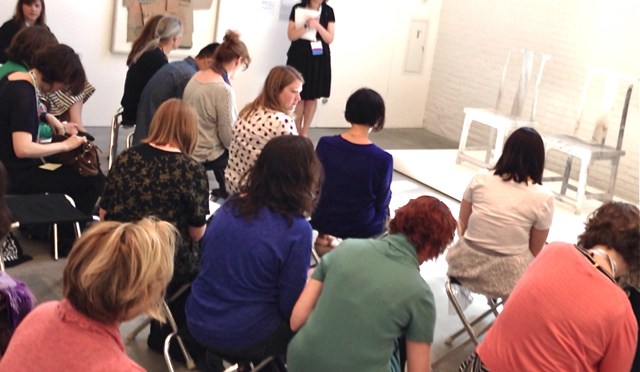
Liz Diament leading part of a gallery teaching experience with Ai Weiwei's "Marble Chair."
Liz Diament leading part of a gallery teaching experience with Ai Weiwei’s “Marble Chair.”

We all know that one way we grow as museum education professionals is by sharing our practices and the thinking that surrounds them. In most cases we do this through traditional presentations: our ideas and experiences tidily packaged; challenges and difficulties presented as something that occurred (safely) in the past, and which we now frame as food for productive reflection. The experimentation and messiness that is so often part of our work — at least if we take the risks necessary to keep evolving — do not often occur in front of our colleagues. That is, unless we participate in a Gallery Teaching Marathon like the one that took place in the Museum of Contemporary Art San Diego during the NAEA conference this spring.

I left the Gallery Teaching Marathon both inspired and hopeful. One important reason was the very nature of the marathon: a group of seasoned museum educators guiding each other in engagements with works of art. Some, by their own admission, did “something they had never tried before;” others shared approaches that had been tried and tested but with works that were new to them. The fact that these educators felt comfortable enough to make themselves vulnerable in front of their colleagues is indicative of extraordinary trust among this community. As well, it reflects the passion and indomitable spirit of a group of professionals who have helped shape our field from the ground up.

For those of us who have become accustomed to teaching in the galleries, it was a luxury to be on the audience end of things, with the primary responsibility of helping make meaning of a series of compelling artworks. It was also fascinating to witness a range of teaching approaches that overlapped as much as they were different. I know many of us left the marathon with new ideas — particular strategies that we plan to borrow from our peers, and which will likely be incorporated into our practice soon enough.

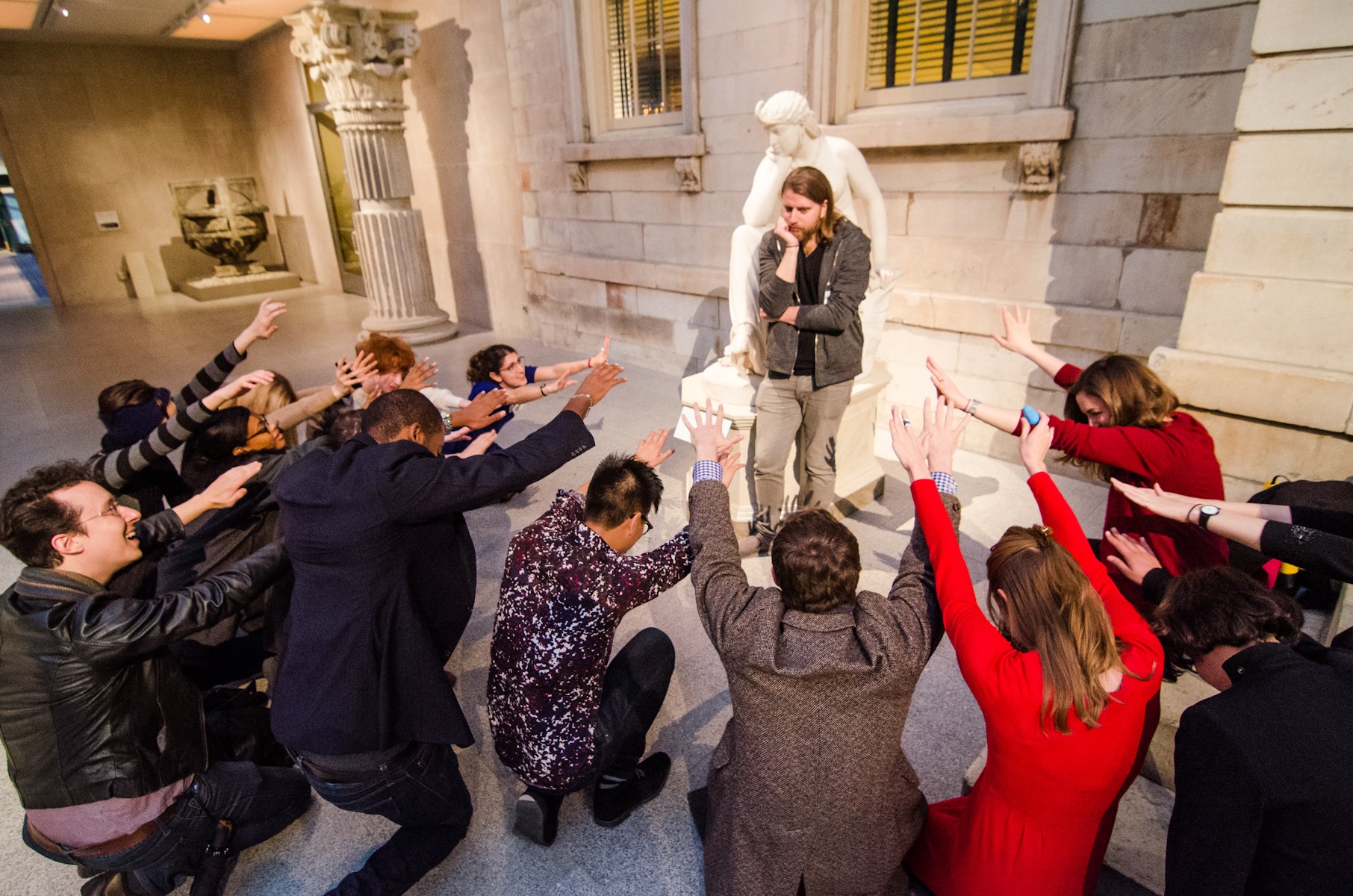
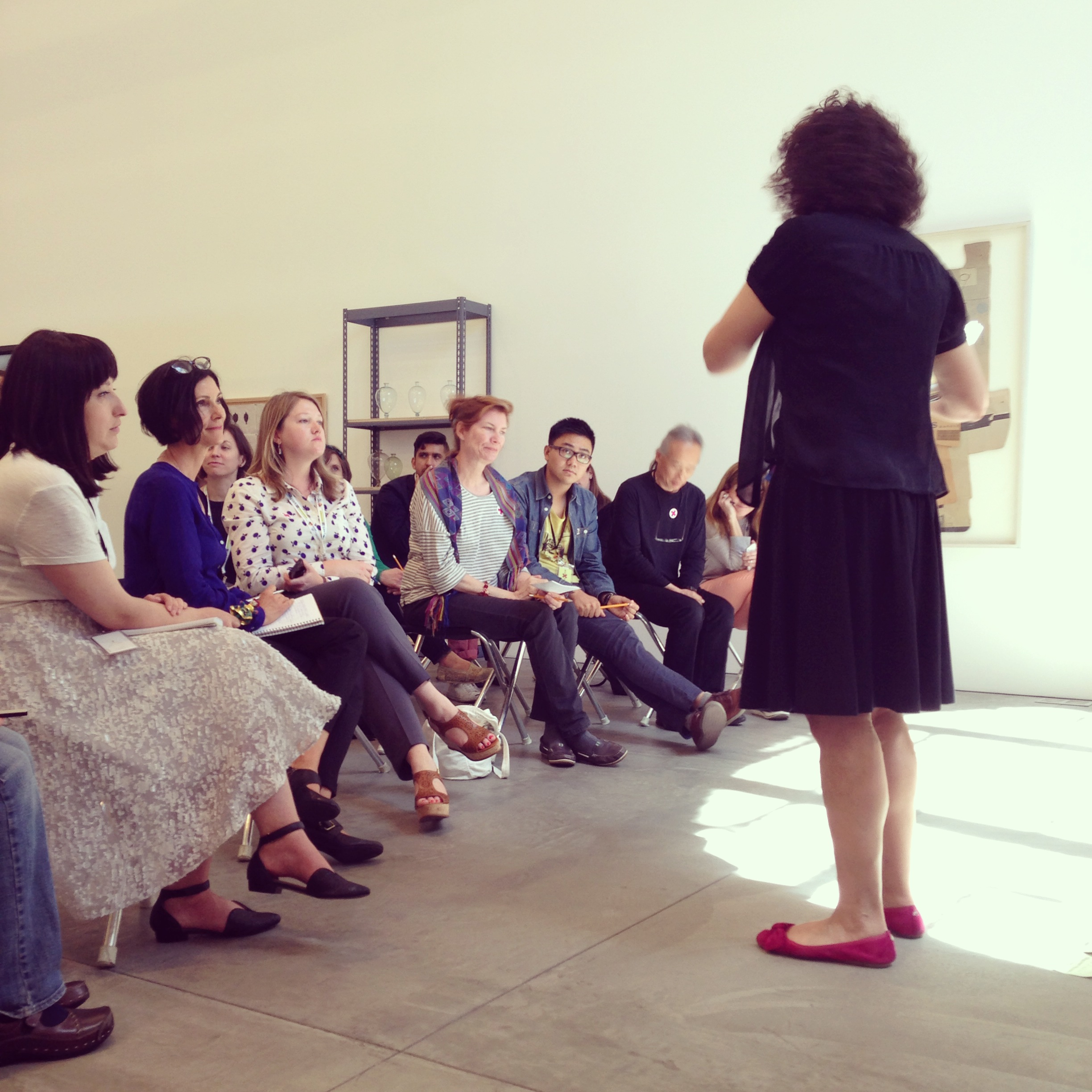
Participants engaging in movement and pantomime strategies led by Jen Oleniczak.

I am ready, for example, to invite viewers to think more explicitly of the layers of meaning that a work might yield (Niki Ciccotelli Stewart), or to encourage them to enact the movements they might make if they could go inside a picture (Jen Oleniczak). I am also keen to have visitors post written questions on the periphery of a work (Heidi Hinish and Liz Diament), or to ask them to do what a particular work “is asking them to do” (Elliott Kai-Kee). More than anything, I am curious to see what happens as other educators in the group borrow and adapt this or that approach, make it their own, and come up with yet other ideas. It is this sort of cross-fertilization that keeps things moving along.
Another gain for me was renewed empathy with audiences. Throughout the marathon, I was acutely aware of how I responded to the various conditions that shaped our gallery interactions. When did the pace of a conversation leave room for my comments and when did it seem too fast or too distant from my ideas? In the case of non-discursive activities, when did I feel too self-conscious to really be in the experience and when did I feel comfortable “going for it”? How did the educator’s demeanor influence my interaction with the work and with others in the group?

By taking the participant’s seat, I was also able to re-discover something I already knew — or thought I knew. Like all of you, I have known for years that partner talk is a valuable approach in the galleries (of course!). But at MCASD, when a group got too large, or when for whatever reason I did not feel prepared to share my thoughts in a group dialogue, how grateful I was to be able to share what had been in my mind all along with a partner! The next time I facilitate partner- or small-group work I will do so from a renewed level of empathy and awareness. Perhaps like me, some of you also left the marathon with your own “re-learnings,” which can only work to enhance visitors’ experiences in the museum.

Beyond specific strategies and empathy, the gallery teaching marathon animated some larger issues that underlie our work. Two that are particularly alive for me at this point:

  1. If the experiences that took place in MCASD are in any way representative of the field, it would seem that we have come to accept that the meanings that viewers shape through words and rational thought are no more worthy than those they shape through poetic and non-discursive modalities. In an educational milieu that values rational thinking and word-based forms of meaning making above all, this places us at the vanguard–but also in tension with the status quo. Given this, how might we work to deepen and strengthen a commitment to poetic/artistic and multimodal ways of knowing so that museum visitors can continue to benefit from rich, multidimensional experiences with museum objects? How might we articulate the educational worth of diverse modes of meaning making? And how might we avoid dichotomizing rational, word-based approaches vis-à-vis more poetic ones, which might put us at risk of throwing out the baby with the bath water — or from recognizing when the two intersect?
  1. A few times during the marathon, I heard participants note that certain activities had taken them away from, rather than closer to, the works that were the target of our exploration. In the same breadth, these people added something along the lines of, “I’m not sure that it matters, though; the activity was worthwhile anyway.” For us educators, this raises a question of intentionality: When are our activities meant to bring us into deeper interaction with an object? When are they meant to spark off creative activity beyond the work itself? When are they meant to do both–or to do something different altogether? Does it matter and, if so, in what way? (These questions remind me of my colleague Megan Laverty’s provocative idea that perhaps the main purpose of art is to generate more art.)
Elliott Kai-Kee leads group to openly explore the question "what is this particular artwork asking me to do?"
Elliott Kai-Kee leads group to openly explore the question “what is this particular artwork asking me to do?”

With these and other questions in mind, throughout the marathon, part of me kept wishing for more time to debrief and reflect on what we were all experiencing. The rest of me was content with the limited reflection time we had, however — there was something wonderful about spending an entire day in the midst of practice; a day of sharing our work in the making; our practices in all their messiness and all their (realized and yet-to-be realized) potential. Perhaps an idea for another occasion might be to have a one-day gallery teaching marathon followed by a half-day reflection session.

But back to the event at MCASD. Early in this post, I said that the Gallery Teaching Marathon left me hopeful. I meant it. As I think back to our day together, I am hopeful for what is to come for our field, full as it is of courageous and dedicated educators who continue to build from the ground up, and to push us all to think and play and interact in thoughtful, imaginative ways. This is significant work for us as educators, and I trust that in time it will lead to more meaning-full museum experiences for visitors.

UPDATE: Response from Elliott Kai-Kee, J. Paul Getty Museum

Olga Hubard’s reflection on the issue of non-discursive and ‘poetic’ approaches versus word-based and ‘rational’ approaches struck a responsive chord with me. I like the way she cautions us against putting the two in opposition rather than seeing them as ‘intersecting,’ or even better, complementary. Indeed, I think it’s crucially important to figure out ways to work them together. I commonly see docents separate their school-group lessons into ‘activity’ stops and ‘discussion’ stops. How is it that we have defined the two in ways that result in such a dichotomy? They must get this from us somehow. Is it a reflection of an argument pitting engagement against interpretation? Materiality against symbolism? The Gallery Teaching Marathon demonstrated a wonderful variety of approaches to the practice of gallery teaching. Is there a way of thinking about teaching that brings them together in a way that would make them more powerful in combination?”

About the Author:

hubardOLGA HUBARD: Associate professor of art education at Teachers College, Columbia University. Olga is interested in the humanizing power of art and in how educators can help promote meaningful art experiences for learners. She has published extensively about this issue, particularly in the context of museum education. Her scholarship has appeared in journals including Studies in Art EducationCurator: The Museum JournalInternational Journal of Art and Design EducationJournal of Aesthetic EducationJournal of Museum Education, and Art Education: The Journal of the National Art Education Association. Olga’s writing is informed by years of experience as a museum educator and art teacher, and by her ongoing studio art practice. She holds doctoral and master’s degrees in art education from Teachers College, an MFA from the School of Visual Arts, and a BA in Art History from the Universidad Iberoamericana (Mexico). Olga’s postings on this site are her own and do not necessarily represent Columbia University’s positions, strategies, or opinions.

Letting Go and Opening Up: Teen Voices in Art Museums

By Chelsea Emelie Kelley, Milwaukee Art Museum, and Patty Edmonson, Cleveland Museum of Art

When museums share interpretive control of their collections, amazing things can happen. Many museums are reimagining how visitors can interact with and engage in their collections, through technology, after-hours adult programming, and even hacking (both sanctioned and independent).

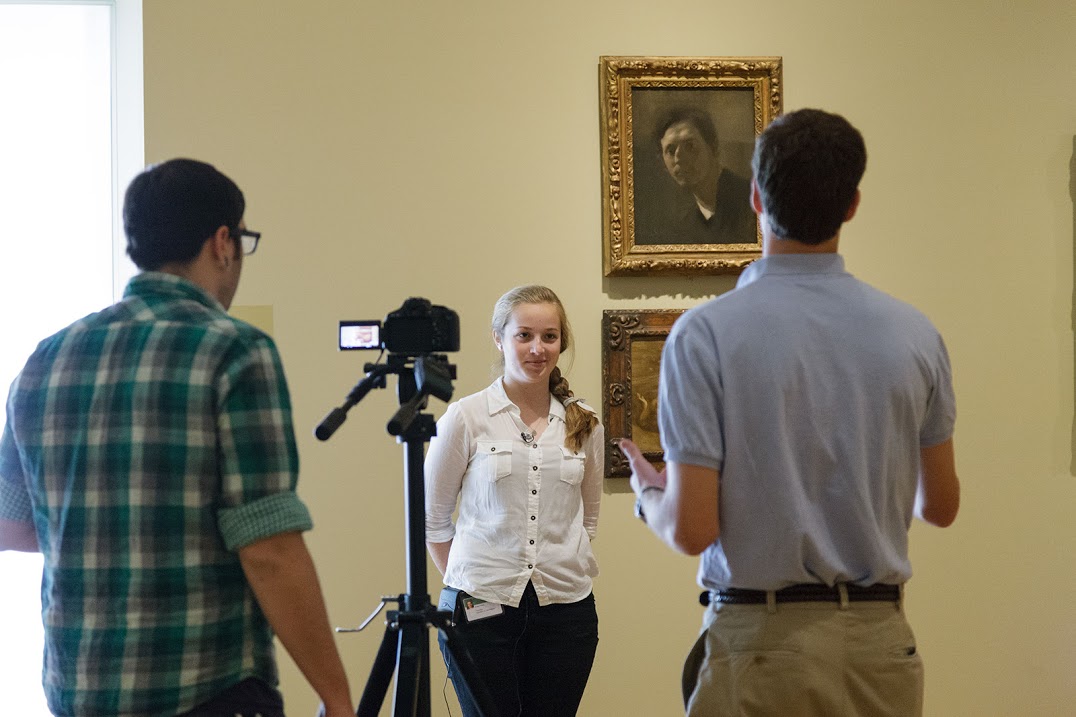
Recording video content with teens as part of the Teen CO-OP program at the Cleveland Museum of Art.

Teen programs provide a very different kind of opportunity for museums to experiment with interpretation. Because many teens participate in multiple programs for extended lengths of time, they become advocates and resources for our museums and its collections. Teens at the Milwaukee Art Museum and the Cleveland Museum of Art have been part of two experimental interpretive strategies that go deeper than one-day-only programs, providing not only learning experiences for students involved, but powerful tools and content for their institutions.

From the museum educator’s perspective, we—Chelsea Emelie Kelly at the Milwaukee Art Museum and Patty Edmonson at the Cleveland Museum of Art—originally connected because both of our programs create video content featuring teens for our collections. However, we’ve come to see that there are more connections and applications to what we’re doing than simply producing object-focused, teen-made videos. We share our programs and projects below, and we’re now thinking about how we can make use of this content beyond teen audiences. Read on and share your thoughts with us!

Teen CO∙OP at the Cleveland Museum of Art

Patty Edmonson, Intergenerational Interpretation Specialist

The Teen CO∙OP started in 2013, and it’s the Cleveland Museum of Art’s newest teen program. We chose ten students from a pool of applicants to participate in a two-week summer session, where we trained them to work with the public and create their own programming. They use these skills during our monthly family days, called Second Sundays. CO∙OP members work in our interactive gallery, Gallery One, answering visitor questions and starting conversations about art and the museum. During these events, they also help with studio projects, pass out the teen guide they made, and create Vine videos. The CMA is working toward a more visible teen presence and authentic teen voices.

Video has been a tool for us to hear these teen voices and get students to think about storytelling in museums. During our summer session we created short films with a local production company, North Water Partners. Each student began by choosing an artwork and we interviewed them about their initial reactions before they knew very much about the piece. After these first interviews they read about their artworks and we talked about historical context. We asked them to complete a series of small tasks: choose three words that describe the artwork; describe this to someone who can’t see; write a tagline for the artwork; tell a story about this artwork; make a Vine about it. These tasks became pieces that they could include in their storyboards. Some also created their own typography or imagery to incorporate into their video.

One of the biggest challenges was balancing fun and appropriateness. I wanted the students to feel comfortable being silly, but there were several moments when we stopped to talk about respecting the art and museum. We also went out on a limb by letting the video content come from their ideas and observations, not solely art historical information. We are not creating mini art historians here. That said, we did have to navigate one interpretation of a portrait with a shadow that looked like a bruise. The student was interested in creating a story of a battered woman, but we stepped in to talk about why this story might not be the best one to imagine, and spent time looking at more portraits and their shadows.

Through these videos, the teens learned to look closer. They seemed excited that their observations were valid and their confidence grew. I also saw their public speaking abilities improve after being behind the camera, which can be tough. One of our big goals was to capture an authentic voice, and we chose not to correct language that museums wouldn’t normally approve, like “I’m finna to the grand ball” (as in fixing to go). I felt that by letting their real voices come through, we let them know that they can be themselves in a museum.

We hope to show these videos on our website, and you can see some of the good and bad Vines under the account, CMA Teen CO-OP. Our plan next summer is to make content that can better fit into our app, ArtLens.

Satellite High School Program at the Milwaukee Art Museum

Milwaukee Art Museum Satellite Program group, 2013-14

Chelsea Emelie Kelly, Manager of Digital Learning

The Satellite High School Program is an art history focused weekly gallery program at the Milwaukee Art Museum for sixteen arts-interested teens from the Milwaukee area to connect with works of art and each other. As part of the program, teens choose a work of art in the Museum collection to study and interpret, and share their ideas in a final project. Over the past year, we’ve experimented with how they share using video in two very different ways.

In the spring 2013 program, teens had one semester to choose a work, study it, and make a creative response to it, in visual art, writing, music, or media of their choice. I wanted to be sure their work was shared with a wider audience, so I used my own personal DSLR camera to film them with their artwork and creative responses. I had them write their own voiceover explaining their piece, their connection to it, and their response project, making sure that the video was just about one minute long for quick, easy consumption. Here’s just one of their videos, featuring Joel:

That project was successful, but I wanted to turn much more of the creation over to the teens themselves. I knew I had a chance to do just that when we received funding to buy a set of iPads for the Education Department.

This fall, as part of a school year-long program, a new group of teens had a different task: they shared their personal connections to their work of art through a video they created on an iPad. Over the course of the semester, they created video blogs (vlogs) reflecting on their changing thoughts about their work of art. They also received “readers” with basic information on their work of art or artist, and led a group discussion with all the Satellite students about their piece to get others’ opinions and thoughts. At the end of the semester, they created midterm videos piecing together with their reflection vlogs to show their evolution of thought. Here is ZouaPang’s video:

Teens continually asked themselves what they were still wondering about, and much changed over the course of the semester. When asked what she learned after an early session, Alana responded: “I learned how to better analyze paintings.” Her answer to the same question at the last session of the semester was much richer: “I learned a lot more about how to analyze art and research which I think is really cool because now instead of just looking at a piece and saying ‘pretty picture’ I notice more things about the pieces I see.” Alana’s video—and all her research and analysis!—is below.

One-to-one iPads came with their own set of challenges. Instead of solo weekend troubleshooting with DSLRs and iMovie, I found myself with a wonderfully excited group who wanted to use the iPad for much longer than I’d anticipated! In fact, I learned that students about doubled the time I usually allotted to use the iPad comfortably and feel good about their work.

Next semester, the same group of students will continue to explore their artwork and create more formal videos for a wider visitor audience about their work of art. We’re going to kickoff the semester with some visitor studies: teens will go into the galleries and do a card-sort exercise with Museum visitors to discover what people actually want to know about works of art (thanks to Marianna Adams for this activity!). Then we’ll pool our data and discuss how we might format our videos for a larger audience, as well as how the teens think we should share the content.

Your Thoughts?

We’re now in the phase of thinking about what we can do with the content our students have worked so hard to create. We know their voices are important and engaging, and are thinking about how best to share them. Since ArtMuseumTeaching.com is a forum for practice, we would love to open our questions up to all of you. What other purposes might these videos serve? Would they be interesting to other audiences? Where and how should these videos be shared? Please share your thoughts with us, as well as comments or questions, below!

Getting a Better Sense of the Terrain: Machine Project at the Hammer Museum

This post is part of a series I am writing this week to explore the role of artists and artistic practice in the experimental work occurring in art museums across this country, and beyond.  In order to more effectively examine the ways in which art museums have become sites for socially-engaged practice and new forms of artist-driven public engagement, I’m interested in taking some time to showcase three telling cases that have been developed in museums at a parallel moment these past few years:

Selected from more than a dozen examples of this type of practice, these three projects each have stretched and pushed their institutions in new and productive ways, opening up unanticipated, thought-provoking, exciting, and even uncomfortable ways for visitors to experience an art museum.

To help get a sense of how many arts enthusiasts, museum professionals, and educators are aware of these types of experimental museum projects, I’ve been asking readers to please take a few seconds and complete the poll below, if you have not already.

Thanks for responding to the question above.  Now onto the second telling case of great work being done in this area of museum practice.

Machine Project at UCLA’s Hammer Museum

“Almost every day now I think about the power that intimacy can have, and that we don’t need to serve a thousand people with each project. We’ve talked often about how you measure success: it’s not just the number of people that come through; quality is part of it.”  Allison Agsten, Machine Project Hammer Report

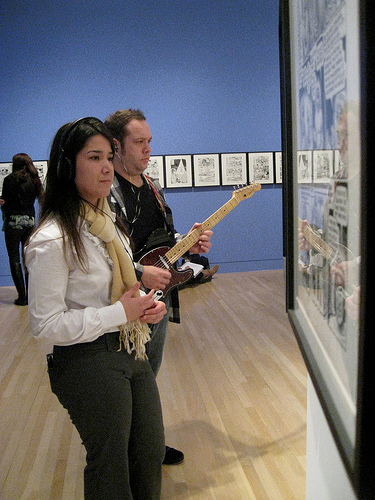
Machine Project’s Live Museum Soundtrack at the Hammer Museum. Guitarist Eric Klerks improvises music for each artworks this visitor views.

In 2010, the Hammer Museum at the University of California, Los Angeles, invited the artist/performer collaborative Machine Project to produce a year of programming which proposed new, alternative, and experimental ways of presenting work at the museum. This decision came out of a process in which the museum worked with a newly-created Artist Council to address many of the visitor services issues the museum was struggling with. Striving to be a truly artist-driven institution, the museum received funding from the Irvine Foundation to create its Public Engagement Artist in Residence program, with Machine Project being the first. Over their residency, twenty-six projects were implemented, including personal soundtracks for visitors, staff pet portraits, table tennis, printmaking workshops, micro-concerts, and a giant animatronic hand that pointed people to different areas of the museum.

The Hammer’s Public Engagement Artist in Residence program specifically sought to bring the creative process of artists into the museum, setting out to utilize artists as problem solvers for visitor services and operational concerns.  As Mark Allen, Director of Machine Project, discusses in his introduction in the Machine Project Hammer Report (2012), however, this became a point of tension between the museum and Machine Project artists:

“When people at an institution speak of a problem, it is often to indicate something that interferes with their operation. From the artist’s perspective, a problem is a provocation or a site to which the artwork responds by creating something that engages the problem and makes it visible in a different light. The problem is aestheticized, framed, or reconfigured; it is seldom erased or resolved.”

micro-concert as part of Machine Project's residency at Hammer Museum.
micro-concert as part of Machine Project’s residency at Hammer Museum.

The Hammer Museum and the artists working with Machine Project have been transparent about these tensions in a unique way that spotlights how productive it can be for visitors to think critically about the museums they visit. While bringing in artists to “fix glitches” may not be a successful goal for experimental practice like Public Engagement, having artists collaborate with museums does work toward more process-oriented goals of having critical conversations about creative negotiation, of building capacities for collaboration, of encouraging museums to cede more control to their communities, and of reconsidering how these institutions engage their publics.  Reflecting upon the project in 2012, a year after its conclusion, the team at Machine Project observed:

“A year later, what seems most interesting about this project is not just what the public experienced, but everything that took place behind the scenes – the conversations with artists, the challenges inside and outside of the museum, the logistic and philosophical issues involved in attempting to suggest other uses for a major cultural institution.” 

This single example of the Hammer Museum’s Public Engagement Artist in Residence program clearly indicates the value of artist-driven visitor engagement, and their work has served as a guide for other institutions to have “a better sense of the terrain” in pursuing similar endeavors.

OTHER POSTS IN THIS SERIES:

Possibilities for Evolution: Artists Experimenting in Art Museums

Blurring the Lines: Walker Art Center’s Open Field

Rethink What Can Happen in a Museum: Portland Art Museum’s Shine a Light

RELATED POSTS:

Towards an Even More Participatory Culture in Art Museums

Participate: Designing with User-Generated Content (book review)

Doing, Not Just Viewing: Working Towards a More Participatory Practice

‘Getting in On the Act’: Exploring a More Participatory Arts Practice