Tag Archives: NAEA

Gallery Teaching Marathon in San Diego

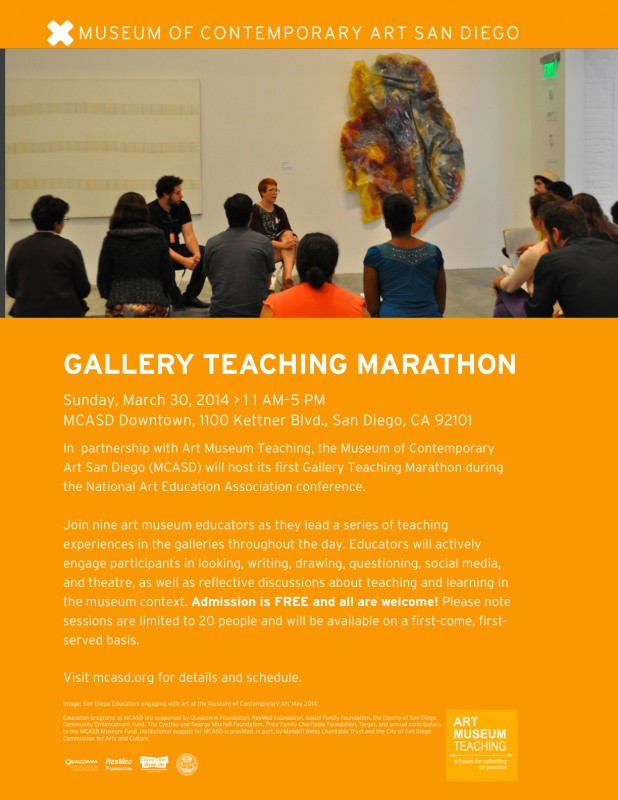
Gallery Teaching Marathon Flyer_2 (1)The ArtMuseumTeaching community has been growing now for more than 2 years, providing an online forum for educators and museum professionals to reflect on practice, teaching, learning, technology, public engagement, diversity, professional development, and a whole host of other issues and topics. During the past year, Google Hangouts have become a new medium to extend these text-based relationships into face-to-face, real-time conversations — bridging enormous distances to bring people together to reflect on the practice of teaching and learning in museums.

Most recently, I have become interested in new ways to bring museum educators together physically in museum contexts, enacting and inquiring into our teaching practices while further building community in an openly-networked fashion.  Our museums’ galleries are increasingly becoming open spaces in which communities of teachers & learners can connect, intersect, and come together to make learning visible and then reflect upon our practice in a shared, public space. Last week, ArtMuseumTeaching partnered with the American Folk Art Museum to host the first-ever Museum Teaching Throw Down — an event that brought together more than 60 museum colleagues and friends from across New York City (and beyond) to actively engage in teaching experiences led by the fabulous trio of Jen Oleniczak, Rachel Ropeik, and PJ Policarpio.  Stay tuned for further post-throwdown reflections and reports from this amazing evening.
marathon-smallExtending this work to bring museum education peers together to reflect on our practice, ArtMuseumTeaching is partnering with the Museum of Contemporary Art San Diego (MCASD) during the National Art Education Association national conference at the end of this month to host its first Gallery Teaching Marathon.  This event will feature 9 art museum educators leading a series of teaching experiences in the galleries throughout the entire day, actively engaging participants in looking, writing, drawing, questioning, social media, and theatre as well as reflective discussions about teaching and learning in the museum context. Admission if FREE, and all are welcome!

Here are the details, followed by the current schedule of amazing experiences.  Please use this blog post as well as the ArtMuseumTeaching Google Community to stay up-to-date on any schedule changes or announcements.
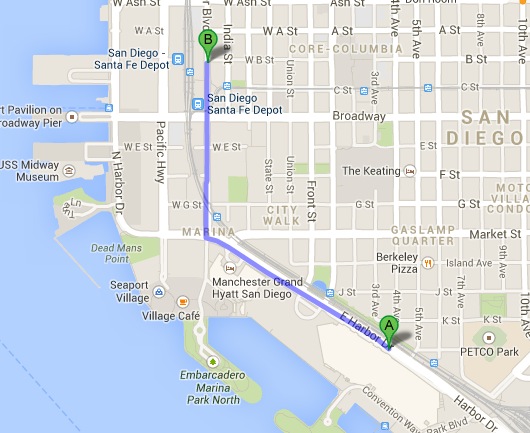
MCASDmapWhen:  Sunday, March 30th, 11am-5pm – link to Google+ Event Page
Where:  Museum of Contemporary Art San Diego, Downtown location (1100 Kettner Blvd)

Before planning your day on this Sunday, we encourage you to first check the NAEA conference schedule (which includes dozens of incredible sessions, events, and forums focused on museum education and all areas of art education).  Make note of the conference sessions happening this day, and then squeeze in some time to walk over to the MCASD-Downtown to join us.  The easy walk from the Convention Center to the MCASD-Downtown location is about 10-15 minutes through sunny downtown San Diego.

MARATHON SCHEDULE

11:00-11:40am
Layers of Meaning
Experience led by Niki Ciccotelli Stewart, Crystal Bridges Museum of American Art

It’s been said that every work of art tells a different story. But, what if there was more than one story to tell? In this session, we’ll engage with a work of art and investigate it together, layer by layer, to uncover the many meanings within.  Directed looking and facilitated conversation, designed to uncover the context(s) of the work.  In this session, participants will engage in looking, talking, writing and drawing; consider the many contexts of the work, including time, gallery placement, and their own personal interests; search for the artists’ message or intention, building on what the group knows and discovers together; and determine how the artwork is relevant in today’s world, and on a personal level.

11:45am-12:25pm
#DramaticPossibilities
Experience led by Jen Oleniczak, TheEngagingEducator.com

Focusing on movement and theatre-based ways of exploring art, and continuing the conversation beyond the gallery by using social media.

12:30-1:25pm
Teaching with Thinking Routines
Experience by Heidi Hinish and Liz Diament, National Gallery of Art

Slow down, look carefully, and enjoy time spent in conversation around a work of art.  In this session, we will model a teaching strategy called a Thinking Routine to guide the discussion. Thinking Routines were developed by researchers at Harvard University’s Project Zero. The routines are short sets of open-ended questions that are designed to help learners engage with complex ideas and objects, to foster rich engagement, and to build understanding.

1:30-2:20pm
Collaborative Poetry, Meet Interpretive Dance
Experience by Rachel Ropeik, Brooklyn Museum

Let’s see what happens when we use a work of visual art to inspire us to two other creative art forms.  We’ll discuss an artwork together, then let it inspire us with both words and movement.  Adventurous experimenters welcome.  No poetry, dance, or even museum experience required.

2:25-3:15pm
VTS-ing VTS
Experience by Michelle Grohe and Jenn DePrizio, Isabella Stewart Gardner Museum

Whether you love it, loathe it, or don’t yet know about it—VTS (Visual Thinking Strategies) is a force within art museum education.  Join us for a open forum to explore the possibilities and limits of this pedagogy.  Ever wondered what VTS looks like with more experienced viewers?  This is your chance to participate in a VTS discussion with colleagues and reflect together on our professional practices.

3:20-4:10pm
What Does This Artwork Want?
Experience by Elliott Kai-Kee, J. Paul Getty Museum

Participants will start with the question, “What is this particular artwork asking me to do?” and as a group perform responses that arise. A brief discussion follows, of how “doing with” relates to “talking about” objects.

4:15-5:00pmCANCELLED (due to illness … we hope Chelsea feels better soon)
Investigating Transformative Experiences with Art
Experience by Chelsea Kelly, Milwaukee Art Museum

What are the connections between individual, art historical, and experiential/group interpretations of works of art? How might we use these experiences to create relevancy for our collections and humanize our institutions? Inspired by the work we do as educators to support, study, and take part in transformative experiences with art (in the spirit of Elkins’ Pictures and Tears, Armstrong & de Botton’s Art as Therapy, and Burnham & Kai-Kee’s Teaching in the Art Museum), join me in a group discussion that will begin with sharing our own personal transformative experiences with art, then branch out to explore the above questions. PLEASE BRING: A story about a transformative experience you have personally had with a work of art, and a picture of that artwork to share (on your tablet or printed out is fine).

ArtMuseumTeaching HAPPY HOUR

check out these amazing drinks at Craft & Commerce, location for this year's Happy Hour

Whether you can attend part of the Gallery Teaching Marathon or not, the ArtMuseumTeaching community invites you to an evening Happy Hour for further networking, community-building, and to learn more about how to get involved.  For this year’s Happy Hour, ArtMuseumTeaching is pairing up with Museum Educators of Southern California (MESC), a nonprofit organization for museum professionals whose work is focused on museum audiences. Here are the details for the Happy Hour:

When: Sunday, March 30th, 5:30-7:00pm – link to the Google+ Event page
Where: Craft & Commerce, 675 W Beech St – http://www.craft-commerce.com/

So if you plan to be in San Diego for the NAEA conference, we hope to see you at the Gallery Teaching Marathon and Happy Hour on Sunday.  Should be lots of fun as we meet new people, connect with old friends, and celebrate the work we do as educators!

Looking Back / Looking Ahead

2013-collageAs the second year of the ArtMuseumTeaching site wraps up, I thought it would be good to post a brief review of the past year as well as some thoughts as we look ahead in 2014.  Not that we need any more end-of-the-year lists or calls for resolutions, but I think it can be meaningful to take a minute and look back at some of the issues that have been on our minds this past year, and imagine a bit about what is on the horizon.  From 3D printing and hacking the museum to MOOCs and the value of museum field trips, there have been a lot of interesting and sticky topics that we’ve discussed here on this site.

Through its second year, the ArtMuseumTeaching community has continued to grow.  Doubling the number of authors, adding 39 new posts, starting a new Google+ Community, and now reaching readers in 143 countries, interested contributors and readers have pushed this site to new heights in 2013.  I hope that the online community and conversation around this site will continue to grow, include more diverse perspectives, and be a space of exchange where we can connect on issues of teaching, learning, and community engagement that matter most in museums.

Looking Back: Most Read Posts of 2013

While I always hate the popularity game of “most read,” it can be fun to look back at the year and see what people seemed most interested in across the board.  Here are the Top 5:

hazel-jackson-pollock“Is This Art? Tales from 3 New York City Educators” (June 2013): Rachel Crumpler, Jen Oleniczak, and Shannon Murphy got together and shared with us the most common “Is this art?” situations they’ve encountered — from grumbles and snarky looks to “pfft, that’s disgusting” and “my four-year-old could do that.” Great tales we can all relate to, and some excellent strategies for tackling these awkward (yet extremely teachable) moments.

MH_WALL“What is Museum Hack?” (December 2013): Museum hackers Mark Rosen and Jen Oleniczak recently described how a group of renegade museum lovers can get people really excited about museums.  Leading creative and thought-provoking tours at the Met, Museum Hack is certainly getting museums and museum educators to ask some interesting questions about what we do.  Jen and I connected via a tech-challenged Google Hangout before the end of the year, and were able to address some of the questions about ‘hacking’ museums for positive change (see video archive embedded in the post).

bookpile“Do Museum Educators Still Have Time to Read Books?” (June 2013): In an effort to ‘bring back the books,’ ArtMuseumTeaching launched its Online Book Club this summer.  Far from MOOCs, the two book club discussions were intimate exchanges that focused on books that have not popped to the best seller list: one very meaningful new volume entitled Museums and Communities (edited by Viv Golding and Wayne Modest) and a classic text re-examined, George Hein’s  Learning in the Museum (first published in 1998).  While it is always a challenge to carve away time to read, I hope we can continue the Online Book Club in 2014.

fieldtrip2“What’s the Value of an Art Museum Field Trip?” (September 2013): It is important for us to remember that 2013 saw the first-ever large-scale, random-assignment experiment of the effects of school tours of an art museum — thanks to the incredible research team pulled together at the Crystal Bridges Museum of American Art.  Anne Kraybill shared with us the results of this significant research; findings which help to make a more rigorous case to administrators, policy makers, philanthropists, and educators that there is significant value in a field trip.

bradford2_2“Teaching for Independence: Empowering Learning in the Art Museum” (May 2013): For me, it is still always important to see ArtMuseumTeaching as a site where we can share our own daily teaching practice — since this is where the blog started for me, personally, back in February 2012.  I was excited to share an experience I had with a group of Portland State University students, thinking about how an educator can empower visitors to learn to begin to see looking and learning with art in a more active, participatory way that also allows for shared authority around knowledge and interpretation.  The post was also a collaboration with Art History Teaching Resources (AHTR), a peer-populated teaching resources site begun by Michelle Millar Fisher and Karen Shelby that promotes discussion and reflection around new ways of teaching and learning in the art history classroom — a collaboration that I know will only grow in 2014.

Looking Ahead

As we look ahead to this new year, there is so much potential and possibility.  In addition to the great posts and contributions already mentioned, 2013 was a great year for collaborations and partnerships.  ArtMuseumTeaching has been connecting with so many other exceptional blogs, online communities, and digital networks, and I know that is going to grow and expand in the year ahead.  We’ve also been experimenting with using Google Hangouts as a way to connect people, and I hope to push that a bit farther in 2014 (perhaps even experimenting with connecting our gallery teaching practice via Hangouts or video connections).

For 2014, I am also excited to be working on ArtMuseumTeaching’s first-ever “gallery teaching marathon” that will happen during the National Art Education Association national conference in San Diego this year.  So if you’re interested in experimenting with a new teaching strategy or just seeing some great museum teaching, please stay tuned.  As soon as we have all the details confirmed, I’ll be sharing this with everyone!  And if you’re interesting in helping coordinate this, definitely let me know — I think we’ll need a few hands on deck to make this work.

The year ahead certainly promises a whole new set of challenges, success stories, and new ways of thinking about both the theory and practice of art museum teaching.  If you would like to share the projects you’re working on or the issues and challenges you are grappling with, please add your voice to this growing community (and just send me a tweet at @murawski27).  Happy New Year!

Curriculum SLAM: Contemporary Art, Contemporary Pedagogy

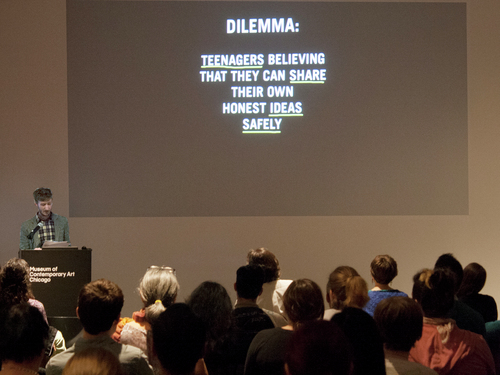
curriculum-slam2Submitted by Lydia Ross, Programmer of Education, School and Teacher Programs, Museum of Contemporary Art Chicago. Re-published from NAEA Digication e-Portfolio site.

As 21st century art teachers there are so many competing pressures for time and attention that it can sometimes be difficult to focus on a core concern of creative teachers. How to gather innovative ideas for projects and curriculum that introduce students to a wide range of contemporary artmaking strategies?

“Recognizing the need to create opportunities for teachers to share innovative practice and understanding that old style curriculum sharing methods may not be the most efficient or engaging ways of exchanging quality curriculum, the Museum of Contemporary Art in Chicago’s Educator Salon invented a fast-paced and fun format to share art projects—the Curriculum Slam!” explained Chicago art educator Olivia Gude.

“Today’s society of media saturation has given us all a touch of ADD. The curriculum slam format works well because it’s quick and entertaining and because the careful selection and preparation process guarantees that the content is fresh and well-thought out—based on significant contemporary ideas about making art.”

Inspired by the emceed hip hop-style poetry slams pioneered in Chicago in the 1980s that brought contemporary aesthetics and style to traditional poetry readings, the Curriculum Slam! re-invents the old-style curriculum fair by adapting a 21st century presentation innovation—the rapid style PechaKucha format. PechaKucha (in which 20 images are set to advance automatically every 20 seconds) was developed by the Klein Dytham architectural firm in Tokyo because there was a need for a public forum to share innovative work, but if you “Give a microphone and some images to …most creative people…and they’ll go on forever!”

curriculumslam

The Curriculum Slam! has become a popular yearly feature of the MCA’s teacher programming since 2010. Teachers have presented on a wide range of topics—using the work of contemporary artists to inspire contemporary curriculum. Presentation subjects have ranged from 5th graders making paintings with the self-imposed limitations (based on the work of Matthew Barney), building and photographing miniature environments (in the style of artists such as Laurie Simmons and outsider artist Mark Hogancamp), humorous horror drawings (inspired by drawings and animation of Tim Burton) and explorations of self-identify in the digital age in which students’ text messages contribute to making self-representations.

“The Museum of Contemporary Art is a learning institution as well as a presenting institution. Through this project we are tapping into many forms of contemporary pedagogy. We are learning from teachers.” -Marissa Reyes, Associate Director of Education, School & Teacher Programs at the MCA

The PechaKucha format has been adapted to enhance curriculum sharing—“We have been using a 14-slides-in-40-seconds format to allow teachers the time to explain some of the details relating to core objectives, materials, choice of artists and other details that contribute to successful projects. We wanted to create a format that balanced being fun and sort of frantic with conveying useful content.”

Curriculum Slam! Goes to San Diego

Now, Chicago brings this dynamic presentation format to the country with the first ever NAEA National Conference Curriculum Slam! emceed by OMGude, Marissa Reyes and DJ Jamie Rees. The event will be held during the 2014 NAEA National Conference in San Diego (March 29-31, 2014) on Monday, March 31 from 4 to 5:50pm. NAEA Secondary Division Director, James Rees commented, “One thing teachers seem to be always looking for is timely content that matters to their students.  This curriculum slam will model a dynamic method of communication, along with a dizzying array of meaningful curriculum. This will be a must attend event this year at the conference!”

How to Get Involved at the NAEA Curriculum Slam!

All members of the NAEA community are invited to apply to be a presenter in the San Diego conference Curriculum Slam! by sending in a short initial application explaining how the teacher’s curriculum unites great contemporary art and great contemporary curriculum, accompanied by a few images. The Museum of Contemporary Art Teacher Advisory Committee will review the applications, conduct phone interviews, choose participants and help presenters prepare for the fast-paced format.

See below for more information on the process of submitting an application by downloading the application forms and template for sample 3 slides in the presentation.

Applications are due on January 6, 2014.

Click here to download the NAEA Curriculum Slam! Fact Sheet (PDF)

Applications have 2 parts:

  1. Word document answering a few questions–who, what, why. Download Application Part 1 (Word)
  2. Submit a Powerpoint with only 3 slides–just give us a taste of what you plan to do. Download Application Part 2 (PPT)

That’s it. Send to MCA School and Teacher Programs at teacherprograms@mcachicago.org

We’ll be in touch by within a few weeks of the December 18 deadline to let you know if you made the Slam! Team for 2014.

After you’ve been selected MCA staffer and Pecha Kucha coach Lydia Ross will “phone meet” with you to assist in making the most dynamic, inspiring and info-packed presentation possible.

Hope to see you in San Diego!

Hangout with NAEA’s New Online Peer-to-Peer Initiative

By Chelsea Kelly, Manager of Digital Learning,  Milwaukee Art Museum

Have you ever gotten home from a conference abuzz with excitement about all the new ideas, people, and programs you’ve learned about and discussed? If so (after you finally recover from all that intense thinking), I’m betting you then thought: “Wow, it’d be great if I didn’t have to wait a full year to get a taste of that again.” Well, that’s exactly why we began a Peer-to-Peer Initiative for the National Art Education Association’s Museum Education Division — to use technology to connect with colleagues and share our ideas and programs in an informal way, outside of conferences.

Google-Hangouts-banner-640x312We’re pleased to announce a pilot series of Google+ Hangouts On Air in the next month. These Hangouts will highlight current work in our field in the conference-like spirit of sharing, discussion, and best practices. (Minus the week-long period of exhaustion and hundreds of emails in your inbox to catch up on afterwards!)

So, please join us for any or all of the below Peer-to-Peer Hangouts this month! Each is about an hour and they are open to all museum educators, regardless of whether you’re an NAEA member.You can find detailed login information for each Hangout on the NAEA Google+ Page.

Tues, Nov 26 | 4 PM EST
Social and Interactive Programs for Adult Visitors
Molly Kysar (The Metropolitan Museum of Art), Katie Hill (Minneapolis Institute of Arts), and Jaime Kopke (Denver Art Museum)

Tues, Dec 3 | 4 PM EST
Discussion: “Teaching in the Art Museum” in Practice
Amy Kirschke and Chelsea Kelly (Milwaukee Art Museum)

Fri, Dec 6 | 1 PM EST
Model of Practice: Professionalizing and Integrating a Docent Program
Mark Osterman (Vizcaya Museum and Gardens)

Tues, Dec 10 | 4 PM EST
All Together Now: Talking about Teens and Museums
Gabrielle Wyrick, Cecelia Halle, and Aric Oak (ICA/Boston)

Fri, Dec 13 | 1 PM EST
Art Museums and the Common Core State Standards
Claire Moore (The Metropolitan Museum of Art), Sara Egan (Isabella Stewart Gardner Museum), and Theresa Soto (Getty)

Fri, Dec 20 | 1 PM EST
Artists as Audiences
Michelle Hagewood (The Metropolitan Museum of Art)

Some friendly reminders on how to Hangout — be sure that you sign up for, or activate, a Google+ account (not just a Gmail account). You can’t actually “hang out” if you don’t have Google+! Find instructions here. Once you’ve got an account, add NAEA Museum Education Division to your circles so you can easily join in the Hangout event. And if you need more details on how to Hangout, there are some more materials on how to join in on the NAEA Museum Education Division page (scroll down a bit to find the resource).

And of course, once you’re hanging out with us or after you watch an archived Hangout, join the conversation on Twitter using #MusEdPeers!

Since this is a pilot, we’d love to hear feedback from you as the Hangouts launch. Similarly, if you have an idea for a future Hangout, post it on our Google+ page or contact Michelle Grohe or me.

hang-outWe can’t wait to Hangout with you soon!

Editor’s Note: As ArtMuseumTeaching stays connected to NAEA’s Peer-to-Peer Initiative and all of these fantastic Hangouts, you’ll be able to find discussions and links to post-hangout video archives here, as well, on this sites Google+ Hangout section.  So let’s all get connected, and spread the word!

RELATED POSTS THAT MIGHT BE OF INTEREST:

Google Hangouts: Live Video Chatting Between Museums and Communities

Reimagining Peer Networks in a Digital Age

When Bloggers Collide

It’s Time to Recognize Excellence

trophies-in-a-rowAs art museum educators, we get so wrapped up in our own practice and day-to-day work that there are many things we sometimes do not have time for. From writing that article we’ve always wanted to write to simply spending more time in the galleries looking at art, we can get so busy that these things speed past us. Too frequently, recognizing the work we do as educators also falls by the wayside. So I am calling on you to press the pause button for one moment and recognize the excellent work your peers are doing in the field. It’s time to recognize excellence in art museum education!

Nominate a colleague for the National Art Education Association Museum Division Awards! This is such a simple process, and you can nominate any current NAEA member for Regional Awards as well as the National Award. Here is what you need to do:

  1. Take 5 minutes and think of someone who is making a difference in your work as a museum educator — whether they are a super supportive mentor, a transformative colleague, or an emerging educator whose hard work is deserving of recognition.
  2. Contact them — shoot them an email saying that you think they simply ROCK, and that you would like to nominate them for an NAEA Museum Division Award (regional or national).
  3. Write a short letter saying how great they are! What has been exemplary about their practice or their role in the field of museum education? What impact are they making at their institution; in their community; in the National Art Education Association? How have they pushed you to become a better educator? Please make them blush when they read it.
  4. Ask your rock star nominee to fill out the short CV form (download here) and to select 2 people to write short, glowing letters of support. Again, this is usually very easy, since as a field we are all here to support each other and recognize excellence. Ask the nominee to have their support letters sent directly to you.
  5. Submit this entire packet (nomination letter, CV form, and 2 letters of support) to Ben Garcia (ben.garcia@berkeley.edu) or myself, Mike Murawski (murawski27@gmail.com), no later than October 1st. Please don’t miss this deadline! We really want to consider your nomination and recognize excellence in your colleagues.

NAEA_Awards_2014_cvrYou can find all of this information and forms by visiting the NAEA Awards website here.

Over the past 30 years, the National Art Education Association has recognized excellence in nearly 150 museum educators that are members of NAEA, many of them are mentors and colleagues that we have had the pleasure of working with or continue to work with now. The list includes “movers and shakers” in our field, but also the quiet, modest, yet powerful educators who would not have been recognized without being nominated by someone like yourself.

So take the time to recognize the excellent and transformative work happening in our field, and nominate someone for an NAEA Award!

If you have any questions at all, or need help with this process, do not hesitate to email me at murawski27@gmail.com or Ben Garcia at ben.garcia@berkeley.edu. Remember that the deadline for submitting nominations is October 1st!

Toward an Even More Participatory Culture in Art Museums

“The value of museums begins and ends with the relationship with our visitors. It’s a contract that is renewed each and every time they engage with us, and if we don’t live up to it, we will be usurped.” — John Falk, speech to AAM (2010)

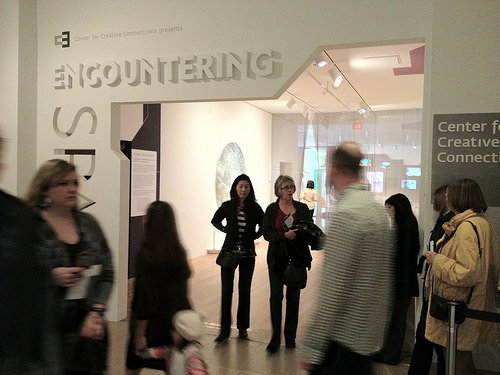
Encountering Space, Center for Creative Connections at the Dallas Museum of Art. Photo by Maria Mortati

Working in museums can be a messy, messy game, but I always love the conversations that crop up when you get a handful of museum educators together to talk ‘shop.’  A couple weeks ago at the National Art Education Association 2013 annual conference in Fort Worth, there was certainly a lot of that happening. I was fortunate enough to be invited to present — or rather have a public in-process conversation — about participatory culture in art museums with an incredible group of colleagues: Preston Bautista (Deputy Director for Public Programs & Audience Engagement, Indianapolis Museum of Art), Judy Koke (Director of Education & Interpretive Programs, Nelson-Atkins Museum of Art), and Susan Diachisin (Director of the Center for Creative Connections, Dallas Museum of Art).  By far, the best part of preparing our presentation was the series of winding, organic conversations that led to Fort Worth.

Not only were we all wildly passionate about visitor engagement and participatory practice, but our own working environments were all changing rapidly — from my own move from St. Louis to the Portland Art Museum this past fall, to leadership changes and various grants & innovation projects.  All in all, we were fairly hyper-motivated to talk about these issues with each other and, ultimately, to explore concepts of participation and exchange in our institutional cultures.

How does an institution’s hierarchy, leadership, and organizational structure actually enable (or disable) participatory practice? How could museum educators at various levels become more involved in fostering an institutional culture focused on visitor experience and engagement?  Could these values find ways of ‘trickling up’ from participatory programs and smaller-scale education projects or exhibitions?

“If … museums must move away from assumed public value and begin to measure their impact, and if … museums must achieve impact for the community instead of impact for the museum, then the impetus is on museum education to rise to the challenge that lies before us and reposition the museum in the eyes of the public.” — Tina Nolan, JME (2010)

As we entered our NAEA session entitled “Toward an Even More Participatory Culture in Art Museums,” we had decided on a set of assumptions that were key to making this a valuable and productive conversation:

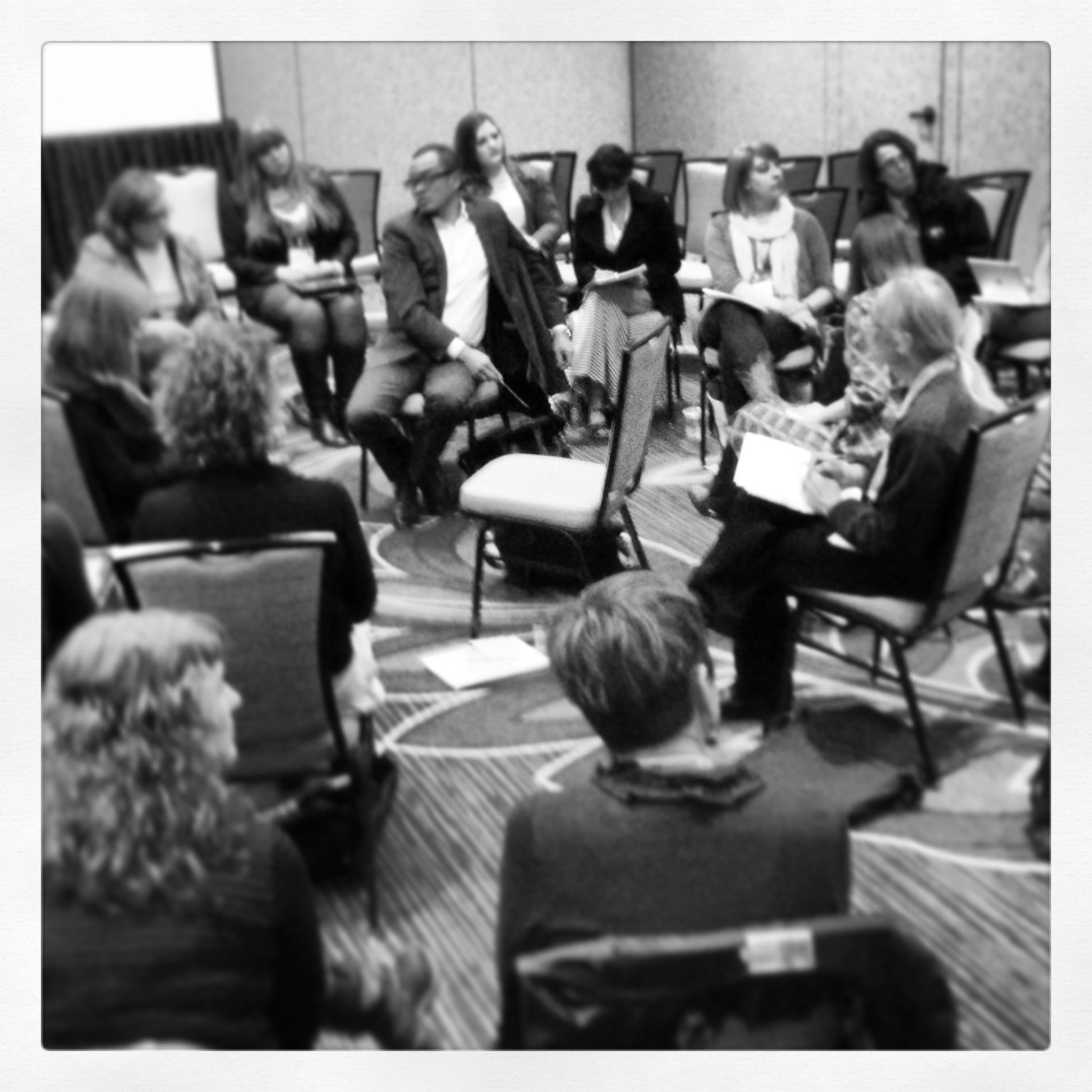
  • conversation at our sessiomn (yes, we exploded the traditional conference furniture layout)
    conversation at our session (yes, we exploded the traditional conference furniture layout)

    There is a shift happening.  Art museums across the continent are taking big steps to change the ‘business as usual’ model, creating structures to put the public’s expectations, needs, and experiences at the center of interpretive planning and exhibition development. We can see this in institutions such as the Detroit Institute of Arts (see great article by their Exec Dir of Learning & Interpretation), Art Gallery of Ontario, Denver Art Museum, Indianapolis Museum of Art, Nelson-Atkins Museum of Art, and the Philadelphia Museum of Art, among many others. In the specific realm of ‘participation’ and public engagement, it is always important to note the Irvine Foundation’s support for institutions such as the Oakland Museum, as well as museum “Innovation Stories” featured via EmcArts & ArtsFwd.  If you still need convincing that change is afoot, watch this video compiled by the Innovatrium at their January 2013 ‘think tank’ of museum leaders.

  • We’re all in this together. Instead of anyone pretending to be an ‘expert’ about these changes in organizational culture, we wanted to be conscious of the fact that we are all co-learning with each other.  It doesn’t matter the size of one’s museum or how involved your senior leadership is in this shifting landscape — we’re all working toward the greater public value and relevance of museums in our communities and beyond. And this needs to be an open, inclusive conversation if it is to be meaningful one.
  • You can’t talk about participatory practice without becoming participatory.  I always feel like every lecture on “visitor engagement” and “participatory practice” is, in part, quite disingenuous if it does not attempt to actually ENGAGE.  Even if an attempt to activate a lecture hall full of 200 spectators fails, I always feel that we should try — walk the walk, right?!  So I was able to convince our group to do a crowdsourcing activity to engage those attending our session, and pull out their ideas in a participatory way.

“For a museum to truly engage its users, it must cease acting as a controlling gatekeeper to its collections and expertise. Rather, the museum must work with its users and communities to unlock the stories its collections hold, responding to the choices its users make. As such, it must give up its traditional authoritarian voice so that users are free to question, debate, collaborate, and speculate — seeking out those issues that most concern them — and are given the support and inspiration required to do so.”  — Graham Black, Transforming Museums in the Twenty-First Century (2012)

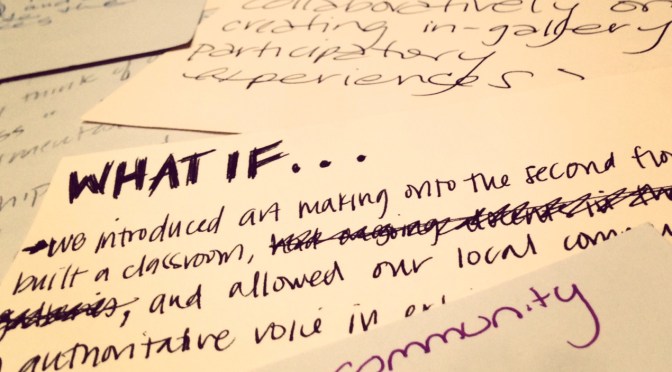
After our initial discussion and framing of these issues, we jumped right into the crowdsourcing exercise to activate everyone’s thinking and to have the group generate ideas. To prevent this conversation from quickly deteriorating into a litany of complaints, barriers, and reasons why we might not be able to enact change at our institutions, we granted everyone in the room freedom from all of these restraints … with a magic wand.  Therefore, without concern about budget cuts, personality conflicts, and perceived curatorial barriers, we invited each participant to take two or three minutes, envision some ways to engender a more participatory culture at their institutions, and then write down a “what if” statement on a small slip of paper.  We collected more than 50 “what if” statements, crowdsourced them with the group, and then spent the final chunk of time opening up a conversation around these ideas.  Here are the 4 statements that, at this moment and with this group, bubbled to the surface:

  1. What if everyone in the museum understood everyone else’s job?

  2. What if there was a real plan for interpretive team development of exhibitions and permanent collections? What if curators and educators didn’t feel like they were ceding territory when they worked together?

  3. What if educators/interpreters and curators worked collaboratively on creating in-gallery participatory experiences?

  4. What if I could include funds for “things I may think of after the budget process” [an “innovation” fund] when I’m writing my department budget?

sampling of the 50+ "what if" statements that participants brainstrormed for crowdsourcing
sampling of the 50+ “what if” statements that participants brainstrormed for crowdsourcing

Rather than recount the conversation or provide my own opinions, thoughts, and perspectives here, I wanted to take this opportunity to open the conversation … to OpenThink the “what if” statements we collected during our NAEA session.  So below is a link to all of the “what if” statements that we were able to collect, in no particular order. Feel free to peruse, and add Comments to the GoogleDoc if you choose.

>>Click here to see ALL of the “What If” statements<<

I invite you to share these with colleagues, send this to others at your museums (yes, curators, too!), and let’s create a conversation in the GoogleDoc or below in the Comment area.  Do you have a “What If” statement that you would like to add?  Are these concerns about exhibition planning, community involvement, and staff development similar at your institution, or different? How can we engender more participatory practice/culture in our work? in our institutions?


NAEA 2013 Breakdown – Museum Edition

Photo by Thomas Hawk
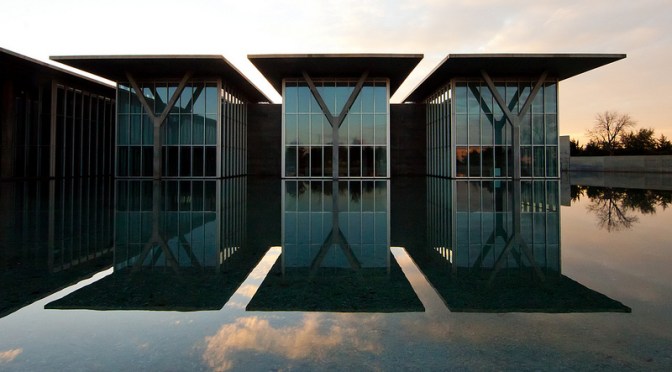
Modern Art Museum of Fort Worth, one of the places hosting NAEA museum preconference activities and a must see while in Fort Worth. Photo by Thomas Hawk

Once again, art and museum educators from across the country (and outside the US) begin to pack their bags and prepare to head to Fort Worth, Texas, next week for the National Art Education Association annual conference (March 6-10). And I thought it would be interesting again this year to offer another quick breakdown of the sessions being offered in conjunction with the Museum Education Division. There are some great sessions being offered this year, in addition to an exciting pre-conference program run by the Museum Division that will for the first time include lots of in-gallery teaching focused on some of the great collections in Fort Worth.

The following stats are pulled only from sessions officially labeled “Museum Education,” so keep that in mind — there are certainly lots of other sessions across divisions that engage with museums, museum learning, and how museums interact with schools and higher education (and I always encourage museum educators to branch out and participate in sessions beyond our “comfort zone”).

But within our own Museum Education Division, here is what it looks like this year at a glance. Click here to compare with last year’s numbers.

Total Museum Education Sessions: 75

Total museum educators presenting: 159 (plus or minus — with 23 people presenting more than 1 session this year)

Most Frequent Session Topics:

  • Visitor/Audience Engagement (various ways of being more responsive to our audiences and visitor needs, etc.) – 11
  • Teacher Professional Development – 9 (duh, it’s NAEA — thousands of teachers attending)
  • K-12 Museum/School Partnerships and School Programs – 8
  • Technologies (iPads, blogs, online communities, etc.) – 7
  • Family Programming – 6
  • Interpretive Resources (gallery didactics, print, web, and mobile) – 6
  • Peer Learning & Communities of Practice (for museum professionals) – 5
  • Art Making & Working with Artist – 5

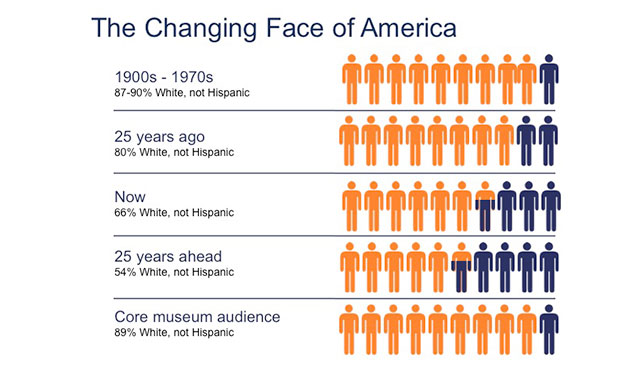
Rather than focusing on what IS popular or in the spotlight this year, I’m so much more interested in what is NOT so popular or prevalent. After reviewing all of these sessions, I found it interesting that the least frequent topics (although still addressed by someone) include Latino outreach and curatorial collaborations. These both seem cause for concern. Our museum recently has some great senior staff discussions around the November article “Diversify or Die: Why the Art World Needs to Keep Up with Our Changing Society” (see the powerful graphic below). Author Ben Davis quotes the 2010 Center for the Future of Museums (CFM) report “Demographic Transformation and the Future of Museums,” worth a read for what it says about the scandalous state of diversity in the visual arts:

“This analysis paints a troubling picture of the ‘probable future’ — a future in which, if trends continue in their current grooves, museum audiences are radically less diverse than the American public, and museums serve an ever-shrinking fragment of society.”

changing-face-of-americaWhile these issues may come up more frequently at AAM, ICOM, or other professional conferences with wider participation than arts educators and art museum educators, the issue is certainly something we, as a field, must be addressing as central to our work. Perhaps these issues will find themselves woven into myriad sessions on visitor and audience engagement in general, but I do fear that when we use the words ‘audience’ or ‘visitor,’ there is a chance that we might unintentionally still be thinking of white, non-Hispanic visitors. I only present this as a potential spark for some conversation, and I’m always open to being corrected and proven wrong (please, prove me wrong here!).

In addition to this blind spot, I also am concerned about the lack of sessions pushing core collaborations with curators — an area that was also severely lacking last year at NAEA. This year, the word ‘curator’ was only mentioned twice in any of the 75 Museum Education Division sessions. At a moment when I know that many major museums are re-imagining (and, in some cases, totally disrupting) the traditional relationships between education and curatorial, this lack of engagement via this year’s NAEA sessions is worth notice. Especially because I know that this issue will find its way into most of the dinner conversations each night in Fort Worth as well as the quick coffee chats we have in the halls between sessions, as it did last year. I am guilty myself, as we have not drawn much attention to this here at ArtMuseumTeaching.com. Given this, I would love to find ways to share the successes and failures of our curatorial collaborations and partnerships, and find ways to push this type of work forward. If you are doing work in this area, let’s get some posts up to shine some much needed light on these collaborations.

Lastly, when I ran a quick analysis of the session titles and short descriptions this year, the most common words used (outside of “art” and “museum”) were, in order of frequency: community, visitors/audience, learning, education, and engagement. While I’m not sure how much this actually tells us, I continually find it interesting to examine the language and vocabulary we use to describe the work we do as museum educators (in fact, there is a session on this very topic on Thursday morning, “Intentional Language: How We Describe Museum Education Can Make All The Difference”). This year, the word ‘community’ rose to become the most common word in the session descriptions, followed by visitors and audience — perhaps showing a bit of a shift in how we are perceiving our work and its relationship with the communities in which we exist. A couple of the least common words to note are ‘curator,’ as mentioned, as well as ‘experimental’ (something we should be doing and sharing more and more).

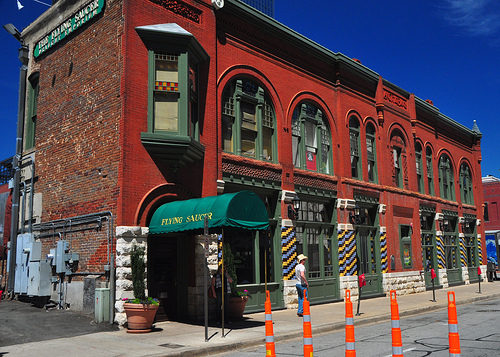
FlyingSaucerFor those of you attending the NAEA Convention in Fort Worth next week, I would like to extend an invitation for you to join the editors and authors of ArtMuseumTeaching.com for a casual Happy Hour event on Thursday, March 7, from 5-6pm at the Flying Saucer (111 E Third St, a short walk from the Convention Center). We’re interested in continually extending and opening up this conversation, and wanted to find a moment at NAEA to pull together anyone who has been involved in the project thus far, as well as anyone interested in learning more.

What: ArtMuseumTeaching.com Happy Hour
When: Thursday, March 7, 5:00-6:00pm
Where: Flying Saucer in Fort Worth, 111 E Third St

I look forward to seeing many of you in Fort Worth, and also getting more of your voices and perspectives involved in the ArtMuseumTeaching.com community!

The What and the Where of Art Museum Education

Educational practices in art museums don’t often make the pages of major newspapers, so I was pleasantly surprised to see this article, “From Show and Look to Show and Teach,” in the New York Times a few months ago (see also Lindsay Smilow’s earlier response to this NYT article). After a cursory glance, I assumed it would detail educational activities as part of an ongoing commitment to fostering free-choice or constructivist learning experiences in some of the most well-known museums on the planet.

As I read, two assumptions of the author began to take shape:

  1. “education” in museums is equated primarily with engaging in processes of art making; furthermore, museum guests expect such offerings under the auspices of “participatory events;” and
  2. the locations of education programs provide significant but conflicting messages.
Whitney Studio, designed by LOT-EK. Photo by Inhabitat

On one hand, the writer cites the director of the Whitney asserting that “education is part and parcel of what we do” after explaining that the physical space for educational activities (presumably at other institutions) is often physically isolated. Shortly thereafter, the author lauded the rather unique Whitney Studio, a “pop-up” center for education at the Whitney that is not only isolated, it is separate from the building altogether. It seems metaphorically significant in this instance that this temporary space is made from enormous shipping containers.

These assumptions prompted me to reflect on my own thoughts about what constitutes education in museums, and where that education should occur. As a graduate student in the mid-1990s I was fully ingratiated in the paradigm of Discipline-Based Art Education, in which aesthetics, art history, art production, and art criticism are considered basic subject areas from which to derive content for art education—while art production for me has always been one way to come to a better understanding of art, the conversations that may be engendered in gallery and other spaces have always been far more intriguing and significant in my own educational practices.

I am certainly not the first person to reckon with the importance of art making as part of an overall educational endeavor. My colleague and friend, Professor B. Stephen Carpenter, made an interesting comment during a panel presentation on reconceptualizing curriculum at the 2012 NAEA convention in New York City. He questioned, ever so briefly, whether or not the act of art making is, in fact, the primary goal/foundation of every model of art education, though his question specifically focused on eco-environmental curriculum. At the time, I thought… if it is primary, then where does that leave the myriad other discourses that surround art education and art museum education? What happens when we as professional educators privilege a particular kind of knowing over all other ways of relating to objects in the museum, particularly when few people excel at those skills, especially as they are presented in very short classes?

The article featured other examples of art-making-as-education in spaces outside the museum, such as Open Field, a grassy space next to the Walker Art Center, and several digital spaces, including online art production classes offered by the Museum of Modern Art. Art museum education has long been relegated to basements and other hidden or cordoned-off areas of the museum, and I pause to wonder what messages are being transmitted when learning is offered outside the physical space of the museum.

Does this practice reify the notion that education is a by-product of the more serious business of being in the galleries? Or is it simply a practical response to a space issue for educators who are increasingly offering educational opportunities that are responsive to their particular learning communities, collections, and spaces?

If one considers art making to be an important exercise with which to engage in order to understand art, a separate space is necessary for obvious reasons, as art can be (and should be) messy. If not, then the what and the where of art museum education is an important and evolving conversation.

I invite you to add your own thoughts and perspectives below, so we can continue to engage in productive exchange about these ideas that are core to our profession.

Opportunities for Advocacy: Strategic Steps for the Future of Museum Education

Co-authored with Scott Winterrowd, Curator of Education, Meadows Museum at Southern Methodist University in Dallas, Texas, and co-guest editor of the summer 2012 issue of the Journal of Museum Education.

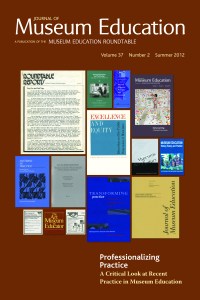
What a difference a few months makes!!! In February of this year we sent off the final drafts of essays for the upcoming issue of the Journal of Museum Education (JME). The 2012 summer issue, “Professionalizing Practice: A Critical Look at Recent Practice in Museum Education,” looks at the development of the field of museum education since the late 1960s, and poses strategic questions for the future of the profession. This issue contains essays and reflections by Elliott Kai-Kee, Marianna Adams, Jim Angus, Ben Garcia, and Ken Yellis. A few months ago we felt confident about the growth of the field and cautiously optimistic about the path for the future we were proposing.

The impetus for this issue of the Journal of Museum Education was a series of conversations about the history of museum education in the United States, and in particular, how this history seemed little known and even less sited in current practice. While we both explored the history of the profession as a means to inform and give a conceptual framework to our present work, a frustration grew with the realization that the dialogues we were having with colleagues at conferences, seminars, and online seemed redundant. These contemporary conversations seemed unaware of the work that had come before, and thus not profited or advanced as result of it.

We began this project in an effort to spark interest in exploring recent professional history to better inform our present practice. We came to understand that there was dual purpose to this project—to examine the recent past to inform the present, and to assess progress and propose a moment of renewed strategic visioning for the profession.

The recent cuts to education at the J. Paul Getty Museum have certainly raised the level of uncertainty as to the position of education in museums. Our concerns have been bolstered by reports of further cuts to education programs around the country, including key leadership positions. But, in these moments there are also strong and clear voices. The powerful letter written by Robert Sabol, National Art Education Association President, was inspiring and made me proud to be an art museum educator and member of NAEA. However, the power of our collective professional voice is needed in this situation. We need to hear from all museum education advocacy organizations and their members.

The actions and events of the past few months are opportunities for us as museum educators to ask ourselves what we stand for, what we believe in, and what we want the future to be. We believe that this issue of the JME could not have been better timed had we been able to plan it. An examination of our history can reveal how our profession has grown as the result of setbacks, challenges and the work of dedicated, articulate practitioners. It also reveals how our field has developed and deepened the thinking and rigor of our work.

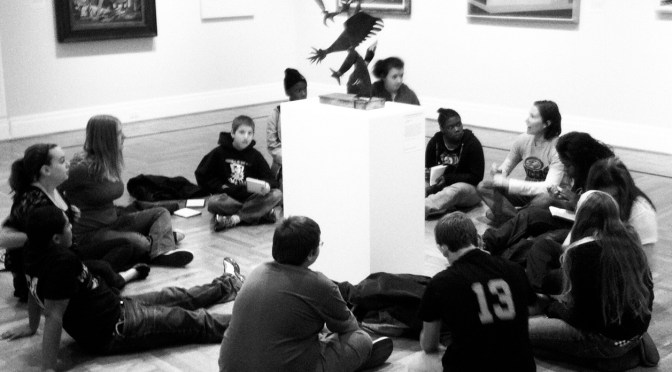
Teacher leading thinking activities in the galleries. Photo by Mike Murawski.

Are we saying the sun is shining; everything is fine, soldier on? Absolutely not! These moments make clear that we must be strong, articulate advocates. While we have spent many years advocating for our collections and our audiences, did we forget to advocate for ourselves? Our strongest advocacy tool is smart and rigorous work. We must examine our practice and demand innovative, and quality thinking and programming. These are opportunities to reach out to our colleagues within our museums and our communities, confident in what are are about and we can do and be.

Ben Garcia’s compelling essay for the JME titled “What We Do Best: Making the Case for the Museum Learning in its Own Right” (available for free download) is premised on the notion that museums are unique environments and we should be focused on doing the work that museums do best. This idea is certainly shared by many others in art museums.

James Cuno, CEO of the J. Paul Getty Trust, has premised his thinking on this very notion (See “The object of art museums” and Whose Muse? Art Museums and the Public Trust). However, unlike Cuno’s policies, Garcia advocates for a progressive understanding of the unique “learning power” of museums and museum collections. At the core of Garcia’s proposal is our role as museum educators to advocate for museum education.

Colleagues, what is your vision for the future of museum education? How can you be an advocate for this future? While the sky may not be falling, we must always remember that as museum educators we must educate about our work, as well as about our collections.

Responding to the Getty Cuts: “A Significant Step Backward”

Photo by Skeevo

At the beginning of the month, the J. Paul Getty Trust sadly announced that it was cutting 34 jobs in its museum division, with the education department being the hardest hit with the loss of 19 employees (almost 40% of their staff).  According to the Los Angeles Times, the expected annual savings of $4.3 million to be redirected to art acquisitions.  Volunteer docents are expected to replace these professional museum educators in leading tours at the Getty.

“Everything the museum does cascades from its collection. The stronger the collection one has, the better one can do everything else.”James Cuno, Getty president and chief executive

This news has certainly sparked many emotional, passionate conversations among museum educators over the past few weeks, as well as some serious soul-searching about our profession.  For me (and I know for many others), the Getty has stood as a bastion for museum teaching — one of the major institutions dedicating its educational mission and vision to forwarding the work of professional gallery teaching.

The work of Elliott Kai-Kee and the entire incredible teaching staff at the Getty has lifted the field of museum teaching to a new level over the past several years. Even beyond Elliott’s recent seminal book co-authored with Rika Burnham, the Getty educators’ recent session at NAEA prompted a great discussion about the role of visitor questions in museum teaching and learning.  Getty educators have always done a wonderful job of evaluating and assessing the work they do, providing reports online, and disseminating valuable data about learning in museums.  For more than a decade now, the Getty Research Institute has also brought in exceptional scholars-in-residence for their Museum Guest Scholar program, including Brigid Globensky, Rika Burnham, George Hein, Kim Kanatani, Sarah Schultz, Dana Baldwin, Kathleen Walsh-Piper, Ray Williams, and Marla Schoemaker.  This keen emphasis on museum education and teaching has been truly inspiring.

Last week, the National Art Education Association responded to the Getty cuts with a letter from its president, Robert Sabol, submitted to the Editorial Board of the Los Angeles Times.  I would recommend that everyone read the letter which has been circulating for the past week.  Upon first reading Sabol’s letter myself, I felt proud to be a museum educator and a member of the National Art Education Association.  I wanted to quickly highlight some excerpts from the letter that I found particularly meaningful for our profession as well as museums in general (and I’ll leave any commentary to readers, who can add their thoughts below):

“The recent decision by President and CEO of the Getty Trust James Cuno to eliminate 19 positions in the Museum Education Department represents a significant step backward as well as a lack of understanding of the public value that museum educators provide.”

“Mr. Cuno’s statement, ‘The stronger the collection one has, the better one can do everything else,’ is out of step with how the museum field and external environment are evolving…. many art museums are shifting from being solely ‘about something to being for somebody….”

“While the collection and preservation of works of art are essential, for museums to remain viable in the future they must also demonstrate their value and relevance to their communities, which is precisely what museum educators are trained to do.”

“Works of art will always be central to the missions and purposes of museums, however, their continued relevance to individuals and contemporary society is dependent upon establishing meaningful connections with the people that view them, something that museum educators are uniquely trained to do.”

I commend Robert Sabol, the entire Board of NAEA, and the Museum Education Division (including the passionate and insightful leadership of Anne Manning) for such a meaningful response to the Getty.  You have affirmed the human-centered nature of the work we do as educators, and framed the immense public value inherent in that work.

I hope that this continues to spark productive conversation and dialogue around this moment, and I invite everyone’s thoughts and reflections below.  I also hope to feature additional posts in the weeks ahead that can take a closer look at the implications this decision has on our field, our profession, and our vision moving forward.

——————

UPDATE: Read Briley Rasmussen’s follow-up post: Public Value and Being Human: Gallery Teaching is Core to Our Mission.

This post is the author’s own and doesn’t represent the Saint Louis Art Museum’s or the Portland Art Museum’s positions, strategies, or opinions.

Rethinking the Way Museums Work with Teachers

Experiences that provide for the professional and personal growth of teachers play an increasingly vital role in museums’ efforts to connect with educational reform. Faced with the complex demands of teaching and learning in the 21st century, museums across the country are rethinking the ways they interact with teachers.  At the recent 2012 National Art Education Association conference in New York, I was fortunate enough to lead a session with William Crow (Metropolitan Museum of Art) and Rachel Bernstein (Los Angeles County Museum of Art) that examined how art museums are collaborating with teachers to develop a “co-expertise” approach that allows for co-creating resources, co-delivering programs, and developing dedicated spaces for a shared exchange of ideas.

As we described through our own work, this “co-expertise” model can afford museums a new way to build meaningful exchanges with teachers and to develop new partnerships with teacher professional learning communities. One central question (of many) that guided our thinking was:

  • In what ways might a “co-expertise” approach catalyze a shift in what learning looks like in a museum, and allow for new ways in which teachers and schools access those types of informal learning?

Since teacher voices are essential to this approach, I spent some time interviewing teachers that I work with through the Saint Louis Art Museum and the CoLab.  The teachers I spoke with had all directly experienced various programs shaped by the co-expertise model, from summer institutes to school partnerships (learn more about the CoLab’s recent work by clicking here, here, and here). I asked each teacher what “co-expertise” means to them, in their own words — how would they describe their shared learning experience with the art museum and with other teachers, and what key things make this approach successful to them and their students?  Here is a short video compilation of these teacher voices, gathering insights from teachers across grade levels, subject areas, and even coming from 3 different states:

To me, these teachers’ perspectives (among many others) have been so inspiring, focusing in on some of the essentials of the co-learning experience.  In my own work with teachers and conversations with colleagues (including William Crow and Rachel Bernstein), a few aspects of the “co-expertise” model have bubbled to the surface for me:

  • Letting go. By this, I mean museums letting go of their ‘authority’ over knowledge and meaning-making, and instead empowering teachers to collaborate with museums as we work together to explore ways to learn from collections.  This model of co-creating learning experiences WITH museums — as opposed to passively receiving content FROM the museum authorities, whether that be text panels, audio guides, curators, or even educators — is so central to rethinking the way teachers interact with museums. It may be one of the most daunting aspects, too, since it requires many museums to broaden their approach to learning.
  • Recognizing teachers as experts. Part of achieving this “letting go” is simply valuing teachers’ voices and recognizing teachers as creators of content, knowledge, and meaning in relation to museums. Professional development workshops can be re-envisioned with more of an emphasis on developing communities of practice where we learn from each other no matter what our “home” educational setting might be (school classroom, university, museum, etc.).
  • Shared growth and experimentation. This sense of creating a community of practice then builds toward a shared, reflective process that leads to professional growth on the side of both teachers and museum educators. Through an open process of thinking ‘outside the box’ and taking risks, we can all move forward in our practice as teachers and learners.

Through this work that I have been engaged with thus far, I feel that the art museum has begun to make a shift in what it has the potential to become: a dynamic cultural landscape where authentic, learner-driven experiences are developed and enacted by teachers and their students. These experiences are empowering teachers to chart their own pathways in unpredictable ways and inviting parallel exploration, risk-taking, and fresh discovery on the part of their students.  And isn’t rethinking the way museums work with teachers ultimately about envisioning a new way to engage students in museum learning?

Reposted through the National Writing Project’s Digital Is website.

Speaking the Same Language

I am the newly-minted President-Elect of the North Carolina Art Education Association (NCAEA). This is an exciting role with a sometimes-daunting set of responsibilities. Most of the 600+ members of NCAEA are K-12 art teachers, so, as a museum educator, I am determined to listen carefully to their needs and wants to best represent them. Even though both museum educators and K-12 art teachers seemingly have the same central mission, we often speak very different professional languages and don’t always understand or appreciate the others’ job.

I had my first taste of the President-Elect “action” during the delegates assembly at the recent National Art Education Association conference in New York. Representatives and delegates from each state (and some from Canada) were part of the assembly activities that lasted a day and a half. One of the most interesting and productive things we did was comment and vote on Position Statements for the organization as a whole. For those who don’t know, the position statements put into writing the platform and position of the NAEA’s executive director and board (representing the membership) on a specific topic or issue. This ostensibly makes advocacy and lobbying a little easier. Plus, it lets the membership know what the association stands for.

Two of the five Position Statements we reviewed concerned art museum education. It was exciting for me to see that museum teaching and learning was really part of the fold, since I can sometimes feel like we’re a little on the edges in NAEA. The Position Statements were ultimately approved (and you can read them in full below), but during the discussion (before voting took place) several delegates had some critical feedback. I assume these delegates were K-12 art teachers, since there were only 2 other museum educators in delegates assembly (out of 100).

As these other perspectives were voiced, I realized that they came from a place of fear and worry. Many teachers are working in states or counties that are getting rid of full-time art teachers, and replacing them with artists-in-residence and the occasional field trip. A few delegates wondered aloud why museum education needed two whole position statements and if we were “tooting our own horn” too much. It may seem like they were resentful or critical of museum education, but I think they were actually concerned that art museum visits could replace classroom art education.

Of course, museum education is here to support and enhance what happens in the classroom, not replace it. I had the opportunity to say just that to the entire delegate assembly, and I’m really glad I did. It made me realize, however, just how much art teachers feel under attack. It must be awful to feel the need to justify your very presence in schools.

So, I’m on a mission, as President-Elect of NCAEA (and President in the future), to help museum educators and K-12 art teachers communicate better, support and defend one another, and spread the art love around.

NAEA Position Statement on Excellence in Art Museum Teaching [Adopted March 2012]

NAEA believes that the opportunity to discover, understand, and appreciate original works of art from cultures past and present is a vital part of a complete education. Furthermore, NAEA asserts that excellent teaching is necessary to foster profound and memorable learning experiences in the museum environment. Excellent museum educators help people see and understand the world in diverse ways and provide them with knowledge and skills to face an ever-changing future.

To achieve excellence in art museum teaching, museum educators:

  • Create a learning environment where students feel safe, comfortable, and respected, enabling them to engage in dialogue with works of art, with each other, and with the museum educator.
  • Actively engage students in processes of creative and critical thinking.
  • Employ a variety of teaching approaches and strategies to connect effectively with diverse learners.
  • Connect the arts to student lives through careful choices of art objects that reflect the complexity and diversity of human cultures and experiences.
  •  Collaborate with and support Pre K-16 educators and other community partners to create meaningful museum experiences that enrich and support learning in and beyond the classroom.

Education and preparation for excellent art museum teaching requires:

  • Deep knowledge of individual works of art and their makers.
  • Knowledge of aesthetics, art history, art practice, art criticism, and other disciplines as they relate to works of art.
  • Knowledge and application of education history, theory, and research relevant to museum learning and the needs and characteristics of learners and museum audiences including Pre K-16, families, and adults.
  • Professional development and ongoing learning to enhance their effectiveness as art museum educators.

NAEA Position Statement on the Benefits of Art Museum Learning in Education [Adopted March 2012]

NAEA believes that art museum learning is a fundamental component to a high quality,effective, and balanced education.

Museum Environment

  • Art museums are valuable cultural resources that offer learners a rich physical and social environment in which to experience and engage with original works of art from different time periods and cultures.

 Knowledge

  • Facilitated learning experiences with works of art cultivate global perspectives and an appreciation of the diversity of cultures, ideas, and human experiences.
  • Firsthand study of original works of art engages students in making connections across disciplines and enriches their understanding of other subjects.
  • Through close examination of artworks, students learn about creative processes, techniques, and materials.

 Skills

  • The study of works of art promotes the development of creative and critical thinking skills that are important to success in life as well as in school. These include inquiry, analysis, and interpretation as well as flexibility, imagination, and reflection.

Personal and Social Learning

  • Art museum learning opens students up to new ways of seeing, experiencing, and connecting to themselves, others, and the broader world.
  • In art museums, students learn from each other and from adults, including docents, museum educators, and artists. They gain confidence and knowledge about using museums and discover the range of careers that museums offer.

Cultural Appreciation and Participation

  • Students who visit art museums often develop an appreciation for cultural organizations and are more likely to use museums as a resource for life-long learning in the arts.