Tag Archives: reflection

Unplugging to Plug In: Encouraging Reflective Practice

Written by Chelsea Emelie Kelly, Park Avenue Armory

This article is a case study about the impact of “unplugging” as it relates to reflective practice for youth and educators. If you’re interested in exploring reflection more broadly, and you’ll be attending the 2016 National Art Education Association Conference in Chicago next week, please join Mike Murawski and myself for our session “Reflective Practice in Museum Education” on Thursday, March 17 at 12 noon (McCormick Place/Lakeside Center/E271a). We’ll unpack reflective practice for museum educators in an interactive, conversational session—we hope to see you there! If you can’t join us, please comment here, tweet us (@chelseaemelie and @murawski27), or follow #NAEAReflect.

guide1
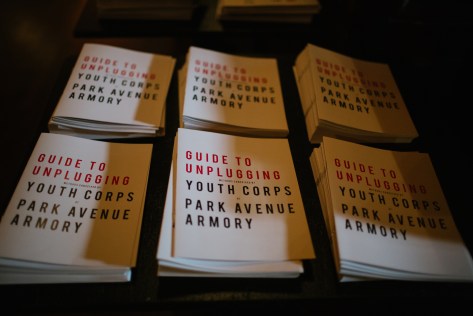
The Youth Corps’ Guide to Unplugging. Photo by Da Ping Luo

When talking about unplugging, we always think of technology. However, I define unplugging as a way of regaining full control of yourself, physically and mentally, in any circumstances.
—Isatu, high school senior, Phase II Youth Corps

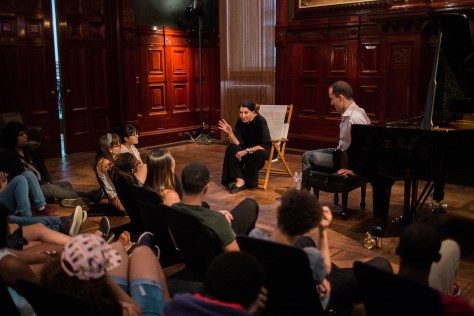
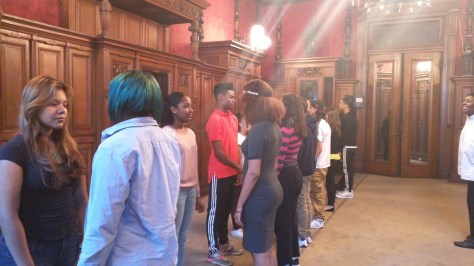
In the summer of 2015, a group of New York City high schoolers and college freshmen, students in the Park Avenue Armory Youth Corps program, gather in the Board of Officers room at the Armory, reclined on lean-back floor seating in front of a grand piano. There is a buzz of anticipation in the air, which turns to quiet excitement when two world-class artists enter the room: performance artist Marina Abramović and pianist Igor Levit.

During the next hour, Abramović and Levit give the students a crash course in unplugging and being present, major themes of their upcoming winter production—a hybrid performance/immersive experience to introduce audiences to a new method of engaging with classical music. Over the next few months, inspired by Abramović and Levit, a number of these students will deeply explore the concept of unplugging: what it is, why do it, and the unexpected realizations it can evoke about our own selves.

Although some might stereotype today’s teenagers as one of the most “plugged-in,” smartphone-obsessed generations of all time, our students offered sophisticated, thoughtful reflections about how we can truly connect with each other and better understand ourselves. As one of the educators facilitating this project, I had the unique opportunity to experience this deep dive into unplugging alongside my students. This post explores both the impact of “unplugging” and reflective practice on teens as well as its impact on me as a teacher, and offers ideas about how we might apply the benefits of unplugging to our practice as art educators and museum leaders.

20150714 Marina Igor Goldberg with YC 008
Marina Abramović and Igor Levit speak to Youth Corps students in summer 2015. Photo by Da Ping Luo

The Project: Goldberg and the Guide to Unplugging

We understand that not many people today know what it is like to be left in silence, stripped from their cellular devices, or even just stare into someone’s eyes… We stepped out of our comfort zone and… left wanting to try it again.
—Terrelle, high school senior, Phase II Youth Corps

Igor Levit and Marina Abramović’s Goldberg (which ran December 7–19, 2015 at Park Avenue Armory) required patrons to lock up their cell phones, watches, and personal belongings in lockers, then sit in silence in the Armory’s Drill Hall for 30 minutes to “unplug” and mentally prepare themselves to be present to listen to Johann Sebastian Bach’s Goldberg Variations, performed by Levit. Abramović’s method for listening to music was experienced by thousands, including New York City public high school students in a student matinee.

The Youth Corps students were charged with developing ways to help their peers prepare for this uncommon experience. First, Youth Corps researched the artists and concepts behind Goldberg, familiarizing themselves with Bach, Levit, Abramović, performance art, and “slow” movements, from slow art to slow TV.  They met with former Armory artist-in-residence Helga Davis, a vocalist and performance artist, who led the students through an activity in which they stared into each other’s eyes, opening themselves to their peers in a new way. They visited current artist-in-residence Imani Uzuri, whose singing and installation inspired by Sister Gertrude Morgan helped Youth Corps center themselves in mind and body.

A printed Guide to Unplugging became one of two facets of the project. As their driving question for the guide, the Youth Corps responded in writing to the question: What is worth unplugging for? They used verbal storytelling and peer editing to brainstorm and solidify their ideas. Their written responses ranged from getting in tune with nature to bike-riding with no destination in mind, from challenging oneself to communicate with family members, to getting lost in artmaking. Others talked of experiencing theater or acting, and some about meditating or being present on their morning commutes. Across the board, students acknowledged the importance in getting out of your comfort zone in order to unplug—and how worth it the challenge of being present is.

You can read the full Guide to Unplugging here.

For the student matinee, and the second part of their final project, the Youth Corps assisted none other than Marina Abramović herself in creating a short pre-show for 450 students. Although the students had already been introduced to the production through a pre-visit from Armory Teaching Artists, this pre-show experience would ensure that students were present and ready for Goldberg itself. Over two meetings, Youth Corps spoke with Abramović about her method and process, and how Levit and the Goldberg Variations dovetailed with her own art practice. When the Youth Corps asked for any tips she had for experiencing Goldberg, Abramović led the group in an immersive breathing exercise—and it was so powerful that it quickly became clear that the pre-show should include the same.  As Lizmarie described:

[Abramović had us start] by lying on the floor with our faces to the ceiling and having our hands to our hearts and stomachs. I felt like I was floating in the middle of the ocean, and found the comparison between the motion of the waves and the beating of my heart. That is when I realized I was in a full state of relaxation. To me, the noises of kids in the hallway outside faded into a nice summer day with seagulls and waves crashing onto the shore.
—Lizmarie, high school junior, Phase I Youth Corps

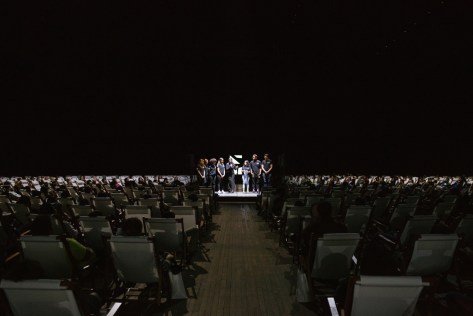
And so the Youth Corps stood beside Abramović in front of 450 of their peers and shared their own personal experiences of Goldberg, then modeled the breathing exercise through which Abramović led the entire student audience. When she finished, the 55,000-square-foot Drill Hall was completely silent, and remained so during both the soundless preface and throughout Levit’s performance. Later, as students filed out, the Youth Corps gave each student a Guide to Unplugging, to explore how they could continue their experience outside of the Armory.

preshow
Youth Corps speak to 450 New York City high school students at the student matinee of Goldberg, alongside Marina Abramović. Photo by Da Ping Luo

The Impact of Reflective Practice

We realized that unplugging is about being aware of your surroundings, reflecting on yourself, and being in control of who you are.
—Lizmarie, high school junior, Phase I Youth Corps

Although my co-teacher and I felt as though we had barely scratched the surface of reflective practice, the students still showed growth and articulated takeaways from their reflective experiences this semester.

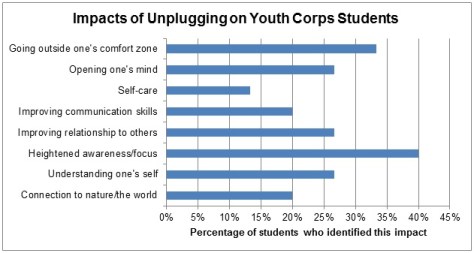
From a quantitative standpoint, data gleaned from retrospective surveys show clear improvement in students’ skills in reflection: 80% of the students said that they reflected on their creative process and that their reflection influenced future choices more often than before they took part in the program. All of the students improved in developing the ability to communicate their ideas and/or find solutions through the creative process. Additionally, 100% also developed interpersonal skills through collaboration and leadership opportunities—closely aligned to the Youth Corps’ realization that reflecting and unplugging is not always a solitary activity, but often relates to our engagement with those around us.

I also analyzed their written statements in the Guide to surface more specific themes about how the students felt the act of unplugging had affected them.

ycreflection
(Note: Percentages will not add up to 100%, since students’ statements often reflected more than one theme.)

In preparation for one of the sessions I am organizing at this year’s National Art Education Association Convention (see note above), I have been thinking a lot about what reflective practice is. The above impacts of “unplugging” identified by our students, are, I believe, all essential to reflective practice, no matter your age and whether or not you are consciously “unplugging” from daily stresses and technology.

Going outside of our comfort zones and opening our minds to new ideas and beliefs allow us to stay nimble, keep learning, and be empathetic. We must be conscious of how we communicate, and ensure we remain connected to the world—both physically aware of what’s around us and metaphorically, empathetic to others’ lives and backgrounds. Staying focused and aware of our surroundings and interactions allow us to be present in the moment. Overall, these practices help us understand ourselves better—both on a personal level and our relationship with others.

Applying Youth Takeaways to Museum Education Practice and Leadership

Be Present

When you stop thinking about everything else and just focus on what you’re doing, you gain a new experience. You are open to things.
—Joselin, high school junior, Phase II Youth Corps

With 40% of the Youth Corps identifying it as an impact of their time spent unplugging, it’s clear that being present is both an essential process in reflective practice and a benefit. In fact, as Terrelle put it, Abramović and Levit’s goal for Goldberg was “to place us outside our comfort zone and challenge us to be present to listen to the music. Marina and Igor wanted us to connect with our mind and body.”

In reflecting about how the semester went overall, my colleague/co-teacher, Pip Gengenbach, and I realized there was so much more we could have pushed the Youth Corps to try in exploring the idea not just of simply “unplugging,” but of truly being present. Of course, hindsight’s 20/20 and there is always room for improvement, but as I reread and analyzed the students’ writing, I found myself wishing we had facilitated even just one more session to encourage the students not to view being present as an end-game in and of itself, but to keep unpacking why the act is so important.

Even so, we scratched the surface: for example, when writing about paying attention rather than listening to music on her commute, Rachel said, “I realized how much more I was allowing myself to experience.” Leidy found presence in communicating more often with her family: “We express how we feel and look for a solution together.” Destiny models excellent self-care when describing her unplugging mechanism: “I put on a facial mask… close my eyes and center my mind on a blank space… I think of a state of peace and tranquility and allow my body to float.”

These experiences are all ways that we can practice being present in our professional lives. Setting aside a phone and committing not to email during a meeting with staff or colleagues, or during a program; taking time to look for solutions together, in person rather than via email; going for a walk during lunchtime—for that matter, actually taking a lunch; and taking time for self-care outside of work (I for one fully endorse Destiny’s masking regimen) are all small things we can do to be mindful with ourselves and when communicating with others.

Be Vulnerable

Often we feel the need to put up a wall. We don’t want people to see certain parts of us, so we hide. But … when we allow ourselves to be vulnerable, we open ourselves and our minds. This is how we begin to surrender to unplugging instead of fighting it.
—Sinaia, high school junior, Phase II Youth Corps

One of the most powerful ways that the Youth Corps—and we as educators—experienced vulnerability was through a two-hour workshop with vocalist and performance artist Helga Davis, mentioned above. Davis challenged us all to stare into each other’s eyes, in silence, for many minutes at a time. Cory describes what happened next:

We were then given the choice to come closer, go further away, or turn away from our partners. I personally chose to get closer to my partner because I wanted them to experience an awkward moment and adjust to it. I found myself visualizing my partner’s life line, and found it easy to see their comfort zone through their body language. My partner was fidgeting with their hands at first, but later on they adjusted. I also allowed them to look into my eyes without restrictions. I challenged myself to open up and dared myself not to worry about what they thought.
—Cory, high school junior, Phase I Youth Corps

IMG_20151104_161630
Youth Corps work with performance artist and vocalist Helga Davis (right) to explore unplugging. Photo by Pip Gengenbach

Some members of Youth Corps, like Cory, have performance experience, and are used to participating in exercises similar to this one. They understood the intimate kinds of nonverbal communications that can occur. For others, myself included, the experience felt foreign and intimidating. Isatu wrote:

The purpose was to [try] to interpret who we are… I [was] afraid to reveal my true self to someone that I barely know. I felt like my partner was not looking at me, but looking into me: she seemed… more aware of herself than I was. The jealousy that I felt helped me to unlock myself, I let all the painful moments that I have experienced out through my tears, because whatever she saw in me made me free. Unplugging in this way helped me to feel the support of the people around me.
—Isatu, high school senior, Phase II Youth Corps

Isatu beautifully describes how allowing yourself to be vulnerable with another person can, in fact, help you both understand yourself better and connect on a deeper level with those around you. Understanding our strengths and weaknesses allows us to better understand our places in the world. Cory summarized her experience similarly: “We must be able to understand ourselves as a person first, in order to comprehend and change the things around us.”

This almost paradoxical statement directly relates to being an educator and leader. It goes back to the old airline oxygen mask adage (help yourself before helping others): know yourself in order to more deeply connect with others. After all, our jobs are not isolated: we have students, colleagues, and/or a field-wide network whom we not only support and encourage, but of whom we can ask support and encouragement. When we allow ourselves to be vulnerable in this way, we are able to foster empathetic collaboration that can strengthen our ideas and work.

I wholeheartedly endorse participating in something like this professionally, but perhaps more easily implementable and significantly less intimidating would be to try something like the Youth Corps’ mentor triads. During every Youth Corps program session, each education staff member works with a small group of two Youth Corps, where all members (staff included!) set a goal and hold each other accountable to it. Knowing that we were all equally committed and that we had a small group of people, most of whom we didn’t know well before our triads, who would be checking in on us are powerful incentives to keep on track. We meet for coffee or treats off-site, which made the whole experience seem special and important, but not a huge drain on busy schedules. And having a mixed group—one first-time student, one student who had been in the program already, and one adult educator—was an amazing way to stay fresh but also grounded. This would be easily replicable and powerful with groups of staff from different levels, areas, and even departments.

Challenge Yourself

Personally, I don’t like talking in front of crowds so I was really nervous. But Marina got us prepared by doing breathing exercises closely related to the Abramović Method, which helped me be less nervous…  She made us feel like everything was fine and there wasn’t anything to worry about.
—Lizmarie, high school junior, Phase I Youth Corps

How many of us have created activities or goals that we know will challenge our students or visitors, yet perhaps don’t always “walk the talk” ourselves by participating alongside them, or trying something new in our own practice? You’re not alone! As I delved into ongoing reflection with the Youth Corps this semester, I was reminded that it is so important as an educator (and leader) to model taking up challenges, just as we expect our students to do, and to always be learning, never complacent.

Personally, I have been taking this to heart since starting at the Armory this past summer. After many years at art museums, I have been thoroughly enjoying the completely unconventional art we present here, as well as trying my hand at theater education techniques, the field from which several of my coworkers in the Education department come. Since last July, we’ve done role-playing, directed questioning, movement-based activities, “tinkering” with different materials—you name it, we’ve tried it. (And not to worry, we’re all learning from each other: I’ve been vehemently representing the “slow art” guard along the way.)

Although these techniques are certainly not unfamiliar to art museum educators, the fearless, try-anything, “show must go on!” attitude of unabashed risk-taking feels new to me, and is enormously inspiring.  My own challenge for 2016 is to continue to reach—testing and stretching my own abilities as a teacher, and pushing our students in the process to do the same with their own goals and experiences in our programs. (And just in case you’re wondering, yes, my co-teacher Pip is part of my “mentor duo” to hold me accountable for this goal.)

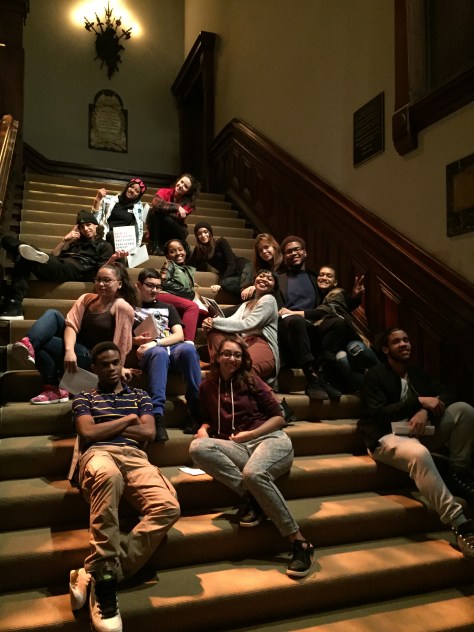
The Fall 2015 Youth Corps cohort. Photo by Chelsea Emelie Kelly

Conclusion: Reflection and Self-Identity

I am grateful to Marina. I think what’s cool about her is that she does things that others are afraid to do. She’s taught me to always stand out.
—Terrelle, high school senior, Phase II Youth Corps

Awareness of self—of our strengths and our weaknesses, of our relation to others and to the world around us—is a key trait of leadership, no matter where in an organization’s hierarchy your job may place you. Understanding our own identity, through reflective practice, allows us to better understand our own work, how we teach, and the place of our institution and programs in our students’ or visitors’ lives.

Youth are in a key phase of their life where they themselves are testing out and defining who they are as people—their interests, beliefs, connections, and communities. But as we all know, it’s not only youth who use museums and cultural institutions as spaces for meaning-making and self-understanding or reflection; visitors of all ages and backgrounds do the same. And it’s important to remember that we ourselves as educators participate in this process as well, every time we reflect on our teaching practice, on our role as leaders in our institutions, or as participants in the world. Being conscious of the reflective process—being present in it, if you will—allows us to be intentional about our teaching practice, improve our connections with our audiences, and ultimately create experiences for all that bring our institutions more deeply into our visitors’ lives.

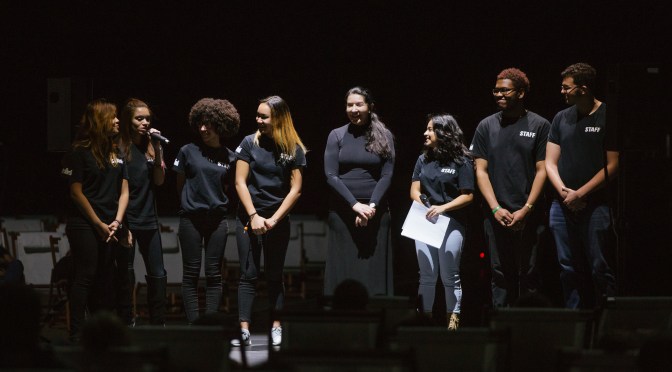
Header Photo: Lizmarie, high school junior and Phase I Youth Corps, speaks to NYC public school students alongside Marina Abramović and fellow Youth Corps. Photo by Da Ping Luo

The Interpretive Value of a Chair: A Personal Reflection

Written by Susan Spero

“For the understanding of a picture, a chair is needed.  Why a chair? To prevent the legs, as they tire, from interfering with the mind.”  –Paul Klee

I’m pushing myself, and I’m tired. There are too many museums in Washington, D.C., on my list, and I am running out of time before I have to fly to the other side of the country.  My foot hurts, too, because I twisted it walking on the capital’s irregular sidewalks; it is bruised badly, but I press onward as I am determined to squeeze in yet another museum. I’m driven. Foolishly, I thought my heavy travel-ready backpack would be ok for this last venture that somehow I could manage it well enough on my shoulders balanced against my back. But now in the Smithsonian American Art Museum, this backpack has become a problem as the guards—properly, I’ll add—keep telling me to wear it on my front. In this position the straps are too tight, so I attempt to hold it near the ground on my side. That position doesn’t work either because it is too heavy for my arm alone. I then compromise by holding the pack at the front of my body with my arms wrapped awkwardly around it.

Whenever I find myself in a museum with short time, I mentally and emotionally agree that I’m going to metaphorically strap on some roller skates and cruise through it all. I like getting a sense of the whole of any museum, even if it is much larger than a skate-cruise allows. This time, with the mix of guard admonishments and sore foot, my push to see everything isn’t working.  Completely frustrated, I spot a bench in a dark room placed before a quite garish painting. I head for the bench, not the painting.

The bench is instantly satisfying, cushioned—quite comfortable. Backpack down next to me, I sigh to gather myself, then look up. The painting looks quite different than it did when I initially walked into the room. It takes me a bit to figure out just what is happening before me; very slowly, the lights illuminating the painting seem to shift into what begins to feel like the slow revolving of a Christmas tree light wheel display. As the colors change, the relationships of the shapes and patterns within the artwork alter, making some versions visually delightful. I’m taken away from my foot misery, fascinated. It’s a celebration of the full color spectrum—a Roy G. Biv tribute. Time is passing and I don’t care; I’m now mesmerized by the work, and comfortable enough to take some time looking.  It’s hooked me; I’ve stopped skating. I’m looking deeply, asking questions. Wondering.

I’m lucky this visit–there are few visiting this part of the gallery, so there is no crowd to subtly press me to move on. I welcome the one person who steps into the gallery space, and when he sits next to me—the bench is a long one and could accommodate many—we talk a bit about what we notice in the abstract world of the painting that changes before us. After viewing a second round of the color cycle, I finally get up to find the label. The work’s painter initially surprises and slightly wounds my pride that I didn’t actually know him immediately, it’s David Hockney’s Snail’s Space with Vari-Lites, “Painting as Performance”.  From the label I’m curious to what a Vari-Lite is? With the color spell broken I make myself move on, away from the comfortable bench.

Later, when I look for more details online, I find a static picture on the SAAM collections site that shows none of the subtle color changes. With a further Internet search, I find a few not-very-equivalent to the real thing YouTube phone-captured videos. These videos just vaguely give a sense of the piece. This is a you-must-see-it-to-get-it artwork. The SAAM thoughtfully gives us a bench so we can sit and see for some time.

I have no idea if anyone else has been struck in the same way I am with this particular painting. Thinking about my experience, I am reminded of one of my first museum visits as a child at the Columbus Museum of Art where there was a machine that demonstrated color light mixing using transparent gels showing how three light primaries (red, blue, green) combine to create magenta, yellow, and cyan. My mother had to drag this whining eight-year-old away from it as I could have played for hours. Years later, I desperately wanted to make something like it for my science project. So I’m moved by color, perhaps in the same way some are moved by music. Color feeds me in a way few other things do.

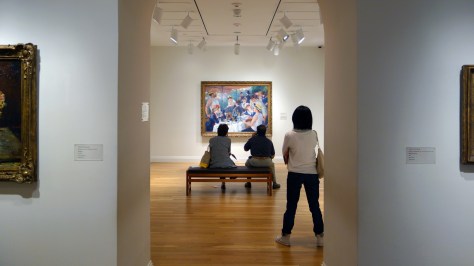
One of my other color memories is thanks to a Windsor chair, notably with a back, so I could really relax while viewing a painting. This chair was placed before one of the most well known paintings in D.C., Renoir’s Luncheon of the Boating Party. My circumstances were similar to those with the Hockney: I was at my first National Docent Conference, overfilled with conversation about art, and in a different twist for me, was being dragged by others for one last look at art before we headed to our flight. Upon hitting the galleries, my goal was to sit and gather myself, so I wandered through in search of a chair aiming to take the first one I could find. At the time, some almost 30 years ago, an available chair seemed a novel thing. And equally unexpected, the guards at The Phillips Collection were students from nearby universities dressed in everyday clothing.  I remember asking an approachable gallery attendant if I could sit in the chair, assuming I could not, and being told that it was there for people to take in the paintings. The atmosphere was welcoming, and the chair made it more so.

Renior-Zucker
Gallery view with Renoir, Phillips Collection. Flickr Photo by Steven Zucker, CC BY-NC-SA 2.0.

The room was full of Impressionist paintings; I was full of a disdainful attitude about them, internally wearing my smugness of ‘I’d been there, I’d done impressionism.’ One of the lessons I learned that day sitting in that welcoming chair has stayed with me since: you don’t know what you don’t know unless you see something for yourself. Being in that chair, the painting invited me in to look, and the more I looked the more I wondered, the more intrigued I became, and suddenly my respect for this work increased. Not having the Internet to turn to in those days, I soon found myself in the bookstore buying information on this masterpiece. Today this 20-minute experience remains vivid in my mind’s eye.

When I recently talked about this with my colleague Peter Samis, Associate Curator of Interpretation at SFMOMA, he suggested that both of these works are clear instances of what he calls Visual Velcro. The Hockney and the Renoir readily hook the viewer into the work in part because of the color dramas they present.  The Visual Velcro with them hooked me so well that I might have stayed for a while to look anyway. Having a place to sit in both instances helped me physically endure a much longer visual journey.  Access to seating can also support our viewing works that are not as easy on the eyes, those that are more unsettling or socially challenging. For instance, the color used in the recent show Rewind at The Baltimore Museum of Art is quite purposeful, the artist has made KKK robes in colorful Kente cloth and other patterned fabrics. While the Rewind show has the visual allure of color, the content is more socially charged; I want to sit in a chair especially in that exhibition. The longer I can be with any artwork, the more I will notice, the more I will feel.

Comfortable chairs in the right places within our galleries are critical. Not only do they offer a place for the weary to rest, but also are an invitation to stop, stare, and wonder. In many ways, in this online venue, I’m preaching to the converted: we know this. But you might want to remind yourself of the interpretive value of a chair.

When was the last time you sat in one in front of a work and let yourself just see?

looking-at-painting2
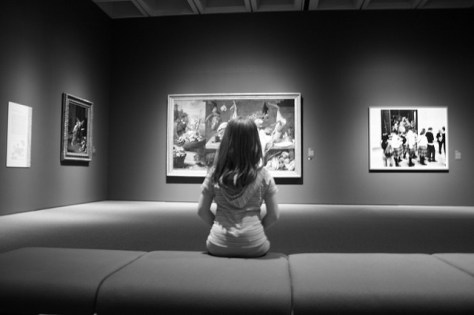
Flickr Photo by Chris Short, galleries at North Carolina Museum of Art. CC BY-SA 2.0.

*     *     *     *     *

ABOUT AUTHOR

SUSAN SPERO, Ph.D. teaches Museum Studies at the John F. Kennedy University in Berkeley CA.  Her classes focus on all aspects of the visitor experience, including discussions on creature comforts.  She also serves on the Museum Education Roundtable Board.

Header image: Flickr photo by John D., “Forest Stream,” CC BY-NC-ND 2.0

2015 Year in Review

As the fourth year of ArtMuseumTeaching wraps up, I thought it would be good to post a brief “Year in Review.”  Not that we need any more end-of-the-year lists or calls for resolutions, but I think it can be meaningful to take a minute and look back at some of the issues that have been on our minds this past year.  I want to thank all of the amazing contributors who have taken the extra time to share their practice with this community!

Since its inaugural year back in 2012, ArtMuseumTeaching has grown from a tiny blog seedling to a robust and active online community now involving more than 60 contributors, publishing 172 posts, and being read by hundreds of thousands of people in as many as 170 countries around the globe.  I hope that this online community and forum will continue to grow, include more perspectives, and be a space of exchange where we can connect on issues of teaching, learning, and community engagement that matter most for museums and the people that make up those museums.

Year in Review: 5 Most Popular Posts of 2015

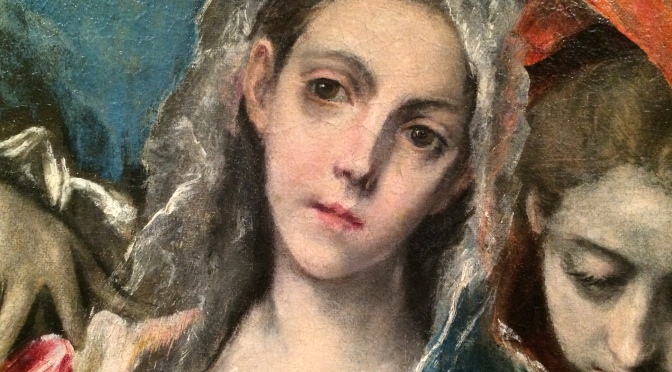
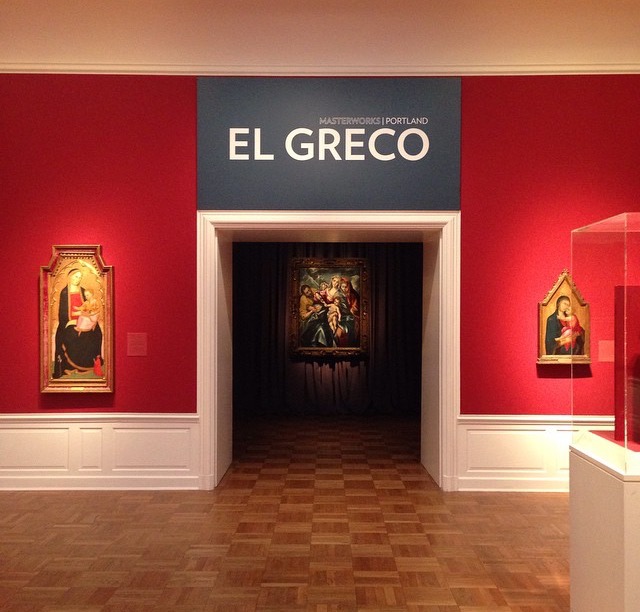
elgreco15. “320 Hours: Slow Looking & Visitor Engagement with El Greco” (July 2015): We all talk about the value of slow looking and extended engagement with art – and this great post by Kelsey Ferreira provides such a unique insight into her experiences spending 320 hours with a single El Greco painting at the Portland Art Museum. What questions did visitors ask? What types of experiences sparked further engagement and learning?  What surprisingly deep experiences did visitors bring to this stunning painting?  A fantastic read for museum educators and art lovers alike!

fb-art4. “Status Update: Facebook as a Reflection Tool” (January 2015): David Bowles of the Metropolitan Museum of Art shared his insights from posting some of the most indelible teachable moments from his gallery experiences on Facebook, and using social media tools such as Facebook to add a reflective element to our practice. This is a great read, especially with David’s five take-aways for museum educators about student learning in the galleries.

Photo23. “We Flipped Our Museum – Here’s What We Learned” (June 2015): Emily Kotecki shared the work at the North Carolina Museum of Art to deepen and activate the museum learning experience through a Flipped Museum pilot program called “Artists in Process.” They developed an online learning platform to support social interaction and choice-based learning, and then worked with sixteen classes from different cities across North Carolina to research, explore, and reflect on the artistic process. Check out their ‘lessons learned,’ and read more in the Summer 2015 issue of the Journal of Museum Education.

ask_home_new-576x10242. “The Big ASK: Experiencing the Brooklyn Museum’s ASK App” (July 2015): Written after my own visit to the Brooklyn Museum this past summer, I briefly explored the what, how, and why of this effort to rethink the museum visitor experience. While I am still attracted to the app’s desire to make personal connections with visitors, I’m a bit concerned with how few visitors use the app considering the staff and resources dedicated to this project.  But I absolutely love that the team at the Brooklyn Museum is super transparent about their thinking and planning via their blog (so awesome!).

jackie-teaching1. “Questioning the Use of Questions” (January 2015): In the most widely-read post of 2015, museum educator Jackie Delamatre responded to Rika Burnham and Elliot Kai-Kee’s challenge to the use of questions in museum teaching. While there is great value in questioning the use of questions, Jackie’s insightful post defends the use of open-ended questions and brings in some of her own personal experiences.  And her search for the ‘Boeuf Bourguignon of questions’ is not to be missed!

Enjoy these popular posts from 2015, and see you in 2016 — a year that promises to bring a whole new set of challenges, success stories, and new ways of thinking about both the theory and practice of museum teaching.  If you would like to share the projects you’re working on or the issues and challenges you are grappling with, please add your voice to this growing community (and just send me a tweet at @murawski27 or email me at murawski27@gmail.com).

Cheers!

Building Community: Reflections on the Ohio Museum Teaching Mashup

Written by Patty Edmonson, Intergenerational Interpretation Specialist, Cleveland Museum of Art; and Hajnal Eppley, Assistant Director, School & Teacher Engagement, Cleveland Museum of Art

Inspired by the Museum Ed Mashup in New Orleans, Cleveland hosted the first Ohio Museum Teaching Mashup at MOCA Cleveland on August 10.  Hosts from a cross-museum team (Nicole Ledinek from MOCA, Gina Thomas McGee from Akron Art Museum, and Bethany Corriveau Gotschall, Patty Edmonson, and Hajnal Eppley from the Cleveland Museum of Art) planned a day-long event with multiple rounds of gallery experimentation and discussion.

As hosts, we were excited about working together and were energized by the planning process, but we weren’t sure how successful this event would be in terms of attendance. Previous mash-ups and throw-downs in New Orleans, Denver, and New York took place when educators were already close geographically, or gathered for an event. Would people from other cities really want to travel all the way to Cleveland for this mashup?

The answer was a resounding, “Yes!” Forty museum and university educators, classroom teachers, and volunteers from cities such as Cleveland, Columbus, Toledo, Cincinnati, Dayton, and Detroit joined together to experiment, share ideas, and play in MOCA Cleveland’s galleries.

Hosts and participants commented that one of the most important components of the event was the opportunity to meet new colleagues and collaborate. While some larger cities host frequent regional museum education or art education professional development, many of us in Midwestern museums have not had these opportunities. Several participants commented that they were unable to attend conferences and, particularly for those in smaller institutions, they sometimes felt a sense of isolation. For many of us, this event was the first opportunity to meet colleagues in the region and lay the groundwork for future collaborations.

Experiments in the Galleries

We divided the day into two experimenting sessions, modeled after the New Orleans experience. After a quick introduction in the morning, randomly-drawn groups of three received an artwork and planned their experience in 45 minutes. “I found that I was easily able to let go of the desire to understand where they [fellow experimenters] came from and what strengths they brought to the table, instead focusing on working together with whoever happened to be in my group to develop an experience. I’ve been thinking about how that kind of experience is particularly useful in understanding how to approach collaborative work, compromise, and flexibility at my home institution,” reflected one of our experimenters.  

Each team executed their plan in six minutes, and then we gathered for a quick recap. After the event, we asked teams what it was like to serve as an experimenter. One summed up the role as “part mad scientist, part educator, part visitor, part experiential development nerd.” Another said:

“Experimenters are willing to take risks…regardless of whether their activities are perceived to be successful or not they are willing to go with the flow and let their assigned artworks guide the experience, embracing spontaneity instead of shying away from it.”

Because this was the first regional gallery teaching experiment and we knew we were asking some participants to step out of their comfort zones, we wanted to provide an opportunity for reluctant participants to observe first, and join the experimentation later in the day if they felt inspired. After lunch we repeated the format of the morning with a shorter planning period. Groups devised experiences for us to embody art, create stories, explore process, and look in refreshing ways.

Instagram photo by @heep -
Instagram photo by @heep – https://instagram.com/p/6NlzbTSOBs/

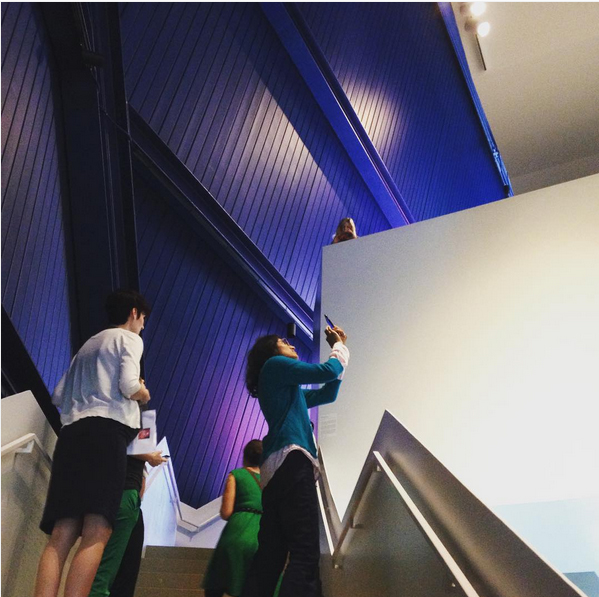
One gallery experience designed by Maria Iafelice (Toledo), Kate Blake (Toledo), and Joan Kohn (Cleveland) involved the architecture of the MOCA building, designed by Farshid Moussavi. Experimenters asked participants to share words they would use to describe a stairwell and then use their phones take pictures of various perspectives of the stairwell as they climbed.  At the top, participants were asked to pull up one of the photos they took and physically place their phones together where their photos connected. The result was a participant-generated photo collage inspired by the space surrounding us.

heep
Instagram photo by @heep – https://instagram.com/p/6NWewRSOBI/

Take Aways

As hosts, we had a number of takeaways. We were truly impressed with the flexibility and creativity of our group. Although I participated as an experimenter in New Orleans, it was equally gratifying to sit back, feel the energy of the moment and watch the magic happen as colleagues worked together! It was especially impressive to see ideas developed between teams of people from different backgrounds—museum educators, classroom teachers, volunteers, and students. Gina reflected:

“I felt really proud to be a part of a special community.”

The format for this event was not brand new. The experiences and discussions we completed together may not all have been radical, trail-blazing gallery experimentation, but this was not the goal. For Midwestern museum and art educators, this event felt like a true beginning to the building of our professional community.

For more pictures, videos, and posts from the event, visit: https://storify.com/heepp/ohio-museum-ed-mashup

Asking Beautiful, Scary Questions: Reflections on “Leading the Future of Museum Education”

Written by Karleen Gardner, Director of Learning and Innovation, Minneapolis Institute of Arts

Reposted from the Museum Education Roundtable’s JME40 blog. Be sure to check out their posts exploring the evolution of the Journal of Museum Education during its 40 volume run as a reflections of the field at large.

I recently enjoyed traveling to the great city of Denver, Colorado and participating in the Leading the Future of Museum Education: Challenges and Opportunities, a convening of an amazing group of museum leaders from across the country. This event (May 2015), co-hosted by Bank Street College’s Leadership in Museum Education and the Education Professional Network (EdCom) of the American Alliance of Museums, offered a much-needed opportunity for educators in our field to come together and discuss issues, the future, and ask beautiful, scary questions.

In her opening remarks, Sarah Jesse, chair of EdCom and Vice President of Education at the Los Angeles County Museum of Art, introduced the idea of beautiful questions inspired by the book A More Beautiful Question by Warren Berger. A beautiful question is:

“an ambitious yet actionable question that can begin to shift the way we perceive or think about something—and that might serve as a catalyst to bring about change.”

Such questions seem to be ingrained in our DNA, for in 1987 a group of 25 art museum educators came together in Denver to explore similar issues and reforms, and to develop a collective vision for the future of the field. The Journal of Museum Education (JME) Volume 13, Number 3, Fall 1988, was dedicated to sharing the insights and key issues from the Denver Meeting. Guest edited and authored by the organizers and participants of that meeting, the JME issue reflected the individual thinking generated through their discussions and widened the conversation to engage more educators from across the field. I am proud to say that two representatives from my museum were in attendance in 1987.

Twenty-eight years later in Denver, our brainstorming and discussions focused on many of the same topics: the empowerment of museum educators as leaders; making our work visible; professional development and career tracks; visitor-centeredness; the lack of diversity and inclusion in our field; and leading change.

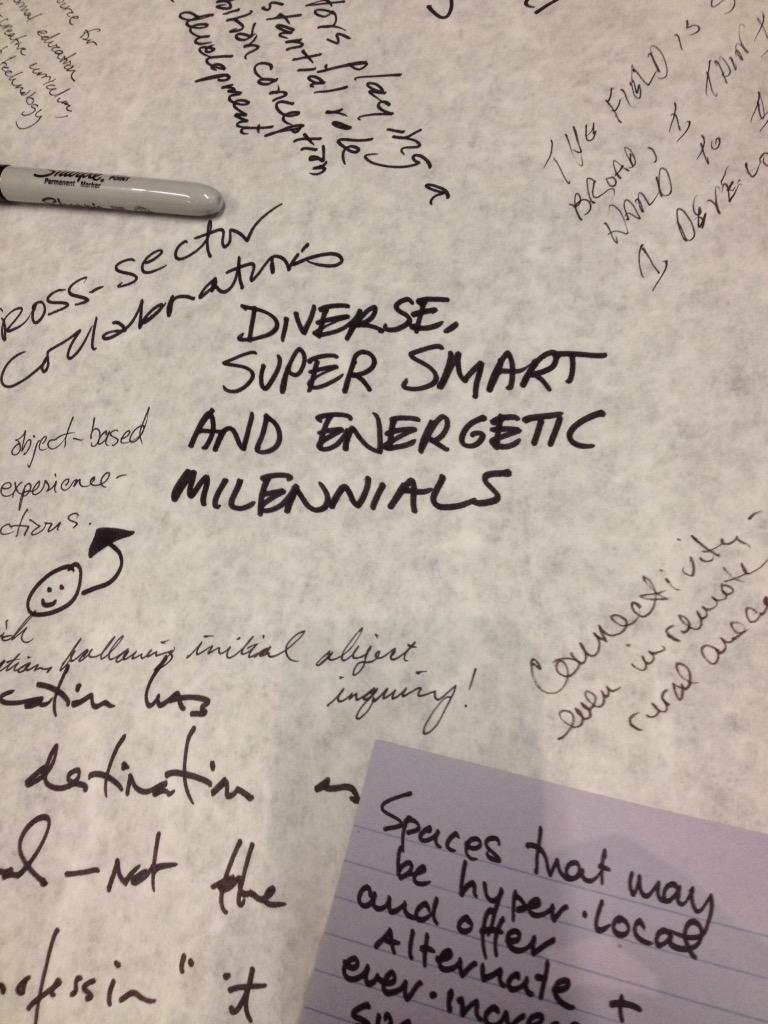
Photo by Rachel Goldberg ‏@EducatorRachel
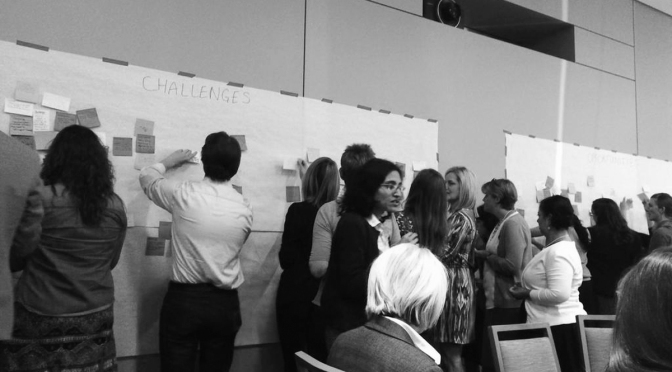
Group brainstorming during convening. Photo via Twitter by Rachel Goldberg ‏@EducatorRachel

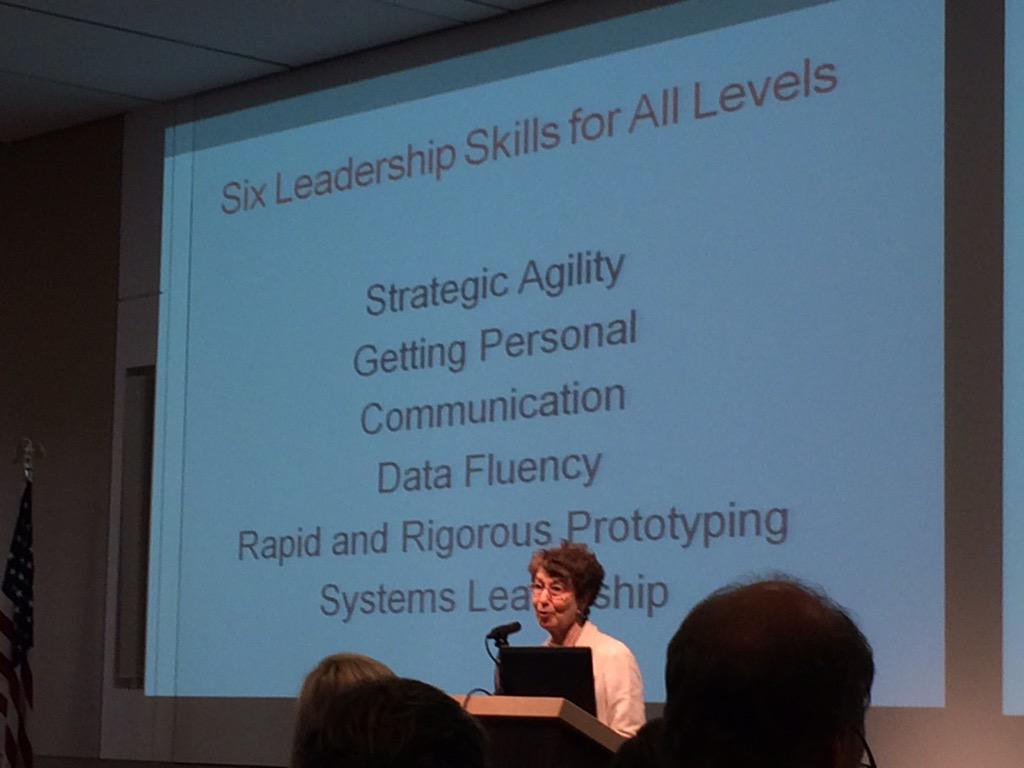
Much of the program and conversation in Denver focused on change on many different levels—the ever-changing and vast-paced world in which we live, the shifts and much-needed changes in our field and institutions, the rethinking of museum education, and the changes in us as individuals. Both Kaywin Feldman, the Duncan and Nivan MacMillan Director and President of the Minneapolis Institute of Arts, and Marsha L. Semmel, principal of Marsha Semmel Consulting, spoke of our VUCA environment and the need for adaptive and strategic leadership. VUCA is short for volatility, uncertainty, complexity,and ambiguity, and a catchall for our turbulent, dynamic reality. In order to thrive, we must have vision, understanding, clarity, and agility and be willing to experiment and take risks. Laura Roberts from Roberts Consulting points out there is no one way or single path to get us where we want to go and the “best practices” from the past won’t be sufficient.

We must challenge ourselves to find these new paths and ask beautiful, scary questions, which will inspire us to take risks and head into uncertain territory, and possibly fail. Some of the beautiful questions that emerged from our brainstorming and conversations in Denver:

  • How might we encourage greater diversity and inclusion in our field?
  • How might museums become truly visitor-centered institutions?
  • How might we find balance in engaging both our core and new audiences; balance between co-creation and expertise?
  • What if we broke down silos and collaboration was the new norm?
  • How might we rethink our work with the public education sector?
  • How might we harness the power of technology to expand access, improve engagement, and try new approaches to our work?
  • What if excellence isn’t enough?
  • What if educators became more empowered and began breaking the rules?

To begin exploring the strategies and solutions to these beautiful questions, we must become adaptive leaders and both individually and collectively embrace the gradual but meaningful process of change. Marsha Semmel introduced us to John Seely Brown who believes in social, participatory learning and teaches us that museums need to stop protecting our assets—our stocks—of authoritative knowledge and instead nurture our flows—creating new knowledge. We are poised to cultivate these flows.

Photo via Twitter from Wendy Ng ‏@twin_muses
Marsha Semmel presenting. Photo via Twitter from Wendy Ng ‏@twin_muses

Laura Roberts, who was asked to reflect on and summarize the convening stated in her closing remarks, “museum educators routinely use the sort of skills an adaptive leader needs. Moreover, if we are going to shift our museums from a focus on objects to a focus on visitors and community, it is clear we are positioned to lead the way…” She noted these observations about our character:

  • Educators are trained to elicit observations and points of view and to bring people together in dialogue. We are good facilitators. We have those “soft skills” to be boundary spanners.
  • We are clever, creative, and imaginative. We are good problem solvers. We are good listeners.
  • We practice the skills of collaboration and partnering. We are matchmakers and brokers.
  • We often serve as the integrators in the institution, bringing disparate staff together.
  • We are often “empowerers.” Many educators are refreshingly light on ego.

We have these skills, and we also need to become more empowered and better advocates for our values, our expertise, and our audiences. Insights on the 1988 Denver Meeting from Diane Brigham in JME echo this concept, stating that our role is essential in serving the missions of our museums and that:

“when we realize that we offer abilities that no one else in the museum can contribute, we are better able to offer leadership. We empower ourselves when we are clear about what we are and have prepared ourselves to practice our profession with rigor.”

It is essential for us to be more rigorous and confident in articulating our goals and vision, and ask beautiful, scary questions that will serve as catalysts for innovation and change in our field and our communities.

What are your beautiful, scary questions?

*     *     *     *     *

You can check out #leadmuseumed tweets from the convening here: https://twitter.com/search?q=%23leadmuseumed&src=typd

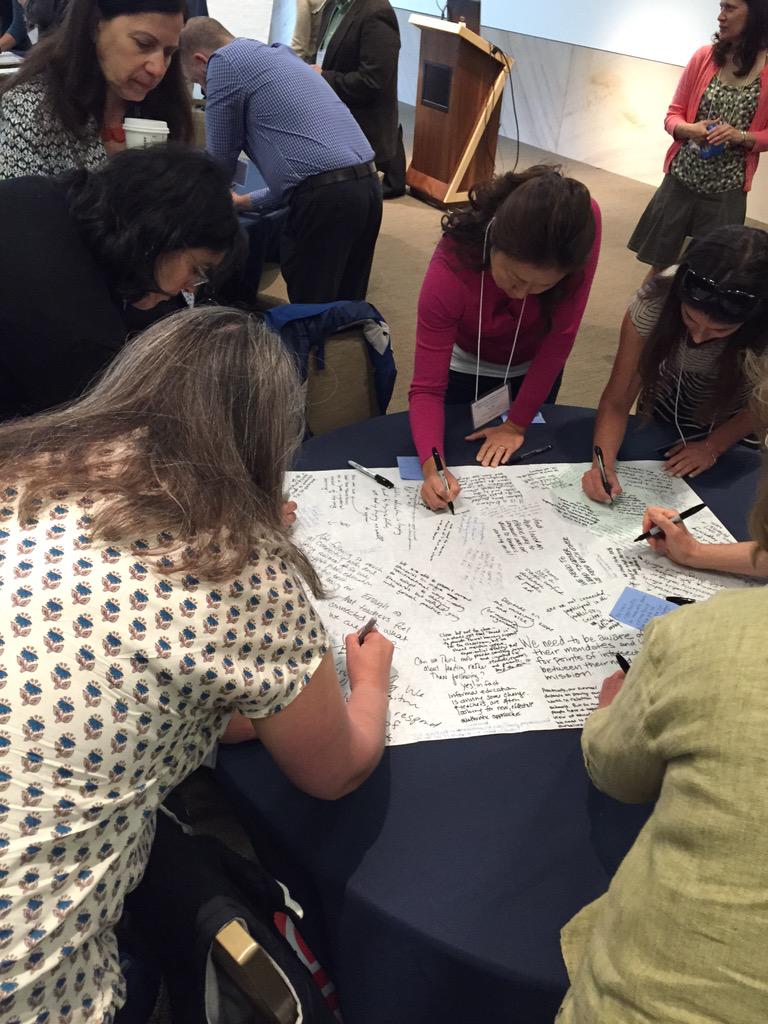
More brainstorming artifacts from convening. Photo via Twitter from Kaywin Feldman ‏@KaywinFeldman
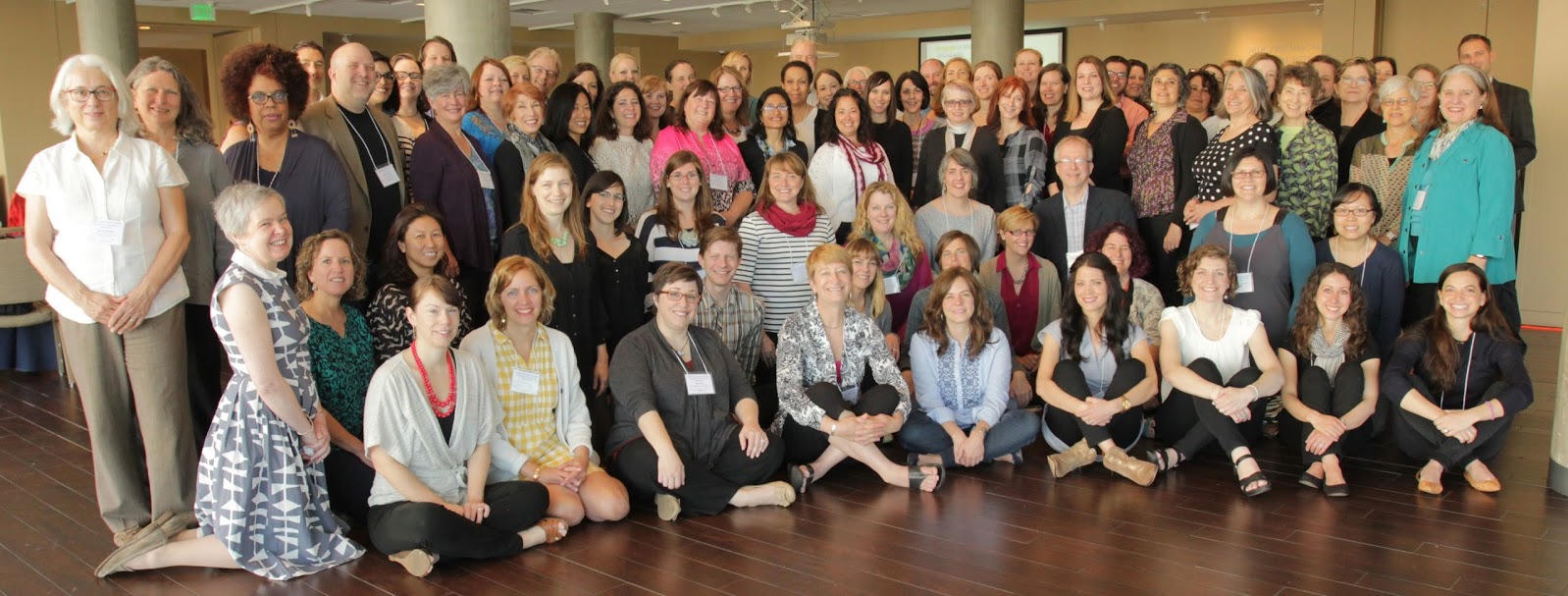
Photo of full group of museum educators and thought leaders convening in Denver for "Leading the Future of Museum Education" (May 2015)
Photo of full group of museum educators and thought leaders convening in Denver for “Leading the Future of Museum Education” (May 2015)

*     *     *     *     *

About the Author

karleengardner-150x150KARLEEN GARDNER is Director of Learning Innovation at the Minneapolis Institute of Arts. She leads initiatives and experiments in interpretation and learning, and works to make the museum accessible and relevant for all audiences. Karleen currently serves on the board of directors of the Museum Education Roundtable, on the editorial team, and as a peer reviewer for the Journal of Museum Education.

*     *     *     *     *

Header Photo by Ann Rowson Love via Twitter @annrowsonlove

The Creative Spiral: Evolving Practice in the DMA’s Art Spot

Written by Jessica Fuentes, Center for Creative Connections (C3) Gallery Manager, Dallas Museum of Art

The creative process is often described as cyclical and sometimes, when I’m in it, it can feel like I am going around in circles, ending up where I started.  Hopefully, when I come back around that circular process, my ideas have evolved so though I may be in a familiar place I am truly somewhere new.  Perhaps the path of the creative process is then more like a spiral, repetitious yet constantly moving forward.  This concept not only illustrates an important artistic process that we want to share with visitors to the Center for Creative Connections (C3) at the Dallas Museum of Art, but also it describes the methods we employ as our space evolves. The creative process is an inspirational component of C3 and it is exemplified through the Art Spot, a hands-on art making area.

A Brief History

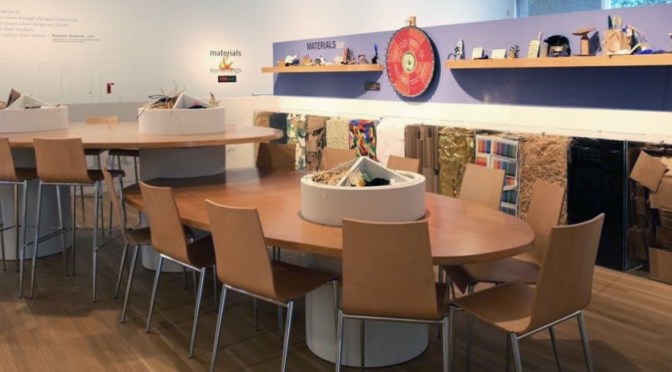
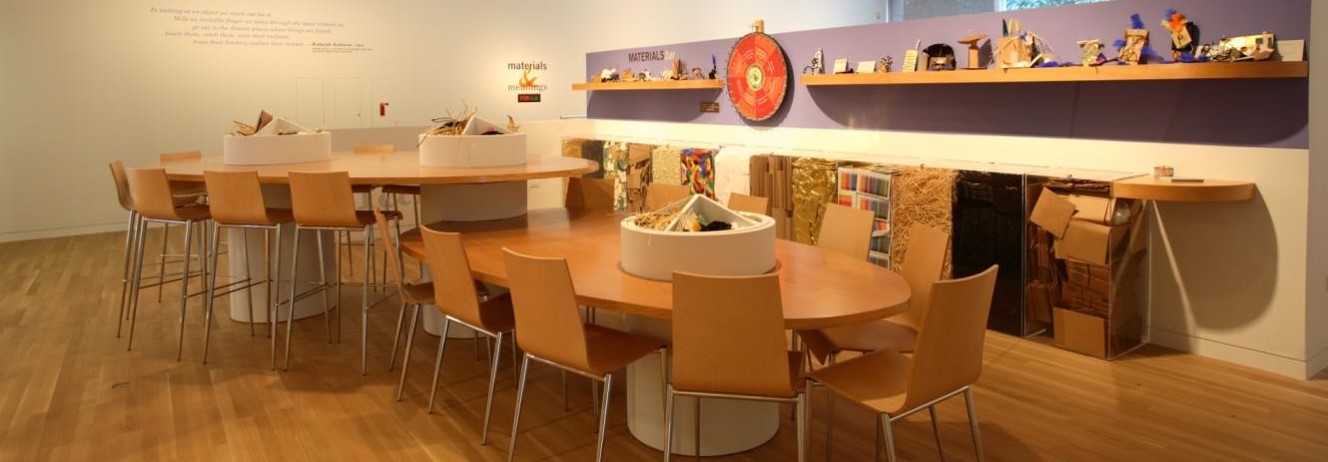
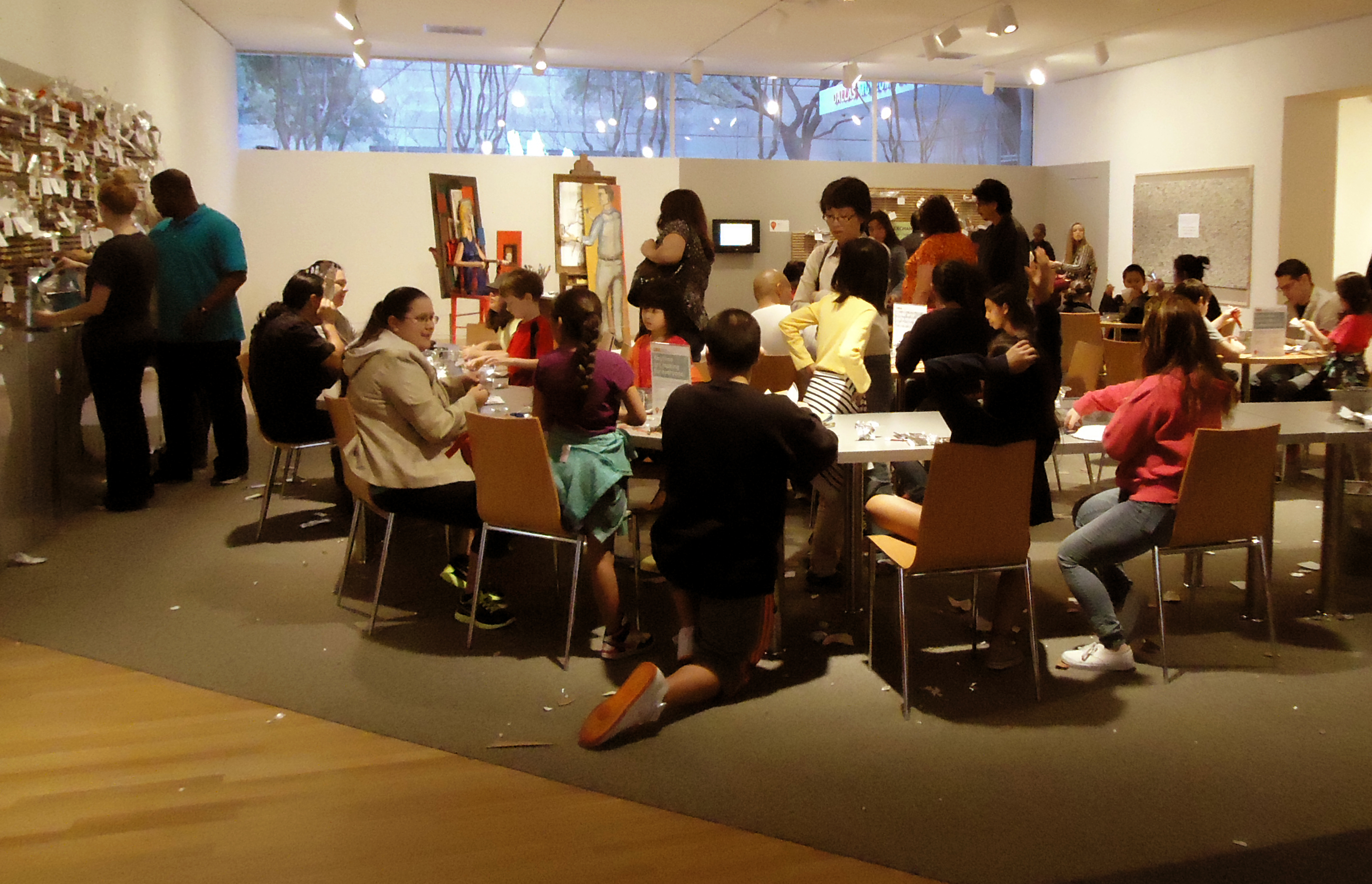
In 2008, the hands-on art-making area within the C3 exhibition Materials and Meanings was called the Materials Bar.  With a total of eighteen standard and tall seats, the space was designed as a communal area for visitors of all ages.  The Materials Bar provided a hands-on experience of the creative process engaging visitors with an inspiration wheel, videos that modeled techniques, materials that encouraged play, and a reflective label writing component.  The materials provided were similar to or related to works of art on view.

Materials Bar
Materials Bar

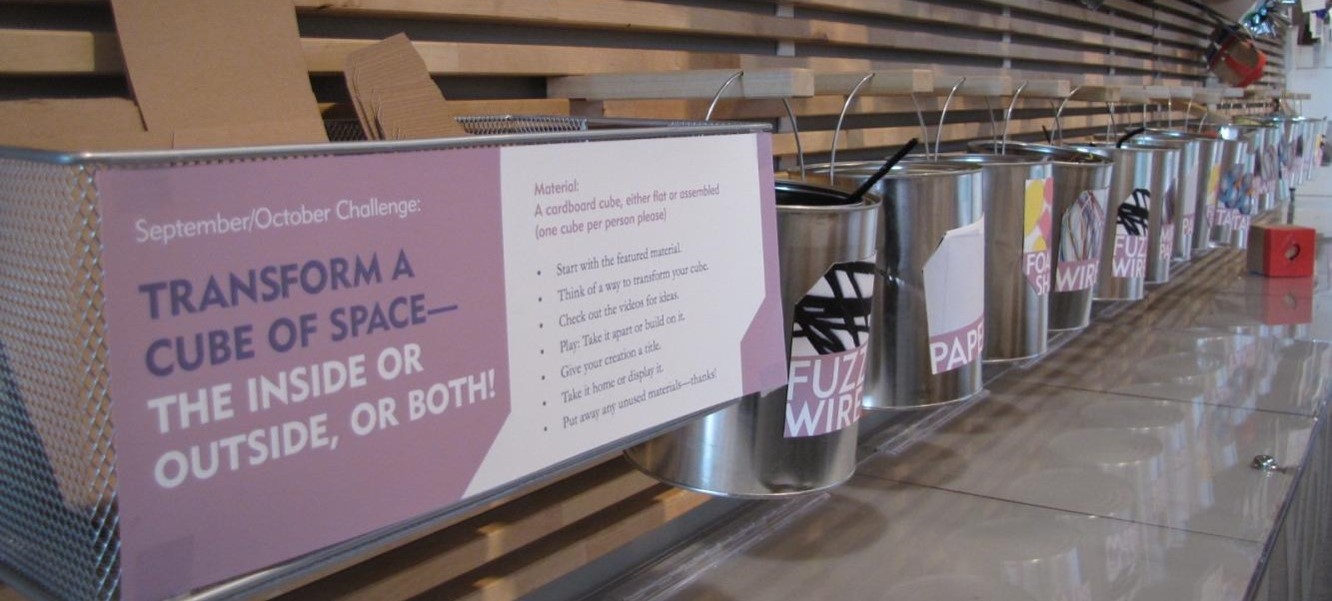
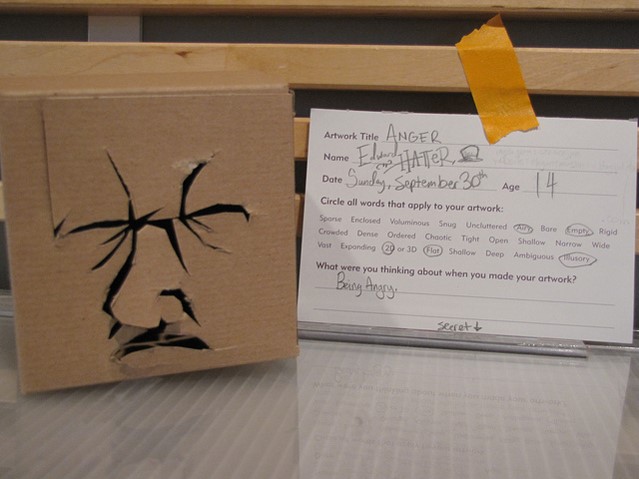
In 2010, C3 presented its second exhibition, Encountering Space, which involved a complete redesign of the entire C3 and transformed the Materials Bar into the Space Bar.  Though it remained a hands-on making area, the focus on the new exhibition theme was evident in the inspirational prompts and reflective labels. Prompts challenged visitors to “transform a cube of space” or “build a sculpture with positive and negative space.” The label cards not only encouraged visitors to reflect, they also introduced vocabulary about space through a word bank.  Additionally, the seating was expanded to accommodate twenty-six visitors.

Space Bar
Space Bar
visitor created label in the Space Bar

In 2012, C3 transitioned away from themed exhibitions and towards a more fluid process of rotating works of art.  Along with our process, the physical space changed, reflecting the end of Encountering Space and the beginning of a simplified graphic identity to reflect the DMA brand.  With additional seating for a total of forty-four visitors, the area was renamed the Art Spot: Anytime art-making for everyone.  Since then, we have experimented with different approaches.  For a year we focused on one work of art, Family Portrait 1963 by Martin Delabano.  Although we changed the materials and prompt every couple of months, they always related back to the work of art.  The following year we explored the broader idea of creativity.  We provided unconventional and everyday materials (like red plastic cups, spoons, paperclips, and twist ties) and challenged visitors to make something new and unexpected with them.  More recently we have made connections between the Art Spot materials and our wall of visitor-submitted images with themes like Textual Awareness or Flowers.

Commonalities and Spiraling Forward

For me, the creative process can be simplified to four steps: inspiration, exploration, creation, and reflection.  With each iteration of the making area in C3, we come full circle.  We start with an idea—a theme like materials, space, or creativity— or a work of art.  Next, we explore the possibilities of that idea and play with what it might look like.  Then, we construct it for visitors to experience, and finally we reflect on the actual visitor experience.  Over the years, the various iterations are in many ways similar, but with each new endeavor we learn and revise.  In each iteration we were inspired by visitors, and hoped to inspire visitors — as art museum educators, we place an importance on encouraging visitors to connect with works of art.  Furthermore, the area has always been about three-dimensional making and the creative process.  In our upcoming redesign, we are sticking with these tenants, but are approaching them in different ways.

In the past we strived to inspire participants with the art on view in the Center for Creative Connections, though we found this can be difficult when the works of art are not directly adjacent to the making area.  Often visitors come straight to the art-making area without looking at the works of art or, if they spend time looking at works of art, they may not be thinking of those objects when they arrive at the making area. When we installed Family Portrait 1963 directly in the Art Spot, we hoped that visitors would be more prone to draw inspiration from the work.  We found that despite its positioning and large size, it quickly gets lost behind a sea of visitors when the Art Spot is full.

Art Spot with
Art Spot with “Family Portrait 1963” and crowd of visitors

In the upcoming redesign, we are installing more works of art in the Art Spot and are strategically placing them near the tables where participants will be creating.  Furthermore, the cases housing these works will have prompts directly on the glass to provoke thought and discussion about the materials, design, and process.  These kinds of prompts can help visitors get into the making mindset, a way of critically looking at and exploring materials.

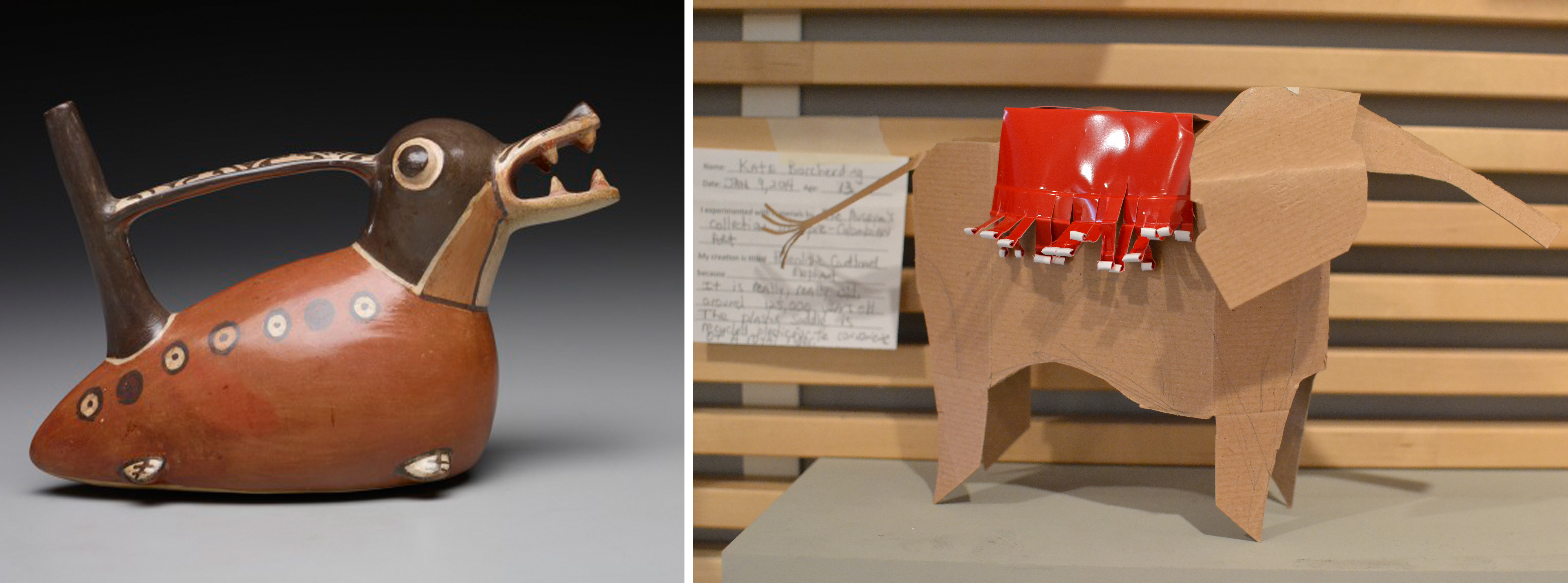
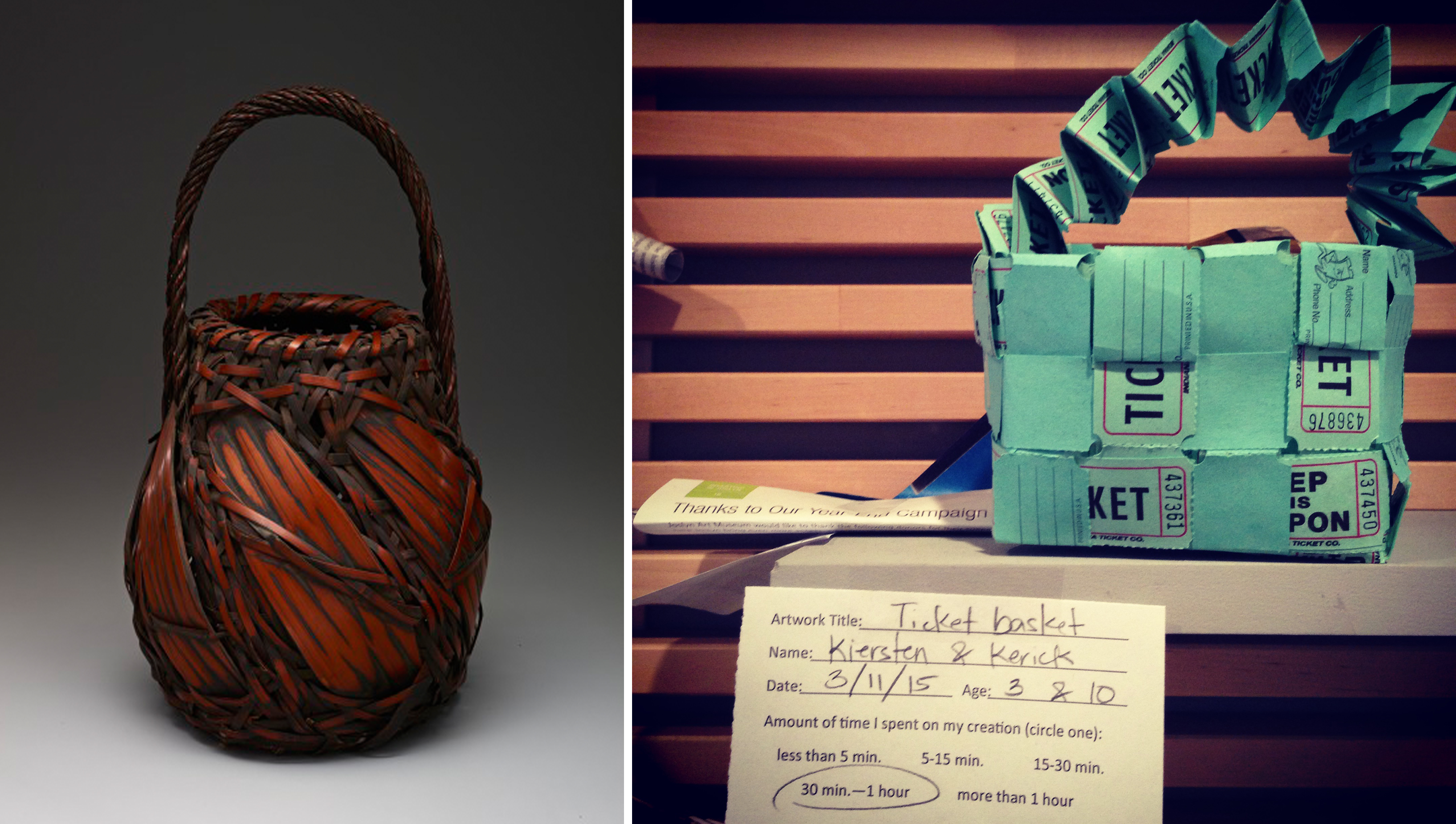
Also, our approach to choosing works of art has shifted.  In the past we chose works of art that exemplified a concept and might inspire visitors to create.  This time we are taking our inspiration from our visitors.  Over the past few years we have documented the kinds of creations made at the Art Spot.  We know that, regardless of the theme or materials, there are common items that are made: rings, animals, flowers, hats, and woven objects.  So, we started with those observations and chose works of art that visitors might more easily relate to and that had some evidence of both the materials and the method of making.

visitor creation displayed in Art Spot
LEFT: Pre-Columbian Single-Spout Strap-Handle Vessel from DMA collection.  RIGHT: visitor creation displayed in Art Spot
visitor creation displayed in Art Spot
LEFT:  Bamboo basket from DMA collection.  RIGHT: visitor creation displayed in Art Spot

Finally, we will continue to encourage the creation of three-dimensional objects, but rather than having one set of materials, we will offer different materials at different stations that relate to the nearby works of art.  This will offer some variety so that visitors have more options.

Looking Ahead

When the Art Spot reopens in the next week, we will continue to ask for visitor input and revise, because being an experimental space means that we are constantly evolving through the creative process.  We will document the creations visitors make; read the reflective statements they write; talk with them about the works of art, the materials, their creations, and their overall experience to get a sense of what aspects of the new design are working and what we may revise.

How Do You Do It?  Share Your Thoughts

How would you describe your creative process?

How do your programs, activities, and gallery spaces change and evolve?

Share your thoughts with us in the comments section below, and let’s collectively reflect a bit more on our planning and reflection processes for these types of creative, experimental spaces in museums.

Status Update: Facebook as a Reflection Tool

Written by David Bowles, Assistant Museum Educator for School Programs, Metropolitan Museum of Art

Cross-posted with Museum Questions, a blog authored by Rebecca Herz that is dedicated to questions about museums and thoughts on creating a reflective practice.

This blog post is about listening and reflection. As a museum educator, my job is to listen. On a good tour, I learn about as much about art from visitors as they learn from me. I also learn something about their lives. But often it seems like these moments evaporate. So for the past two years, I have been posting some of the most indelible teachable moments from my gallery experiences on Facebook.

I limit myself to one moment per tour. I try to stick to the facts, and not interpret the child’s ideas in my own words. I describe the context succinctly, and stick to a few sentences at most. I imagine reflecting on the teaching experience with someone who has never heard of the field of museum education – so no jargon allowed. When it makes sense, I include a visual of the artwork that sparked the teachable moment.

The moments I capture tend to be funny, which is why they make good Facebook posts. But they also highlight important moments of discovery, and often mark pivot points in gallery conversations. I try to focus on what Piaget might have called moments of disequilibrium – those wonderful, maddening moments when you discover for yourself that what you thought was simple, is not.

Here are three such experiences, some thoughts on what I’ve learned about school tours and student visitors along the way, and tips for anyone interested in giving this a try.

1.  Fear of the Unknown
Bowles-FB1

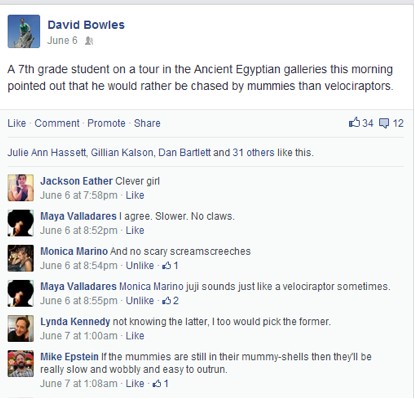
“A 7th grade student on a tour in the Ancient Egypt galleries this morning pointed out that he would rather be chased by mummies than velociraptors.”

I think the young man’s logic was that mummies chasing him through the Museum were likely to shuffle along slowly, while raptors are nimble pack hunters (as anyone who saw the kitchen scene from the original Jurassic Park can attest). He makes a valid point. This comment sparked a stimulating conversation among the class about fear of the unknown. We sat in the dimly lit gallery surrounded by sarcophagi and other tomb equipment unearthed along the Nile, and other classmates chimed in with their honest reactions to the unfamiliarity of the experience. After several other students also expressed fear, one young lady allowed that she “sort of liked being scared.” I asked her if it felt “safe scary” and she nodded. The young man whose comment started the conversation smiled at her and nodded as well.

These students feel slightly scared by the unknown Egyptian galleries filled with mummies and other ancient artifacts. But they are attracted to the unknown. The unknown in a museum setting, like the unknown in movies, is “safe scary.” For them, what is interesting about this space at the Met is not the connections they can make to their school curriculum, or the comparison between the ancient and the contemporary, but the opportunity to exist temporarily and safely in a space outside of the safety and routine of the everyday.

2. Time Travel

Bowles-FB2

“6th grade student, after discussing a sculpture of the historical Buddha: “So, is the Buddha like the Doctor? Doctor Who I mean.” Mind expanded.”

If you’ve never watched Doctor Who, close this browser and go watch some. The Doctor is an extravagant, brilliant, and charismatic alien who explores the universe trying to help the helpless, ease suffering, and generally leave things better than he found them. His ship, the TARDIS, can travel anywhere in space or time. Since he seems to like Great Britain, he comes to Earth a lot. Coincidentally, the show is produced by the BBC, so the Doctor is invariably British, as are his plucky human companions. The Doctor is a troubled hero, whose views on the universe are often transcendent as well as maddening.

On some level, the young lady who asked me if the Buddha was anything like the Doctor understood that the story of the Buddha, like the story of Doctor Who, is about creating an impossible narrative of characters who can save the world. On another hand, she may have been reaching for a way to connect historical information about the Buddha (i.e. he really existed, he was a prince, he traveled throughout India and Nepal, etc.) with the more incredible aspects of his story (i.e. his description of concepts like samsara and nirvana, his awakening or enlightenment, etc.) She seemed interested in the Buddha not as a representative of another culture but as a superhero, an embodiment of the type of figure that could save the world. In short, I think she saw a role model.

3. Love and Marriage

Bowles-FB3

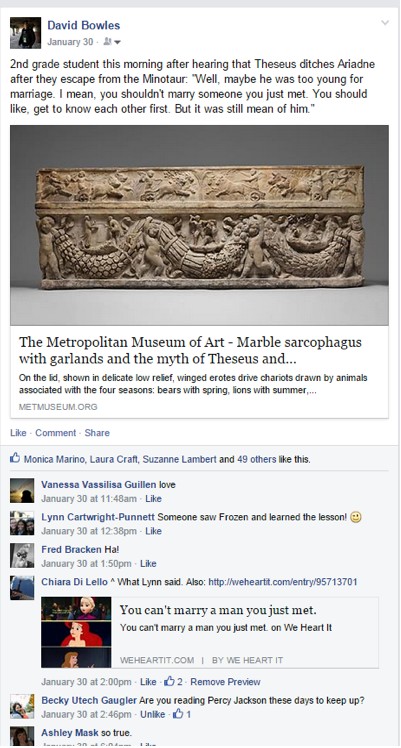
“2nd grade student this morning after hearing that Theseus ditches Ariadne after they escape from the Minotaur: “Well, maybe he was too young for marriage. I mean, you shouldn’t marry someone you just met. You should like, get to know each other first. But it was still mean of him.”

Like the Greek myths that inspired it, this discussion offered an interesting analysis of human behavior. After telling these students the myth of Theseus and Ariadne, I asked students what they thought of the story’s ending. The first flurry of responses focused on abandonment and notions of fairness; everyone agreed that Theseus made a bad choice. Well, nearly everyone. I pushed for dissent, and asked if anyone had another point of view. This young lady had been sitting silently for a while, and when she did speak it was with energy.

On some level she was trying to make Theseus’ decision to abandon Ariadne acceptable. On a deeper level, I wonder if this student, like the young lady who compared the Buddha to the Doctor, was thinking about role models. As you can see in the comments left by my Facebook friends, Disney’s ‘Frozen’ explores these ideas very effectively as well. Whether or not this student had seen the movie (and I suspect she had), it was a powerful reminder to me about making room for respectful dissent when interpreting works of art. Students really absorb the lessons that they learn from movies, so it makes good sense to keep tabs on what those lessons are – and what ambiguities they might offer.

So what patterns have I noticed about kids’ interests at the Met?

The Unknown

Many of these conversations involve discovering new frontiers, and the thrill and fear that accompany real, authentic exploration. As long as the fear of the new doesn’t overwhelm the group, it can be very productive if acknowledged. There’s a lot to be said about the transformative power of discomfort; just ask an oyster.

Role Models

Humans are social animals; we look to others for tips on how to behave. Many students are searching for role models, and some have found them in fictional characters. These young people are looking for ways to connect these characters and their worlds to the real world around them, and they will do so at the first opportunity.

Contemporary Connections

Museum educators often talk about contemporary connections: strategies or concepts that help visitors understand something unfamiliar by tying it to something personally familiar from today. When students initiate their own contemporary connections, they often do so in unpredictable ways that can be surprising, humorous, or subversive. There is something to be said for letting students make their own connections instead of doing it for them. Kids will bring pop culture with them into the museum regardless, so ignoring its power means missing opportunities for authentic discussion.

Keeping up-to-date on popular trends among young learners can really help make genuine connections that make complex ideas accessible. It can also highlight key misunderstandings about objects or the stories objects tell. For example, the idea that you should get to know your future partner well before committing is a very particular approach to marriage, presumably not one endorsed in most ancient societies.

Some Takeaways for Museum Educators

1. Listen. Really Listen.
Focus on what students are really saying when they respond to your questions, not just what you think they mean. This is hard. Use the words they use to define academic terms and abstract concepts. If a student’s comment strikes you as snarky or disruptive, lean in to it. Find out more. Let them know you’re interested in their thinking. Give them space to explain. If they don’t want to explain to you, consider asking them to turn and talk with some of their peers. Listen to what you hear, and think about how it connects to your own ideas about the content or lesson.

2. Let students drive the conversation.

My boss sometimes talks about how effective museum educators need to be a ‘Guide on the Side’ rather than a ‘Sage on the Stage,’ and this is vital to effective gallery teaching. Use a light touch to keep the conversation moving. Stay goal-oriented, but don’t get so attached to your goals that you lose sight of the importance of the process of discovery for your participants.

3. Ask for divergent thinking

Seek out dissenting ideas so that you are encouraging participants to think both deeply and individually. Some works of art open themselves up to a wide range of possible interpretations without ever committing to just one – examples might include many modern and contemporary art objects. Other works of art, like a Gupta period Buddhist sculpture or ancient Roman sarcophagi, have very specific meanings that their makers intended; there are incorrect understandings of some works of art, and that is important for us to acknowledge. Those misunderstandings are often great starting points for real inquiry if you can help students ground their misunderstandings in the visual elements of the artwork! Either way, seeking out divergent thinking empowers students to discover and craft the complexity of interpretation for themselves.

4. Reflective Practice needs others

I think the capacity to reflect in action (while doing something) and on action (after having done it) is an important part of professional practice. Both are hard to do, and both benefit greatly when other people can be sounding boards. I find these status updates help me slow down and think about the choices I’ve made. Better yet, doing so gives me immediate informal feedback.

Give it a try!

About the Author

BowlesDAVID BOWLES: Assistant Museum Educator for School Programs, Metropolitan Museum of Art.  David oversees the strategic planning, staff and volunteer training, program implementation, and evaluation of all aspects of guided K-12 school tours at the Metropolitan Museum of Art. In collaboration with colleagues, he also develops resources for educators, in particular for educators who are bringing students to the Museum on guided or self-guided visits. David also teaches across a range of audience areas, including K-12 educator programs and adult gallery talks. Before this, he worked at the Rubin Museum of Art as Manager of School Programs. He earned his M.S.Ed from Bank Street College and a B.A. with Honours from McGill University. David’s postings on this site are his own and don’t necessarily represent the Metropolitan Museum of Art’s positions, strategies, or opinions.

How Can Museums Change Teens — and Vice Versa?

Written by Chelsea Kelly, Milwaukee Art Museum

Over the past four years, I have worked with hundreds of Milwaukee-area teens who love art, and who, over their time in teen programs at the Milwaukee Art Museum, grow to love museums as well.

I have always had a sense that my students grow over their time at the Museum. This year, though, to really study that growth, we designed our longstanding Satellite High School Program as a year-long experience to explore exactly how weekly sessions at an art museum might change the thinking of our teen participants. To that end, our program outcome for students was that they would show an increased ability to reflect upon their own experiences and performance.

Evaluation is a grey area—much like teaching and interpretation—and we as educators need to use multiple methods in order to get a fuller picture of what’s going on with our students.

This means I’ve been thinking a lot about evaluation: How do we show change was made? Years ago, I thought evaluation was more or less a prickly, black-and-white, necessary evil that forced me to use altogether too much math. But over the past two years, I’ve come around to believe evaluation is completely the opposite (though math is still important!). Evaluation is a grey area—much like teaching and interpretation—and we as educators need to use multiple methods in order to get a fuller picture of what’s going on with our students. And further, these methods can be tools to help our teaching, improving programs and our impact on students.

In the end, I found I needed to use reflective practice myself to understand how my students were changing, and to explore and experiment with a number of different methods for articulating their growth. In this post, I’ll share a few of the methods we used in the Satellite High School Program this year to explore how our teen interns changed through reflective practice.

First… What is Satellite?

The Satellite High School Program is a year-long internship for sixteen teens ages 16 to 18 from diverse high schools all over the Milwaukee area. Once a week after school, they come together at the Museum and explore how art can be made relevant to our lives today. They participate in “object studies” (hour-long discussions on a single work of art), behind-the-scenes career talks with staff, and resume-writing workshops, and also mentor elementary school students in tours of the permanent collection.

Teens create a final project that has a real-world impact on the Museum. They choose a work of art in the Museum Collection, research it, and form their own interpretation of the piece. In past years, students have created responses in visual art, writing, or performance. This year, the students used iPads to create videos on their work of art, explaining what the work means to them and how it changed their thinking or art practice. You’ll see a few of those videos later in this post.

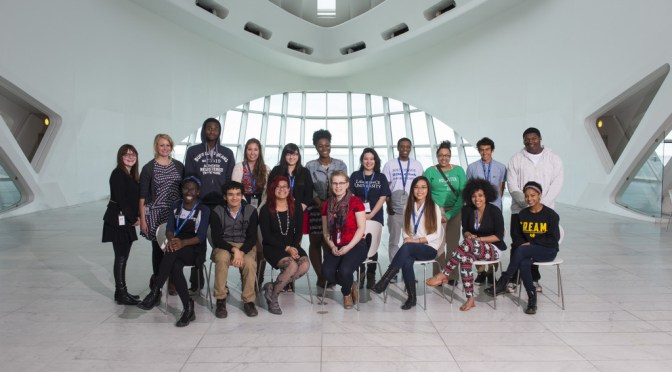
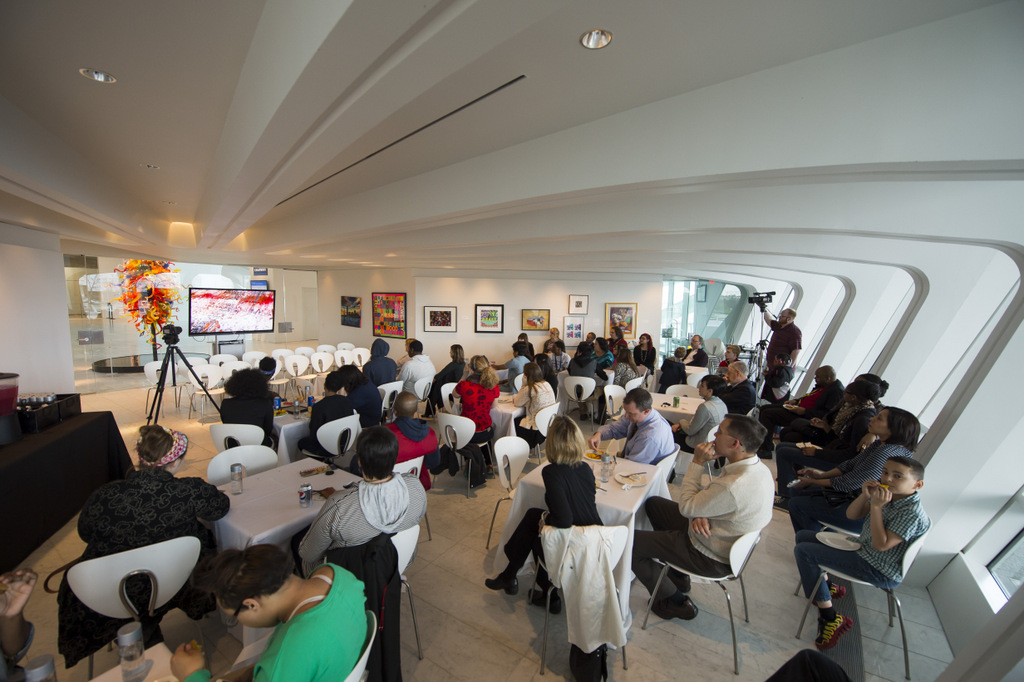
Friends, family, and teachers of the Satellite interns watch their final project videos at the program celebration. Photo by Front Room Photography

Core Evaluation

Let’s start with the core evaluation method we used for the program. We were lucky to work with one of our teen program funders, the Milwaukee Public Schools Partnership for the Arts & Humanities, and the University of Wisconsin-Milwaukee’s Center for Urban Initiatives and Research (CUIR) to develop the outcome above and to establish a tool to measure it.

We settled on one-on-one interviews, doing a “pre” interview on the first days of the program in October and a “post” interview on the final days of the program in May. Each student was privately asked the same set of questions in the pre- and post-interviews, meant to get at their ability to reflect on their experiences in the program. I scored each interview on a rubric that measured level of detail in their responses, and then we compared their pre-program score to their post-program score to see if they had improved.

At the end, every student did improve in their ability to reflect—their answers got significantly more detailed. As someone whose default is to be a more qualitative thinker, it was rewarding to use the rubric to see their interviews as data, in a quantitative, more tangible way.

But as helpful as this was, it’s still just one method of evaluation. Being able to explain in detail is certainly one aspect of successfully being able to reflect. But as I listened to their responses, and thought about what I had seen in the students over the course of the whole year, I realized there is much more to reflecting than just detail. Their responses used stronger vocabulary, they expressed sophisticated ideas, and they asked more and deeper questions. How could I articulate that kind of change?

Unexpected Data

Happily, along the way, we also found that we had collected some unexpected data which helped me more concretely see the change in my students.

Exit Slips

At the end of each session, teens used a web app on their iPads called Infuse Learning to fill out a quick exit slip survey. Exit slips are an easy way to take the pulse of your students at the end of a session. For Satellite, they answered the questions “What is something you learned today?” and “What are you still wondering about?” Though different from our interview questions, these certainly also support reflective practice by thinking back on the day’s session.

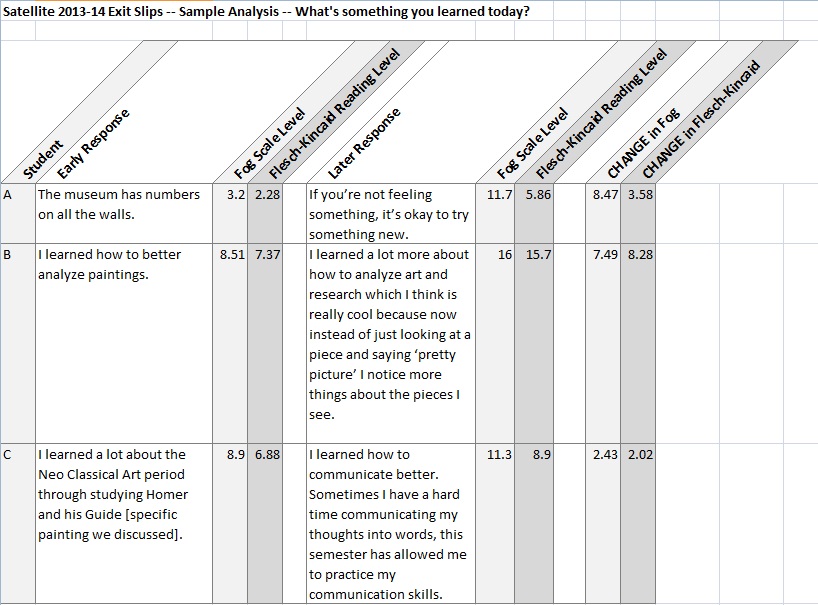
As the year went on, I noticed that the teens ‘ responses were growing more sophisticated: they were longer, they used more art vocabulary, and they realized that they might not be able to answer questions definitively, if at all. At the suggestion of Marianna Adams, who specializes in museum research and evaluation, I tried running these responses through two readability tests to see if that would quantify the sophistication of these responses. One test produces the sample’s Fog Scale Level, which measures syllable count and sentence length (a score of 5 being readable, 20 being very difficult). The other was for the Flesch-Kincaid Grade Level, which approximates the average grade level necessary to read and understand the text.

For the first question (“What is something you learned today?”), students’ scores jumped considerably in Fog Scale and Reading Level. Since these tests measure syllable count, sentence length, and grade level, this corroborates with what I found in the core evaluation.

somethingyoulearnedtoday

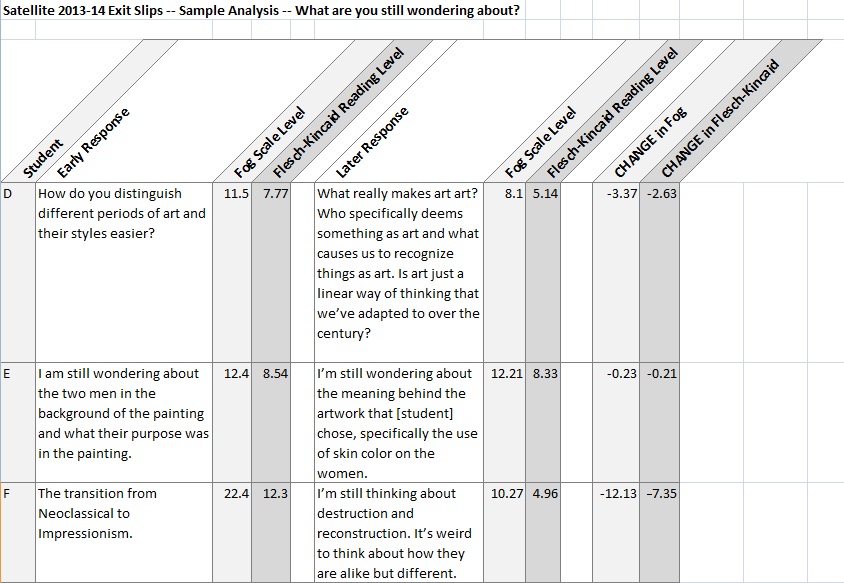
But I was surprised to see that when I tested responses to the second question (“What are you still wondering about?”), students’ scores actually dropped! Yet if you read their responses, there is a drastic change—for the better.

stillwonderingabout

Take Student D’s responses. In his early answer, he asks a relatively basic art historical question about distinguishing one type of art from another. In his later response, he is thinking deeply about the purpose of art and how we even decide what art is. And while Student F uses high-level art history vocabulary in her first response, it’s without context; later on, she’s thinking about how two seemingly opposite concepts may have something in common after all.

The scores of these comments may have decreased, but I’d argue that their reflective quality increased—the teens ask big questions that might not have an answer; they ditch high-level vocabulary to more informally muse on philosophical questions of art, destruction, and race. Running these responses through the tests helped me see, again, that while tools can be helpful, they’re ultimately just one tool—we need more than one to paint a bigger picture.

Videos

To round out that image, I’ll share one final unexpected evaluation tool: the teens’ final project videos as well as a talkback session they conducted at their video premiere.

For their final project, each student chose one work of art in the Museum Collection and looked at it, researched it, and talked about it with others for seven months. (Given that most visitors spend under 10 seconds looking at art in museum galleries, this is a feat in and of itself!) They distilled a school year’s worth of thinking into brief, 2-4 minute videos that answered what the work meant to them, what it had meant to others, and how their own thinking had changed as a result of looking at the piece—all questions with, of course, that familiar reflective bent.

The teens also participated in a talk-back/Q&A at the celebration where we premiered these final projects. Guests—museum staff, teachers, family, and friends—asked the group questions about their experience. If you like, you can watch the teens’ videos, along with the Q&A, in the YouTube playlist below.

Impact — Can Museums Change Teens?

So: does all the above—interviews, exit slips, readability tests, and final projects—add up to a full image of the impact that a year’s worth of reflective practice can have on students?

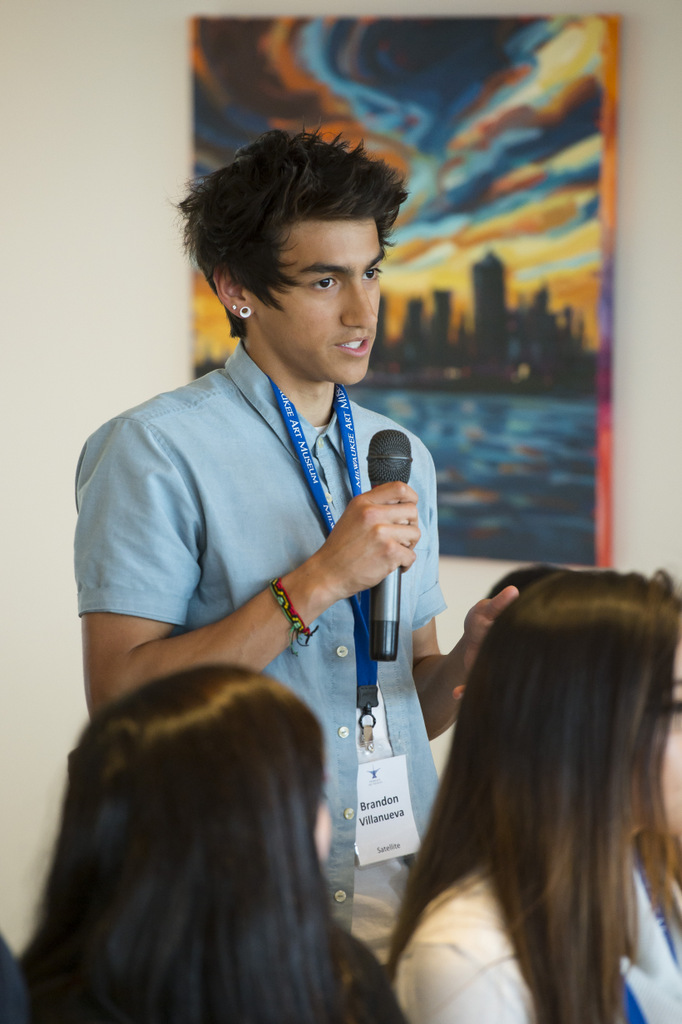
Brandon answers a question during the Satellite premiere Q&A session. Photo by Front Room Photography

I’m not sure we can ever paint a full picture of student growth in intensive programs such as this one. I do think combining all of these tools can help, though—especially if the evaluative tools actively support the goal of the program. The interviews, exit slips, and activities were all intentionally structured to be reflective, related to the outcome itself. This relevancy was key, not only in genuinely evaluating the program’s success, but also in supporting the students’ abilities through the methods themselves. It’s also important that we educators make the program goal transparent to the students. The Satellite interns knew from the beginning that they were working on reflective ability—this helped prime them to think reflectively from the get-go.

As far as impact beyond reflective capacity, I also want to share a few quotes from the teens themselves about their time in this program:

“The videos help us think deeper about what we do—so even in school I think deeper about what I’m doing or why this was made or why this happened.”
“I learned that I shouldn’t judge a book by its cover. When I first saw my piece I just thought it was a bunch of different colors and didn’t really think about it actually having a meaning. But now I’ve learned that it actually has a super cool meaning behind [it], and I never would have learned about that meaning if I hadn’t taken the chance to explore. So I shouldn’t be so quick to judge.”
“We had to give tours and I found out that I really like to work with children and art at the same time. I would like to pursue a career in art education for elementary school students.”
“I was able to change and evolve my way of thinking, now being able to look past the obvious… I learned that art holds all the answers to any questions anyone may have, you just have to search for it.”

From the other evaluation tools, we saw that the students developed their ability to reflect on themselves and their own performance. But as seen in the comments above, they were also able to develop skills reflecting on the world beyond them—the world of art history, their future careers, how they interact with other people. All of these are ways of thinking that are valuable for their futures, as they go to college, discover their passions, and pursue meaningful career opportunities.

amt7_FRPhoto_140515N_C2_0135

Can Teens Change Museums?

I’ve shown how this program helped these students grow in many ways. What about the Museum itself? Have these students had an impact on our institutional practice?

Institutions move at a slower pace than most programs, and if change and impact are complex to measure in sixteen individual students, then it’s multiplied tenfold for an organization that serves hundreds of thousands visitors a year. Even so, over the past few years, the work of teens in our programs has slowly but surely worked its way into the daily fabric of the Museum. Teens have interviewed artists on behalf of the institution. They have advised docents on ideas for giving tours to high schoolers. Their video projects will be part of on-site and online Collection Resources at the Museum, as well as our Archives, for all visitors to access while learning about works of art.

Ultimately, evaluation and impact are ongoing, a grey area that has a lot in common with the act of teaching itself. When done well and intentionally, evaluation doesn’t just show if we’ve met a goal. The tools we use to evaluate ideally become part of our teaching practice, because they reinforce the very abilities we are trying to help our students develop.

As for what I’m still wondering about? This year, our evaluation methods for the most part required the teens to have specific existing skills, such as writing for the exit slips or proficiency in using an iPad (though we did have video-making workshops as part of the program). I’m thinking about other ways to holistically gather data. For example, given that much of our evaluation methods emerged from teaching tools, should I document or film our discussions with works of art and find ways to analyze them? I’d love to hear any ideas or tools you’ve used to evaluate your programs, just as I hope this post has inspired you to take a fresh look at your teaching practice and find unexpected ways to see the growth in your participants.

*     *     *     *     *

ABOUT THE AUTHOR

Milwaukee Commercial PhotographerCHELSEA EMELIE KELLY: Manager of Digital Learning at the Milwaukee Art Museum, where she develops educational technology initiatives and oversees and teaches teen programs. She is passionate about using gallery teaching and technology to foster relevancy for art museums in the 21st century. She has previously worked at the Frances Lehman Loeb Art Center, the Metropolitan Museum of Art, the Frick Art & Historical Center, and the Carnegie Museum of Art. Chelsea is a graduate of Vassar College and holds an M.S.Ed. in Leadership in Museum Education from the Bank Street College Graduate School of Education, where she was a Kress Foundation Fellow. She is also the founder and co-editor of The Art History BlogChelsea’s postings on this site are her own and don’t necessarily represent the Milwaukee Art Museum’s positions, strategies, or opinions.