Blending Art, Technology, & Interpretation: Cleveland Museum of Art’s Gallery One & ArtLens

By Caroline Goeser

I am part of the team that has led the development of the Cleveland Museum of Art’s Gallery One and ArtLens iPad app. These new initiatives – blending art, technology, and interpretation – are garnering interest in the press and among museum colleagues. Many thanks to Mike Murawski for asking me to offer my perspective on the project, understanding that it is newly launched and we are in the process of gathering initial feedback. This project is the focus of a paper session at Museums & the Web 2013 in Portland (link to paper here). Responses so far have been enthusiastic as well as probing and have challenged us to think in new ways about what we’ve created and how we want to move forward. Recurring questions from reporters, colleagues, and visitors can serve as a way of introducing some of our goals and future ideas.

What was your plan behind integrating technology?

A view of Gallery One from the main lobby of the Cleveland Museum of Art. Photo courtesy of Local Projects.

Our plan conceives technology as an interpretive tool to drive active experiences with art at CMA. Creating Gallery One and the ArtLens app has been part of our mission to put visitors front and center. We wanted to build a gallery experience at the entrance to the museum that would welcome all visitors, with particular focus on families, college students, and young professionals – audiences that have not always seen CMA as their kind of place. We wanted to offer them new possibilities to experience art in a participatory way through the medium of interpretive technology. We also wanted visitors’ encounters in Gallery One to spark interest in the museum as a whole and to provide tools of understanding and enjoyment that could enhance their experience of art in the galleries.

On January 21, 2013, we opened Gallery One and went live with the ArtLens iPad app. Gallery One is a unique space just off the museum’s main lobby in which 55 top-quality art objects from the permanent collection are arranged in thematic groupings that cross time and cultures. This organization allows visitors to make connections across CMA’s comprehensive collection of world art. For example, sculptures of the human form from ancient Rome, Japan, Africa, and 19th-century France greet visitors as they enter the gallery, prompting them to experience how our bodies have inspired art differently over time. Another installation groups paintings and ceramics from Europe and Asia, asking visitors to engage with roots of our contemporary, global culture. Interactive, multi-touch screens interpret selected art installations, allowing visitors to engage actively with the works on view by virtually creating their own works of art, or by physically striking a pose inspired by a work of art they see. Gallery One also includes Studio Play, a dedicated family space with hands-on art-making activities, as well as interactive technology stations that provide young children and their families with fun ways to have first encounters with art and CMA’s collections.
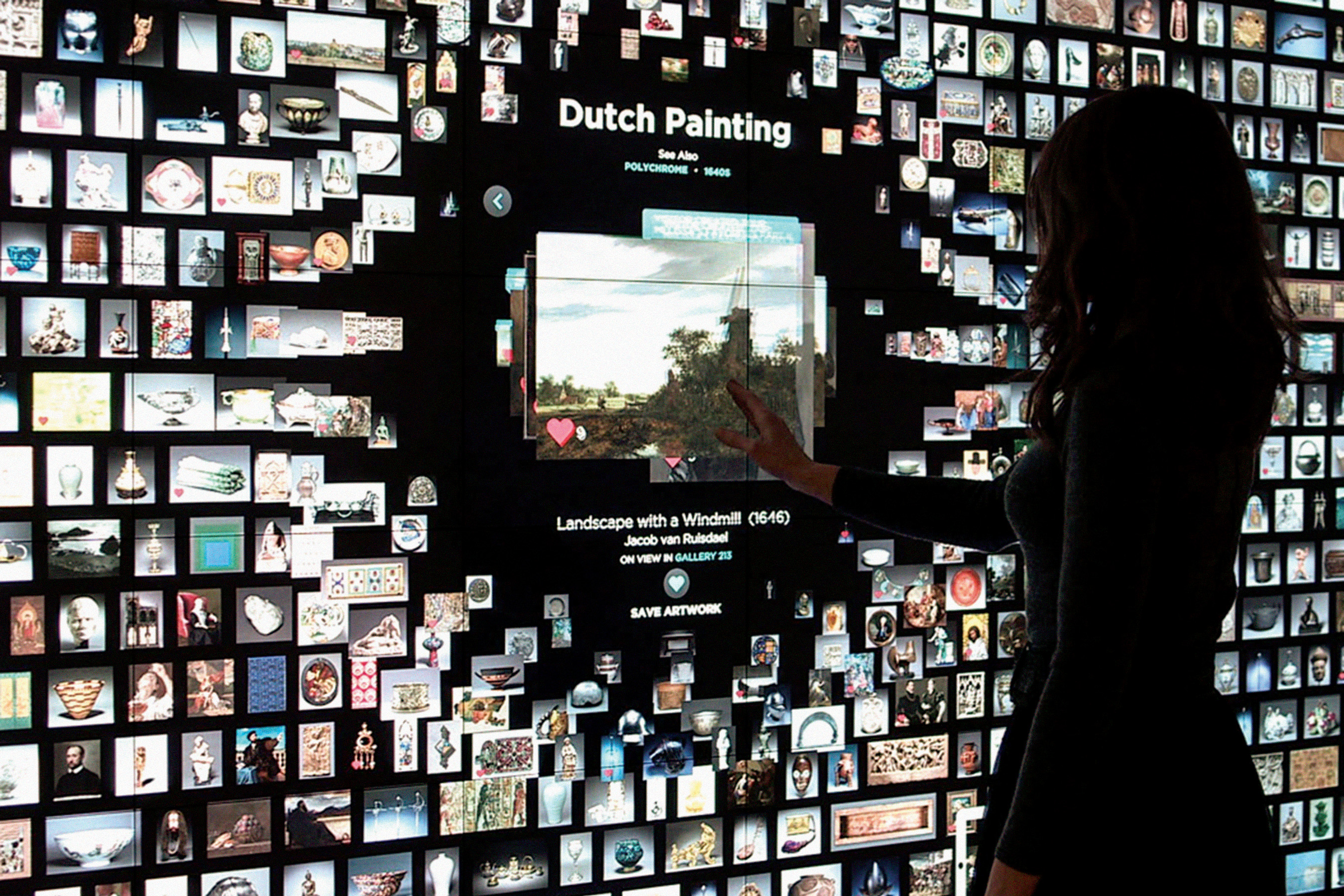
A detail of the Collection Wall in Gallery One. Photo courtesy of Local Projects.

Within Gallery One, just off our new central atrium, a one-of-a-kind, 40-foot multi-touch Collection Wall displays high-resolution images of almost 4,000 works of art from the permanent collection, most on view in the galleries. Every 40 seconds, the wall changes views, showing groupings of art objects based on themes, allowing visitors to see that the collection is dynamic, depending on how you view it. Visitors can touch and browse objects on the Collection Wall to discover other artworks that are related and to find tours that connect objects throughout the collection.

The Collection Wall functions as a place to organize a visit through the permanent collection galleries by way of a unique connection with the ArtLens iPad app. By docking their iPad (or one available for rent) at the Wall, visitors can save their favorite objects to the app and create a personalized tour through the museum. The app’s way finding system directs them to the objects on their tour or to other objects in the collection. They can also find CMA-created tours to organize their visit according to themes they like. Alternatively, they can browse through the galleries and find works of art that engage them, discovering text and video interpretation within the app, or even scanning two-dimensional objects through image recognition to find quick bites of text or video.

What are your learning goals for visitors?

Our goals for what visitors take away involve experience rather than content. We hope that:

  1. visitors have fun with art
  2. the interactive games and interpretation provide tools for understanding and spark social experiences with art
  3. visitors find transformative moments of discovery about continuing creative traditions that make art relevant for them.

Above all, we want to refrain from providing a single, authoritarian guide but instead to offer a variety of choices for visitor engagement. Rather than designing content to meet our own goals for visitors, we have learned from our audience evaluation and responded to the way many of our visitors browse through our galleries, drawn to particular works of art based on their own visual interests and prior knowledge. We’ve been mindful of Jay Rounds’ prescient advice in Curator (2006):

“Visitors come to museums for their own reasons, and those reasons are not necessarily congruent with the goals of the museum. No doubt their browsing through exhibits is suboptimal when compared against [a] museum’s goal that visitors ‘engage in systematic study or exploration.’ But the same [browsing] behavior may prove to be an intelligent response to the situation when measured against the goals of the visitors themselves.” (p. 134)

Sculpture installation in Gallery One. Photo courtesy of Local Projects.

Gallery One and ArtLens were designed to honor browsing behavior. There’s no preferred path through Gallery One; visitors can move from one art installation to another, each with its own story. The Collection Wall asks visitors to browse rather than search: to find artworks they like visually, and to discover connections to related works by theme, medium, or time period. The “Near You Now” section of the ArtLens app follows browsers as they meander through the permanent collection galleries, indicating where they are in the building and the artworks near them. For objects with video interpretation, visitors can find a variety of short segments that they can choose according to their personal preferences rather than a prescribed sequence.

When visitor evaluation begins later this spring, we can find out how these tools are working for our visitors. In the meantime, we’ve been fortunate to have visits from a variety of museum colleagues who have shared initial responses. Following his on-site visit, Peter Samis of SFMoMA wrote to our CMA team:

“The Collection Wall reminds me of David Weinberger’s Everything Is Miscellaneous (2008): it makes every artwork equally available, democratizing the collection…, it enables me to create a tour that threads me like a needle through all the various parts of the building. It disappears the architecture, the molecules, and replaces them with a new organizing principle: visual interest.”

Cool! Interpretive technology serves visitors’ visual interests and democratizes the collection. The challenge comes in the connectivity between the Collection Wall and the iPad app. With the ability to save almost any object to their iPad, what will visitors expect when they reach the actual objects in the galleries? Currently only a portion have video and audio interpretation within the app, some draw web texts and label copy from our databases, but others feature only basic “tombstone” information. We’re eager to discover visitors’ expectations, and in the meantime, to develop priorities for creating new interpretive content.

How can visitors contribute their own art interpretation within the iPad app?

ArtLens video and audio content draws on conversations with curators, educators, conservators, and community members. We hope the variety of voices allows visitors to feel part of the conversation and to suggest that there is no single way to interpret or enjoy a work of art. The community voices are particularly important, as they call up continuing traditions that grow from the artworks on view and connect visitors with people in their community – like the Imam of the Cleveland Mosque for whom the Islamic prayer niche in our collection is part of a living tradition, or the Cleveland ballet dancer who brings his creative perspective to Degas’ Frieze of Dancers.
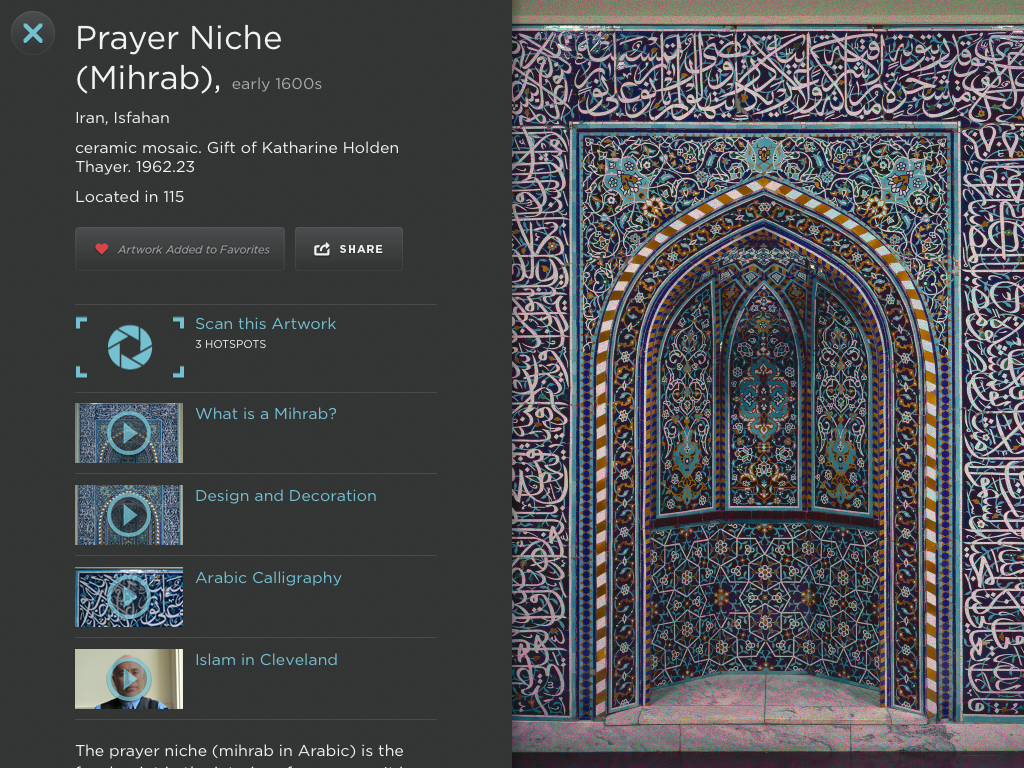
: Object page for CMA’s Prayer Niche (Mihrab) in ArtLens. Photo courtesy of the Cleveland Museum of Art.

ArtLens also allows visitors to create their own tours – playlists of their favorite objects with their own catchy titles: “Randomness and Variety,” and “Lightning Tour Before Dinner Dash.” They can share favorite objects through Facebook and Twitter. We conceived these as first steps toward more extensive visitor participation. We’ve discussed the potential for gathering visitors’ stories about CMA’s artworks and incorporating them into the app. We’ve also dreamed about the potential to capture visitors’ voices within the app, so that they can contribute their own insights about their favorite works of art from the galleries or from off site.

We encourage you to download ArtLens to your iPad and give us your feedback. Our project is ambitious – an interpretive system that reaches throughout CMA’s permanent collection. I’ve outlined some of our ideas and plans here, but there’s much more to come, so stay tuned!

I want to extend huge thanks to the members of my CMA team in Education and Interpretation responsible for the development of interpretive content in Gallery One: Seema Rao, Patty Edmonson, and Hajnal Eppely, and in ArtLens: Jennifer Foley, Lori Wienke, and Bethany Corriveau. They are part of CMA’s Gallery One development team, led by Griffith Mann in Curatorial, Jane Alexander in Information Technology, Jeffrey Strean in Design, and myself. Local Projects of New York is responsible for all media design and collaborated with us on the concept development. Earprint Productions of San Francisco produced the ArtLens app digital content, in collaboration with the CMA interpretation team.

ABOUT AUTHOR
image005CAROLINE GOESER currently serves as the Director of the Department of Education and Interpretation at the Cleveland Museum of Art. Joining the museum in 2009, she reorganized the Education Department in 2012 to focus on two primary goals: 1) invigorating classroom experiences through object-based educational programs, and 2) creating vital experiences with works of art in the galleries through interpretive text, technology, gallery teaching, and public programming for visitors of all ages. Caroline collaborates with the Chief Curator and Directors of Information Technology and Design to oversee the new Gallery One, an interactive gallery for intergenerational visitors. She has facilitated and enhanced the museum’s collaborative interpretation program, which has garnered national recognition with the recent award of an NEH Challenge Grant. With colleagues at CMA and Case Western Reserve University, she has worked to re-envision the joint CWRU-CMA doctoral program in art history, which recently received a major grant from the Mellon Foundation to focus on object-based study. Caroline’s postings on this site are her own and don’t necessarily represent the Cleveland Museum of Art’s positions, strategies, or opinions.
Bookshelf: The Exemplary Museum – Art and Academia

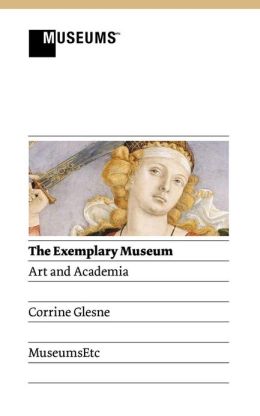
ExemplaryMuseum-coverIn The Exemplary Museum: Art and Academia, Corrine Glesne takes a far-reaching survey of the state of academic art museums throughout the United States, primarily by means of detailed interviews with the diverse makeup of these museums’ constituents, including directors, staff, students, faculty, administrators, volunteers, as well as public and school audiences. Though my own experience in working with academic museums is admittedly somewhat limited, I became interested in this book through my frequent work with university audiences in museums. I was looking to this book to provide fresh insights into the relationship between the museum and the academic community, and it certainly did provide them. Some ideas presented in the book may already be familiar to many of us, but it was still nice to see them being reinforced across the field. One of the big questions it raised for me is: how can we, as educators, regardless of institutional affiliation, learn from academic museums, which have traditionally focused much more on education at their core than the traditional public encyclopedic museum model of “preserve and collect”? What challenges and opportunities do we have in common with academic museums, and what challenges and opportunities are unique to these museums?

In determining just what makes a museum “exemplary,” Glesne, who was commissioned for this project by the Samuel H. Kress Foundation, narrowed her search by locating academic museums with objects donated from the Kress collection, and further refined her field of inquiry by identifying academic museums through surveys that seemed to be functioning as model institutions in terms of leading by example. This led her to a consideration of twelve institutions. While I would have liked to see a bit more information on the criteria that Glesne used to determine these museums’ “exemplary” status, this particular focus does lend itself to a manageable series of case studies. Tellingly, Glesne begins her analysis of the academic museum with an example of a docent-led high school tour of a Kress Foundation object, revealing her own personal emphasis on the educational role of the academic museum, as well as a somewhat obligatory focus on the role of the “great Kress giveaway” which is the subject of her first chapter. She also discusses how crucial outreach programs and K-12 educational programs became in the development of the academic museum’s history during the second half of the twentieth century, as they transitioned from private study collections to fully public institutions.

Connecting on Campus

Perhaps the crux of the book, in a chapter titled “Art Across the Curriculum,” Glesne discusses how academic museums have attempted to become embedded in the curricula of their parent institutions. For those of you who have worked with faculty before, many of these strategies for engagement in the museum might sound familiar, in terms of seeking out specific courses that mesh with a collection, networking with faculty at regularly-scheduled departmental meetings, and forming committees to develop curricula.

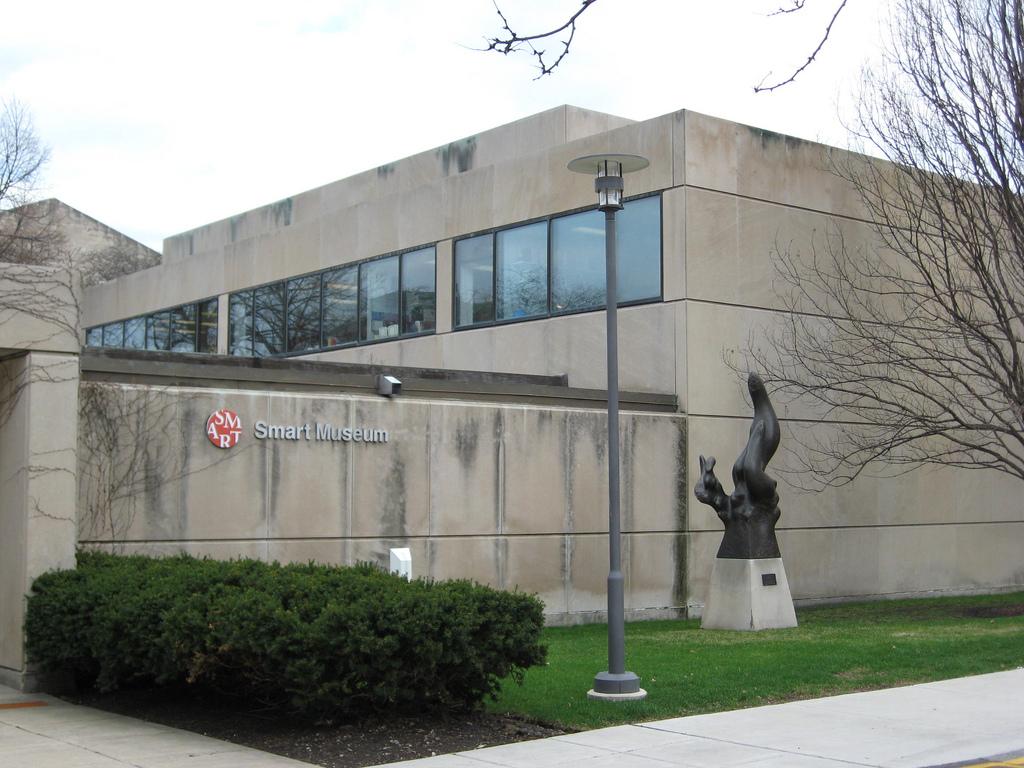
Smart Museum of Art, University of Chicago

For me, this chapter reinforced the challenges of finding meaningful, sustainable connections with classes and allowing faculty, especially those from non-art-related disciplines, to feel independent and at home in working with a collection on their own, rather than with a museum staff serving as a mediator. Glesne also suggests some very novel approaches to connecting with faculty, including emphasizing the museum’s presence at new faculty orientations so that they are aware of the possibilities a museum can offer before they have even designed their classes.
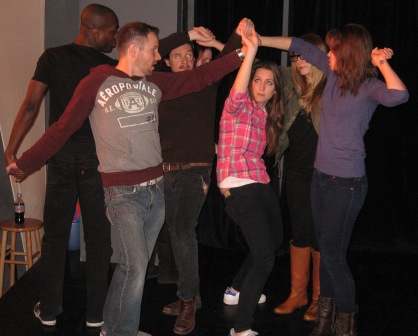
In a particularly useful section of this chapter, Glesne breaks down the ways in which museums connect with academic curricula by identifying specific categories of curricular involvement. These categories include:
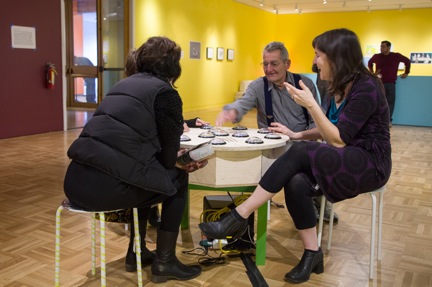
  1. “Skill development,” for example, a foreign language class that uses museum objects to provide structure to a conversation;
  2. “Interdisciplinary analysis,” or using a museum’s collection to find meaningful cross-references to other, non-art-related aspects of history;
  3. “Comparative analysis” which seeks to make connections around specific concepts, for example, how objects might communicate different messages about “love” across time and cultures;
  4. “Social critique,” which is often a topic of engagement for classes, especially as academic museums are sometimes more in a position to take risks in terms of controversial exhibitions;
  5.  “Research,” or how the practice of art historical analysis can cultivate research skills around these objects as primary source documents;
  6. And finally, “creative inspiration” as a platform for the creation of works in other forms or media.

Glesne also discusses the increasing role of the “academic curator” as it evolved out of the Mellon Foundation’s College and University Art Museum Program, and how this unique position has played a vital role in establishing stronger connections between academic museums and university faculty. As Glesne points out, this position has often had the effect of freeing up the academic museum’s other education staff to think in a more focused way about K-12 involvement. However, I am somewhat cautious about this split, as it could be seen to reinforce differences in the approach to these two audience segments, rather than seeking to address commonalities between them. On the other hand, I often wonder if public museums might find an academic curator to be a valuable position in terms of focusing on increased interactions with college audiences.

Alternative Forms of Campus & Community Engagement

Photo from "Anything for Art" http://blogs.oberlin.edu
Photo from “Anything for Art” http://blogs.oberlin.edu

Glesne’s next chapter, “Museum Art in Everyday Life,” considers the ways in which academic museums seek to connect to students and the public outside of the curriculum. She discusses the many ways in which campus art museums have tried to increase visibility through social events and informal learning. Some examples that stood out in my mind are the Snite Museum of Art’s desire to make the Museum a kind of alternative “tailgate” space to connect the Museum with Notre Dame’s much more visible football games, and the always-popular Art Rental Program at Oberlin College’s Allen Memorial Art Museum. I was particularly struck by how meaningful the ability to check out original works of art has been, not just for the students who rent these objects (for a mere $5), but for the greater Oberlin community, including a senior center that proudly displayed works from the program in its central building. Some of simplest, yet most effective programs involve turning over the programming to a student advisory council, allowing students to take ownership of the galleries. Glesne concludes this chapter by discussing the role that academic museums play in preparing people for careers in the arts. In surveying 79 museum workers, including staff, faculty, volunteers, and students, she concludes that while, admittedly, involvement in the arts is usually something that is inculcated at a very young age, experience with an academic museum in college can lead to further interest down the road in a career in the arts.

In the Periphery and at the Center

In the final section of The Exemplary Museum, Glesne ruminates on the larger role that academic museums play, both in academia and in the art world. She addresses the often peripheral nature of these spaces and the effects that the recent economic downturn has had on many campus art museums. However, she also addresses the ways in which these museums have been successful, through positioning themselves as centers of arts and culture on campus, and/or emphasizing the possibilities for collaborative, interdisciplinary education. For the public community, she notes that academic museums have been invaluable in providing arts access to regions that are either rural or are outside the coastal art centers of the United States.

Remarkably, Glesne first discusses the importance of the academic museum through metaphor, noting that her respondents often used words like “hidden gem, platform for narrative, catalyst, laboratory, library, and portal” in describing the changing role of the campus museum (p. 204). While these terms are certainly applicable to the twelve exemplary museums that Glesne surveys, they are also pertinent to the larger discussion about the shifting role of museums in the 21st century. Glesne also includes a useful bibliography and appendix section at the end of her book, including mission statements from participating museums, detailed responses to questions on why participants became interested in museums, and questions that she asked of museum directors. Of particular interest to the readers of this blog, she also includes an appendix on examples of educational technology in academic museums, which often tend to overlap with faculty projects involving these technology platforms.

Overall, The Exemplary Museum: Art and Academia provides a thorough and compelling survey of recent activities of academic museums around the country and the unique challenges and opportunities they encounter. While educators in public museums may find some of these ideas familiar, it is heartening to know that we are not alone in our work, and the unique role of the academic art museum provides a fascinating set of case studies for thinking about how any museum can make education at the center of its mission.

I am interested in hearing more on your thoughts on Glesne’s book in the comments below, especially from those of you who do work in academic art museums.

What’s at Your Core? Knowing What’s Important to You and Why It Matters

Photo by tiff_ku1

I was recently asked “What are your core values as a teacher?” For a moment I was stumped. I have taught students and colleagues about articulating clear and effective core values and the importance of using these to guide strategies and practices. I referenced established core values and used them in my own work as a museum educator. However, I realized that I had been thinking about institutional core values. What are the core values of your museum? What are the core values of your department? While I felt that I had a strong sense of who I was as a museum professional, it has been a very long time since I thought about and articulated my core vales, separate from the institution where I worked. This process was eye opening and resulted in something very valuable—knowing my core values.

So what are core values? In their book Built to Last, Jim Collins and Jerry I. Porras  define core values as “the essential and enduring tenets of an organization—the very small set of guiding principles that have a profound impact on how everyone in the organization thinks and acts.” The National Parks Service further defines core values as foundational values that are “so important to us that through out the changes in society, government, politics, and technology they are STILL the core values we will abide by.” I like to think of core values as:

  • Those things that you will go to the mat for and defend doing every time.
  • The things that you will keep doing even if you are penalized for doing so.
  • They must also have a consciously rejected but equally viable opposite (more on this later).

If we re-draft Collins and Porras’s definition for ourselves, core values are the essential and enduring tenets for our lives—the very small set of guiding principles that have a profound impact on how we think and act.

A key to this definition is the phrase “very small set.”  I recently read, “If you have 10 core values, you don’t have core values, you have a shopping list.” Core values should be honed to get at the depths of your guiding principles. You should be able to remember and list your core values on one hand, or may one hand and a thumb, and be able to practice these values everyday, not just on the ideal, perfect once-in-a- lifetime day.

“What do you love to do?” or “How to find your core values?”

I must admit this took me a while. When I had done this work with my own museum colleagues or students it had always been generative group process, but on my own I found myself staring at a blank page. Clearly I had to stand for something, but what? Lots of museum and education jargon floated in and out of my mind. I decided to start making notes throughout the week. I kept an ongoing list on my phone of all the things that I did that were important to me or I felt good about doing, from job tasks, to how I acted in a meeting, to how I taught a program. I also looked for things that I saw in others that I appreciated and respected. In addition, I kept a list of all the things that upset and angered me, both in my own actions and those I saw exhibited in others. The latter I analyzed for what was upsetting me and considered what the opposite might be. From these lists I had a more honed and simplified one, but it was still a shopping list.

The next step was to really get to the core. I took each item on my list and asked a series of questions.

  1. Why is that important to you?
  2. Why is that important to you?
  3. Why is THAT important to you?

This exercise is based on one presented by Geoffrey M. Bellman in “Getting Things Done When You Are Not In Charge” and “Your Signature Path: Gaining New Perspectives of Life and Work.”

While seemingly silly at the outset, this is a very challenging exercise. Each questions requires deeper soul searching and greater clarity. The process asks us to challenge our assumptions and look deeper at the things that we do and why we do them.

Through this process many of my initial ideas remained on my list of core values, others merged, and some fell off all together because I realized that they were more about my own capacities or an institutional culture, not a personal core value.

The final step was to ask myself what was the viable opposite of each value, and did I consciously reject it. As with many things in life, knowing something’s opposite makes you understand it that much clearer. For example, if I value collaboration, the opposite of that would be to work alone without the help or contributions of anyone else and the belief that a single mind makes the best ideas and products. I consciously reject that idea. By the end I was able to be more articulate about why my personal core values were important to me and why I would be willing to defend them, no matter what.

You are probably asking, “What did you come up with?” I came up with a list of five core values. I share them with you only as an example. You core values must truly be your own.

Listening— It shows care and respect for others and builds trust. When teaching in the art museum trust is essentially to creating dialog around works of art. It enables people to feel safe to share their ideas, leading to greater understanding of each other and works of art.

Reflection—enables us to pause and a look back upon what we have experienced and learned.  It is essential for improving our practice as teachers and the experience of our students. It is also critical to aligning our teaching with the goals and values of our programs, our institutions and ourselves.

Collaboration—enables us to create something that is stronger and better as the result of many people contributing to its creation. When teaching in the museum learning becomes a collaborative process in which all participants contribute to the experience, making it stronger and more meaningful than if the teacher solely directed it.

Acknowledging the skills, experiences and contributions of others—When we do this, we show respect for others and value what they bring. Although seemingly simple this is critical to open communication. In the workplace, in our partnerships and in our teaching, this practice can open dialogue, leading to more meaningful interactions, and a greater sense of agency.

Mentoring—mentorship and support can go in all directions, upward to our directors and managers, horizontally to our peers, and forward to a younger generation of practitioners. I am committed to the profession of art museum education and believe that as a practitioner I have a responsibility to contribute to the growth and improvement of the field as a whole. I also believe that I have not made it to where I am today in my career alone. I owe a debt to teachers, advisors, colleagues and the students I have taught. This cycle of mentoring invigorates and improves the field of museum education and thus the experiences of students, the value of works of art and art museums.

Why is THIS important to you?

So why should we do this work. As I said before it isn’t quick and it isn’t easy. But it is valuable.

Core values can help us make decisions. In “Ten Essentials for Getting Value from Values,” Rosebeth Moss Kanter explains that principles guide choices. While she is speaking about for profit businesses, this can also apply to us. When we know our core values, our decisions become clearer and simpler.

conquerCore values can help us be our best selves and guide us in aligning our actions with our values. Rosebeth Moss Kanter also writes, “principles are codified, made explicit, transmitted in writing in many media, and reviewed regularly to make sure people understand and remember them.”  While I don’t think you need to scream these from the mountaintop or put them on a t-shirt, I would encourage you to write them down. I keep mine tacked to the wall next to my computer. I see them everyday. As I wrote this I reviewed them and asked myself if they still held true. They guide me day-to-day, project-to-project, and keep me pointed in the right direction. If you are in a safe work environment I encourage you to share your core values with your colleagues. This process can build understanding and generate a discussion about how your shared work embodies the values of your team members.

For me, this process helped me better understand the kind of place I wanted to work and the kind of work that I wanted to be doing. Many of my core values share similar sentiments and ‘lead in a direction.’ Is that the direction that I am going? Is that the direction that this institution is going? Am I living my core values? When we ask ourselves these kinds of questions and live our core values we work smarter and more passionately, our work is more meaningful, and we are better educators.

What Can Art Museums Learn from the MOOC Phenomenon?

Written by Linda Forshaw, guest author
_______________________________________

MOOC-connections1In recent years there has been a new player in the field of education. MOOC (massive open online courses) have taken the world (somewhat) by storm with various free courses from prestigious (and sometimes not so prestigious) universities and colleges. Here is a quick YouTube video describing the basic nuts and bolts of a MOOC, if you are thinking “What in the world is a MOOC?”

Despite there being some skepticism — mainly in relation to the quality of education, incidents of plagiarism, and low completion rates — the popularity of online education platforms continue to grow. In an article entitled “The Year of the MOOC,” Laura Pappano writing for the New York Times reports how the online learning revolution–that reportedly started when more than 150,000 willing students enrolled on an “Introduction to Artificial Intelligence” course back in the fall of 2011–has grown at an ever increasing pace. As an example, some 370,000 students signed up for the first official courses from edX, a nonprofit MOOC created by Harvard University and the Massachusetts Institute of Technology. edX is not alone in attracting record numbers of online students. Coursera, a for-profit MOOC created by Stanford professor Andrew Ng, has seen 1.7 million students sign up since its inception.

The pace at which online learning is traveling continues to grow. The year 2013 is set to herald a new offering from the UK’s Open University. Futurelearn, the country’s first real step into MOOC platforms is set to offer courses from Kings College London, the University of Warwick, and others. Meanwhile, back in the U.S., 2U (one of ten startups changing the world according to Forbes) is planning to advance the field of online learning even further by by offering paid, for-credit undergraduate degrees from the likes of Duke, Vanderbilt, and Emory Universities.

With online learning platforms showing no immediate signs of abating, the question remains how art museums can play a role in this sweeping open education movement? It seems that they already are to at least some extent . Initiatives to deliver art to the masses by the likes of the Khan Academy, Google Art Project, The Virtual Hampson Museum, The Giza Archives, and Europeana have been heralded by some as offering an opportunity for those alienated from the world of art to get involved and slated by others who argue that images of famous painting and other artifacts are all well and good, but fall short as an adequate substitution for the real thing.

MOOC1Perhaps the best path forward for museums looking to make inroads in online learning is to create courses that can act as complementary to personal visits, but also provide more than enough information to be sufficient in their own right for those who cannot (for whatever reason) attend in person. Thanks to the Google Art Project and the expansion of the Khan Academy into art history, displaying works online is likely to become increasingly commonplace for museum and art galleries. Steven Zucker and Beth Harris, in their article explaining why the Google Art Project is important, report that other museums have started to make public domain images available for download – namely The Brooklyn Museum,, Metropolitan Museum of Art, and The National Gallery of Art. As a result, those who do not get involved may well be left behind.

While there is much discussion about what these open technologies are not, what we do know is that they are expanding opportunities like no other and it can be reasonably said that the museums themselves should join others in discussing the options for learning.

And isn’t learning what it’s all about?

Author

lindaLinda Forshaw is a Business Information Systems graduate from Lancaster University in the UK. A contributor to Degree Jungle, she is a full time writer and blogger specializing in education, social media, and entrepreneurship. Contact her on Twitter @seelindaplay

Toward an Even More Participatory Culture in Art Museums

“The value of museums begins and ends with the relationship with our visitors. It’s a contract that is renewed each and every time they engage with us, and if we don’t live up to it, we will be usurped.” — John Falk, speech to AAM (2010)

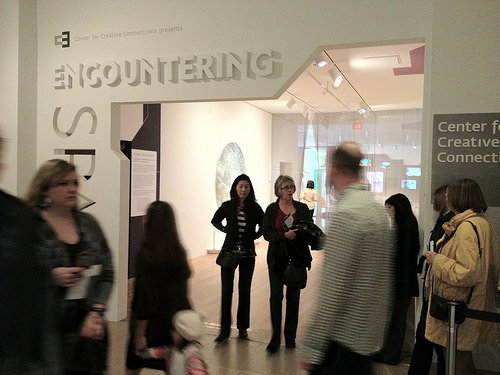
Encountering Space, Center for Creative Connections at the Dallas Museum of Art. Photo by Maria Mortati

Working in museums can be a messy, messy game, but I always love the conversations that crop up when you get a handful of museum educators together to talk ‘shop.’  A couple weeks ago at the National Art Education Association 2013 annual conference in Fort Worth, there was certainly a lot of that happening. I was fortunate enough to be invited to present — or rather have a public in-process conversation — about participatory culture in art museums with an incredible group of colleagues: Preston Bautista (Deputy Director for Public Programs & Audience Engagement, Indianapolis Museum of Art), Judy Koke (Director of Education & Interpretive Programs, Nelson-Atkins Museum of Art), and Susan Diachisin (Director of the Center for Creative Connections, Dallas Museum of Art).  By far, the best part of preparing our presentation was the series of winding, organic conversations that led to Fort Worth.

Not only were we all wildly passionate about visitor engagement and participatory practice, but our own working environments were all changing rapidly — from my own move from St. Louis to the Portland Art Museum this past fall, to leadership changes and various grants & innovation projects.  All in all, we were fairly hyper-motivated to talk about these issues with each other and, ultimately, to explore concepts of participation and exchange in our institutional cultures.

How does an institution’s hierarchy, leadership, and organizational structure actually enable (or disable) participatory practice? How could museum educators at various levels become more involved in fostering an institutional culture focused on visitor experience and engagement?  Could these values find ways of ‘trickling up’ from participatory programs and smaller-scale education projects or exhibitions?

“If … museums must move away from assumed public value and begin to measure their impact, and if … museums must achieve impact for the community instead of impact for the museum, then the impetus is on museum education to rise to the challenge that lies before us and reposition the museum in the eyes of the public.” — Tina Nolan, JME (2010)

As we entered our NAEA session entitled “Toward an Even More Participatory Culture in Art Museums,” we had decided on a set of assumptions that were key to making this a valuable and productive conversation:

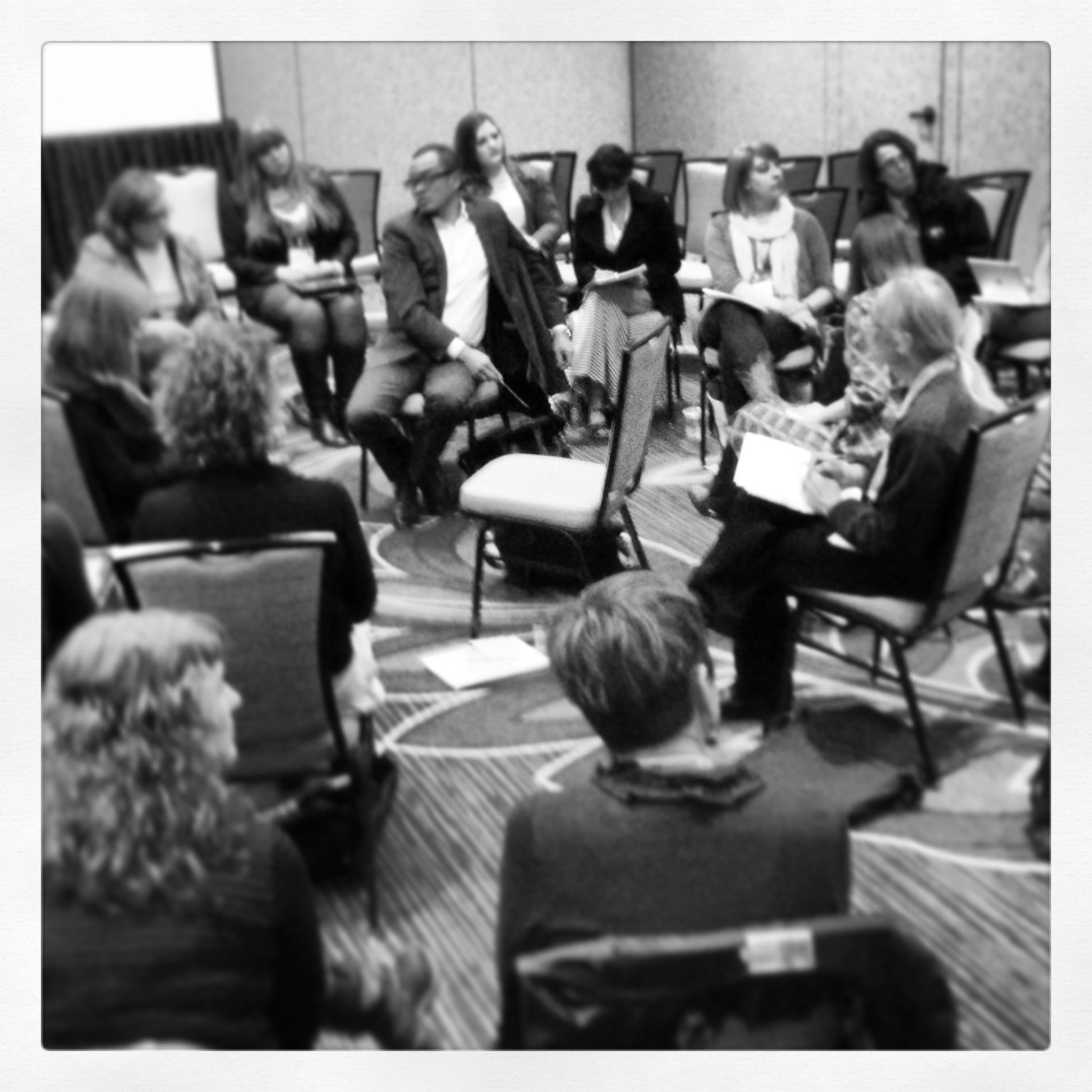
  • conversation at our sessiomn (yes, we exploded the traditional conference furniture layout)
    conversation at our session (yes, we exploded the traditional conference furniture layout)

    There is a shift happening.  Art museums across the continent are taking big steps to change the ‘business as usual’ model, creating structures to put the public’s expectations, needs, and experiences at the center of interpretive planning and exhibition development. We can see this in institutions such as the Detroit Institute of Arts (see great article by their Exec Dir of Learning & Interpretation), Art Gallery of Ontario, Denver Art Museum, Indianapolis Museum of Art, Nelson-Atkins Museum of Art, and the Philadelphia Museum of Art, among many others. In the specific realm of ‘participation’ and public engagement, it is always important to note the Irvine Foundation’s support for institutions such as the Oakland Museum, as well as museum “Innovation Stories” featured via EmcArts & ArtsFwd.  If you still need convincing that change is afoot, watch this video compiled by the Innovatrium at their January 2013 ‘think tank’ of museum leaders.

  • We’re all in this together. Instead of anyone pretending to be an ‘expert’ about these changes in organizational culture, we wanted to be conscious of the fact that we are all co-learning with each other.  It doesn’t matter the size of one’s museum or how involved your senior leadership is in this shifting landscape — we’re all working toward the greater public value and relevance of museums in our communities and beyond. And this needs to be an open, inclusive conversation if it is to be meaningful one.
  • You can’t talk about participatory practice without becoming participatory.  I always feel like every lecture on “visitor engagement” and “participatory practice” is, in part, quite disingenuous if it does not attempt to actually ENGAGE.  Even if an attempt to activate a lecture hall full of 200 spectators fails, I always feel that we should try — walk the walk, right?!  So I was able to convince our group to do a crowdsourcing activity to engage those attending our session, and pull out their ideas in a participatory way.

“For a museum to truly engage its users, it must cease acting as a controlling gatekeeper to its collections and expertise. Rather, the museum must work with its users and communities to unlock the stories its collections hold, responding to the choices its users make. As such, it must give up its traditional authoritarian voice so that users are free to question, debate, collaborate, and speculate — seeking out those issues that most concern them — and are given the support and inspiration required to do so.”  — Graham Black, Transforming Museums in the Twenty-First Century (2012)

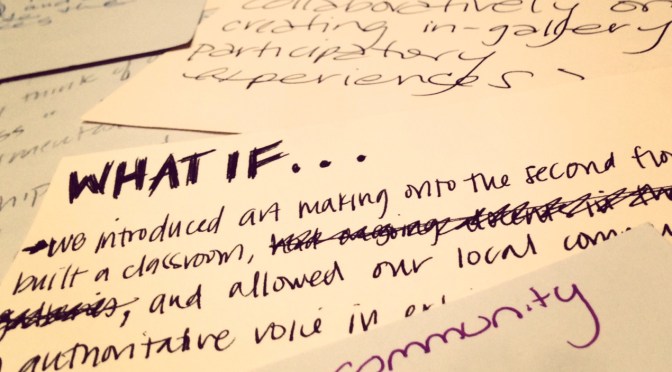
After our initial discussion and framing of these issues, we jumped right into the crowdsourcing exercise to activate everyone’s thinking and to have the group generate ideas. To prevent this conversation from quickly deteriorating into a litany of complaints, barriers, and reasons why we might not be able to enact change at our institutions, we granted everyone in the room freedom from all of these restraints … with a magic wand.  Therefore, without concern about budget cuts, personality conflicts, and perceived curatorial barriers, we invited each participant to take two or three minutes, envision some ways to engender a more participatory culture at their institutions, and then write down a “what if” statement on a small slip of paper.  We collected more than 50 “what if” statements, crowdsourced them with the group, and then spent the final chunk of time opening up a conversation around these ideas.  Here are the 4 statements that, at this moment and with this group, bubbled to the surface:

  1. What if everyone in the museum understood everyone else’s job?

  2. What if there was a real plan for interpretive team development of exhibitions and permanent collections? What if curators and educators didn’t feel like they were ceding territory when they worked together?

  3. What if educators/interpreters and curators worked collaboratively on creating in-gallery participatory experiences?

  4. What if I could include funds for “things I may think of after the budget process” [an “innovation” fund] when I’m writing my department budget?

sampling of the 50+ "what if" statements that participants brainstrormed for crowdsourcing
sampling of the 50+ “what if” statements that participants brainstrormed for crowdsourcing

Rather than recount the conversation or provide my own opinions, thoughts, and perspectives here, I wanted to take this opportunity to open the conversation … to OpenThink the “what if” statements we collected during our NAEA session.  So below is a link to all of the “what if” statements that we were able to collect, in no particular order. Feel free to peruse, and add Comments to the GoogleDoc if you choose.

>>Click here to see ALL of the “What If” statements<<

I invite you to share these with colleagues, send this to others at your museums (yes, curators, too!), and let’s create a conversation in the GoogleDoc or below in the Comment area.  Do you have a “What If” statement that you would like to add?  Are these concerns about exhibition planning, community involvement, and staff development similar at your institution, or different? How can we engender more participatory practice/culture in our work? in our institutions?


Gravity and Grace: Cross-Departmental Collaboration at the Brooklyn Museum

If I were stitching a sampler about some of my recent museum education work, it might start like this:

A is for Anatsui.  B is for Brooklyn.  C is for collaboration.

Photo by David Sky, seemsartless.com

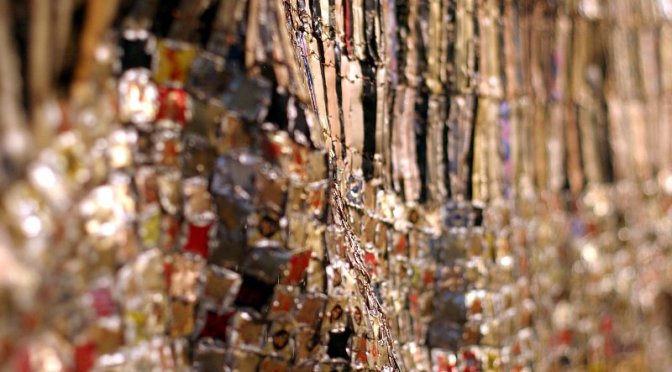
Where the rest of the alphabet would go, I’m not so sure, but those first three letters reflect my experience working on Gravity and Grace: Monumental Works by El Anatsui, the retrospective exhibition at the Brooklyn Museum.  Every show in every museum takes a dedicated team to pull it off, of course, but I’m taking this digital moment to highlight what’s been a particularly wonderful example of cross-departmental cooperation, which isn’t an easy thing, especially in a mid- or large-size institution.  In this case, it led to a variety of ways to engage with the exhibition that ultimately (I hope) makes the show a great experience for our visitors.

We have a downloadable Teaching Resource for teachers who want to bring their students to see the show.  We hosted a conversation between El Anatsui himself, Susan Vogel (filmmaker and author of El Anatsui: Art and Life), and Kevin Dumouchelle (the museum’s Associate Curator for the Arts of Africa and the Pacific Islands and curator of this show in its Brooklyn presentation):

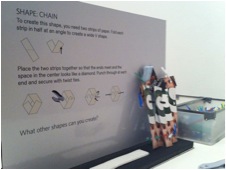
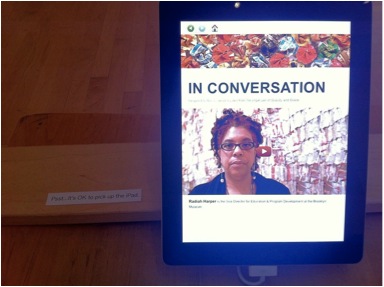
We have an in-gallery hands-on activity inviting visitors to use paper and twist ties to imitate some of the folds Anatsui and his assistants use to create his massive metal artworks (more on that in a bit).  We have iPad kiosks that solicit visitor responses to the art on display using video questions posed by museum staff.  We have QR Codes to scan for those seeking further context.  And that’s in addition to our array of tours, workshops, and art-making classes designed for families, students, and adults.  So many options for engagement!

So how did all this come about, and what made it so collaborative?

PaperFolding
Photo by Rachel Ropeik

My part in it started when I took on the role of Project Educator for the show.  The Education staff here divvies up a given year’s roster of special exhibitions to assign a Project Educator or two to each show.  These folks represent Education’s voice in interdepartmental meetings and help shape education programming during the show’s run.

From the get-go, Kevin generously shared his knowledge, thoughts, and time with me and Matthew Branch, my fellow Project Educator.  For Kevin, the collaboration inspiration started even earlier in the process: with Anatsui himself.  “The work is so open ended,” Kevin says.  “There was a real possibility for thinking big and thinking of options that we might have been a little bit more cautious about if we had more specific instructions from the artist.”

While some artists provide detailed notes for how their pieces should be installed, Anatsui likes to leave it up to the team at each location.  “That filtered down to every aspect of the show,” Kevin adds.  “Which made it a lot of fun.”  Take a peek at this time-lapse video of the show’s installation. As you can see from the art handlers, designers, and conservators involved, it took a team to get the show up.  Not to mention Robert Nardi in our Technology department, who made this video to share with the internet at large:

Go, team, go!

Adding her enthusiasm and creativity to the mix was Sara Devine, the museum’s Manager of Interpretive Materials, who made sure we had a hands-on activity in an exhibition full of objects that, oh man, do you ever want to touch.  We can’t touch the art, but thanks to Sara’s input, we can do our own tactile experimentation.  Physically embodied engagement?  Check. Multimodal sensory inputs?  Check.  Music to the ears of any art educator.

iPadScreenshot
Photo by Rachel Ropeik

Sara also enlisted representatives from our curatorial and education staff (and, again, Technology’s cooperation) to record several 30-second video clips that ask visitors questions about the exhibition and invite them to enter their responses on iPads throughout the galleries.

All in all, it’s an exhibition that offers visitors a range of ways of interacting, and it could only have been done by creative interdepartmental teamwork. As Sara states:

“I know it sounds pretty obvious, but what allowed this exhibition to be a good example of cross-departmental collaboration was an ongoing and open line of communication, which is surprisingly rare. I think we all very easily get caught up in our own part of the process and forget to reach out, ask for input, and keep others informed. We all made a conscious effort to communicate and I believe that is the biggest reason our collaboration was so successful.”

I couldn’t have said it better.  This opening up of the closed doors–be they metaphorical or literal–between departments is a way many museums approach (or are starting to approach) their work, and it’s an exciting prospect to look forward to.  In Mike Murawski’s recent post about the Museum Education Division sessions at this year’s NAEA Convention, he noted that we’re in “a moment when many major museums are re-imagining (and, in some cases, totally disrupting) the traditional relationships between education and curatorial.”  Sure, it may be testing uncharted waters, but when it works (as it has with Gravity and Grace), it can produce amazing results.

How have you worked to open lines of communications across departments at your institution?  Join the conversation below, and share some of the best collaborations you have been involved with.

The Landscape of Arts Inclusion in Public Schools

Emily Shallman and I started talking about exclusion in arts and education while we were both working on our respective Master’s degrees. Lately, I have been eager to ask her to blog about her extensive research in inequitable access to the arts in public schools. Her findings suggest that museums, along with many non-profit arts organizations, are needed as key partners in providing equitable arts engagement and learning for students. Emily’s research prompts me to consider the museum’s place in the “landscape” of arts access, best practices for partnering with schools, and if museum’s are achieving their full potential to impact students. How are different art museums sustaining partnerships with public schools in high poverty areas? Are museums offering comprehensive arts education that represents art across cultures and communities? With more dialogue about these questions art museums can become more inclusive parts of this “landscape” themselves. – Aletheia Wittman, The Incluseum

You can also read this post in its entirety on The Incluseum website, including additional citations and notes. The Incluseum is a blog and project to promote social inclusion in museums coordinated by Rose Paquet Kinsley and Aletheia Wittman. Art Museum Teaching and The Incluseum are co-hosting this post in hope that Emily’s work and observations can catalyze a broader dialogue among museum professional and educators.

* * * * *

artwork-hangingArts education is a complex system today, as public schools–in conjunction with Parent Teacher Associations (PTA’s), local arts organizations, teaching artists, art specialists, volunteers, museums, school boards, the state legislature, and national policy–work in collaboration to deliver the arts to children. This intertwined web of arts advocates is a reaction to the worsening reality that the arts are no longer a stable piece of public school curriculum, with many schools excluding the arts altogether. The arts have had to react, and find a solution for inclusion in this landscape of severe budget cuts and focus on math and literacy. Rather than demanding to be included in the daily curriculum, with a mantra of “Do not cut the arts,” the arts have forged new partnerships to keep arts education alive in some public schools.

Let me paint the picture for you as best I can in an effort to make arts education more transparent, so that you can see how you fit into this landscape, and where there is room for improvement.

Schools, in the way they deliver (or do not deliver) arts education to children are highly diverse. This diversity means that public school A in Los Angeles, CA, is very different from public school B in San Francisco, CA, based on school population, size, parent involvement, student engagement and achievement, and of course, arts education. In the same way, public school B in San Francisco is also drastically different from public school C in San Francisco. Public schools are increasingly centered on the local, as arts education funding (at least in California) is distributed by local school districts. This distribution of funds, while on the surface entirely equitable, is not.

While each public school may get an equitable amount (based on school population and size, among other factors), PTA’s can quickly change the picture of arts education. More affluent schools tend to have more active PTA’s, and usually raise additional funds for academic programs that they value (and this sometimes includes the arts). Moreover, schools can decide how best to use the money they do receive—does this mean hiring a teaching artist for a week-long intensive for third graders in dance instruction, or does it mean buying new music stands and replacing outdated instruments, or does it mean using these funds to add to the overall school budget to help save a teacher from getting laid off (and hoping that teacher involves her students in arts learning)?

As you can see, arts education in public schools gets complicated quickly, and the picture can also seem rather bleak. However, I believe we are in a golden age of opportunity and collaboration.

Getting Arts Education into Public Schools

Local arts organizations, arts non-profits, and museums, have been afforded the opportunity to help deliver arts education to public school children. These institutions can provide a critical piece of learning to students, and if the success is documented, these collaborations can have a large impact on student learning. Unfortunately, there is no one model to follow when it comes to arts education delivery. As schools are centered on the “local” so is the delivery of the arts. The report from the President’s Committee on the Arts and Humanities (2011) summarizes this nicely, stating:

Photo by Michael Baltz

“Almost every community—indeed almost every school—that tries to address the vexing problem of how to get more arts into schools does so differently. A complex patchwork of arts education services across the country is the result, representing a mix of delivery models that include standards-based sequential arts curricula taught by arts specialists; formal and informal arts integration strategies; and short and long term teaching residencies for artists…There is no one model that works best for every community, and no single solution for the host of economic, pedagogic and logistical challenges faced by arts education advocates.”

Much progress is still to be made in terms of equitable and engaged learning with the arts, however. Interestingly (as based on my thesis research), a local elementary school in San Francisco with a high-poverty student population was a target of grant funding for the arts and actually had so many arts programs that the teachers were concerned about having enough time to teach other subjects. Comparatively, another elementary school in San Francisco, with an average socioeconomic student population (neither affluent, nor high-poverty) had very limited arts education, despite a very vocal and committed PTA full of arts advocates. Lastly, another elementary school in San Francisco, with an affluent student population and a highly involved and highly funded PTA, had hired a full-time art specialist (a very rare occurrence, I can assure you) to teach sequential visual art to all students for an hour each week. The national trend, however, is still that those students in the highest poverty areas are the ones with the least amount of arts education, and are those that could most benefit from them.

Pioneering Partnerships

There are substantial connections and programs to be cultivated with schools and outside organizations to bring quality arts education to all children. The arts, more than any other academic subject, is an area pioneering these partnerships. One successful example is seen at the Children’s Creativity Museum (CCM) here in San Francisco. At CCM, public and private elementary-school through high-school students can participate in creative field trips such as claymation, music studio, or innovation lab taught by museum educators.

art-collagesHigh school students can work at the museum in the C.I.T.Y. (Creative Inspiration Through Youth) Teen Program, a paid employment opportunity, helping run exhibits and getting job experience in an arts non-profit environment. In addition, CCM has a growing outreach program, teaching claymation workshops at after-school programs in the Bay Area. While CCM’s programs are quite established and the link to childhood and youth arts education is evident, I know of other arts institutions that are taking baby steps toward inclusion. For example, some art museums now have field trip guides (sometimes just a folded pamphlet) for elementary students to learn about famous artworks in understandable language.

Arts advocates, one school at a time, are inserting the arts, sometimes briefly, to change the landscape of learning. Hopefully this trend will continue to gain momentum. I know that it takes a whole ecosystem of arts advocates, from those working at the national and state level who make policy that supports equitable and quality education, to those at the local level, who raise additional funds for arts education to be taught in public schools, to teachers who understand the importance of the arts, to researchers who publish this knowledge, to people who have been impacted by the arts who share their stories to create more arts advocates.

Wouldn’t it be wonderful to have a full-time arts specialist in every school, in addition to a visiting teaching artist and relevant field trips to museums, as well as after-school arts programs by local arts organizations? Just think of all those students could accomplish!

How are different art museums sustaining partnerships with public schools in high poverty areas? Are museums offering comprehensive arts education that represents art across cultures and communities? With more dialogue about these questions, art museums can become more inclusive parts of this “landscape” themselves.

Arts Education Advocacy Resources

EMILY SHALLMAN has a BA in Elementary Art Education with a Washington State Teaching Certificate and Reading Endorsement from Western Washington University, and a MA in Urban Studies from the San Francisco Art Institute. Emily has experience as an Art Specialist, teaching visual art to grades K-5. Her MA thesis researched the history of arts education in public schools, as well as case-study analysis of the inequality of arts education based on socioeconomic factors. Currently, she works at SFAI, serves as a Board Fellow for the California Alliance for Arts Education and runs a children’s illustration blog www.illustrationsby.com. She lives in San Francisco, CA with her husband and two cats.

NAEA 2013 Breakdown – Museum Edition

Photo by Thomas Hawk
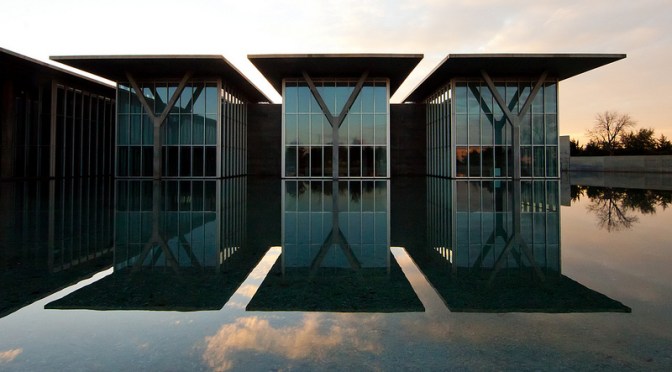
Modern Art Museum of Fort Worth, one of the places hosting NAEA museum preconference activities and a must see while in Fort Worth. Photo by Thomas Hawk

Once again, art and museum educators from across the country (and outside the US) begin to pack their bags and prepare to head to Fort Worth, Texas, next week for the National Art Education Association annual conference (March 6-10). And I thought it would be interesting again this year to offer another quick breakdown of the sessions being offered in conjunction with the Museum Education Division. There are some great sessions being offered this year, in addition to an exciting pre-conference program run by the Museum Division that will for the first time include lots of in-gallery teaching focused on some of the great collections in Fort Worth.

The following stats are pulled only from sessions officially labeled “Museum Education,” so keep that in mind — there are certainly lots of other sessions across divisions that engage with museums, museum learning, and how museums interact with schools and higher education (and I always encourage museum educators to branch out and participate in sessions beyond our “comfort zone”).

But within our own Museum Education Division, here is what it looks like this year at a glance. Click here to compare with last year’s numbers.

Total Museum Education Sessions: 75

Total museum educators presenting: 159 (plus or minus — with 23 people presenting more than 1 session this year)

Most Frequent Session Topics:

  • Visitor/Audience Engagement (various ways of being more responsive to our audiences and visitor needs, etc.) – 11
  • Teacher Professional Development – 9 (duh, it’s NAEA — thousands of teachers attending)
  • K-12 Museum/School Partnerships and School Programs – 8
  • Technologies (iPads, blogs, online communities, etc.) – 7
  • Family Programming – 6
  • Interpretive Resources (gallery didactics, print, web, and mobile) – 6
  • Peer Learning & Communities of Practice (for museum professionals) – 5
  • Art Making & Working with Artist – 5

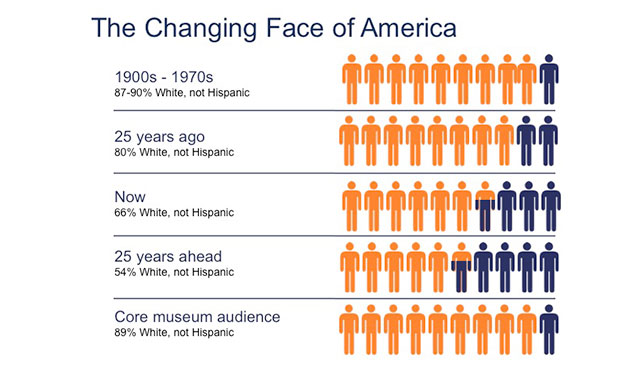
Rather than focusing on what IS popular or in the spotlight this year, I’m so much more interested in what is NOT so popular or prevalent. After reviewing all of these sessions, I found it interesting that the least frequent topics (although still addressed by someone) include Latino outreach and curatorial collaborations. These both seem cause for concern. Our museum recently has some great senior staff discussions around the November article “Diversify or Die: Why the Art World Needs to Keep Up with Our Changing Society” (see the powerful graphic below). Author Ben Davis quotes the 2010 Center for the Future of Museums (CFM) report “Demographic Transformation and the Future of Museums,” worth a read for what it says about the scandalous state of diversity in the visual arts:

“This analysis paints a troubling picture of the ‘probable future’ — a future in which, if trends continue in their current grooves, museum audiences are radically less diverse than the American public, and museums serve an ever-shrinking fragment of society.”

changing-face-of-americaWhile these issues may come up more frequently at AAM, ICOM, or other professional conferences with wider participation than arts educators and art museum educators, the issue is certainly something we, as a field, must be addressing as central to our work. Perhaps these issues will find themselves woven into myriad sessions on visitor and audience engagement in general, but I do fear that when we use the words ‘audience’ or ‘visitor,’ there is a chance that we might unintentionally still be thinking of white, non-Hispanic visitors. I only present this as a potential spark for some conversation, and I’m always open to being corrected and proven wrong (please, prove me wrong here!).

In addition to this blind spot, I also am concerned about the lack of sessions pushing core collaborations with curators — an area that was also severely lacking last year at NAEA. This year, the word ‘curator’ was only mentioned twice in any of the 75 Museum Education Division sessions. At a moment when I know that many major museums are re-imagining (and, in some cases, totally disrupting) the traditional relationships between education and curatorial, this lack of engagement via this year’s NAEA sessions is worth notice. Especially because I know that this issue will find its way into most of the dinner conversations each night in Fort Worth as well as the quick coffee chats we have in the halls between sessions, as it did last year. I am guilty myself, as we have not drawn much attention to this here at ArtMuseumTeaching.com. Given this, I would love to find ways to share the successes and failures of our curatorial collaborations and partnerships, and find ways to push this type of work forward. If you are doing work in this area, let’s get some posts up to shine some much needed light on these collaborations.

Lastly, when I ran a quick analysis of the session titles and short descriptions this year, the most common words used (outside of “art” and “museum”) were, in order of frequency: community, visitors/audience, learning, education, and engagement. While I’m not sure how much this actually tells us, I continually find it interesting to examine the language and vocabulary we use to describe the work we do as museum educators (in fact, there is a session on this very topic on Thursday morning, “Intentional Language: How We Describe Museum Education Can Make All The Difference”). This year, the word ‘community’ rose to become the most common word in the session descriptions, followed by visitors and audience — perhaps showing a bit of a shift in how we are perceiving our work and its relationship with the communities in which we exist. A couple of the least common words to note are ‘curator,’ as mentioned, as well as ‘experimental’ (something we should be doing and sharing more and more).

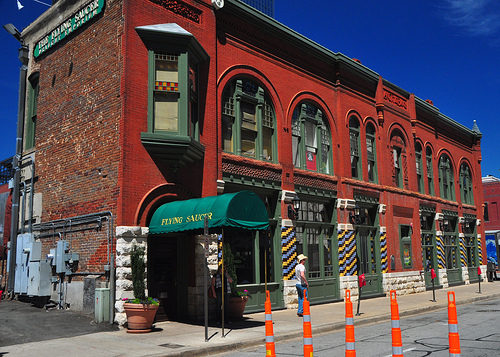
FlyingSaucerFor those of you attending the NAEA Convention in Fort Worth next week, I would like to extend an invitation for you to join the editors and authors of ArtMuseumTeaching.com for a casual Happy Hour event on Thursday, March 7, from 5-6pm at the Flying Saucer (111 E Third St, a short walk from the Convention Center). We’re interested in continually extending and opening up this conversation, and wanted to find a moment at NAEA to pull together anyone who has been involved in the project thus far, as well as anyone interested in learning more.

What: ArtMuseumTeaching.com Happy Hour
When: Thursday, March 7, 5:00-6:00pm
Where: Flying Saucer in Fort Worth, 111 E Third St

I look forward to seeing many of you in Fort Worth, and also getting more of your voices and perspectives involved in the ArtMuseumTeaching.com community!

Reimagining Peer Networks in a Digital Age

By Mike Murawski, Portland Art Museum; Dana Carlisle Kletchka, Palmer Museum of Art, Pennsylvania State University; Elyse Eidman-Aadahl, National Writing Project, University of California Berkeley

“People’s relationships remain strong—but they are networked. Neighbors, and neighborhoods still exist, to be sure, but they occupy a smaller portion of people’s lives. It is hard to borrow a cup of sugar from a Facebook friend 1,000 miles away, but it has become easier to socialize, get advice, and exchange emotional support at whatever distance. Where commentators had been afraid that the internet would wither in-person ties, it is clear that they enhance and extend them.” (Lee Rainie & Barry Wellman, Networked: The New Social Operating System, 2012).

In their recent book Networked: The New Social Operating System, Lee Rainie (director of the Pew Charitable Trusts Internet & American Life Project) and Barry Wellman (Professor of Sociology at the University of Toronto and Director of NetLab) have argued that the large online social circles of familiar platforms such as Facebook, Twitter, Pinterest, etc. actually expand opportunities for learning, problem solving, decision making and personal interaction. Their work at the Pew Internet Project and the NetLab (especially research for the Connected Lives Project) suggests that digital technologies are not isolated — or isolating — systems, but rather networked systems built upon these social networking platforms as well as mobile device technologies.

As Rainey and Wellman remind us (although we need no reminder):

“Daily life is connected life, its rhythms driven by endless  email pings and responses, the chimes and beeps of continually arriving text messages, tweets and retweets, Facebook updates, pictures and videos to post and discuss. Our perpetual connectedness gives us endless opportunities to be part of the give-and-take of networking.”

But how do we—as museum and arts education professionals—maneuver within a technology-mediated world in a way that allows us to cultivate productive, human-centered networks and communities? Museums and schools have been widely engaged in how digital media and technology can connect them with their students and audiences. But what about the potential of these same technologies to build entirely new “communities of practice” among professionals—whether art teachers, university faculty, or museum educators?

These questions are at the core of a series of conversations that we will be facilitating over the next several weeks, centered around a panel discussion that will be part of the National Art Education Association annual conference in Fort Worth at the beginning of March. Through these organic and open conversations, we hope to begin exploring models of human-centered professional exchange and peer networks suited to the increasing complexity, connectivity, and velocity of the 21st century. Drawing on innovative work from the National Writing Project (such as Digital Is), sites of exchange such as this one (ArtMuseumTeaching.com), and connected learning models developed with MacArthur Foundation’s Digital Media and Learning Initiative, we’ll be discussing how online networks and communities can harness the power of emerging technologies and social media to share, collaborate, curate, and participate with peers both today and in the future.

One way to more easily digest this sizeable topic is perhaps to take it one bite at a time.  So we’re excited to be facilitating two public “on air” Google Hangouts along with the session at NAEA—one hangout prior to the conference to take that first bite, and one a couple weeks after the conference to extend our thinking and perhaps follow-up on questions raised in the panel.  The online Google Hangout format also allows us to potentially engage a wider range of people than just those attending the NAEA conference, while at the same time practicing one of the most widely used technologies for face-to-face online engagement.

CONVERSATION #1 – Come Chat With Us via Google Hangout

“What Do WGoogleHangoutIcone Want from Online Communities of Practice?”

Open Google Hangout w/ Mike Murawski, Dana Carlisle Kletchka, Elyse Eidman-Aadahl

Thursday, February 28th – 1:00pm Pacific / 4:00pm Eastern

For this preconference conversation on Google Hangout, we thought we might simply ask:  “what do we want from online communities of practice and peer networks?”  What online networks and communities are you involved with? When you consider jumping into a new online community, what do you hope it will achieve?  What types of exchanges and experiences keep us engaged and prevent us from leaving (or ignoring) the online network? During this conversation, we were able to gather your thoughts, questions, and experiences which will inform our discussion at NAEA on March 7th.

View the YouTube recording of the “On Air” Google Hangout here:

Couldn’t join the Google Hangout?  Watch the broadcast above, and please add your thoughts and perspectives to the “Comments” section below, and we’ll utilize this space to keep the conversation going.

CONVERSATION #2 – NAEA Conference Session

NAEA_logo  “Reimagining Professional Exchange & Peer Networks in a Digital Age”

  NAEA Panel Session w/ Mike Murawski, Dana Carlisle Kletchka, Elyse Eidman-Aadahl

  Thursday, March 7th, -12:00-12:50pm, Meeting Room 121C/Center/1st Floor

At this session, we gathered with a great group of peers to share some of our own experiences working as developers, researchers, and participants in online networks and communities of practice, but also spent time opening up the conversation about key issues (many pulled from the preconference Google Hangout).  For example: how do we promote online ‘contributing’ instead of just online ‘visiting’ when it comes to these experiences? What are some ways to build co-learning interactions online?

Couldn’t attend the session?  Please feel free to connect with either of the Google Hangouts, or chime in via the “Comments” section below.

CONVERSATION #3 – Reconnect via Google Hangout

GoogleHangoutIcon“The Digital Follow-Up: How Do We Drag Everyone Back to Their Screens?”

Open Google Hangout w/ Mike Murawski, Dana Carlisle Kletchka, Elyse Eidman-Aadahl

Thursday, March 28th – 1:00pm Pacific / 4:00pm Eastern

One of the most difficult things to motivate busy museum and education professionals to do is to reconnect online after the conference or workshop.  While we all know the values of extending these relationships and opportunities to reconnect, it can be so difficult to make these a reality.  It only seems appropriate to make this one of the topics of our own ‘digital follow-up’ discussion.  How do we manage and nurture online professional networks so that members stay active, build stronger ties, and feel supported?  We also kept this follow-up conversation open to issues and questions that were addressed in the panel session at NAEA.

View the YouTube recording of the “On Air” Google Hangout here:


We look forward to continuing this exciting series of conversations!  If you have any ideas for a future Hangout or online get-together, let me know and we can work to schedule here within the ArtMuseumTeaching.com community.

Reposted through the National Writing Project’s Digital Is website.

Sweet Spots for Engaging Parents in Family Spaces

Museum Educators know that providing experiences for family audiences are a valuable way to advance the museum’s mission, expand its audience, and strengthen its place within the community. A relatively new way many museums are providing for families is with interactive exhibits. In recent years, these family spaces have evolved from engaging only children to engaging the entire family.

This shift has opened up new areas of study in family learning, broadly defined by the Family Learning Forum as “a special form of free-choice learning” that results in “shared meanings among and between family members.” I like this definition because it presents children and adults as being equally active in family learning. While many family programs and family spaces in museums focus on outcomes for children, I wondered what I could learn if I studied the adult half of the family learning equation. In 2011, I took a look at how adults, in the context of their families, used the Building Zone, a family space located in the National Building Museum in Washington, DC. Through observations and surveys, I uncovered a few sweet spots for parental engagement.

Blocks

photo by ijiwaru jimbo

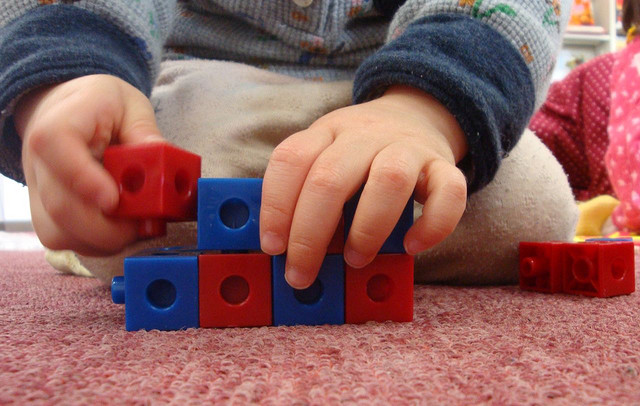
I already knew that blocks provide endless learning opportunities for children, but now I’m starting to think they are the absolute perfect toy. The majority of parents’ active engagement took place in the Building Zone’s two block areas. One at the front of the room consists of bins of small blocks with various architectural shapes and designs and larger foam blocks. The other block area spans the back wall of the room and has two different types of large plastic interlocking blocks. The block areas were the most popular places for caregivers to actively play with their children. I even occasionally observed adults building structures by themselves.

There is just something about the act of building that excites people of all ages. In her recent blog post, Gretchen Jennings makes this observation about museum Maker Spaces:

I also think their emphasis on family and multi-generational participation is a welcome change; often discovery and play spaces have been perceived, either because of their design or because it was assumed, as places for kids only, and adults just stood and watched or wondered off to see the rest of the museum.

My theory is that blocks can be interacted with on many different developmental levels. It doesn’t matter whether the fun stems from exploring the cause-and-effect relationship of knocking down a tower or exercising complex problem solving and abstract reasoning skills – blocks can interest people all ages. The adults I observed were much more interested in helping their children build than pretending to drive a toy truck.

Books

Photo by Svante Adermark

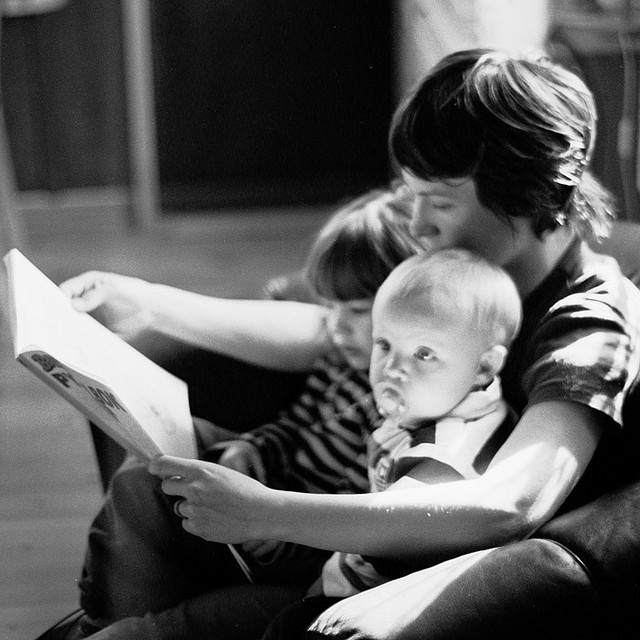
Another common area for parental engagement was the Book Nook, a corner of the room with pillows on the floor, bookshelves, and a few puppets. As with blocks, adults seemed comfortable interacting with their children around books. The children in the Building Zone were all pre-readers, so this is another area in which caregivers could use their knowledge and skills to help their children. The Book Nook was also the only area, aside from the block areas, that I observed adults engaged with the materials by themselves. A couple of times, I saw adults reading the children’s books silently to themselves.

Again, I believe the books appealed to the adults’ developmental level. Stories, like blocks, can be approached and interpreted in different ways. High-quality picture books have layers of meaning embedded in their text and illustrations that require abstract thought and background knowledge to understand.

Benches

The two adult-sized benches in the middle of the Building Zone were one of the most popular places for adults to be in the family space. While caregivers played the most in the block areas and the Book Nook, a different kind of engagement was taking place on the benches – caregivers were observing the children.

Part of the Family Learning Forum’s definition of family learning is learning about each other. While Susie Wilkening of the Reach Advisors is right to be concerned when parents don’t engage with the museum content at all, I think it’s important not to overlook observing one’s children as a form of parent engagement. This is especially true when you consider that the adults I surveyed hoped that they would be able to observe their children playing in the Building Zone and said that being able to observe their children having fun is one of the things that makes a family experience positive. I’m curious to know what readers think about active versus passive forms of parent engagement. To what extent should museum family spaces be designed to encourage parent’s active participation, and to what extent should they be designed for passive observation?

Museum family spaces are sites for complex social interactions and learning experiences. Focusing on the family as a whole in the areas of family learning and parent engagement allows museums to create meaningful experiences for all their visitors. Have you noticed any sweet spots for engaging parents with children in your museum?

A Teaching Interview: THE Audition for Museum Educators

Stricken with those awful nerves that overcome your system while you try to remember those lines you were up past midnight cramming into your head, you cling to your crumpled, dingy papers for dear life – the papers that contain the information you were trying so hard to memorize, the statements you need to naturally and conversationally say. You know you know it, but every time you try to say something without glancing at your papers that are quickly becoming damp from your sweaty palms, your brain freezes. Your name is about to be called as you sit in the uncomfortable chair, fidgeting with the sticker that betrays your best outfit. Doors swing open, and a smiling voice says, “We are ready for you.”

This scenario easily depicts almost every audition I’ve ever had. It also depicts the ‘teaching interviews’ or ‘sample tours’ or even ‘classroom simulation’ I and many other museum educators have had to do as part of interview processes. As a still-sometimes actress, if it quacks like a duck and looks like a duck, call it a duck – museum educators audition for their jobs. A lot. Good monologues do not get actors cast – and good information doesn’t always get museum educators hired. Technique plays a large part in both careers, posing the question: Isn’t it about time we start paying more attention to how we are saying things, and not just what we are saying?

Teaching AuditionIn an audition, the actor is usually provided with an opportunity to bring in a prepared monologue. The actor will perform said monologue and the director makes a decision if the actor is getting called back or sent on their way. Generally speaking, the actor will spend hours, days, even weeks finding that perfect monologue that not only showcases their skill set as a performer, but also connects with the particular role they are auditioning for. If an actor is auditioning for Cosette in Les Mis, their first choice wouldn’t be a piece that brings people to gut-busting laughter. Sounds a little familiar, doesn’t it?

For the teaching interviews I’ve had the pleasure and anxiety of experiencing, it all starts with successfully completing the in-person/phone interview. Then there is the nerve-racking moment of reading the invitation to do a teaching interview. While each institution is different, usually the main idea is to assemble a sample tour (or tour stop) and, with a nod to multimodal learning, an activity for that stop. Usually the prospective educator has about a week to put together this stop and spends countless hours researching the collection, choosing objects, picking that ONE object that will showcase knowledge, teaching skill and personality. Just like an actor auditioning for a role.

actors warming up prior to auditions

But actors will warm up before auditions – take 10 minutes and walk into Ripley-Grier and see dozens of actors at all times doing tongue twisters, stretching, working on breath support and even adjusting their posture. They’ve realized that it’s not just about what you are saying – while the selection is important, it’s equally about how they are saying those words. There is the old adage that you can make people interested in a banana bread recipe if you are interesting enough. In museum education, you might know every fact about Rembrandt and his Self Portrait that hangs exquisitely in the West Gallery at The Frick Collection – but, if you can’t capture your audience and if you can’t be heard, then what?

Some museums are picking up on this idea and calling it what it is.  I had the pleasure of being at the Denver Nature and Science Museum at the end of January to lead professional development workshops and found they audition their education staff. There is an educator position entitled “Performer – Facilitator” and part of the interview is a legitimate audition. According to David Allison, Visitor Programs Manager, and Samantha Richards, Educator/Coordinator for Earth Gallery Programs, after the telephone interview, “they [the candidates] are asked to prepare a monologue and a science facilitation…we also have them do a ‘cold read’ of a script.” When asked why, David replied, “The cold reads show us the comfort level they have with improvisation and the ability to ‘ramp up’ their performance on the spot…the prepared pieces both shows us how well they prepare and also what their instincts are around performing and presenting dynamic shows to our guests.” Samantha added, “The cold read also shows us their performance skills…it is as much about how they wear the cape and how engaging they are as how comfortable they feel.”

For the educators who are uncomfortable with the performance aspect, DMNS has an alternative. According to Samantha, “We do also offer the option of reading two contrasting stories instead of monologues.” The audition section of the job description itself is very clear:

Two contrasting monologues (e.g. comedic and dramatic, 3-5 min each) with some movement;

OR

Choose two children’s stories to read. For one, pick 2-4 pages to read as if you were reading one on one with a child. For the other pick 2-4 pages to read as if you were reading to a large group, where you would need to use dramatic voices and movement to tell the story.

David added, “Some educators take to it quickly and can easily adapt. Others struggle. We can generally tell very quickly if someone is a good fit or not for our team.”

The audition aside, DMNS also does ask for a science facilitation – the information and research is still there. They are also focusing just as much on the presentational aspect of the positions. Samantha added to this idea: “It is very important that our staff is comfortable doing everything from talking to one child about a rock to wearing an astronaut suit and ‘being’ an astronaut in front of a hundred visitors.”

Teaching interviews are not much different than auditions. As educators, it’s time to start focusing on how we are saying the things we are saying. Take an improv class. Do deep breathing before a tour. Pull out some tongue-twisters to get the muscles in your mouth ready to say those artist names and movements without tripping over syllables. We are not actors – but – we have an audience. And taking advantage of every trick of the trade will only make us more engaging and our passions more interesting. In the words of Kid President during his pep talk, “Boring is easy, everybody can be boring. But you are gooder than that.”

Have you had a teaching interview/audition? Does your institution conduct them? How did/do you prepare? Should more museums have auditions and practice-based interviews for education positions?

What Do You Customize? OMCA’s we/customize project

The we/customize project at Oakland Museum of California explores the Bay Area perspective on the popular cultural activities of hacking, remixing, tailoring, modding, mash-ups, kit bashing, and customizing. The connecting spark in each of these spheres of activity is the shared impulse of the maker to radically alter the familiar to personal standards.

we/customize was born of a conversation about custom motorcycles, and grew into something akin to adulthood as the consequence of friendship and collaboration.

As non-participants in this part of our culture, Carin Adams­ (Associate Curator of Art and Material Culture) and I (as the Research and Experience Coordinator) were trying to find the kernels of interest connecting us to choppers. This lead us to observe how people form communities focused on the radical alteration of objects, how these groups self select themselves, and develop identity by means of their chosen activities. To round out the team and help us think about connecting disparate groups, Carin and I asked Evelyn Orantes (Senior Experience Developer) to join us to create our curatorial trio.

To create an exhibition around the activity of customization and the associated communities, we set out to develop the project differently than through the traditional museum approach. Our goal wasn’t to create a new working model for museum exhibitions, nor would we necessarily recommend the particular path we took. We wanted to have fun putting the project together while finding a means to exhibit the content we felt was the most exciting. This subject matter lent itself to be sifted out of conversations and by building relationships with these communities. Our process of content development, did however, reinforce the changing role of the museum as a forum for living cultural activity.

To build the exhibition in conversation with audiences – we made our initial public foray on two fronts. First by going out into the public at Oakland Art Murmur and asking people on video – “What do you customize?” The second, we hosted a panel discussion at OMCA, with Johnny Chung Lee, Jesse Hernandez, and Daniela Rosner about their work and views on customization. These conversations became the basis for how we framed our research, and the public interviews remain part of the content.

To further the dialog, we began with our interviews and panel discussion, we decided to continue going out into the public to build the content for the exhibition. This decision either allowed or forced us to divide the public side of the project into three main phases.

PHASE I: September 26–December 22, 2012

Photo by Ryan LeBlanc

Using the Oakland Rover—a Might-E Truck by Canadian Electric Vehicle, customized by designers Martin Sprouse and Dan Rosenfeld for Oakland Museum of California, we traveled throughout the Bay Area engaging communities in creative projects that explored how people modify objects to serve their own needs. From toy hacking to airbrushing, sound remixing and bike modification— Oakland Rover programs led to rich interactions with the public, who contributed their projects and ideas. These “missions” featured customizers who brought the public a variety of workshops, demonstrations, and participation in the conversation about customization.

The first phase of our project also saw the launch of our social media campaign to continue our conversations with the public online with our blog (wecustomize.org) and on Twitter (@OaklandRover). These exchanges gave us valuable feedback shaping the second and third phases of the project.

PHASE II: December 22, 2012–January 28, 2013

The Oakland Rover’s missions ended when it rolled into OMCA’s Great Hall on December 22. The exploration of customization continued with the transformation of the gallery itself. With paint still on the walls from the previous exhibit, we filled in the space with findings from the Oakland Rover missions as well as visitor input. Starting January 4, guest customizers began on-site demonstrations of their work and invited visitors to join their projects. From scraping out bikes to toy hacking to clothing customization, visitors helped us prototype the Customizer-In-Residence Series and develop interactives.

Photo by Johnna Arnold

PHASE III: February 9, 2013­–June 2, 2013

The final phase of the we/customize project is the exhibition, exploring the many forms of customization. The weekly Customizers-in-Residence Series will activate the space through live interactions with people from a variety of customization groups. Through the four months of the exhibition, the space will continue to build, with new projects by both our audience and our Customizers-in-Residence living in the space.

Photo by Johnna Arnold

While planning the project we realized a tradition opening celebration was out of context with our intent. As the exhibition transforms over time – as a consequence of customizers on site and the objects we’re accumulating – we realized the exhibition wouldn’t be complete until the show closed. With this in mind, we’ve planned on brining all the Customizers-in-Residence as well as museum staff together for a final closing party. Not only as a celebration of the conclusion of the project but our final attempt at igniting that initial spark, within each of these spheres of activity, in a culminating experience.

“What do you customize?” – Join the Conversation

The we/customize project began when we asked ourselves how we connect across communities. We launched the project by asking the public “What do you customize?” While we’ve refined our questions as the project developed, we still want to know – What do you customize? What do you start with? What tools do you use? and Why? Where is the boundary between a customization and an invention?

Authors/Project Collaborators:

seanSean Olson is the Research and Experience Coordinator at the Oakland Museum of California, and is a member of the we/customize curatorial team trio. An artist and an educator, he has an MFA from Mills College. He has taught at Diablo Valley College as well as Mills College. Sean lives and rides his bike in Oakland. Look for the guy with the custom dress shoes with SPD cleats.

CarinCarin Adams is the Associate Curator of Art and Material Culture at the Oakland Museum of California and is a member of the we/customize curatorial team trio. She joined OMCA in 2006 as curator for the off-site exhibition program at Oakland International Airport. A resident of Oakland and the mother of two, Carin has an endless supply of toys to hack. She has BFA from California College of the Arts and a MFA from the Art Institute of Chicago.

evelynEvelyn Orantes is the Senior Experience Developer at the Oakland Museum of California, and is a member of the we/customize curatorial team trio. With over a decade of museum work at OMCA under her sparkly belt, she delivers meaningful moments of honor, discovery, memory and inclusion for visitors, from the annual Días de los Muertos special exhibition to programs stimulating the minds of all ages. A graduate of UC Berkeley, she is the queen of California culture mash-ups, dishing the authentic complexities of California, one exhibition or program at a time.

A Forum for Reflecting on Practice