Category Archives: Spotlight on Practice

How Can Museums Change Teens — and Vice Versa?

Written by Chelsea Kelly, Milwaukee Art Museum

Over the past four years, I have worked with hundreds of Milwaukee-area teens who love art, and who, over their time in teen programs at the Milwaukee Art Museum, grow to love museums as well.

I have always had a sense that my students grow over their time at the Museum. This year, though, to really study that growth, we designed our longstanding Satellite High School Program as a year-long experience to explore exactly how weekly sessions at an art museum might change the thinking of our teen participants. To that end, our program outcome for students was that they would show an increased ability to reflect upon their own experiences and performance.

Evaluation is a grey area—much like teaching and interpretation—and we as educators need to use multiple methods in order to get a fuller picture of what’s going on with our students.

This means I’ve been thinking a lot about evaluation: How do we show change was made? Years ago, I thought evaluation was more or less a prickly, black-and-white, necessary evil that forced me to use altogether too much math. But over the past two years, I’ve come around to believe evaluation is completely the opposite (though math is still important!). Evaluation is a grey area—much like teaching and interpretation—and we as educators need to use multiple methods in order to get a fuller picture of what’s going on with our students. And further, these methods can be tools to help our teaching, improving programs and our impact on students.

In the end, I found I needed to use reflective practice myself to understand how my students were changing, and to explore and experiment with a number of different methods for articulating their growth. In this post, I’ll share a few of the methods we used in the Satellite High School Program this year to explore how our teen interns changed through reflective practice.

First… What is Satellite?

The Satellite High School Program is a year-long internship for sixteen teens ages 16 to 18 from diverse high schools all over the Milwaukee area. Once a week after school, they come together at the Museum and explore how art can be made relevant to our lives today. They participate in “object studies” (hour-long discussions on a single work of art), behind-the-scenes career talks with staff, and resume-writing workshops, and also mentor elementary school students in tours of the permanent collection.

Teens create a final project that has a real-world impact on the Museum. They choose a work of art in the Museum Collection, research it, and form their own interpretation of the piece. In past years, students have created responses in visual art, writing, or performance. This year, the students used iPads to create videos on their work of art, explaining what the work means to them and how it changed their thinking or art practice. You’ll see a few of those videos later in this post.
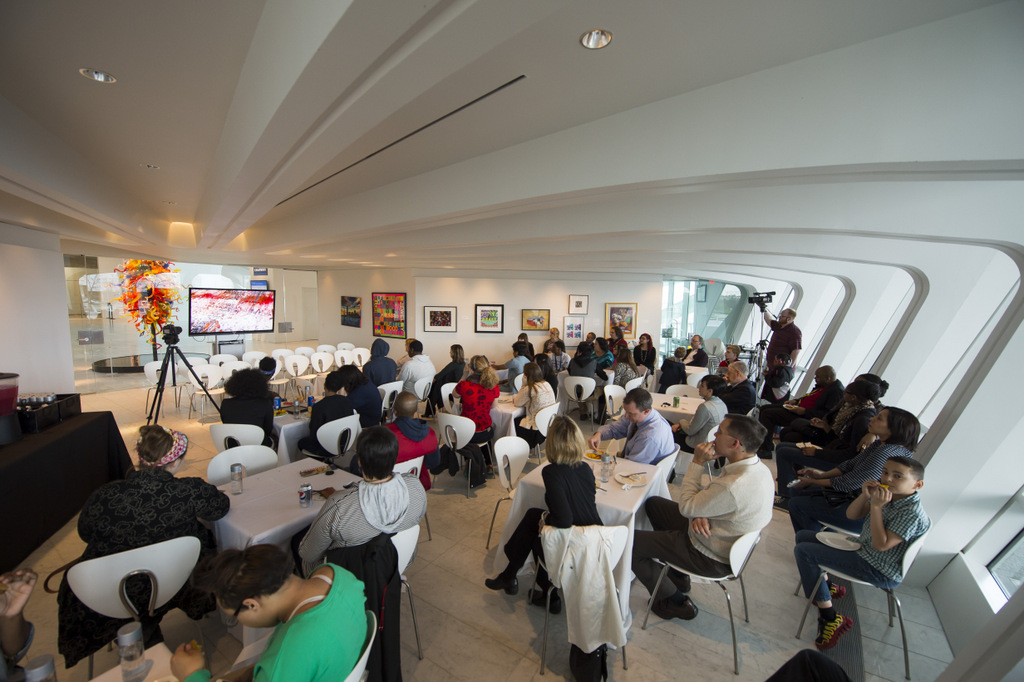
Friends, family, and teachers of the Satellite interns watch their final project videos at the program celebration. Photo by Front Room Photography

Core Evaluation

Let’s start with the core evaluation method we used for the program. We were lucky to work with one of our teen program funders, the Milwaukee Public Schools Partnership for the Arts & Humanities, and the University of Wisconsin-Milwaukee’s Center for Urban Initiatives and Research (CUIR) to develop the outcome above and to establish a tool to measure it.

We settled on one-on-one interviews, doing a “pre” interview on the first days of the program in October and a “post” interview on the final days of the program in May. Each student was privately asked the same set of questions in the pre- and post-interviews, meant to get at their ability to reflect on their experiences in the program. I scored each interview on a rubric that measured level of detail in their responses, and then we compared their pre-program score to their post-program score to see if they had improved.

At the end, every student did improve in their ability to reflect—their answers got significantly more detailed. As someone whose default is to be a more qualitative thinker, it was rewarding to use the rubric to see their interviews as data, in a quantitative, more tangible way.

But as helpful as this was, it’s still just one method of evaluation. Being able to explain in detail is certainly one aspect of successfully being able to reflect. But as I listened to their responses, and thought about what I had seen in the students over the course of the whole year, I realized there is much more to reflecting than just detail. Their responses used stronger vocabulary, they expressed sophisticated ideas, and they asked more and deeper questions. How could I articulate that kind of change?

Unexpected Data

Happily, along the way, we also found that we had collected some unexpected data which helped me more concretely see the change in my students.

Exit Slips

At the end of each session, teens used a web app on their iPads called Infuse Learning to fill out a quick exit slip survey. Exit slips are an easy way to take the pulse of your students at the end of a session. For Satellite, they answered the questions “What is something you learned today?” and “What are you still wondering about?” Though different from our interview questions, these certainly also support reflective practice by thinking back on the day’s session.

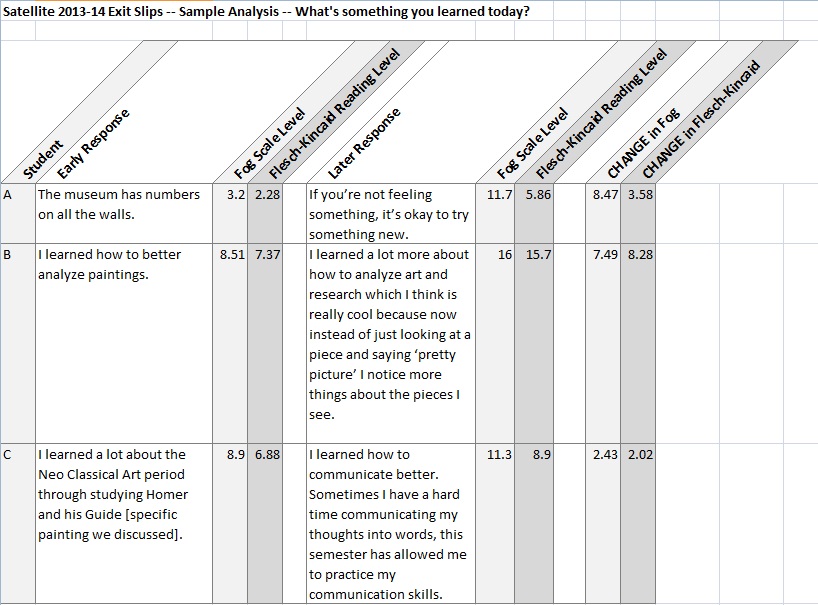
As the year went on, I noticed that the teens ‘ responses were growing more sophisticated: they were longer, they used more art vocabulary, and they realized that they might not be able to answer questions definitively, if at all. At the suggestion of Marianna Adams, who specializes in museum research and evaluation, I tried running these responses through two readability tests to see if that would quantify the sophistication of these responses. One test produces the sample’s Fog Scale Level, which measures syllable count and sentence length (a score of 5 being readable, 20 being very difficult). The other was for the Flesch-Kincaid Grade Level, which approximates the average grade level necessary to read and understand the text.

For the first question (“What is something you learned today?”), students’ scores jumped considerably in Fog Scale and Reading Level. Since these tests measure syllable count, sentence length, and grade level, this corroborates with what I found in the core evaluation.
somethingyoulearnedtoday

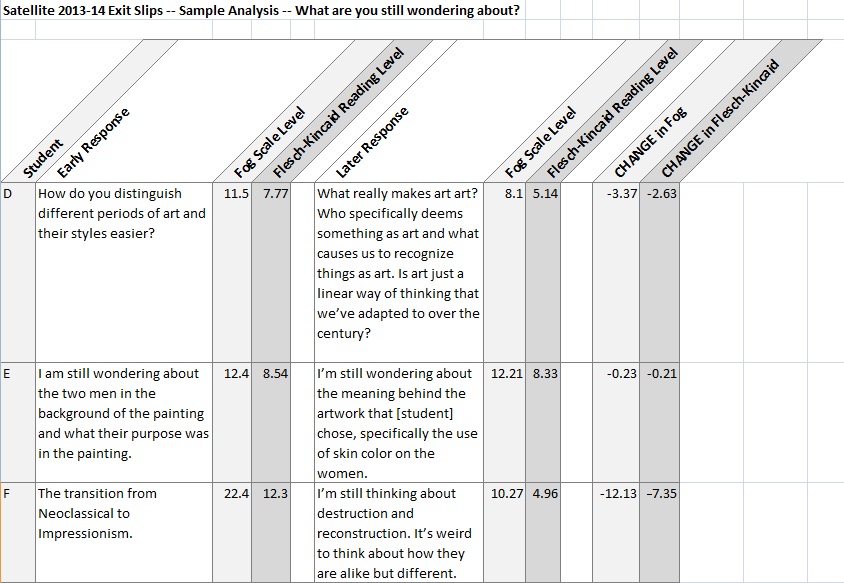
But I was surprised to see that when I tested responses to the second question (“What are you still wondering about?”), students’ scores actually dropped! Yet if you read their responses, there is a drastic change—for the better.
stillwonderingabout

Take Student D’s responses. In his early answer, he asks a relatively basic art historical question about distinguishing one type of art from another. In his later response, he is thinking deeply about the purpose of art and how we even decide what art is. And while Student F uses high-level art history vocabulary in her first response, it’s without context; later on, she’s thinking about how two seemingly opposite concepts may have something in common after all.

The scores of these comments may have decreased, but I’d argue that their reflective quality increased—the teens ask big questions that might not have an answer; they ditch high-level vocabulary to more informally muse on philosophical questions of art, destruction, and race. Running these responses through the tests helped me see, again, that while tools can be helpful, they’re ultimately just one tool—we need more than one to paint a bigger picture.

Videos

To round out that image, I’ll share one final unexpected evaluation tool: the teens’ final project videos as well as a talkback session they conducted at their video premiere.

For their final project, each student chose one work of art in the Museum Collection and looked at it, researched it, and talked about it with others for seven months. (Given that most visitors spend under 10 seconds looking at art in museum galleries, this is a feat in and of itself!) They distilled a school year’s worth of thinking into brief, 2-4 minute videos that answered what the work meant to them, what it had meant to others, and how their own thinking had changed as a result of looking at the piece—all questions with, of course, that familiar reflective bent.

The teens also participated in a talk-back/Q&A at the celebration where we premiered these final projects. Guests—museum staff, teachers, family, and friends—asked the group questions about their experience. If you like, you can watch the teens’ videos, along with the Q&A, in the YouTube playlist below.

Impact — Can Museums Change Teens?

So: does all the above—interviews, exit slips, readability tests, and final projects—add up to a full image of the impact that a year’s worth of reflective practice can have on students?
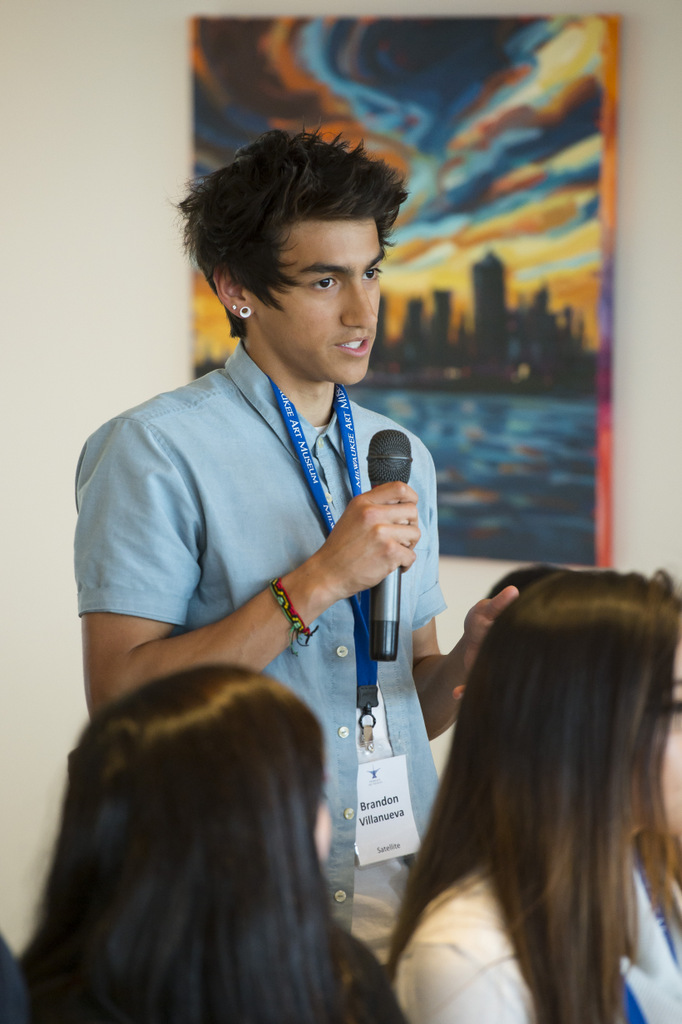
Brandon answers a question during the Satellite premiere Q&A session. Photo by Front Room Photography

I’m not sure we can ever paint a full picture of student growth in intensive programs such as this one. I do think combining all of these tools can help, though—especially if the evaluative tools actively support the goal of the program. The interviews, exit slips, and activities were all intentionally structured to be reflective, related to the outcome itself. This relevancy was key, not only in genuinely evaluating the program’s success, but also in supporting the students’ abilities through the methods themselves. It’s also important that we educators make the program goal transparent to the students. The Satellite interns knew from the beginning that they were working on reflective ability—this helped prime them to think reflectively from the get-go.

As far as impact beyond reflective capacity, I also want to share a few quotes from the teens themselves about their time in this program:

“The videos help us think deeper about what we do—so even in school I think deeper about what I’m doing or why this was made or why this happened.”
“I learned that I shouldn’t judge a book by its cover. When I first saw my piece I just thought it was a bunch of different colors and didn’t really think about it actually having a meaning. But now I’ve learned that it actually has a super cool meaning behind [it], and I never would have learned about that meaning if I hadn’t taken the chance to explore. So I shouldn’t be so quick to judge.”
“We had to give tours and I found out that I really like to work with children and art at the same time. I would like to pursue a career in art education for elementary school students.”
“I was able to change and evolve my way of thinking, now being able to look past the obvious… I learned that art holds all the answers to any questions anyone may have, you just have to search for it.”

From the other evaluation tools, we saw that the students developed their ability to reflect on themselves and their own performance. But as seen in the comments above, they were also able to develop skills reflecting on the world beyond them—the world of art history, their future careers, how they interact with other people. All of these are ways of thinking that are valuable for their futures, as they go to college, discover their passions, and pursue meaningful career opportunities.
amt7_FRPhoto_140515N_C2_0135

Can Teens Change Museums?

I’ve shown how this program helped these students grow in many ways. What about the Museum itself? Have these students had an impact on our institutional practice?

Institutions move at a slower pace than most programs, and if change and impact are complex to measure in sixteen individual students, then it’s multiplied tenfold for an organization that serves hundreds of thousands visitors a year. Even so, over the past few years, the work of teens in our programs has slowly but surely worked its way into the daily fabric of the Museum. Teens have interviewed artists on behalf of the institution. They have advised docents on ideas for giving tours to high schoolers. Their video projects will be part of on-site and online Collection Resources at the Museum, as well as our Archives, for all visitors to access while learning about works of art.

Ultimately, evaluation and impact are ongoing, a grey area that has a lot in common with the act of teaching itself. When done well and intentionally, evaluation doesn’t just show if we’ve met a goal. The tools we use to evaluate ideally become part of our teaching practice, because they reinforce the very abilities we are trying to help our students develop.

As for what I’m still wondering about? This year, our evaluation methods for the most part required the teens to have specific existing skills, such as writing for the exit slips or proficiency in using an iPad (though we did have video-making workshops as part of the program). I’m thinking about other ways to holistically gather data. For example, given that much of our evaluation methods emerged from teaching tools, should I document or film our discussions with works of art and find ways to analyze them? I’d love to hear any ideas or tools you’ve used to evaluate your programs, just as I hope this post has inspired you to take a fresh look at your teaching practice and find unexpected ways to see the growth in your participants.

*     *     *     *     *

ABOUT THE AUTHOR
Milwaukee Commercial PhotographerCHELSEA EMELIE KELLY: Manager of Digital Learning at the Milwaukee Art Museum, where she develops educational technology initiatives and oversees and teaches teen programs. She is passionate about using gallery teaching and technology to foster relevancy for art museums in the 21st century. She has previously worked at the Frances Lehman Loeb Art Center, the Metropolitan Museum of Art, the Frick Art & Historical Center, and the Carnegie Museum of Art. Chelsea is a graduate of Vassar College and holds an M.S.Ed. in Leadership in Museum Education from the Bank Street College Graduate School of Education, where she was a Kress Foundation Fellow. She is also the founder and co-editor of The Art History BlogChelsea’s postings on this site are her own and don’t necessarily represent the Milwaukee Art Museum’s positions, strategies, or opinions.
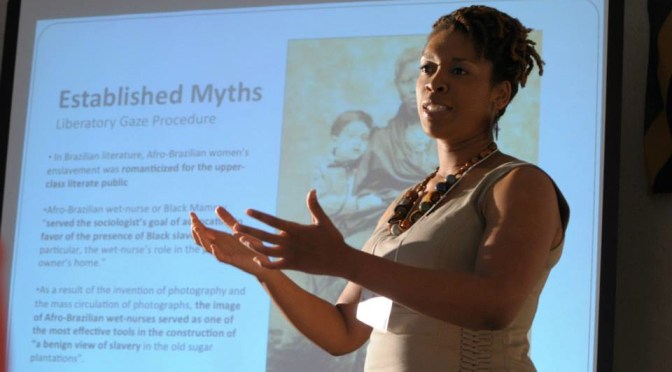
Eggs, Oreos, & Solidarity: MCRP in Our Daily Lives

Editor’s Note: This post is part of a series on ArtMuseumTeaching.com during August that focuses on the recent book Multiculturalism in Art Museums Today (2014). Find links to additional posts in this series by several of the book’s authors, and please join us for an Online Book Club via Google Hangout on August 20th.

Written by Melissa Crum, PhD

Writing the chapter entitled “Multicultural Critical Reflective Practice and Contemporary Art” in the book Multiculturalism in Art Museums Today (2014) challenged Keonna Hendrick (Brooklyn Museum) and I to consider our roles as critical multiculturalists when our marginality is not the focus, and how multicultural critical reflective practice (MCRP) manifests in our daily lives. MCRP is an on-going theoretical framework and practice that requires educators to investigate and challenge their cultural beliefs and assumptions in order to become a more cognizant, critical, and culturally competent educator (Crum & Hendrick, 2014). We reflected on our experience and impact on teachable moments in and out of learning spaces.

In what follows, I explore how past traumas might be used to form allegiances with other marginalized bodies in order to offer Socratic engagement in microaggressions from others. As classroom and museum educators, our job is to offer new ways of thinking for our pupils and patrons when we discuss complex and emotionally wrenching topics. We often prepare for offensive comments from youth but not from adults. My reflection questions, what do we do when we hear uncritical comments from peers?

Eating Identity

I was attending a conference that marked the 50th anniversary of Freedom Summer of 1964. Freedom Summer was a project where over 1,000 volunteers from across the U.S. were trained to support Mississippians in non-violent disobedience to combat racist Jim Crow laws. The conference consisted of scholars, artists, and activists reflecting on the historic moment and imagining ways to organize for the future. Before the conference, three colleagues and I had brunch at a local restaurant that served an Asian twist on American dishes. When the waitress came to our table, a colleague asked the waitress’ opinion of the unique kimchi breakfast meal. The waitress offered a positive review and referred to herself as “an egg.” “Egg” is a metaphor for how she, a white woman, internalizes an Asian or “yellow” identity. Presenting herself as “an egg” was her way of aligning herself with Asian culture so we could view her food review as accurate. Upon her leaving, we questioned her statement, its purpose, and our role as scholars who critically interrogate presentations of identity. Each of us identify with different ethnicities – African-American, Mexican and Filipino, Pakistani, and Native American – and agreed that the statement was problematic. At the end of the meal, I decided to address the statement with her.

When she came to our table, I thanked her for the food review and great service. Then I said, “I have a question about a statement you made earlier. I was wondering what you meant when you said you were like ‘an egg.’” A bit flustered, she casually explained that it was a running joke and the restaurant owner, also a white woman, referred to herself as “an egg.” She added that the Asian cook also referred to her by this name. In between her retorts, I asked her a series of questions with a calm and genuinely inquisitive disposition absent of patronization: How did you expect us to feel after you made the statement? If any of us appeared Asian to you, would you have made the comment? If an Asian person were here, how do you think they would feel about your statement? Do you think Asians you encounter, like the cook, determine if your statement is appropriate? After some discussion, she noted that she is part Native American, reads Angela Davis, and concluded with an apology.

There were a few concepts at work in this moment: My empathy with other marginalized bodies and her assumed cultural clearance from them. I explained to the waitress that, “an egg” was similar to a Black person being labeled an “Oreo.” The idea that one’s exterior (skin color) contrasts their interior (cultural norms and sensibilities) doesn’t allow for complex identities and can be hurtful. But “egg” and “Oreo” are metaphors that operate in different ways.

“Oreo” is a derogatory term often used against African-Americans to signify the absence of language, mannerisms, and ways of life connected to stereotypical ideas of Blackness. To call a Black person an “Oreo” assumes they are mentally disconnected from a “true” Black identity and their supposed internalized whiteness makes them “safe” to those who may fear them. In contrast, the white of the egg hides any signs of difference represented by the yellow yolk. As a result, those who consider themselves “eggs” have the flexibility to hide or present their elements of difference on occasions that best suit their interests. Those who wear their difference on the outside (i.e. African-Americans) are not offered such leeway.

The white waitress referring to herself as an “egg” was not in an effort to demean herself in the way “Oreo” can. It was a way for her to validate her culinary tastes and do what bell hooks calls, ‘spice up the dull dish of whiteness’ (hooks, 1992). Calling herself an egg was her presentation of cultural clearance. For me, cultural clearance is a self-determined license to explore cultural tropes, stereotypes, and concepts through one’s own experiences as a way to make sense of one’s own identity and marginalized identities one chooses to appropriate. All cultural clearances require a back story to validate a connection to a foreign identity. The waitress’ back story – being “part Native American”, sharing the “egg” identity with the restaurant owner, the Asian cook using the term, and her familiarity with activist Angela Davis – was her way to align herself with marginalized bodies to validate her comment. As the white-owned restaurant is appropriating Asian flavors to “spice up” mundane American dishes, the waitress mimics the behavior in her self-presentation.

Our Responsibility

In practicing MCRP, we question individuals appropriating segments of culture and presenting them as identity accouterments to be displayed and removed at will. Such practices are reductionist in ways that do not allow for the cultural consumer to seek a deeper understanding of other cultures. Euphemisms like “egg” and “Oreo” are Enlightenment and Eugenic-eque attempts at categorizing identities, thus limits humanity. I believe, as an MCRP practitioner, I have the responsibility to speak up for other marginalized groups while locating my marginality in respect to theirs. At the restaurant, I connected to the trauma of African-American colleagues and students labeled “Oreo”, empathized with the absent Asian person whose identity was relegated to the consumption of fermented vegetables, and situated my identity along both groups in solidarity. Its important to do all three. If not, we risk supporting the causes of others to the detriment of our own. This solidarity acknowledges a larger interconnected social justice effort for which we are all responsible.

crum-changethemodel

MCRP can help us build solidarity so that we can imagine ways to organize for the future. As I continue to consider the role of MCRP in my daily life, I seek to operate in the spirit of the brave Freedom Summer members of CORE, SNCC, and their volunteers combating discrimination through critical education.

*     *     *     *     *

 ABOUT THE AUTHOR

crum-headshotMELISSA CRUM: Founder of Mosaic Education Network, a consulting firm that provides services to companies, non-profits, and educators for arts-based diversity training and social justice curriculum. Crum earned her Masters of Arts in African American and African Studies and her PhD in Art Administration, Education, and Policy from The Ohio State University. She offers services to businesses, non-profits, educators and school administrators to address individuals’ self-perceptions and misconceptions of their employees, patrons, and students so that they work together to create an inviting atmosphere. Additionally, her work connects culturally appropriate curriculum, community-based problem solving, and arts-based methods to build innovative education strategies to help parents, teachers, and other community stakeholders to transfer their knowledge into curriculum regardless of their level of formal education. 

REFERENCES & RESOURCES

  • hooks, b. (1992). Eating the other. In Black looks (pp. 21-40). Cambridge, MA: South End Press.
  • Crum, M & K. Hendrick (2014) Multicultural critical reflective practice and contemporary art. In Multiculturalism in art museums today (pp.271-298). Lanham, MD: Rowman & Littlefield.

OTHER POSTS IN THIS SERIES:

“Building Canopies for Multiculturalism: (Re)Turning to the Visitor,” by Joni Boyd Acuff & Laura Evans

“It’s Not Always about You: Facilitating Critical Self-Reflection in Others,” by Keonna Hendrick

“Reflecting on a Hybridized Museum Practice,” by Marianna Pegno and Traci Quinn

*     *     *     *     *

Online Book Club Hangout (VIDEO)

On August 20th, ArtMuseumTeaching.com brought together a group of authors and editors of the book Multiculturalism in Art Museums Today for a live discussion via Google+ Hangout.  Those joining the Hangout included Joni Boyd Acuff, Marianna Adams, Briley Rasmussen, Alicia Viera, and Veronica Betancourt.  Please find the video archive of this conversation below, and enjoy!

Don’t Have Your Copy of the Book Yet?  No problem.  As part of this collaboration with Rowman & Littlefield Publishers through this series of posts about Multiculturalism in Art Museums Today, we are able to offer ArtMuseumTeaching.com readers a special discount.  To receive a 25% discount, go towww.rowman.com to order this book and enter the discount code: 4S14ACUEVA

It’s Not Always about You: Facilitating Critical Self-Reflection in Others

Editor’s Note: This post is part of a series on ArtMuseumTeaching.com during August that focuses on the recent book Multiculturalism in Art Museums Today (2014). Find links to additional posts in this series by several of the book’s authors, and please join us for an Online Book Club via Google Hangout on August 20th.

Written by Keonna Hendrick, Brooklyn Museum

Melissa Crum (Mosaic Education Network) and I came together to develop multicultural critical reflective practice (MCRP) as a protocol because we shared the belief that the decisions museum educators make about our teaching practice — such as the artwork to discuss, language we use, expectations we set for learners — are informed by our willingness to move beyond our individual interpretations and values. When we teach, we may create opportunities for our biases to shape and limit learners’ perspectives on artworks, peers, and themselves. MCRP is a theoretical framework and ongoing practice in which educators identify, analyze, and challenge the cultural beliefs, values, and assumptions that color our interactions with artworks and learners. Leading others through MCRP while writing about the practice has challenged me to re-address my biases while reflecting on how my perspectives and values impact our teaching. I have facilitated practical applications of MCRP with many groups; however, my experience training a small group of emerging educators in a mid-sized art museum in this practice greatly impacted my engagement in the process.

Developing Critical Self-Reflection in Educators

Keonna Hendrick challenges learners to think critically about cultural representations in art.  Photo by Jonathan Dorado , Brooklyn Museum
Keonna Hendrick challenges learners to think critically about cultural representations in art. Photo by Jonathan Dorado , Brooklyn Museum

In the first of a two part-session focused on developing critical self-reflection in educators, I asked each educator to write a short autobiography at home, reflecting on a moment of their lives and writing freely for 30 minutes. I met with each of them individually one week later to discuss the process and to consider how their personal narratives might inform their work in museum education. Although they were not asked to share the details of their autobiographies, several chose to tell me about their personal experiences. They explored relationships, events, and expectations that informed the way they saw themselves in the past and present. I knew when I assigned the exercise it might trigger difficult memories, hard feelings, and even trauma that might be challenging for both participants and myself to work through.

As I listened to their stories, I was incredibly aware of the trust they vested in me to receive their personal truths and to guide them as they considered the intersection between their personal and professional lives. They were vulnerable, honest, passionate, and confused. I found it necessary to be present and aware of my own biases and experiences, and to resist responding from the feelings they may evoke. There were some moments when values were expressed that were in direct conflict with my own, and I had to remind myself that no matter how difficult reflections can be to hear, the purpose of exploring MCRP is to identify and address our attitudes (no matter how negative).  It took courage for these educators to share their autobiographies — without any certainty of how I might respond — and to challenge themselves to think critically about their experiences. And it challenged me to listen without judgment and to respond with care while encouraging them to engage in deep reflection. While the educators commented on the success of the workshop, I couldn’t help but feel exhausted, wondering how Melissa and I might assist others in preparing to facilitate such delicate discussions.

Promoting Critical Self-Reflection in Our Practice

Facilitating exercises that promote critical self-reflection is hard work but it’s worth it. Just as museum educators should be aware of information, teaching strategies, and audience, facilitators of MCRP should be comfortable with and actively engaged in this practice. Witnessing the courage of the participants and facilitating MCRP with many participants individuals has urged me to delve deeper in my own critical reflective practice and to ask: Why have I been afraid to acknowledge certain aspects of myself and others? Identifying these fears and their origins helps me understand why my progressing self-awareness may have been stifled at times and charges me to take responsibility for working through those fears towards an improved cultural consciousness.

Creative Commons image from www.worldette.com
Creative Commons image from http://www.worldette.com

Identifying fear is no small feat. Even taking the first steps of facing those fears while admitting to behaviors and attitudes that negatively impact others can be incredibly difficult. When we offer MCRP as a resource to others for improved pedagogy, we become more accountable for our own failings as educators. Learning from my failures in teaching, forgiving myself for poor decisions, and continuing to engage in the work to address the limitations of my actions and knowledge are challenges I have encountered as a practitioner and facilitator of MCRP. Through journaling, reading both scholarly writings and personal narratives, and engaging in a monthly peer group, I have grown to recognize some prejudices that I had not previously explored as a result of ignorance and limited conversation. Although I am not proud of these prejudices, my ability to acknowledge and work to overcome them has enabled me to be more patient with others and myself. It has helped me engage in an ongoing practice of forgiveness for others and myself. Educators may make poor choices from time to time; however, resisting the temptation to rest complacently in those decisions and repeat them with learners and with artworks disrupts educators’ potential to support learners in becoming self-actualized and expanding our cultural perceptions.

*     *     *     *     *

 ABOUT THE AUTHOR

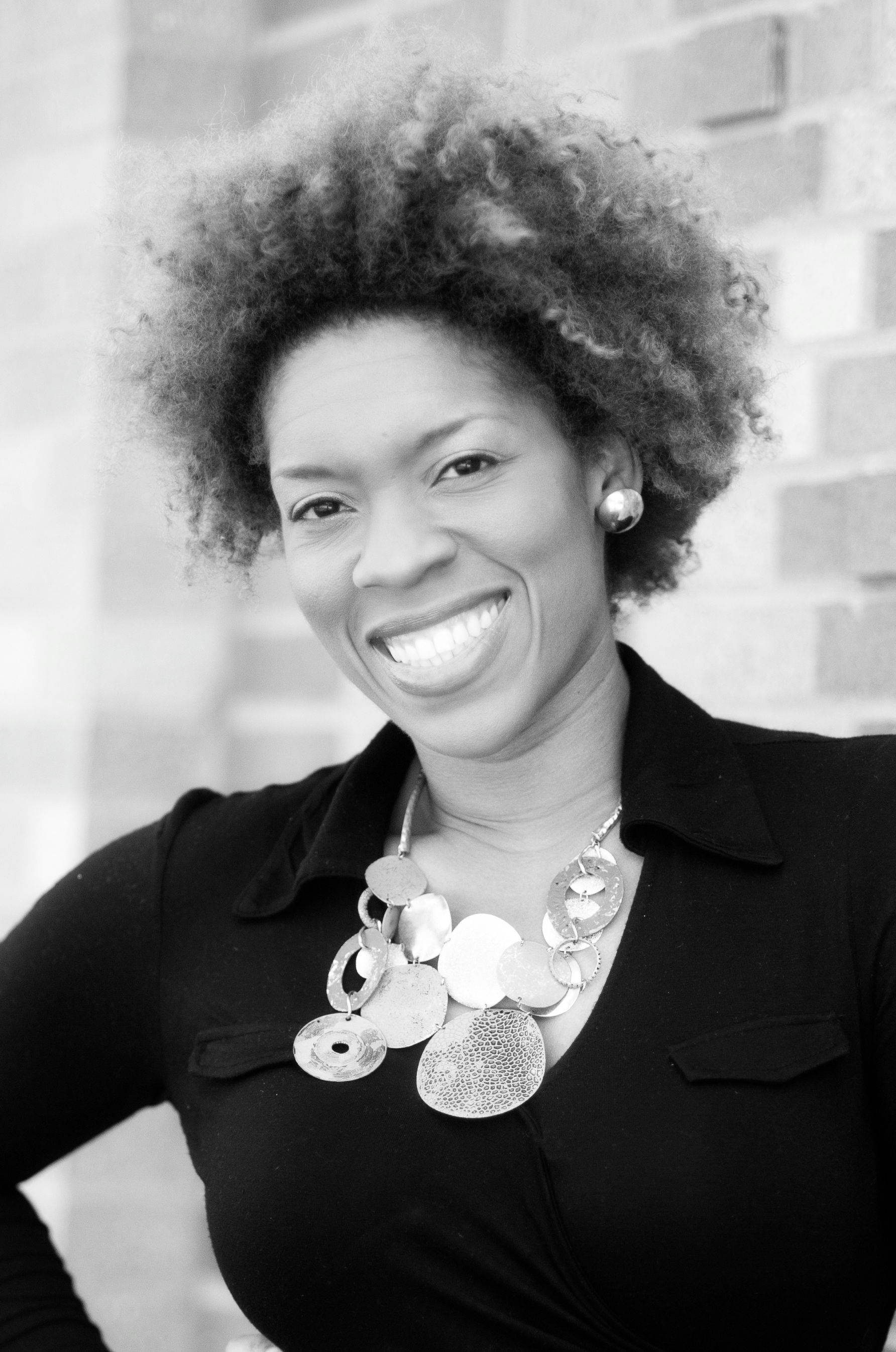
HendrickHeadshotKEONNA HENDRICK: Senior Museum Educator at the Brooklyn Museum, Hendrick oversees the 10-month Museum Education Internship Program, a professional development opportunity for emerging museum educators working with school, youth, family, and adult audiences. She has also worked as a Family Programs Educator at the Museum of Modern Art and served as a board member for New York City Museum Educators Roundtable and Classical Contemporary Ballet Theatre. She holds a B.A. in History and Studio Art from Wake Forest University and a M.A. in Arts Policy and Administration from The Ohio State University. Hendrick is an innovative museum educator and arts administrator who develops practical applications for big picture ideas and issues. She is committed to exploring the transformative nature of art-centered experiences, promoting cultural understanding across communities, and engaging adults, children and adolescents in personally relevant experiences.  Keonna’s postings on this site are her own and do not necessarily represent the Brooklyn Museum’s positions, strategies, or opinions.
OTHER POSTS IN THIS SERIES:

“Building Canopies for Multiculturalism: (Re)Turning to the Visitor,” by Joni Boyd Acuff & Laura Evans

“Eggs, Oreos, and Solidarity: MCRP in Our Daily Lives,” by Melissa Crum

“Reflecting on a Hybridized Museum Practice,” by Marianna Pegno and Traci Quinn

*     *     *     *     *

Online Book Club Hangout (VIDEO)

On August 20th, ArtMuseumTeaching.com brought together a group of authors and editors of the book Multiculturalism in Art Museums Today for a live discussion via Google+ Hangout.  Those joining the Hangout included Joni Boyd Acuff, Marianna Adams, Briley Rasmussen, Alicia Viera, and Veronica Betancourt.  Please find the video archive of this conversation below, and enjoy!


Don’t Have Your Copy of the Book Yet?  No problem.  As part of this collaboration with Rowman & Littlefield Publishers through this series of posts about Multiculturalism in Art Museums Today, we are able to offer ArtMuseumTeaching.com readers a special discount.  To receive a 25% discount, go towww.rowman.com to order this book and enter the discount code: 4S14ACUEVA

Evaluation Can Be Fun

Written by Marianna AdamsAudience Focus, 2014 Educator-in-Residence at the Isabella Stewart Gardner Museum

Cross-posted from mariannaadams.blogspot.com

One of the great luxuries I value about my time here at the Gardner Museum has been the opportunity to have rather leisurely and unstructured conversations with museum educators here and at other museums in the Boston area. I appreciate the value of not always having an agenda and not needing to solve a problem. We bounced ideas off each other and I always came away with a fresh perspective, a deeper conviction in my intuition, and lots of new ideas. Our talks often meander around the relationship between a museum experience or program and how we choose to evaluate it. A few themes have emerged from the conversations so far.

There is Life Beyond the Survey

MA-SURVEYOver the years I have not made a secret of how much I don’t like written questionnaires, paper or online, despite how much I end up using them on evaluation projects. Why? The written survey is the most difficult methodology to do well. It’s the default methodology that most people think of when planning an evaluation and most of them are tedious and poorly focused. It’s a blunt instrument that cannot capture much in the way of subtlety and nuance (and life is so much about nuance). In recent years, with the plethora of online survey programs, we are drowning in surveys so survey-fatigue is a reality. Most surveys are really asking for the visitor to tell us that we did a good job (e.g., How satisfied were you with this experience?) and not enough about how the visitor values or benefits from the experience. Besides, the written questionnaire usually does not reflect the spirit of the experience we’re trying to evaluate, bringing me to my next point.

Match the evaluation method to the experience.

Imagine yourself at a museum’s “evening hours” event. There is a great band, wine, engaging activities going on throughout the galleries, good friends, and a happy crowd of people of all types and ages. The atmosphere is both relaxing and energized at the same time. As you stroll towards the door to leave the museum, someone hands you a piece of paper. It’s a survey asking you to evaluate this time you just had and it smacks you out of the pleasant, liminal state you spent several hours dropping into. That’s an example of how the survey methodology is not well matched to the quality of the experience you just had.

So what methodology might better align with the evening program experience you imagined yourself attending above?

First you start with what you want to know and why.

So often we select the methodology before we figure out what we want to know and why. We decide on surveys or focus groups when those may or may not be the best ways to collect the data. Often we collect more data than we know what to do with. Here’s an example that came up in a recent conversation:

Like many art museums, the Gardner offers several community nights with free admission throughout the year and these events are very well attended. Primarily, the Gardner wants to know if these events are indeed attracting people from communities close to the museum. Yes, we could easily get zip code information via a written questionnaire. The problem is that we tend to throw in a lot of other questions that we don’t really need the answer to. The other area of inquiry the Gardner would like to know about revolves around how visitors connect to the museum. So let’s keep those two data points in mind, residence and connection, as we think about how to get useful information.

Think creatively about ways to get that data and match it to the spirit of the experience.

How could we get zip code data and not make people fill out a survey?

Imagine a big map (maybe near the wine bar because most everyone would go there), with zip code areas and neighborhoods clearly identified. Give people a small colorful adhesive file folder dot and invite them to put it on their zip code. It becomes a fun, social activity and, for some reason, people like to find themselves on a map. It’s simple and inexpensive. At the end you have a picture of the zip code distribution of your audience. You could do this for other evening events and compare the maps.

MA-response wall

What about the ways visitors connect to the museum?

One methodology that I love to experiment with is embedded performance assessment. This means that visitors don’t realize they are providing evaluation data, even when we tell them, because the process is engaging on it’s own. At a workshop for the Gardner Museum education staff this week, artist-in-residence Paul Kaiser inspired us all to explore new ways to engage visitors and possibly end up with some interesting evaluation data.

MA-galleryPaul first introduced us to the concept of collaborative writing, using the example of Japanese renga poetry. He then provided us with a set of words —  rising, distant, enclosed, fold, release — and asked us to take the spirit of renga into the galleries, substituting the verses for objects, spaces, or views based on that set of words. We did it and were struck by how beautifully the experience honored the spirit of what Mrs. Gardner did in the ways she arranged objects to suggest ideas or relationships.

We played with ways to use this activity with visitors, discussing ways to engage families and adult visitors at community nights in something similar. Perhaps if we created a more playful set of words to match the feel of these events, visitors would find it enjoyable. We brainstormed possibly having a place where people could post their responses and read what others thought about. Having these responses could be a rich data source that helps us better understand ways that visitors make connections to the museum. We were jazzed!

What are some unconventional ways that you have collected rich and useful data about the visitor experience?

OTHER POSTS IN THIS SERIES:

Towards a More Mindful Practice

Falling in Love with Your Visitors

Barriers to Family Engagement in Museums

*     *     *     *     *

ABOUT AUTHOR

AdamsMARIANNA ADAMS is President of Audience Focus Inc. Her professional roots began in K-12 public and private school teaching (fine art, English literature, social studies, and special education) and segued into museum education where she headed several education departments in Florida museums. She founded Audience Focus Inc., in 2007 after 12 years of conducting evaluation, research, professional development, grant proposal writing, and concept development for the Institute for Learning Innovation. Her degrees are from George Washington University (Ed.D.), University of South Florida (M.A.) and Mercer University (B.A.). In her spare time she is an avid yoga practitioner and teacher.

Barriers to Family Engagement in Museums

Written by Marianna Adams, Audience Focus, with Elizabeth Margulies, Museum of Modern Art

Cross-posted from mariannaadams.blogspot.com

All three families scheduled for last week had to cancel or reschedule so it gave me some time to think and have some great conversations with museum educators around the country. What emerged as a theme for me this week was thinking about challenges to facilitating exciting, authentic co-participation in family experiences. I’ve invited Elizabeth Margulies, Director, Family Programs and Initiatives, at MoMA to chime in as she has some valuable reflections to share.

MoMA 1

Since 2004, the USS Constitution Museum has been actively involved in experimenting with and evaluating techniques that foster family engagement. Currently their IMLS-funded project “Engage Families” seeks to identify characteristics of family programming that result in active intergenerational engagement, enjoyment, and learning in museums and libraries. To assist that effort, I implemented an online survey of museum and library professionals around the country in November 2013. Two key findings emerged that will be the focus of this post: 1) professionals value and want to create fun, authentic, opportunities for visitors of mixed ages and interests to co-participate and learn together; 2) accomplishing this comes with many challenges. We want to address two frequently cited challenges here.

1. It’s Really About What You Value

MoMA 3The most frequently cited barrier to achieving their vision for engaging family programs in the USSCM study was lack of resources – specifically time, money, space, and/or staff. Interestingly, whenever I ask museum professionals what prevents them from doing anything this is often the first response. For me, these resources will always be in limited supply, therefore, they become expressions of what we value. For example, we might say that regular exercise is important, but unless we really value it, we will not juggle our personal budgets and complex schedules around to get to the gym or that yoga class.

MoMA is proactively addressing how family programs are perceived and value within the organization by engaging in a cross-departmental dialogue.

As Elizabeth Margulies explains:

Retail, Publications, and Education began meeting over a year ago to see how we might build on the success of some publications written by Education and developed by Retail. In our conversations we realized that we could use some help defining what we all wanted and we hired an outside consultant, Stephen Gass of The Gass Company to work with us. The goal is to articulate the personality and voice of the programs, experiences, and products MoMA creates for kids and families along with the values that drive our decisions. It’s been gratifying to find that everyone thinks this is a worthwhile effort. We wouldn’t have known how important everyone felt the child/family audience was if we didn’t bring them all together to discuss it.
If lack of resources tends to be your main reason as to why you don’t have the kind of family experiences you say you want, then this is where your work has to start.

What are ways that you have been able to shift the culture of your organization towards a more family-friendly position?

2. But Parents Won’t or Don’t Want to Participate!

Museum and library practitioners express concern and even frustration at not being able to get the adults to engage or to engage “properly.” This always raises the question “What is proper?” When I have felt like being the “bad” grandparent and check my phone, it’s mostly because I’m bored. Either I’ve been separated from my wonderful granddaughters or what we are being asked to do is uninspired and/or disconnected from what’s important in the artwork.

It always comes back to intention. If we want co-participation across generations then everything we do has to support that intention. I’ve heard from that when they clearly and consistently communicate the expectation that adult caregivers participate, they have better engagement within the groups.

Certainly we want families to feel comfortable doing what they feel is best. There always needs to be room for groups to engage as much or as little as they want. As the educators at MoMA and the American Museum of Natural History advise, if we communicate clear intentions early and often then we will see more co-participation and enjoyment. More importantly, if what we are asking groups to do is compelling then there will be more engagement. Studies suggest that some parents want to hand over the experience to the program facilitator. We always have to graciously accept that some people don’t want the experience we’ve provided. In that case, if we are true to our intentions they will self-select other programs that better suit their needs. It’s also why a variety of youth and family programs is advisable.

MoMA Education_2012_SMALLBut enough about the parents/caregivers. I want to focus more on the responsibility of the museum educators who deliver experiences designed to encourage co-participation and engagement. Some museums are able to hire experienced museum educators for their family programs, giving greater consistency and depth to the experiences. For many museums, family programs seem to be shuffled off to the youngest, least experienced facilitators who are given almost no mentoring on how to engage intergenerational audiences effectively.

In the UK Kids in Museums is “compiled entirely from visitors’ comments. It’s a practical and powerful tool to encourage and support museums, galleries, and historic houses around the country” to more successfully engage family audiences. For example, a few points from their Manifesto speak to the importance of the educator’s approach:

  • Be positive and do away with the word ‘No’. Tell visitors what they can do at the door, don’t pin up a list of things they can’t.
  • Share storieswith each other. Listen. Families can be experts too.
  • Don’t say ssshhhush! If kids are being noisy, ask yourself ‘Why?’ Is it because they’re excited? Great! Then capture that excitement. Is it because they’re bored? Then give them something meaningful to do.
  • Say ‘Please touch!’as often as you can. Everyone finds real objects awesome. Direct kids to things that can be handled, teach respect and explain why others can’t.
  • Give a hand to grown-upsas well as children. Sometimes it isn’t the kids who are shy – parents need your support too. Produce guides, trails and activities so everyone can join in.
  • Be aware of different families’ needs.Use your imagination with signs, symbols, and words understood by all. Design everything you offer to be equally accessible to disabled and non-disabled visitors alike.

The educators for MoMA’s family programs have developed a range of guidelines and self-evaluation tools to support their family educators. Most importantly, family program facilitators are asked to:

Reevaluate. After your program, think about why families might not have participated as you hoped. Possible reasons:

  • Adults didn’t know they were expected to participate;
  • Adults weren’t asked to participate or work with their child until too late in the program;
  • Instructions weren’t clear about what parents were supposed to do, or the activity, discussion was too difficult (even for the adults);
  • The gallery has too many distractions or logistically doesn’t give families enough room to do what you’ve asked;
  • There is a language barrier;
  • Families couldn’t hear you.

PLEASE SHARE

What strategies do you use to facilitate greater co-participation within and across family groups?

OTHER POSTS IN THIS SERIES:

Towards a More Mindful Practice

Falling in Love with Your Visitors

Evaluation Can Be Fun

*     *     *     *     *

ABOUT AUTHORS

AdamsMARIANNA ADAMS is President of Audience Focus Inc. Her professional roots began in K-12 public and private school teaching (fine art, English literature, social studies, and special education) and segued into museum education where she headed several education departments in Florida museums. She founded Audience Focus Inc., in 2007 after 12 years of conducting evaluation, research, professional development, grant proposal writing, and concept development for the Institute for Learning Innovation. Her degrees are from George Washington University (Ed.D.), University of South Florida (M.A.) and Mercer University (B.A.). In her spare time she is an avid yoga practitioner and teacher.

moma Elizabeth Margulies - HeadshotELIZABETH MARGULIES, Director, Family Programs and Initiatives, Department of Education, joined The Museum of Modern Art in 1999. Elizabeth designs, develops and oversees MoMA’s wide array of Family Programs and resources including gallery talks, workshops, artist talks, film programs, digital projects, activity cards, games, audio guides and the Museum’s interactive space, MoMA Art Lab. She collaborates with MoMA Retail and Publications, on children’s books and products, and in 2010 with Cari Frisch, co-authored, Make Art, Make Mistakes: A Creativity Sketchbook. In 2012, she collaborated with colleagues in Education, the Museum’s Digital Media and Graphic Design Departments, and Rendor Monkey, to launch MoMA Art Lab, an app for the iPad. The app won a 2013 Webby Award in the Education & Reference (Handheld Devices) category, and a Parent’s Choice Silver Honor for app design. Before coming to MoMA, Elizabeth worked in theatrical and television production. She holds a B.S. in Theater from Skidmore and a Master’s of Education from Bank Street College of Education. Elizabeth has taught in both public and private schools in New York.

Falling in Love with Your Visitors

Written by Marianna AdamsAudience Focus, 2014 Educator-in-Residence at the Isabella Stewart Gardner Museum

Cross-posted from mariannaadams.blogspot.com

I know this sounds a bit too new-agey but it’s what keeps coming up for me after my first full week in my residency at the Gardner Museum. Three families came to the museum this past week and the best way I can describe the experience is that I just fell in love with all of them. They arrived so excited and in good spirits, even if some of the children were a bit wary at first.  Their openness to new experiences reminded me to be more open in turn  to their unique ways of visiting and looking at art. A few reflections are shared below (while the experience are real, the names of the family visitors have been changed).

It’s About Choice & Control

One of the first things I learned from my mentors, John Falk and Lynn Dierking, was that visitors like and need choice and control in their museum experience. When I checked back with the families a day or so after their visit, the one consistent remark was how much they liked doing their own thing. Cole (age 10) told his mom, who had not been able to come to the museum, that he liked the visit because “they let us do whatever we wanted.”

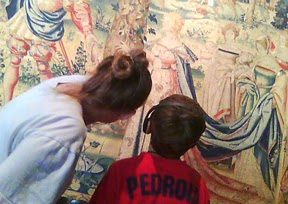
tapestry-smallOne thing visitors like to choose is the pace. Eva, who visited with her two sisters, and her grandniece, Suzie, (age 7) and grandnephew, Chuck, (age 12) said she liked the “very relaxed pace” of the visit and added “this is a great way to come to the museum together.” A rather quick and focused pace was set by 8-year-old Zuri because she wanted to use the family guide, while her father and brother, Cole, (age 10) were happy to keep up. In another family, Baylor (age 10) had recently discovered audio guides and he immediately plugged into one during the visit. This slowed the pace down considerably. As his mother wrote to me the next day, “Using the audio guide really clicked in for Baylor last summer, and has totally changed our museum experience, allowing us both to have more private and quiet looking times as well as more social looking.”

Kids See the Darndest Things

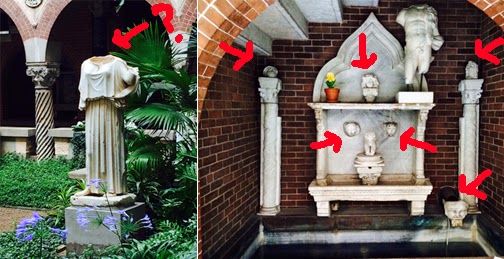
I am continually fascinated by what draws children’s attention and this week’s visits were no exception. Typically it is not what educators tend to include on tours. For example, Suzie was first taken with the missing head on a statue in the courtyard. Throughout the visit she commented on how many statues were missing heads and arms. This caused us all to heighten our attention to what was missing. When we passed along a hallway to go upstairs she paused at a niche housing several stone and marble heads a long with a sculpture missing all limbs and the head. She said, “Oh, so this must be where they keep the heads” and calmly walked on.

combined headless & heads

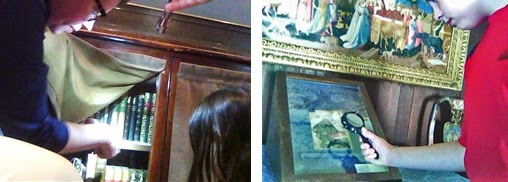
Because the Gardner is one of the few museums lit primarily by natural light, and there are many cases with small, fascinating objects and notes, sometimes things can be difficult to see. Even though, there were opportunities in all the groups where they were straining to see something they did not ask to use the flashlights. or magnifying glasses. Sometimes I would shine the light where they were looking and everyone in the group would gather round and spend more time looking and talking. Reports from families a few days after the visit suggested that the flashlights were a big hit, even though they never directly asked for them.

combined magnify flashlight

They “Stumped the Chumps

Children frequently stumped us all with their insightful questions that we couldn’t answer. When that happened, all of us, adults and children, got involved in the conversation, equally contributing bits and pieces of what we knew and speculating on all the possible answers. Yes, I could analyze these interchanges and point to how they are modeling critical thinking, good inquiry, and how children need to see that no one has all the answers, but I’m not. They were just beautiful moments of people coming together and puzzling out something. I want to leave it at that.

What About Content?

It’s challenging for educators to intentionally lighten up on content in any museum experience, even though research continually finds that family motivations for museum visits is NOT to learn new knowledge. Families seek an enjoyable time together that serves as a sort of family glue, creating memories that they continue to share. Certainly parents and children like to learn things but it’s not the focus or reason for their visit.

At the beginning of the visits this week, I let families know that I did not have any plans for them, I just wanted to wander around with them, that I didn’t know the collection but there was a Gardner Museum educator with us in case there was anything they wanted to know.  Having a knowledgeable person with us proved to be a popular feature for families, for when questions came up Julia Brucker and Michelle Grohe were there. I’m grateful for their skilled ability to know just when and how much to engage so that the experience stayed in the family and was not diverted to the educator. That said, the families did not automatically think to ask the educators when a question arose. In most cases, after listening to families wonder out loud about something, I suggested asking the museum educator, which they eagerly did and it enlivened the conversation. I’m not sure why this is the case and together with families enjoying but not asking for the magnifying glass and flashlight, it feels like a pattern might be emerging. I will see if it continues in this week’s visits.

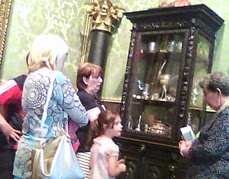
talking with volunter and elbow of hanger-onAt one point a group intercepted a gallery volunteer roaming the gallery for just this purpose. The volunteer noticed that Suzie and Chuck were interested in a silver encased ostrich egg and talked to them about it. This brief interchange warmed my heart as the volunteer was focused totally on the group’s interest and experience. She had no agenda except to facilitate visitors’ interest.

Implications for Practice

Realistically we can’t accompany every family group in this way, but it feels increasingly important that we, as educators, connect with audiences on more than an intellectual level. Finding practical ways to fall in love with the visitors seems key to me. When we connect with visitors on a deeply human level then the way we design experiences will change. When we start to see visitors as thoughtful, insightful friends who are eager to explore what the museum has to offer, we stop seeing them as security risks or potential dollar signs. I invite you to find your own ways to authentically connect with your visitors and share what happened.

Note: All the photos were taken with Blynk a tiny time-lapse camera during the family visits. This little gadget is now my new best data-collecting friend. And the “Stumped the Chumps” reference is a nod to Car Talk.

OTHER POSTS IN THIS SERIES:

Towards a More Mindful Practice

Barriers to Family Engagement in Museums

Evaluation Can Be Fun

ABOUT AUTHOR

AdamsMARIANNA ADAMS is President of Audience Focus Inc. Her professional roots began in K-12 public and private school teaching (fine art, English literature, social studies, and special education) and segued into museum education where she headed several education departments in Florida museums. She founded Audience Focus Inc., in 2007 after 12 years of conducting evaluation, research, professional development, grant proposal writing, and concept development for the Institute for Learning Innovation. Her degrees are from George Washington University (Ed.D.), University of South Florida (M.A.) and Mercer University (B.A.). In her spare time she is an avid yoga practitioner and teacher.

Towards a More Mindful Practice

Written by Marianna AdamsAudience Focus, 2014 Educator-in-Residence at the Isabella Stewart Gardner Museum

Cross-posted from mariannaadams.blogspot.com

Amid many possible areas of exploration I considered for my residency at the Gardner Museum, I decided to see if I can bring more mindfulness to my own thinking about families in museums. Through my research and evaluation on families in many types of museums and my experience taking my granddaughters (currently 6 & 7 years old) to museums, I have been struck by what Ellen Langer refers to as “mindless” practice. It’s when we keep doing the same thing over and over without questioning the underlying pedagogy or assumptions. We stop paying attention and go on autopilot. Nothing very interesting can happen in that place.

I know that there are increasing examples of innovative and thoughtful work by museum educators in the area of family programs and I encourage you to share those ideas with us here. Yet over the years of both watching and participating in family museum programs three key questions keep emerging for me.

Where is the family in family programs?

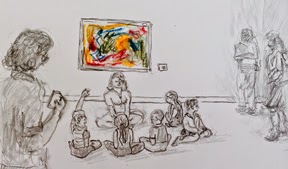
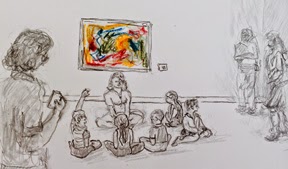
Figure 1: I did this awkward little drawing as a composite memory of many family programs in different museums. While this is from my experience, try a Google image search for "family programs in art museums” and you will find, amidst lots of pictures of kids making art, some images that have this same basic choreography. Yes, the odd tilt of the painting bothers me too.
Figure 1: I did this awkward little drawing as a composite memory of many family programs in different museums. While this is from my experience, try a Google image search for “family programs in art museums” and you will find, amidst lots of pictures of kids making art, some images that have this same basic choreography. Yes, the odd tilt of the painting bothers me too.

First, what is billed as a family program often turns out to be a program for kids but the parents/caregivers have to stay with them. Adults are rarely engaged in a meaningful way and connections within the social group are neither acknowledged nor fostered. For example, when a family program facilitator takes families into a gallery, they often sit the children on the floor and the adults (either because they don’t really know what else to do or because they don’t want to sit on the floor) stand around in a semi-circle behind the kids. For me, this is a clear example of an invisible pedagogy. We are teaching adults that this experience is for kids and adults need not participate. When I talk with family program educators, they usually say they want adults to engage in the program. Sometimes they go so far as to imply that it’s the fault of the parents, as in “They won’t get off their cell phones.” Having been one of those adults at a family program who dearly wanted some sort of diversion and thought often about pulling out my phone, I ask, “What are we offering to the adults that is more interesting than their mobile devices?”

A host of questions emerge for me that I would love some e-conversation about: Why do we repeat this model over and over again? Does our training push us towards a developmental model where we know only how to program towards children or adults, but not both at the same time? Is the skill of encouraging parent child engagement one that is better fostered through other disciplines and thus should we be looking at best practices in other disciplines such as social work or psychology?

Why do we use a school model of discussion and interaction in family programs?

I’ve watched many well-meaning facilitators sit or stand in front of a work of art and make eye contact with the children almost exclusively. Not only does this tell parents to stand back but children quickly figure out that they are supposed to look at the facilitator and most of them conform. Children are asked questions and they raise their hand to answer, just like in school. Families tend to have fluid conversations, a lot of give and take, and while we might remind a child to not interrupt we rarely ask our children to raise their hands when having a conversation around the family dinner table. Why then do we default to the school model in the museum experience?

Even more frustrating is that this school model draws attention away from the objects and instead focuses attention on the educator. I’ve taken time-lapse photos and the average time spent looking at the art when sitting in this configuration is about 2-3 seconds – total, unless of course a child is not paying attention to the facilitator and looks at the art anyway.

How does the experience leverage the uniqueness of the museum?

The most important issue for me is that too many of the activities we offer in family programs don’t maximize the value of what the museum has to offer.

Engaging people of all ages in hands-on activities in the galleries can be a wonderful way to guide them into a deeper appreciation of the artwork. Yet, I’m concerned because too often the activities don’t connect very well with the artwork or the way the artist worked. I keep asking, “Why is this activity happening in the museum?” Most of what I see could be done anywhere and, sometimes, would be more effective without the visual distraction and noise of the gallery. I wonder, do we continue to under-maximize the uniqueness of the museum because we aren’t clear on what that is? Or do we operate on the assumption that families aren’t able to grasp it?

What will be my focus at the Gardner Museum this summer?

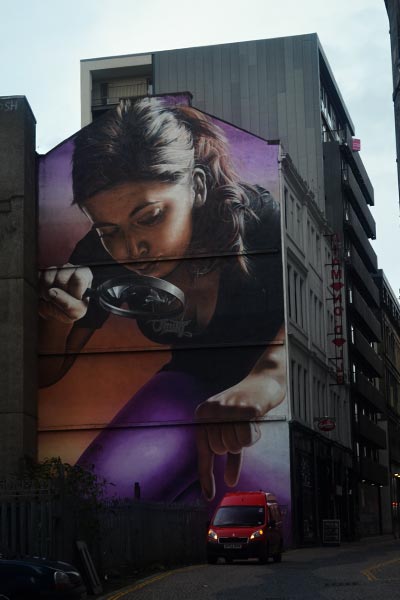
Figure 2: Sam Bates a.k.a. Smug, Girl with Magnifying Glass, Glasgow, Scotland.

As I continued to think about these issues I realized I was focusing only on how the educators planned and implemented programs. I began to wonder if I, too, have gone on autopilot. I know what kind of family experiences I’d like to see in the museum but, as I frequently warn my colleagues, using ourselves as a representative for the general visitor is not very smart. So, during the month of July I’ve invited families to come to the Gardner and allow me to accompany them.

I won’t have an agenda, lesson plan, protocol, notebook, or audio recorder and I plan to allow both the “educator me” and “evaluator me” to recede to the background. I want to explore facilitating “with” families rather than “for” them. I want to pay more attention to invisible pedagogies – both how the physical space itself instructs and how actions from people (me included) communicate behaviors and attitudes. I will invite the families to begin where they want to. I will have a few things with me, such as a flashlight for dark corners, some sketching materials, and magnifying glasses but I may not ever pull them out. I’m imagining, for instance, that as conversations evolve the need for things like that magnifying glass will naturally arise and I will, much like Mary Poppins, slide it out and hand it to the adults so they can facilitate the experience for their family.

Admittedly I’ve had moments of near panic just thinking about the unstructured quality of this experience. I have no idea what will happen and have to trust that if I stay mindful, sensitive, and observant that I will notice new things and be filled with wonder. I’ve invited local museum educators to come hang out with me. They can’t bring notebooks either and they have to agree to talk with me afterwards and write up a reflection of their experience.

The family visits begin on Wednesday, July 9. Meanwhile, I invite your comments. I hope I’ve raised some hackles one way or the other. If everyone is nodding in gentle agreement then I haven’t pushed enough buttons.

OTHER POSTS IN THIS SERIES:

Falling in Love with Your Visitors

Barriers to Family Engagement in Museums

Evaluation Can Be Fun

ABOUT AUTHOR

AdamsMARIANNA ADAMS is President of Audience Focus Inc. Her professional roots began in K-12 public and private school teaching (fine art, English literature, social studies, and special education) and segued into museum education where she headed several education departments in Florida museums. She founded Audience Focus Inc., in 2007 after 12 years of conducting evaluation, research, professional development, grant proposal writing, and concept development for the Institute for Learning Innovation. Her degrees are from George Washington University (Ed.D.), University of South Florida (M.A.) and Mercer University (B.A.). In her spare time she is an avid yoga practitioner and teacher.
The Art Museum Education Consortium and You

Written by Dana Carlisle Kletchka, Co-Editor of ArtMuseumTeaching and Curator of Education, Palmer Museum of Art. 

“Too Much of a Good Thing can be Wonderful.” –Hunter S. Thompson

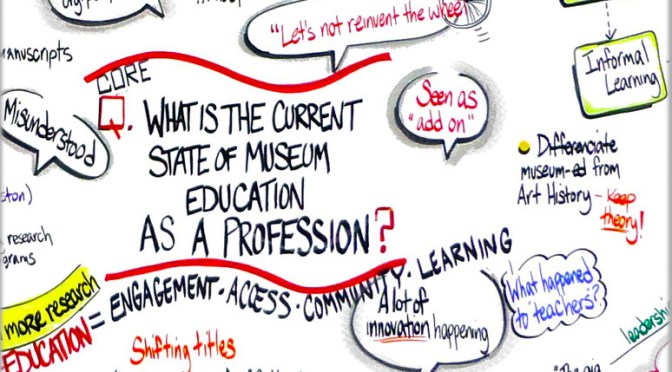
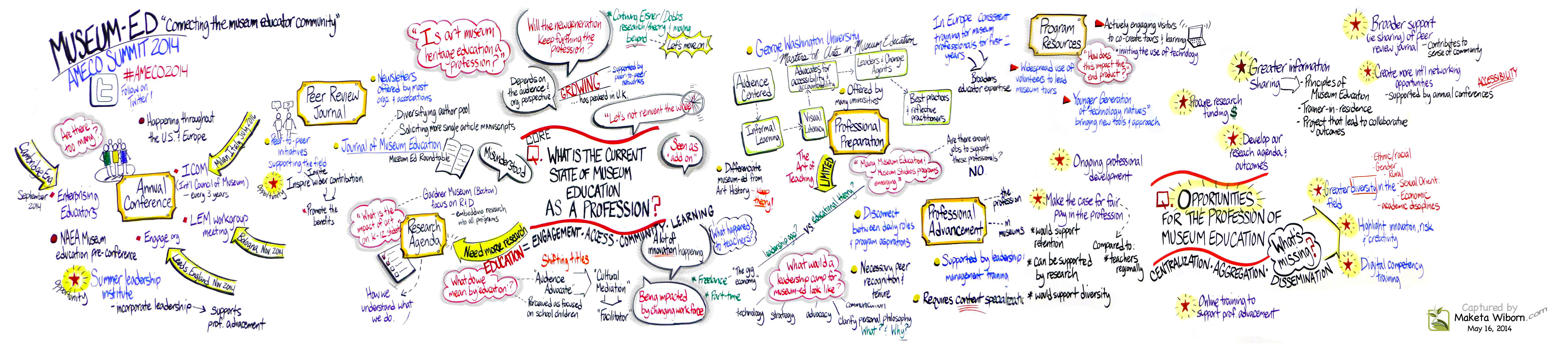
I’m back from participating in the third meeting of the Art Museum Education Consortium (AMECO) in Seattle, WA, where a group of representatives from various organizations discussed, deliberated, and strategized the current state and future directions of our field in the tranquil setting of the Frye Art Museum. The participants were thoughtful and forthright as they shared insights, resources, and professional opinions about where we have been and, more importantly, where we could and should be going. Although the group was not unanimous in their thoughts on nearly any one topic, a clear exception is the opportunity that technology and social media offer for professional development, communication, and praxis for art museum educators. (see graphic representation of the AMECO proceedings near the bottom of this post)

Museum-Ed Museum Education Summit 2012

Throughout the meeting, I kept returning in my own mind to two things:

  1. The number of resources that currently exist for art museum educators. When I began my graduate work in the field in 1995, I struggled to find excellent sources for inspiration and professional development. The situation is far, far different now—there is so much exciting work being done.
  2. The ways in which ArtMuseumTeaching.com, as a digital community of practice, can support and encourage the progress and evolution of our field in ways that are both powerful and palatable. We are all incredibly busy, but somehow we make time for a source of information that is powerful, well-curated, social, and welcoming.

To that end, I would like to share the myriad professional resources offered by the groups represented at the meeting. Take a few moments over your lunch break (yes, I know . . . what lunch break?) and click the following links to see the good work being done in and on behalf of the field of museum education:

American Association of Museums’ Education Professional Network (EdCOM) advances the purpose of museums as places of lifelong learning, serves as an advocate for diverse audiences and educators, and promotes professional standards and excellence in the practice of museum education.

ArtMuseumTeaching.com is a digital community and collaborative online forum for reflecting on issues of teaching, learning, and experimental practice in the field of art museum education. It is the goal of this site to connect educators, ideas, and resources around a dialogue about what we do in our practice of teaching and learning.

Bank Street College Museum Education: Childhood, Museum Education (Non-certification), and Leadership in Museum Education programs. The programs emphasize the educational role and mission of museums in a pluralistic society by providing a sound foundation in human development, learning theories, developing learner-centered classroom curricula, and museum policy and practice. Faculty are drawn from both teaching and museum backgrounds and include working museum professionals. The programs combine course and field experiences in both schools and museums.

Canadian Art Gallery Educators (CAGE) is a non-profit association of educators and museums across Canada. Formed in 1989, CAGE has a long history of providing support for gallery and museum educators.

Committee for Education and Cultural Action (CECA) is one of the oldest international committees of ICOM, and as such it achieves the major objectives of ICOM: the exchange of scientific information at an international level, the development of professional standards, the adoption of rules and recommendations, and the realization of collaborative projects.

Engage.org engage is a membership organization representing gallery, art, and education professionals in the United Kingdom and over 20 countries worldwide. engage promotes access to, enjoyment, and understanding of the visual arts through gallery education.

George Washington University Museum Education: Master of Arts in Teaching. The George Washington University developed its master of arts in teaching in museum education in consultation with the museum community. The interdisciplinary curriculum balances academic study with carefully supervised fieldwork, preparing practitioners with the range of knowledge and competencies requisite to leading the profession

Group for Education in Museums (GEM) is a European organization that champions excellence in heritage learning to improve the education health, and well-being of the general public.

Samuel H. Kress Foundation supports the work of individuals and institutions engaged with the appreciation, interpretation, preservation, study, and teaching of the history of European art and architecture from antiquity to the dawn of the modern era.  Among their broad support for art museums, the Kress Interpretive Fellowship provides a new kind of mentored professional development opportunity intended to encourage students to explore interpretive careers in art museums, whether as future museum educators or curators; to strengthen the profession of museum educator within the art museum community; to strengthen ties between museum educators and curators in the shared task of interpretive programming in art museums; and to expand the range of promising career options available to students of art history and related fields.

LEM: The Learning Museum Network Project is a permanent network of museums and cultural heritage organizations to ensure that that can play an active role with regard to lifelong learning and to raise awareness among decision makers at a European level.

Marcus Institute for Digital Education in the Arts (MIDEA), a project of the New Media Consortium provides timely, succinct, and practical knowledge about emerging technologies that museums can use to advance their missions.

Museum Education Monitor tracks and records research and resources in museum education worldwide. The aim of MEM is to help create a “road map” to new and current learning in museum education. Its goal is to enhance the development of theory and practice in the field by both academics and museum workers.

Museum Education Roundtable fosters professionalism among museum educators by encouraging leadership, scholarship, and research in museum-based learning. MER also publishes the Journal of Museum Education, the only journal printed in the United States devoted to the theory and practice of museum education.

Museum-Ed strives to meet the needs of museum educators by providing tools and resources by and for the museum education community. Museum-Ed is a not-for-profit organization dedicated to providing museum educators opportunities to ask questions, to exchange ideas, to explore current issues, to share resources, to reflect on experiences, and to inspire new directions in museum education. Museum-Ed is not a membership organization. All of the resources on the Museum-Ed Web site are free and available to educators in any type of museum, and anyone interested in the field of museum education.

National Art Education Association’s Museum Education Division advances the mission and vision of NAEA, advocating for the value of art museum education in lifelong learning, as well as promoting the needs of educators and the diverse audiences museums engage. The division builds community and develops leadership, advances research and knowledge, and fosters a culture of learning in the field.

University of Texas Master of Arts (MA) in Art Education with a Museum Focus. The purpose of the Master’s Degree Program in Art Education is to provide students with the opportunity, environment, and resources to explore issues in art education, conduct research on a significant aspect of art education, and enhance their knowledge of art and art education.

*     *     *     *     *

Many thanks to Kris Wetterlund and Scott Sayre of Museum-Ed for endeavoring to bring this meeting to fruition while being the most gracious of hosts; to the Kress Foundation for supporting and and participating in this significant event; and to Maketa Wilborn for his ability to summarize, understand, and represent complex issues and ideas.

Maketa Wilborn’s graphic interpretation of the AMECO meeting. Click on image to see a larger view.

AMECO hosts: Museum-Ed and Frye Art Museum; sponsored by the Kress Foundation

Participating Organizations: Isabella Stewart Gardner Museum, Art Museum Teaching, Marcus Institute for Digital Education in the Arts (MIDEA), Bank Street College, George Washington University, Museum Education Roundtable, Kress Foundation, University of Texas at Austin, Canadian Art Gallery Educators (CAGE), EdCOM/American Alliance of Museums, The Learning Project, Engage.org, Group in Education (GEM), Museum Education Division/National Art Education Association, and International Council on Museums/Committee for Education and Cultural Action (CECA).

Meeting the Future Head On: Future Reports, Trends, & Next Practices

“The purpose of strategic foresight is to prime your imagination to envision different futures — some of the many ways that the world could evolve into more than an amped-up version of today.” – Elizabeth Merritt

What does the future hold for museums?  What are museums (or, more accurately, the people working in museums) doing right now that deserves to be shared, examined, and reflected upon?  How can museums think more critically about their role in the transforming landscape of education — now and in the years ahead?  We all have these questions floating through our minds, but may not often have the time and space to chew on them or hear others’ thoughts.  I, myself, have a pile of printed reports, trend watches, and ‘future of museums’ readings sitting on my desk, and every once in a while I glare at it and wish that I could absorb it all in a few minutes like Neo in the film The Matrix.  Without superhuman powers, though, I decided to dive into that pile this week.

In an exceptional Museum-iD post gathering perspectives from global museum innovators in response to the question “What will museums be like in the future?,” Adam Rozan from the Oakland Museum of California remarked:

“… museums will thrive, using challenges as opportunities to test new business and engagement models, and, in doing so, meeting the future head on.”

So it’s in that spirit that I wanted to bring together and share a group of resources from the past 6 months that present and analyze trends, future thinking, and ‘next’ practices in museums and education that help us meet the future head on.  I hope that you find this list useful, and please add additional resources, links, and ideas to the Comments section below — allowing this to become a more organic resource.  Let’s dive in, shall we…

Visitors engaging with a sea of all images that were posted on Flickr during a 24-hour period and dumped into the exhibition space in the "What's Next" exhibition at the Future of the Photography Museum in Amsterdam. Photo by foamamsterdam
Visitors engaging with a sea of all images that were posted on Flickr during a 24-hour period and dumped into the exhibition space in the “What’s Next” exhibition at the Future of the Photography Museum in Amsterdam. Photo by foamamsterdam

Next Practices in Art Museum Education

NextPracticesIntended to take us beyond “best practices,” Next Practices in Art Museum Education is a new compilation of information from the Association of Art Museum Directors (AAMD) member museums and their innovative approaches to engaging the public with the arts through diverse learning opportunities. Next Practices incorporates 100 case studies of the recent and ongoing educational programming that its member museums have designed and implemented.

The resource underscores the many forms art museum education can take, and provides practical and inspiring ideas for future programming at institutions worldwide.  The resource represents a much-needed survey of the exceptional educational practices happening in art museums across the country, and ranges across ages and types of engagement & learning.

NMC Horizon Report: 2013 Museum Edition

HorizonReport2013Released in November 2013, the NMC Horizon Report: 2013 Museum Edition examines key trends and technologies in the museum sector, as well as significant challenges that museums are faced with in adopting these technologies.  The report hones in on six emerging technologies for their potential impact on and use in education and interpretation within the museum environment:

  • BYOD (Bring Your Own Device): given the increasing number of people who take their smartphones and other devices with them everywhere they go, the BYOD movement is an effort to move away from a top-down system of providing devices toward a practice that instead provides the networks and frameworks through which museum visitors interact with a range of content on their own devices.
  • Crowdsourcing: A method of gathering ideas, information, or content from a wider public community around a shared goal — capitalizing on the power of collective intelligence and public knowledge, as in the case of Wikipedia. Crowdsourcing strategies are being used by museums to curate exhibitions, gathering metadata around artworks or artifacts, promoting community engagement, and crowdfunding new projects.
  • Electronic publishing: Near and dear to my heart, electronic and digital media are continuing to redefine the publishing avenues of museums, tapping into modern digital workflows and social media activities to develop new forms of content and significantly extend the reach of that content beyond the limits of traditional print.  Beyond making these electronic platforms available to anyone, the report identifies the next phase of electronic publishing as linking these platforms together to produce new types of content.
  • Location-based services: Enabled by WiFi access points, GPS, RFID tags, and crowdsourced positioning technologies, location-based services are now available to deliver up-to-the-moment information that is related to a particular spot — guiding visitors through spaces, directing them to exhibits and objects that match their preferences, and triggering information and content specific to the visitor’s exact location in the museum.
  • Natural user interfaces: While we are already familiar with technologies and devices that respond to the natural movements of gestures of the human body (taps, swipes, arm motions, and natural language), there are prototype technologies being developed that extend these capabilities and combine facial expression and gesture-sensing technology with voice recognition that could allow museum visitors to interact in an increasingly natural fashion.
  • Preservation and conservation technologies: While museums have always addressed issues of preserving and conserving cultural heritage, these practices are being challenged by questions around how to preserve and conserve via digital materials as well as working with digital and time-based media — requiring new approaches and new skills that bring in electronic and multi-disciplinary perspectives to digital preservation efforts.

I was fortunate to be part of the 44-member Advisory Board and the process that helped identify these technology trends currently affecting the practice of museum education, interpretation, and visitor experience, and I look forward to the next annual report in this NMC series.

TrendsWatch 2014

TrendsWatchCenter for the Future of Museum’s annual forecasting report, TrendsWatch 2014, summarizes six emerging trends identified through CFM’s research and the Dispatches from the Future of Museums, CFM’s free e-newsletter. The report explores how each trend is playing out in the world, investigates what this means for society and for museums, shares examples of how museums are engaging with this trend, and suggests how museums might respond.  Here are the six trends/topics that this report identifies:

  • “For Profit for Good: The rise of the social entrepreneurs”
  • “Synesthesia: Multisensory experiences for a multisensory world”
  • “A Geyser of Information: Tapping the big data oil boom”
  • “Privacy in a Watchful World: What have you got to hide?”
  • “What’s Mine Is Yours: The economy of collaborative consumption”
  • “Robots! Are Rosie, Volton, Bender and their kin finally coming into their own?”

The report’s author, Elizabeth Merritt, writes in her introduction:

“As you read about these six trends, think about how they will shape the world, what it would be like to live in the world they may create, and how you and your organization might respond…. Personally I think the most important and challenging question question is raised in ‘For Profit for Good’: How big an impact do museums want to have on the world, and how can we ensure that the good we do is good enough?”

A great read, and certainly a report to look forward to each year from CFM.  And speaking of CFM, here are a few more resources and future thinking items from their realm.

Building the Future of Education: Museums and the Learning Ecosystem

BuildingFutureComing out of a convening organized in September 2013 by the American Alliance of Museums (AAMC) and The Henry Ford, the “Building the Future of Education: Museums and the Learning Ecosystem” report includes essays by educators, students, researchers and reformers that summarize and explore how leaders from the worlds of education and museums can work together to integrate the nation’s assets into what they call a ‘Vibrant Learning Grid.’  The convening and report asks the big question: How can museums and schools collaborate to create a new future for education?

The report pulls together leading thinkers and related case studies that focus on this and other core, burning questions, addressing a range of issues that include:

  • investing in greater capacities to support and manage partnerships
  • strengthening family engagement and envisioning parents as co-learners
  • building open learning networks across community institutions
  • leveraging digital learning and collaborative technologies

The report ends with a powerful “Call to Action” that came out of the second day of the convening, with some practical suggestions for moving the conversation forward and enacting change. They share several ideas, including increasing awareness, sharing information, disrupting conventional thinking about the educational landscape, and implementing radical experiments that increase the role of museums in an expanded view of education.

Guide to the Future at the 2014 Annual Meeting

CFMFor those of you heading to Seattle this weekend for the 2014 Annual Meeting of the American Alliance of Museums (AAM), there are lots of great sessions, panels, and events to attend that bring together leading thinkers to discuss the future of museums as well as existing trends.  The CFM’s Elizabeth Merritt shared her insights recently via the CFM blog, and I encourage you to take a look (even if, like me, you are not attending the AAM conference this year).  You’ll find sessions discussing almost all of the reports I list above.  If I were attending AAM this year, one of my top picks would be “Crowdsourcing to Community Sourcing: Engaging Visitor Input” with Jeff Inscho, Lori Phillips, Daniel Davis, and Petra Pankow.

Share Your Thoughts

What are some of your ideas about the future of museums, and the ‘next’ practices that will help museums thrive?  And what are your thoughts about these types of reports and publications that spotlight ‘innovation’ and ‘future thinking’ — are they limited in their scope, or helpful as we all reflect on our own practice?  What sources do you look toward when thinking about new ideas, experiments, and projects?

Expectations & Satisfaction in Gallery Experiences

Written by Jenn DePrizio, Director of Visitor Learning, Isabella Stewart Gardner Museum

Since participating in the 2014 Gallery Teaching Marathon held at the Museum of Contemporary Art San Diego during the NAEA conference, two questions have been swimming around in my mind:

  • Where do our expectations for behavior in gallery experiences come from?
  • What does satisfaction look and feel like in an art museum experience?

Issues of expectations and satisfaction are part of the work we do each day.  We plan gallery talks, tours, and programs with intention and hope that we meet the needs and expectations of our visitors.  During the Marathon, I participated as both a learner and facilitator in the varied gallery experiences that ranged from using thinking routines to creating poetry to using movement as a way to express personal interpretation of a work of art.  Since that day I have been thinking deeply about expectations and satisfaction from both points of view as learner and teacher.  The reflection that follows begins to dig into the questions posed above.

Where do our expectations for behavior in gallery experiences come from?

Yasumasa Morimura, An Inner Dialogue with Frida Kahlo (Collar of Thorns), Color photograph, 2001 Museum purchase, International and Contemporary Collectors Fund 2002.9. Image from http://carearts.org/

As a teacher I approach each learning opportunity with my own set of expectations.  For the Marathon, I paired up with my Gardner Museum colleague Michelle Grohe (Director of School and Teacher Programs) to offer an experience we called “VTSing VTS.”  We wanted to move beyond the heated debates that sometimes surrounds Visual Thinking Strategies. We simply wanted to engage in conversation about a work of art with our colleagues using the method, and then talk about what the experience was like — hence our title “VTSing VTS.”  One of the misconceptions about VTS is that it can only be used successfully with young children or those unfamiliar with art, i.e. beginner viewers. So, Michelle and I were curious to see what a VTS discussion would be like with a group of non-beginner viewers, specifically our art museum education colleagues. We wondered, “What would museum educators do with the open-ended question ‘What’s going on in this picture?’” with this work of art: An Inner Dialogue with Frida Kahlo (Collar of Thorns) [2001], by artist Yasumasa Morimura.

We anticipated that some members of our group may have prior knowledge to contribute to the conversation—maybe someone would be familiar with this artist’s work, maybe someone would think it looked like an image by Frida Kahlo they’d seen before, maybe someone would have first-hand knowledge of photographic processes.  We hoped that through our group dialogue we could dispel the myth that these kinds of comments should not be shared.  Often in VTS discussions with non-beginners, participants hold back and do not share background knowledge they may have about the work being discussed. Is this because they think they can’t or shouldn’t? If so, where does that restrictive idea come from? Because we wanted everyone to authentically participate in the discussion, before turning it over to Michelle to lead the VTS discussion, I encouraged everyone to share whatever they wanted to express —observations, questions, prior knowledge, etc. The resulting discussion was one in which many ideas were contributed and numerous questions were posed.

VTSing VTS group shot

What does satisfaction look and feel like in a museum experience?

Prior to the VTS discussion, we wanted to take the pulse of the group in terms of knowledge and experience with VTS, so I asked a simple question about what was on their minds about VTS.  There were many thoughtful responses, but one that stuck with me is “I am wondering if this experience will be satisfying.”  It’s a natural feeling to wonder if what you are about to engage in will be enjoyable and fulfilling.  But in this case I wonder if some of this skepticism may have been based on the fact that the discussion would be entirely generated by the group with no art historical content added by the facilitator.  The content of our 20 minutes together talking about a work of art would come entirely from the participants with the skilled facilitator (Michelle) paraphrasing and linking comments.


VTSing VTS close upSo, I’m curious, do we need art historical information to be satisfied in an art museum experience?  Throughout the Marathon, we had participated in a number of gallery experiences that did not include any art historical information, discussion of artist intention or biography, etc.  In those instances, the facilitator encouraged us to experience the works of art through poetry, movement, creating sound effects, and sometimes even silence.  Is it because VTS is based on words that participants expect the facilitator to contribute certain words, i.e. information?  How much of our criteria for satisfaction is dependent on the type of experience we are having?  If our experience is word-based, do we expect the facilitator to provide art historical content? And if our experience is movement-based or poetry-based, do we have the same expectations?

For me, VTS discussions are always satisfying—even when they are not (more on that in a moment)—for many reasons.  At the Gallery Teaching Marathon, what was most satisfying for me was getting to know my colleagues better.  By listening to the way people talk about a work of art, I caught a glimpse of the way they think.  I learned how comfortable they felt (or did not feel) when offering a divergent opinion.  I discovered that even seasoned museum professionals can feel self-conscious about taking the conversation in a different direction. I was given a privileged peek into who they are.  It’s not every day that we see others in an authentic, vulnerable way like that. The final comment of our VTS discussion offered a different interpretation of the work of art.  As a teacher I appreciated greatly that someone was brave enough to offer an idea so different than the rest of the group.  This is what I cherish about open-ended gallery experiences—the opportunity for every visitor’s voice to be heard and valued equally.

Can we be satisfied by not being satisfied?

All of this thinking about satisfaction has led me to another question: When is not fully being satisfied a good thing? A desire for more from an experience does not have to be a negative thing.  It is the curiosity that is sparked, the debate that is started, the challenge to one’s way of thinking that is necessary for a transformative experience.  It is precisely that hunger for more discussion, deeper understanding, and expanded knowledge that propels our thinking and understanding of art and ourselves.  So, can we be satisfied by not being satisfied?

Weeks after the Gallery Teaching Marathon, I am appreciative for colleagues who were willing to experiment and discuss our teaching practice.  There are many, many ways that we can encourage our visitors to have meaningful experiences with our collections. No one technique can accomplish all that is possible with a work of art.  What happened in the galleries at MCASD during the Marathon reinforced my belief that our teaching practice can and should be diverse and far-reaching.  I hope we can continue to be open-minded and supportive of the work that we each do. For me that would be so satisfying.

Long Live the Spirit of Play: Tracking a Theme through NAEA 2014

By Rachel Ropeik, Brooklyn Museum

Nothing signifies 'play' like this installation by Martin Creed. Photo by Nicolas Mirguet.
Nothing signifies ‘play’ like this installation by Martin Creed. Photo by Nicolas Mirguet.

What do maker spaces, bodily collisions with strangers, and sculptures made of Turkish delight have in common?  They were all part of sessions at the recent 2014 National Art Education Association Convention in San Diego.  To be more specific, they were all part of sessions that focused on a theme threading through the four days of sun and arts teaching: the spirit of play.

That’s how I’m referring to it, at least.  The same idea was talked about as “being OK with failure”, “going in without predetermined outcomes”, and “iterative approaches”, but it was all shades of the same thing, and it was popping up everywhere.  (Side note: The importance of play in our work lives has been a topic beyond the museum sphere for a while.  Here’s a nice, clear Psychology Today article from 2008 that talks about what play means for our brains.)  People are interested in testing new ideas without knowing how they’ll end up, and I love it.  Like my theme tracking after the last AAM Annual Meeting, I want to follow this one through the NAEA Convention, highlighting some (though by no means all) of the conversations, actions, and tweets that made it one of my top conference takeaways.

Talking about play started out at the Museum Education Division Preconference, which was hosted at Balboa Park, home to some inspirational collaborations between cultural institutions.  Collaboration was the theme of the Preconference, and the very first session of the day, a keynote panel of experienced museum collaboration facilitators, included advice like:

and

Conference attendees were excited about this theme, too, and talked/tweeted about it throughout the day.

Seema Rao of the Cleveland Museum of Art reminded us about taking chances.

David Bowles from the Metropolitan Museum of Art talked about what motivated him to take part in the Noguchi Museum’s Teacher Think Tank (a program that started with the open-ended goal of getting museum educators and K-12 teachers together to think about museums and schools working together).

On Saturday morning, a session called Museum Maker Spaces: Creating and Play for Adults (not to be confused with “adult play”) took up the playfulness banner.  I’m sorry to have missed that session, but thanks to colleagues like Emily Holtrop (from the Cincinnati Art Museum) and Cate Bayles (from the John Michael Kohler Arts Center), I heard about some of its key themes on Twitter.

https://twitter.com/EmArtGirl/statuses/449944722451083266

https://twitter.com/FreshInTheField/statuses/449948897473875969

No pressure for an end product?  What do we get out of play?  As the larger debate continues about how to make museums relevant, I’m glad these are some of the issues being posed.  I’m a firm believer that the museum can be a space for more than an in-depth, object-centered experience.  As a museum educator, yes, that’s at the heart of what I do in many ways, but is it the only thing I do?  No.  The only—or, dare I say best—thing visitors can experience when they come to a museum?  Heck, no!

Museums can be many things to many people.  For those of us dedicated to making museums meaningful, setting up experiments and pushing the boundaries of what makes a “good museum visit” is a great way to find out what some of those many things might be.

That was exactly the spirit of the Gallery Teaching Marathon, organized by this site’s Mike Murawski and hosted at the Museum of Contemporary Art San Diego on Sunday of the NAEA Convention.  As any regular reader of ArtMuseumTeaching.com knows, Mike is a voice for pushing our museum education practice, and he invited us to do just that through in-gallery sessions throughout the day.  In his original email looking for educators interested in leading a session, here’s how he put it:

“I would encourage people to think of this as an opportunity to try something new, take risks, and know that you will be among supportive colleagues, peers, and educators.”

And for those who ventured into one or two or all of the Gallery Teaching Marathon sessions, risks and newness were there for them to find.  Without speaking for my talented fellow educators who offered a wide range of experiences in the galleries that day, I will say the session I facilitated was exciting and invigorating to lead, and I hope fun to take part in.

photoWe used Richard Serra’s site-specific work, Santa Fe Depot to inspire us to write found poems, to focus on the environment around the work (up to and including the tourists dancing on top of Serra’s forged steel blocks, the commuter trains arriving and departing immediately next to us, and the pile of “organic sculpture” a dog had left behind next to the artwork), and finally, to create our own interpretive movements based on the words we’d generated.

Throughout the day, the Marathon sessions were full of eager, interested attendees, gung-ho for all the weirdness that might come their way and then ready to reflect on it. For my part, I found it incredibly liberating to be trying something with no idea how it would go over.  I liked explaining to the experimental adventurers at my session that I’d never done this before and talking about which elements of what we did made them uncomfortable and why.  It felt like an exciting deviation from what I expect from my own teaching, which led directly to me thinking about how to make it less of a deviation.

How can I take that spirit of fun, unexpected experiences in the museum and layer it into my job?  How can I give the teachers I work with—especially now, when so many are stressed over standards and evaluation—the same kind of joyful, playful invigoration that I felt from all these NAEA sessions and colleagues?  How can I spread my own belief that sometimes the most fun you can have in a museum comes from doing something within its walls that you would never have expected to do?

That’s what I’ve come home thinking about, and I’d love to hear if this idea affected any of you, too.  Any anecdotes to share about how the spirit of play has impacted your museum work?  Any advice for spreading the enjoyably surprising?  Any other NAEA sessions you attended that connected to this idea?  Share your thoughts in the comments.

If you want to read more about some of the things I’ve mentioned, check the Twitter hashtags #naea14, #naeamused14 (for museum-related content), and #galleryteachingmarathon.  There’s also my complete Storify account of the Convention, which has plenty more tweeting about the spirit of play, and Olga Hubard’s recent reflection on the Gallery Teaching Marathon itself (touching upon some of these same ideas).